
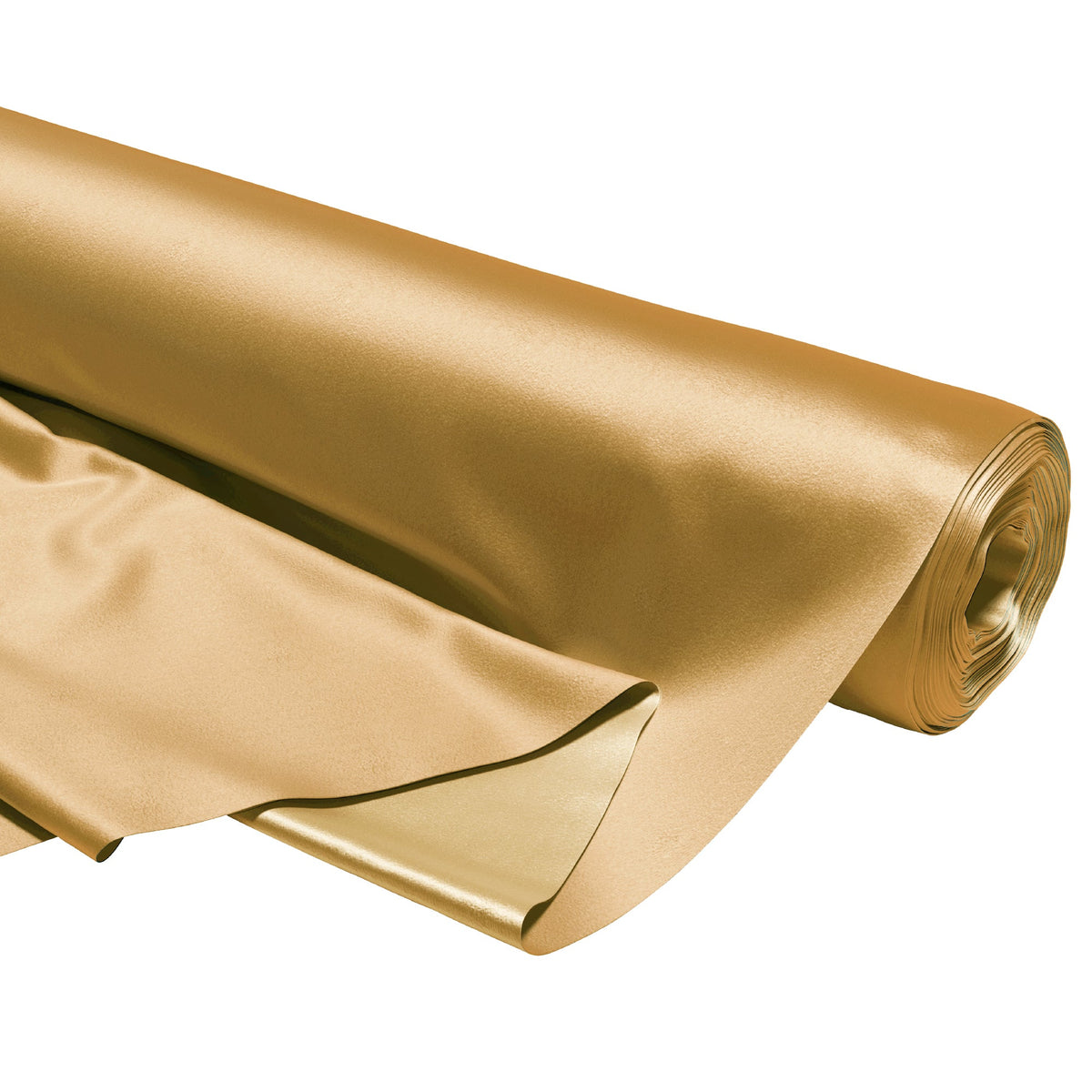
Take one wall behind a cake table or a haldi chair. It is 2.4 m wide, and you can fix a rod 2.4 m up. Each piece of cloth has to reach from the rod to the floor, plus about 10 cm to fold over the rod, so every drop is 2.5 m long. In satin that is 110 cm wide, three drops cover the wall: 7.5 m of cloth. In embossed velvet that is 150 cm wide, two drops do it: 5 m. Same wall, same height, and one cloth needs half as much again as the other.
So the answer to "how much backdrop cloth do I need" is never one number. Measure the wall width and the drop. Divide the width you want to cover by the width of the cloth and round up. That gives the number of drops. Multiply by the drop length, and buy cuts long enough that each drop is a single piece.
Why the cloth width changes the metres
A backdrop hangs in strips that run from top to bottom, side by side. The length you order becomes the height of each strip. The width of the cloth is fixed by the roll, and it is what decides how many strips you need across the wall.
That is why a metre is not the same amount of cloth from one fabric to the next. A metre of 110 cm satin covers 1.1 square metres. A metre of 150 cm velvet covers 1.5. The guide to fabric width in cm and inches shows the common widths and conversions, so check the width on the product page before you count anything.
The second rule is easy to miss. Each drop has to be one piece. A join halfway down a backdrop shows in every photo, and on a shiny cloth it catches the light. So a 2.5 m drop needs a cut of at least 2.5 m. A 2 m cut will never make it, however many you buy. This is where the cut sizes start to matter more than the price per metre.
How full should a backdrop be?
Flat cloth is the cheapest, and behind a photo it is often the best. Pull each drop straight, overlap the edges by a few centimetres so no wall shows between them, and the camera sees one smooth colour. Drapers work with a simple rule for anything fuller: cover the width once for flat, one and a half times for soft folds, and twice for a full gathered look. The same one and a half and twice sit behind our guide to how many curtain panels a window needs.
Weight changes how full a cloth looks. Velvet is heavy and hangs in deep, slow folds, so it reads as full at less than one and a half times. Satin is light and slippery. Gathered, it falls into many thin folds that each catch a line of light, which is lovely in person and busy in photos.
Whole drops rarely land on those ratios, so check what you actually get. On the 2.4 m wall, three satin drops give 330 cm of cloth, about 1.4 times the wall. Two velvet drops give 300 cm, 1.25 times. That is the fewest drops that cover the wall, and the extra either gathers into gentle folds or runs a little past each edge of the wall. Aim for one and a half times, 360 cm, and whole drops push you up: four satin drops give 440 cm and three velvet drops give 450 cm, both close to twice the wall and a properly gathered look.
Satin, velvet or cotton for backdrop decoration?
Satin: the most shine for the money

Satin is the usual pick for a haldi or a birthday wall: it costs the least per metre and it shines. The trouble shows up in photos. A shiny face throws light straight back, so a phone flash or a tube light opposite the wall can turn into a white streak behind someone's head. Satin also shows the fold lines from the packet clearly. Iron it on the back at a low synthetic setting before you hang it, as the satin care guide explains.
At 110 cm wide, it also needs more drops than any other cloth here. For a haldi, orange satin or yellow is the usual pick. For a puja wall lit by warm bulbs, gold satin reads rich from across the room. If you want a white backdrop, the frost satin photographs as a soft, slightly warm off-white and the plain white looks cooler. Both sell in 1, 2, 3 and 5 m cuts, and a 5 m order arrives as one uncut piece.
Velvet: low shine, heavy and forgiving in photos

Start with the weight, because it decides how you hang it. The embossed velvet card gives 170 GSM, so one 2.5 m drop at 150 cm weighs about 640 grams, and two drops put well over a kilo on the rod. That weight is also why it hangs straight without being pulled, and why light creases tend to ease out after a few hours on the rod.
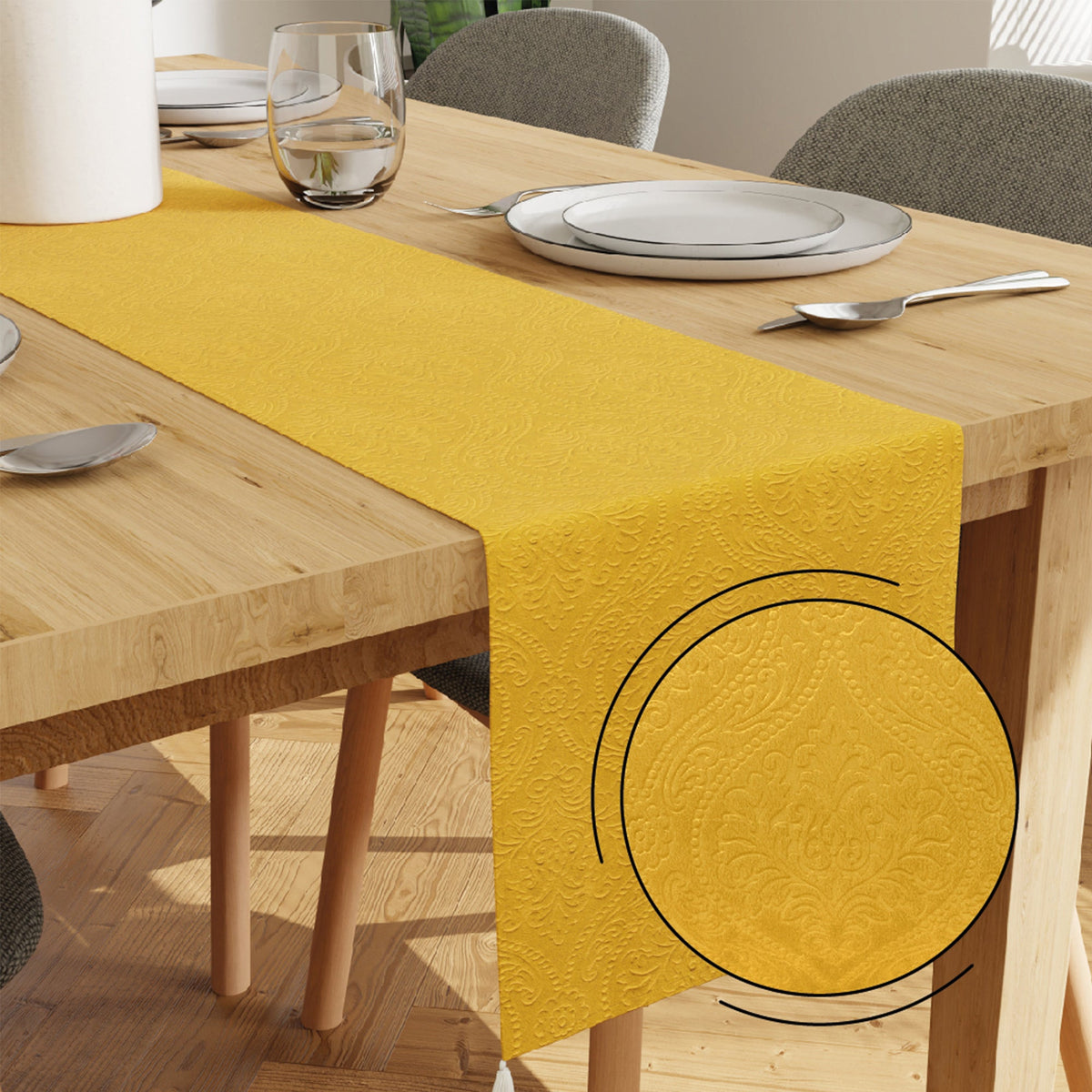
The pile scatters light rather than mirroring it, so a flash leaves a soft sheen instead of a hard streak, and colours look deep. Maroon embossed velvet is a common choice behind a puja or a mandir, and the pressed damask pattern gives texture without a print. For a pale wall that should still look finished, the cream embossed velvet photographs close to white. In a dim room, dark velvet can look almost black behind people, so put a lamp on the faces, not on the cloth. Only the embossed range sells 2, 3 and 5 m cuts; the plain velvet page lists a 1 m option only. The velvet fabric guide covers both ranges.
Cotton canvas: plain, matte and easy to pin

Pick canvas when the backdrop is a base for something else: a marigold string, paper flowers, a name in cut-out letters. It has no shine, and at 180 GSM by its product card it is a firm, close weave that holds safety pins and clips well. It hides a patterned wall better than thin satin does, though a bright window behind any cloth will still show through.
At 150 cm wide, the natural canvas needs the same two drops as velvet. On 13 November 2026, fourteen canvas colours had every cut in stock. White was not one of them, with only the 1 m cut available, so a white backdrop is easier in satin or cream velvet.
How many metres of backdrop cloth to buy for one wall
Here is the 2.4 m wall with 2.5 m drops. Prices are the selling prices checked on 13 November 2026; check them again on the day you buy.
| Cloth and width | Drops | Cloth across (times the wall) | Metres | Cuts to buy | Price |
|---|---|---|---|---|---|
| Satin, 110 cm | 3 | 330 cm (1.4x) | 7.5 | 5 m + 3 m | ₹2,488 |
| Satin, 110 cm | 4 | 440 cm (1.8x) | 10 | 5 m + 5 m | ₹3,238 |
| Embossed velvet, 150 cm | 2 | 300 cm (1.25x) | 5 | 5 m | ₹2,199 |
| Embossed velvet, 150 cm | 3 | 450 cm (1.9x) | 7.5 | 5 m + 3 m | ₹3,528 |
| Cotton canvas, 150 cm | 2 | 300 cm (1.25x) | 5 | 5 m | ₹2,419 |
Velvet costs more a metre than satin, yet the fewest-drops velvet wall comes in cheaper than the satin one, because the wider cloth needs one drop fewer. How you combine cuts matters as much. Three separate 3 m pieces of satin cost ₹2,607 and leave three 50 cm scraps. One 5 m piece cut in half, plus one 3 m piece, costs ₹2,488 and leaves one. Every line here is on the fabric by the metre page, with the width shown in the size option.
Hanging a backdrop without drilling
Most rented flats will not allow new holes. Three ways work without them:
- A tension rod between two walls, if the backdrop sits in an alcove or a passage. Fold the top 10 cm of each drop over the rod and hold it with two or three safety pins. No sewing needed.
- The curtain rod you already have. Take the curtains down for the day and hang the drops in their place.
- A thin rope or strong string tied tight between two existing hooks or window grills, with the cloth hung over it and held with clothes pegs or binder clips.
If you use stick-on hooks, check the weight printed on the packet. A 2.5 m drop of velvet or canvas weighs 640 to 680 grams by the weight on its product card.
None of these cloths makes any fire claim on its product page. Keep diyas, candles and agarbatti on a table in front of the backdrop and well clear of its hem, never on the floor under it.
Test the colour in a phone photo first
Before you buy five metres, hold up one metre against the wall at the time of day the function will happen, and take a photo with the lights you will use. Yellow and orange are common for a haldi, and red, maroon and gold for a puja, though customs vary by family. Whatever the colour, the photo shows two things a shop swatch cannot. A cloth close to the wall paint disappears, so white on a white wall reads as nothing. And warm bulbs can push cream towards yellow and gold satin towards orange.
What the cloth becomes afterwards
A printed 5x8 ft panel suits one festival. A plain drop goes back into use. A 2.5 m drop of satin is long enough for a dining table runner; the satin guide works through cutting three runners from one length. A drop of embossed velvet makes a chowki cover, as the puja chowki cloth guide shows, or a mandir back cloth, or several cushion fronts. Canvas becomes cushion covers or a plain table cover.
If the plan is bigger than one wall, a stage, a mandap or a whole courtyard, it is a decorator's job: they bring the frame, the length of cloth and the people to hang it. The wedding home decoration guide covers what cloth can do around the house at that scale.
Frequently asked questions
How many metres of cloth do I need for a backdrop?
Count drops, not square metres. For a 3 m wall with a rod at 2.4 m, satin needs three drops of 2.5 m, which is 7.5 m. Velvet or canvas needs two drops, 5 m, but two 150 cm widths only just span 3 m, so buy a third drop if you want any folds.
Should a backdrop cloth touch the floor?
Let it rest on the floor by a few centimetres, or stop it just above. A hem that hangs 10 cm short looks like a mistake in photos, and a long puddle of cloth gets stepped on and pulls the drop off the rod.
Can I use a saree as a backdrop?
Yes, for a small photo corner or a puja shelf. A saree is long but only a little over a metre wide, so two or three side by side cover a narrow wall, and they cost nothing if they are already in the cupboard.
Do I need to stitch a backdrop cloth?
No. Fold the top over a rod or a rope and fix it with safety pins or clips. Leave the bottom edge loose on the floor. The cut edges of satin can fray a little, so keep them at the back or turn them under.

Leave a comment
This site is protected by hCaptcha and the hCaptcha Privacy Policy and Terms of Service apply.