
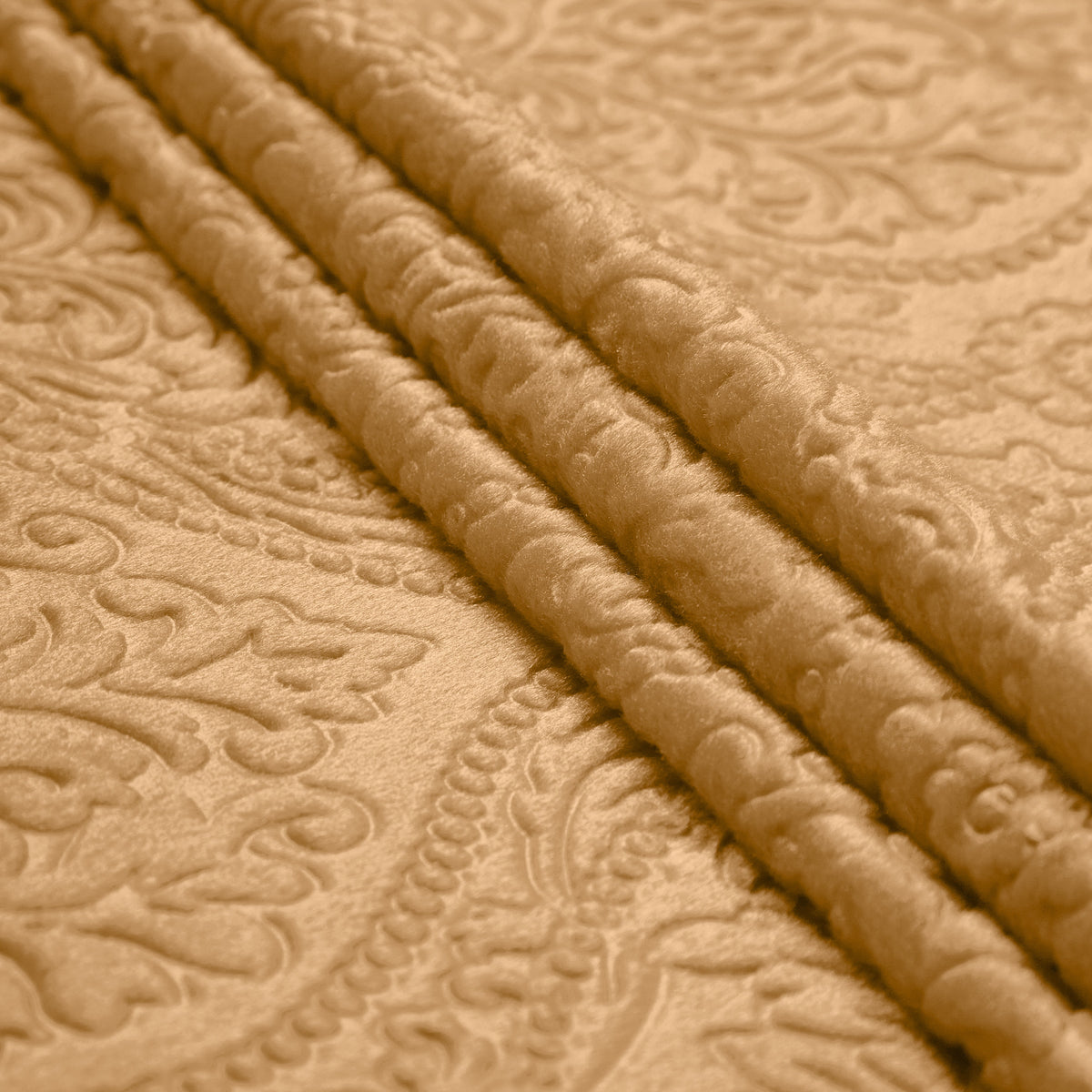
Velvet has a reputation as the difficult cloth in the house. Dry-clean only, expensive enough that cutting into it feels reckless, best kept for a chair nobody sits on. That reputation was built on cotton and silk velvet and on what they cost, and neither is what comes off the roll here. Both of the ranges sold by the metre are polyester, and both sit under ₹500 a metre.
The parts of the reputation that survive the switch are the pile's own habits rather than the fibre's. It still crushes under weight, still collects dust, still feels warm to sit against. What goes away is the caution. You can buy one metre to look at before committing to five, and you can cut a cushion front wrong and start again without it stinging.
Velvet fabric here comes in two ranges. The embossed line has a damask pattern pressed into the pile, measures 150 cm across and sells in cuts of one, two, three and five metres from ₹459. The plain line has an even pile with no pattern, measures 152 cm across and sells one metre at a time at ₹499. On the day this was written every colour in both ranges was available, though stock moves, so check the shade you want on the day.
What is velvet fabric made of?
Velvet is not a fibre. It is a way of weaving. Short cut fibres are made to stand up from a woven backing instead of lying flat, and that standing pile is the whole point: it catches light from one direction and swallows it from another, which is why the same piece of cloth looks like two colours in one photograph. Silk, cotton, viscose and polyester can all be woven into velvet, and the fibre is what moves the price and the care label. How densely that pile stands is what you actually see and feel.
Both ranges here state polyester on their own product pages, the embossed one as pure polyester and the plain one as 100% polyester. What that buys you is a cloth you can wash at home rather than send out, at a price low enough that you can cut into it without flinching. What it does not buy you is the depth a good cotton velvet has, which is a large part of why cotton velvet costs more.
Polyester velvet feels warm against you in a room with no air conditioning, and it holds dust and pet hair the way every pile cloth does. Where those trade-offs land, room by room, is worked through in are velvet cushion covers worth it. The short version for metre goods is the same: this is the affordable, washable kind of velvet rather than the heirloom kind, and for a first project that is the better way round.
Embossed velvet and plain velvet are two different buys

| Embossed velvet | Plain velvet | |
|---|---|---|
| Colours | 8 | 15 |
| Width | 150 cm | 152 cm |
| Stated weight | 170 GSM, on a spec image in the gallery | not stated |
| Cuts sold | 1, 2, 3, 5 m | 1 m |
| One metre | ₹459 | ₹499 |
| Longest cut | 5 m at ₹2,199 | not sold |
| Surface | damask motif pressed into the pile | even pile, no pattern |
The patterned cloth is the cheaper one: ₹459 against ₹499 for a metre, and it is also the only one of the two that sells a bulk cut.
Colour choice runs the other way. Fifteen plain colours against eight embossed, and the plain line holds the pastels. White, peach, pale lime, lemon yellow and pink exist only there, so a nursery curtain or a pastel cushion front is a plain-velvet job by default. The embossed eight are the classic furnishing shades: maroon, navy blue, coffee, red, gold, beige, cream and grey. The plain grey is the one to look at when you want velvet to sit quietly rather than announce itself.
What embossed velvet actually is
Embossing is a heat and pressure finish applied after the cloth is woven. A heated roller carrying the design presses the pile flat where the motif falls and leaves it standing everywhere else. What you are looking at is not ink. It is one colour of cloth at two different heights, and the light does the rest, which is why the embossed maroon reads near-black along a fold and clear wine on the flat, and why the gold picks out its scrollwork wherever the light rakes across the pile.
Two things follow from that. There is no print on the surface to crack or wash away, because nothing was printed, though the pattern is a heat finish and heat is also what can undo it, so keep a hot iron off the face. And the cloth is directional twice over. Any pile fabric has to be cut with the nap running the same way on every piece, a rule set out for pile cloth generally in the guide to fabric width and length; on the embossed line the damask repeat also has to line up where two panels meet. Say so before your tailor plans the layout rather than after.
How do you judge velvet fabric before you buy?

Upholstery buying guides often tell you to compare Martindale rub counts before you commit. Neither range here publishes one. On weight the two ranges part company: the embossed listing carries 170 GSM on a spec image in its photo gallery, and the plain listing states no weight anywhere. So on the embossed cloth you have one figure to hold against another shop's, and on the plain cloth you have none.
Either way the number settles less than the cloth does, and here the smallest cut can be the swatch. Both ranges sell a single metre, so ₹459 on the embossed line or ₹499 on the plain buys you the cloth to handle, and a metre is enough to make a cushion front even if you decide against the rest.
Then use your hands. Press a thumb hard into the pile and lift it away: on a dense cloth the mark fills back in by itself, on a thin one it sits there looking at you. Bend a corner back and look at the base of the pile under a lamp, because visible backing between the tufts means a sparse pile whatever the surface suggested. A dark shade like the plain navy hides that gap better than a pale one does, so look longer at the dark colours than you think you need to. Hold a fold up to a window and see how much light comes through. And rub the pile the wrong way with your palm a few times, then look at your hand, since fibres that come off that easily onto a palm will come off onto a sofa.
What this velvet suits, and where it struggles
Both listings claim a wide spread of uses. The embossed page names sofa covers, curtains, cushion covers, bedsheets and suits. The plain page names bed covers, curtains, cushion covers, chair upholstery and sofa covers. A list that broad is a manufacturer's list rather than advice about your room.
Cushion fronts are the safe answer, and after that an occasional chair, a bench top, a headboard, or a set of evening curtains for a room you mostly use after dark. The reason velvet turns up at Diwali and at weddings is the pile again: a lamp low in the room lights the standing fibres and leaves the folds dark, so one colour of cloth reads as several.
Curtains carry two conditions. Only the embossed listing states a weight, and 170 GSM on a spec image tells you less than a metre on the arm does, so choose the rod and brackets after you have handled the cloth rather than before. And plan the joins, because anything wider than the roll needs two widths seamed together with the nap matched across the seam, and a seam in pile cloth shows more than a seam in a flat weave. One small thing that catches people out on the dark colours: navy and black velvet pick up thread ends and lint while you are working on them, so cut them away from a woollen jumper and keep a roller within reach.
Where it struggles is the sofa three people use every evening. Which fabric belongs there instead is settled against the rest of the range in the guide to buying fabric by the metre, and if that is your project, the wider fabric range has cloths built for it. Budget a little extra time as well. Pile cloth shifts against itself under a machine foot more than a flat weave does, so a tailor will want more pins for the same job.
Is it cheaper to buy the metre or buy it made?

One metre of plain velvet arrives as a piece 100 cm long and 152 cm wide, at ₹499. A 40 cm cushion needs squares of about 43 cm to leave 1.5 cm of seam on every side. Three of those fit across the 152 cm width and two fit down the 100 cm length, so one metre gives six squares: three covers, front and back, all cut the same way up so the nap matches.
Against that, the velvet red cushion cover and the fifteen other colours in the ready velvet range come finished and zipped in packs of two, from ₹459 for the 40x40 cm pair up to ₹809 at 60x60 cm. The ready range runs to sixteen colours, most of them selling all four sizes and a few only two or three.
So ₹499 of fabric makes three covers at roughly ₹166 each, and ₹459 buys two made at roughly ₹230 each. The cloth wins by a little over ₹60 a cover, and a tailor charging even ₹100 a cover to cut, hem and set a zip takes that back with room to spare. Buy the metre if you already sew, or if you want a size or a colour the ready range does not carry. Buy it made if the saving above was the only thing pulling you towards the metre.
On cut length, the embossed line rewards the bigger order slightly: five metres at ₹2,199 works out near ₹440 a metre against ₹459 for a single. Small enough that it should not decide anything by itself. The plain line lists only a one metre option, so more than a metre means raising the quantity, and its own page says an order of three metres arrives as one 300 cm piece.
Common questions
Is velvet fabric good for curtains?
For a room you use in the evening, yes. Velvet hangs in deep folds and the colour looks better under a lamp than under noon sun. Plan for two things. The embossed listing states 170 GSM on a spec image and the plain one states no weight at all, so pick the rod and brackets after you have handled the cloth rather than from the listing. And at 150 or 152 cm a broad window needs widths joined, with the nap running the same way on every one of them.
Can you use velvet fabric to upholster a chair?
For an occasional chair, a bench or a headboard it works, and both listings here name chair or sofa upholstery among their uses. For a seat several people use daily, the pile flattens where the weight goes and a shine develops in that patch. Neither range publishes a rub count, so there is no durability rating to check that against before you commit.
How much does velvet fabric cost per metre in India?
At Encasa it is ₹459 a metre for the embossed range and ₹499 for the plain, dropping to about ₹440 a metre if you take the embossed five metre cut. Cotton and silk velvet cost a good deal more than either, so a very different price elsewhere for something also called velvet is usually a different cloth.
Does polyester velvet need dry cleaning?
Not according to either listing. The embossed page says hand or machine washing is fine without losing colour, sheen or softness, and the plain page claims very good colour fastness with dark shades washed separately. What actually matters with velvet is the spin and the drying rather than the wash, and the method for that is in how to wash velvet without flattening the pile, which applies to a cut length as much as to a finished cover.

Leave a comment
This site is protected by hCaptcha and the hCaptcha Privacy Policy and Terms of Service apply.