
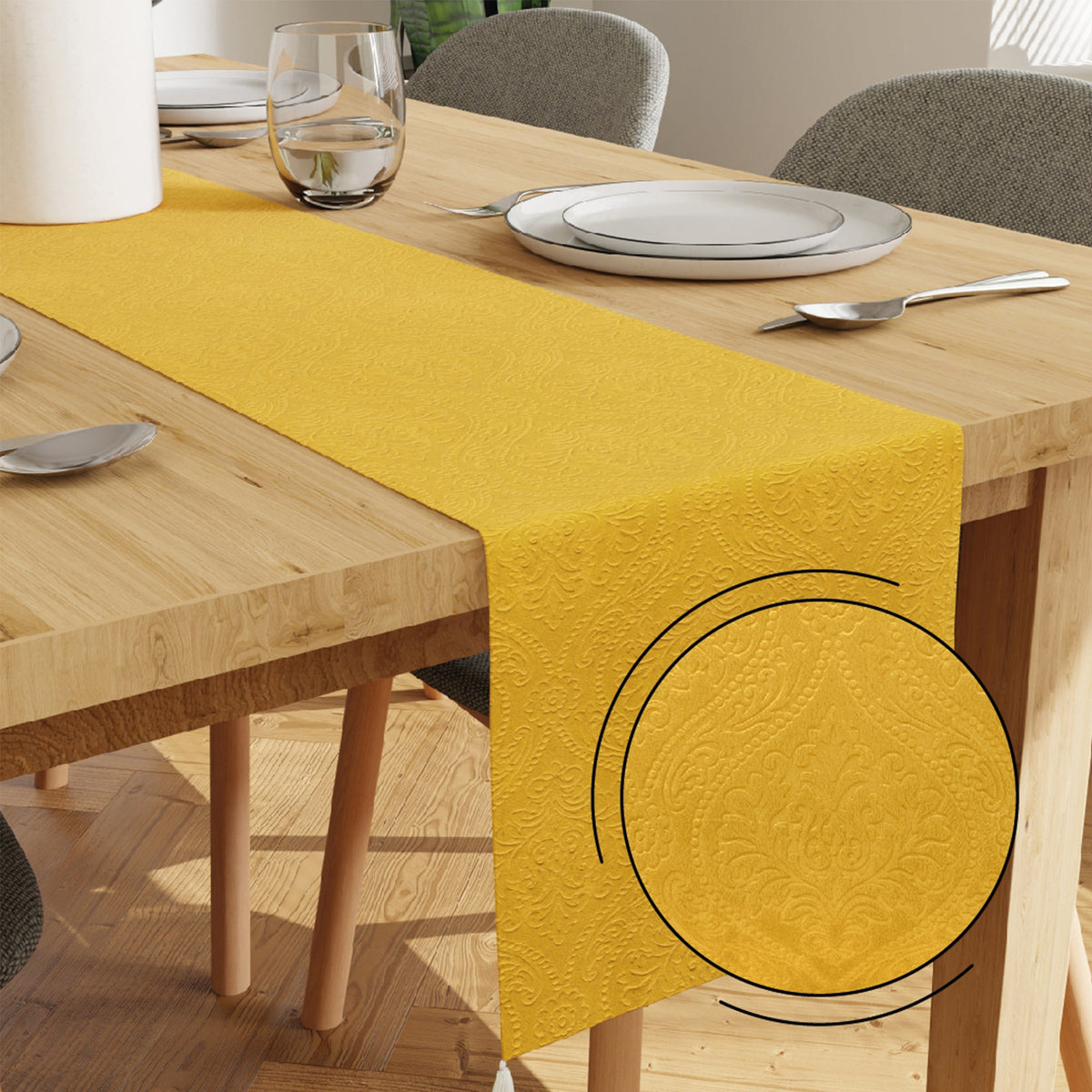
"What cloth should I put in the mandir, and does the colour have to be red?" It is a question that comes up when someone sets up a first home, when the old cloth in the mandir has gone grey with smoke, or the week before a Satyanarayan katha when the chowki needs dressing.
Colour is your family's choice, and red, yellow, white and gold are all common. The size is the top of the mandir or chowki plus a small drop over the edge. The fabric depends on what touches it. Cotton is best for the surface where the diya plate, kalash and kumkum sit, because you will wash it often. Velvet or satin is for the part people look at, like the front drop or the wall behind the idols.
That last point matters more than the colour, and it gets the least attention when people shop.
Which colour cloth is used for pooja?
There is no single rule, and families do this differently. A few patterns are common:
- Red and maroon are often used for Devi, and many homes treat red as the everyday mandir colour.
- Yellow and gold are often chosen for Vishnu, Satyanarayan and Lakshmi, and many families use yellow on Thursdays.
- White is used in some homes for Shiva, or as a plain base under brighter cloths.
- Many families avoid black in the mandir.
If your family has a custom, follow it. If you are unsure, ask the elder or the pandit who usually leads your pujas. Families from different regions often have different answers, and both are right in their own homes.
Then there is a practical side. A mandir cloth lives next to a diya and agarbatti every day. Pale yellow and white tend to show soot, oil and haldi sooner. Deep red and maroon hide them for longer. If you light a ghee diya twice a day and only want to wash the cloth once a week, a deeper shade will look clean for longer. If you want a cloth that looks bright and fresh, choose the lighter one and plan to wash it more often.
What lands on a mandir cloth in a normal week
Think about what a home mandir cloth goes through in a few days. Oil or ghee from the diya creeps under the plate. Water drips from the kalash or the achaman spoon. Kumkum and haldi powder fall from fingers. Ash drops from the agarbatti, and a few grains of rice and a crushed flower get left behind. None of this happens once a year. It happens every morning.
So a daily mandir cloth has to survive frequent washing. It should also soak up a drip instead of letting it run to the edge, and stay put when someone lifts the kalash.
Plain cotton comes closest. It soaks up water, and on a wooden or marble shelf it tends to stay put better than a shiny cloth. Velvet looks rich, but powder settles into the pile and the raised pattern. Polyester satin is smooth and shiny, which is why it drapes so well. But that smooth face also slides on a polished shelf, and a kalash on top can shift when someone moves it.
The answer is two layers. Put cotton under anything that gets used every day: the diya plate, the kalash, the rice. Use velvet or satin where nothing sits: the front edge, the sides, or the wall behind. On a very small shelf, two layers can bunch and make an idol rock, so keep the top cotton piece flat and only as big as the things it holds. A plain cotton cloth can do the whole job alone, too, if your family likes a simple mandir.
What size pooja cloth for your mandir or chowki?
For a chowki, the rule is the top of the chowki plus the drop you want on each side. Our Diwali chowki guide works that rule through for a festival chowki, including one long enough to touch the floor. For everyday use, the drop can be much smaller. You need enough to cover the edge and stay put, and not so much that it reaches the diya on the floor.
Measure first. Home mandirs and chowkis come in many sizes. Here is how a few real cloth sizes fit some common setups:
| Your mandir or chowki | Cloth that fits | How it sits |
|---|---|---|
| Small chowki or bajot, 30 cm square | One 43 x 43 cm cotton napkin | Hangs 6.5 cm over each side |
| Small chowki, 38 cm square | One 43 x 43 cm cotton napkin | Only 2.5 cm over each side, so it just covers the top |
| Wall-hung wooden mandir, shelf 30 cm deep and 60 cm wide | A 32 x 150 cm velvet runner laid along the shelf | Pushed against the wall, it covers the depth with about 2 cm over the front edge; 45 cm left at each end to hang down or fold under |
| Rectangular chowki, 75 x 45 cm, for a katha or griha pravesh | 1 metre of satin, which is 100 x 110 cm | 17.5 cm over each short end, 27.5 cm over the front and back |
| Wall behind the idols, up to about 140 cm wide | 1 metre of embossed velvet, which is 100 x 150 cm | A back cloth 100 cm tall that covers the full width, with a few cm spare for hems |
A napkin that sits well on a 30 cm chowki leaves almost nothing to tuck under on a 38 cm one. Measure the top with a tape before you buy, not by eye.
Cotton for the cloth that does the work

For a small chowki, a plain cotton table napkin is a good fit. It is a clean square with proper hems, so the edges do not fray, and it is made to be washed again and again. The Cotton Deep Red Table Napkins are 43 x 43 cm and come in a set of four for under ₹700. The listing says they are 180 GSM mercerised cotton, and the photos show a true deep red with a thin hemstitch line near the edge.
You do not need all four in the mandir. One on the chowki and one spare is enough, so there is always a clean cloth on washing day. The other two can go to the dining table, or be kept aside for a katha.

If your family prefers yellow, the Cotton Sunbeam Yellow Table Napkins come in the same 43 cm size and set of four. In the photos they are a strong golden yellow, which hides soot better than a pale lemon would. For orange or maroon, pick from the table napkin range, but check the size option: some colours also sell a 23 cm cocktail size, which is too small for most chowkis.
For a bigger chowki or a pooja table, a napkin is too small. The Cotton Deep Red Table Cloth comes in a 56 x 56 inch square, about 142 cm across, as well as rectangles. On a 75 x 45 cm chowki that is far more than you need, so fold it to the size of the top. A folded cloth also soaks up a drip under the kalash better than a single layer.
Velvet and satin for the part people look at

A wall-hung wooden mandir usually has a shallow shelf, and a table runner fits that shape well. The Embossed Velvet Red Table Runner is 32 cm wide, and the 150 cm length costs under ₹500. Lay it along a 30 cm deep shelf, let the tasselled ends hang down the sides, and put a cotton napkin on top under the diya plate. The runner gives the mandir its colour, and the napkin protects it.
Two of its other colour names can mislead you. The "lemon yellow" photographs as a deep golden yellow, close to mustard. The "gold" looks like a soft golden beige with no metallic shine. If you want a shine that catches the diya light, satin does that better. The other shades are in the table runner collection.
For a back cloth, buy velvet by the metre. One metre of the Embossed Velvet Red Fabric is 100 cm long and 150 cm wide, at under ₹500. Its spec card says 170 GSM. Cut edges fray, so hem them or fold them back. Once the sides are hemmed, that covers the wall behind a mandir up to about 140 cm wide, and for a narrower niche you fold the extra under. The embossed velvet by the metre comes in eight colours, including red, maroon and gold. There is no yellow, so for a yellow back cloth you need satin.

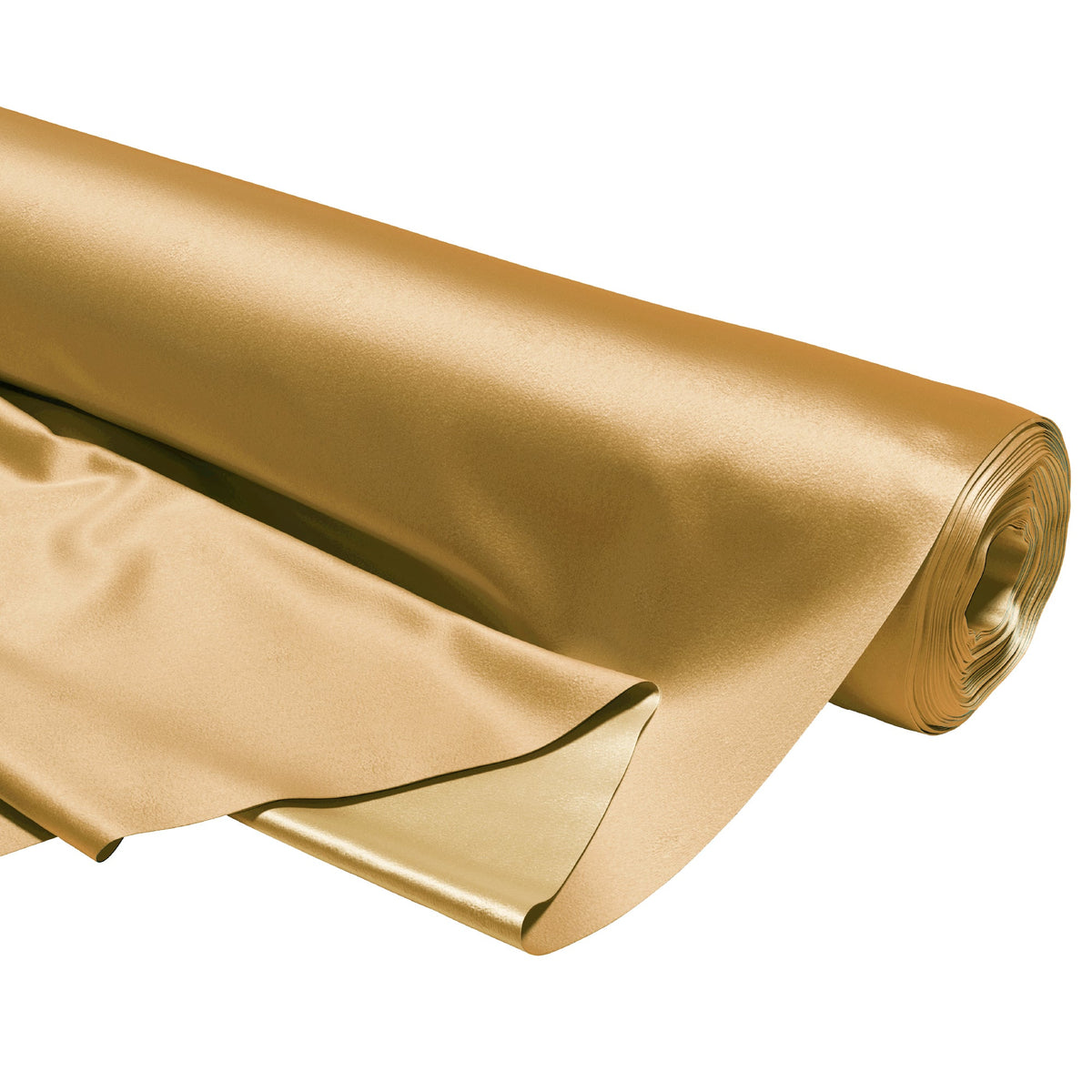
Satin is the easy choice for a larger chowki for a Satyanarayan katha, a griha pravesh or a purnima puja, when the family wants yellow and shine. The Satin Polyester Silk Yellow Fabric is 110 cm wide and costs a little over ₹300 a metre. A 1 metre cut covers the 75 x 45 cm chowki in the table above with a generous drop on all four sides. The gold satin is a deeper antique gold if you want to drape the mandap or the wall behind it. Because satin slides, put a folded cotton cloth under it on a polished chowki, and a cotton napkin on top under the kalash. Iron it on the back at a low setting, as our satin guide explains, because a hot iron can leave a glazed mark.
One rule applies to all of these. Velvet and satin here are polyester, and polyester melts if a flame touches it. Keep every diya on a metal plate or stand, and keep the cloth's edges, tassels and drapes well away from the flame.
Washing and putting the cloths away
How often to wash depends on your diya, the smoke and whether the plate catches the oil. A good sign is the first grey film or oil ring; change the cloth then, not weeks later. Shake the cloth outside first so ash and rice do not go into the machine. Brush off dry kumkum before any water touches it. Treat a ghee or haldi mark before washing, using the steps for oil and haldi stains.
The velvet runner and the satin need less washing, because nothing sits directly on them. Wash them gently when they look dull, dry them in the shade, and fold rather than crush them. Satin and velvet kept for kathas and festivals can be packed away with the rest of your festive linen, away from moths and damp.
Common questions
What cloth is used for Satyanarayan puja?
Many families cover the chowki in yellow, and some samagri lists also ask for a small red cloth for the kalash. Practices differ, so follow your family's way or ask the pandit. A clean cloth in a colour your family uses matters more than any one fabric.
Can a table napkin be used as a pooja cloth?
Yes. A plain cotton napkin is a hemmed square of washable cloth, which is just what a small chowki needs. Choose a solid colour with no printed cutlery or festive motifs, and make sure it is wider than the chowki top.
How often should the mandir cloth be changed?
There is no fixed schedule. A cloth next to a daily diya needs washing far more often than one in a mandir used only on festival days. A spare cloth means the mandir is never bare on washing day.
Is black cloth used in pooja?
Many families avoid black in the home mandir. Customs differ, so if you are unsure, ask an elder. If your family has no custom, red, yellow or white are the usual choices.

Leave a comment
This site is protected by hCaptcha and the hCaptcha Privacy Policy and Terms of Service apply.