
It is a little after the muhurat on Lakshmi Puja night. The aarti is done, the family is still sitting on the floor, and someone leans in to move a diya closer to the idol. The end of the cloth, which hung a bit too far forward, is now resting against the brass plate, and the plate is hot.
Nothing catches fire most years. But the near-miss tells you how to plan the whole setup. On a puja chowki, fabric does three jobs in three places: the top holds the kalash, rice and idols; the front drop is what everyone looks at; and the floor is where people sit and where the diyas often go. Each place has its own risks, so each place wants a different cloth. Diwali falls on Sunday 8 November in 2026, which leaves enough time to measure and buy before the rush.
What a Diwali puja setup asks of fabric
Think of the chowki in layers, starting from the flame and working outward.
The top surface gets the wettest and messiest use. The kalash sweats or spills, rice and kumkum get scattered, a ghee lamp may sit on a plate right next to the cloth, and flower petals stain when they are crushed. Whatever lies here has to be washable and cheap enough not to worry about.
The front drop does the decorating. Nothing sits on it, so it can be the richer fabric: velvet, a brocade-look weave, or anything with a sheen that catches the lamp light. Its only risks are a flame at the bottom edge and feet brushing past.
The floor in front of the chowki takes knees, feet and the diya row if you light lamps on the ground. Here you want something thick and flat that does not slide, and that will not ruin a good rug if a drop of oil lands on it.
Most homes use a single red or yellow cloth for everything. It works, but it means the cloth that sits under the kalash is also the one meant to look festive in the photos. Splitting the jobs between two pieces solves that, and it costs less than one large fancy cloth.
How big should the chowki cloth be?
The sum is simple. Cloth size equals the top of the chowki plus twice the drop you want on each side.
Say your chowki is 60 cm square and 30 cm high. If you want the cloth to hang 20 cm down each side and stop short of the floor, you need 60 + 20 + 20 = 100 cm square. If you want it to touch the floor, you need 60 + 30 + 30 = 120 cm. Anything longer than that lies in folds on the ground, right where the floor diyas go. That pooled edge is the one that ends up near a flame.
Measure your own chowki before you buy, because they come in many sizes, and a small mandir shelf behaves differently again. For a shelf, only the front drop matters; the back is against the wall.
Here is how common pieces work out on that 60 cm, 30 cm high chowki:
| Piece | Size | On a 60 cm square chowki, 30 cm high | Best use |
|---|---|---|---|
| Velvet table runner | 32 x 150 cm | Laid front to back, it drops 30 cm to the floor at the front and leaves about 60 cm to fold under at the back | Front panel over a plain base cloth |
| Velvet table runner | 32 x 240 cm | Far too long for this chowki; suits a shelf or sideboard about 120 cm wide, with 60 cm hanging at each end | Long mandir shelf or sideboard altar |
| Cotton square tablecloth | 56 x 56 in (about 142 cm) | Hangs about 41 cm on each side, so roughly 11 cm lies on the floor unless you fold it under | Base cloth for a larger chowki or puja table |
| Velvet fabric cut to size | 100 x 100 cm from a 1 metre cut | 20 cm drop on all four sides, clear of the floor by 10 cm | A made-to-measure chowki cover |
Ready-made table linen is cut for dining tables, so on a small chowki it is either too narrow (a runner) or too big (a tablecloth). You fix that by layering, or by cutting fabric to size.
The base layer: washable cotton under the kalash

Put cotton on the top surface. It soaks up a kalash drip instead of letting it run, it can take a hot wash after the festival, and a turmeric or kumkum mark has a fair chance of coming out of plain cotton. Velvet pile is harder: powder tends to sit in the pile and the pressed pattern, and you end up brushing it for days.
A solid colour also helps here. Rice, flowers and the idols show up better against a plain ground than against a print. The Cotton Deep Red Table Cloth is a solid-dyed 180 GSM cotton that comes in a 56 x 56 inch square as well as rectangles. On a small chowki you fold it under to the drop you want. On a larger puja table, say 90 x 60 cm, the 72 x 56 inch size leaves a generous hang all round. If you want a different shade, red, maroon and yellow solids are all in the tablecloth range. Pick the one closest to your family's usual puja colour.
The front drop: where velvet earns its place

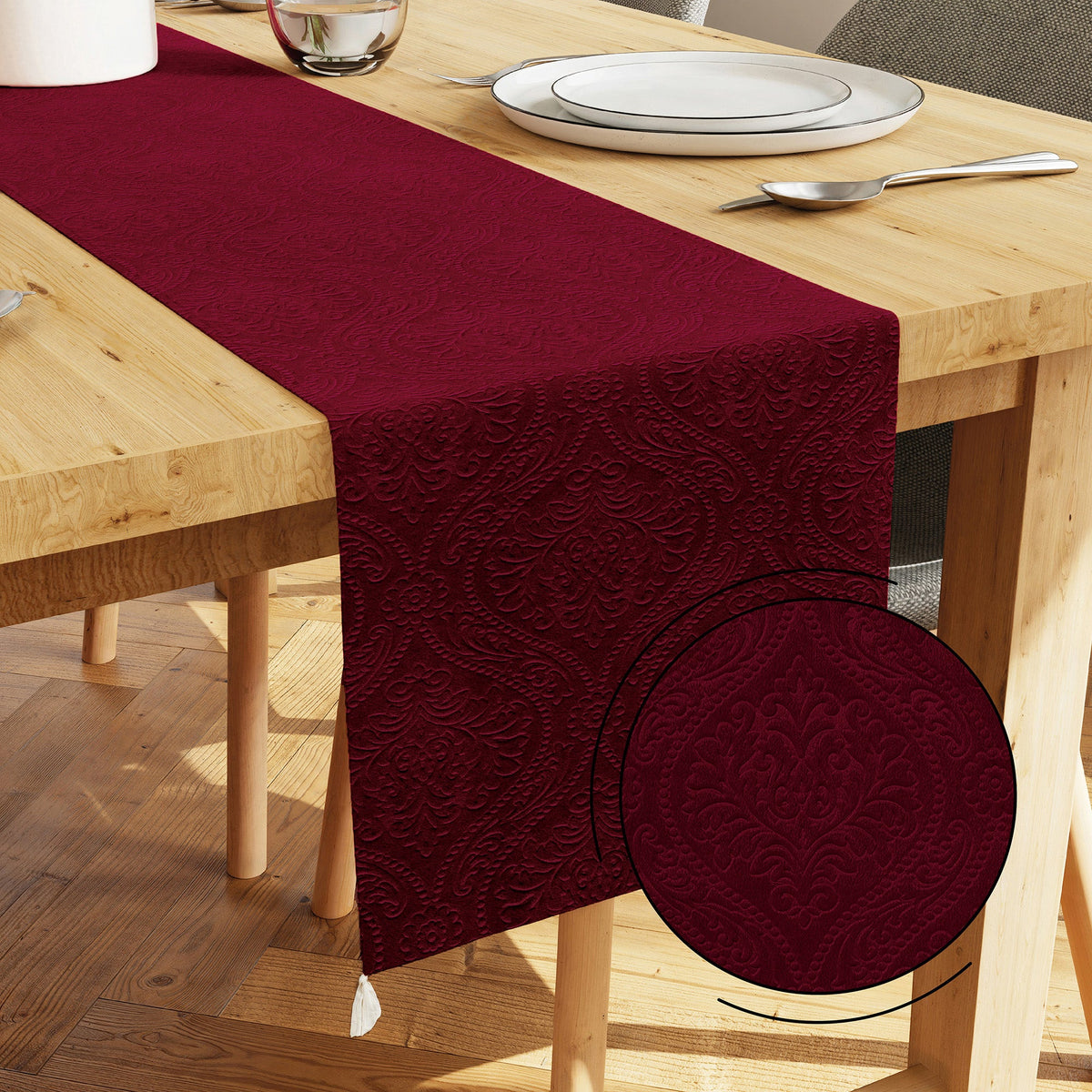
Velvet looks right at puja because its pile catches lamp light from every angle. A damask pattern pressed into it adds depth without printing anything on the surface. That is why an embossed velvet runner works as the front panel over the cotton base. Lay it front to back down the middle of the chowki, let it fall to the floor at the front, and tuck the spare length under the back.
The Embossed Velvet Red Table Runner comes in 32 x 150 cm, which suits a chowki of up to about 60 cm, and 32 x 240 cm for a long shelf. The maroon version is the same cut in a deeper shade. Maroon works well against a red base cloth, because the two colours stay distinct, and red-on-red can blur together in photos. There are gold and cream runners in the table runner collection too. In the product photos the gold looks like a soft golden beige rather than a metallic shine, so expect that when you order.
One thing to keep in mind with all of these: the runners are 175 GSM polyester velvet. Polyester does not flare up like paper, but it melts when a flame touches it, and the molten edge sticks. Cotton chars instead. Neither should touch a diya, so the runner's tassel should hang above the floor diya row, not beside it. Put every lamp on a metal plate or a small stand, and keep at least a hand's width of bare floor between the cloth and the flame.
A made-to-measure cover from a metre of velvet

If your chowki is an odd size, or you want the velvet over the whole top and not just as a strip, buy fabric. The Embossed Velvet Maroon Fabric sells in 1, 2, 3 and 5 metre cuts, and a 1 metre cut is 100 cm long and more than a metre wide. That is enough for the 100 cm square cover in the worked example, with a strip left over for a matching shelf edge. You will need to hem the cut edges or fold them under, because a raw edge frays.
The catch is the same as before: whole-top velvet sits under the kalash and the kumkum. If you go this way, put a small steel or brass thali under the kalash and the diya, and a cotton napkin or square of cotton under the rice. The velvet stays the background and never becomes the work surface.
Seating on the floor in front of the chowki

Puja is done sitting down, and once the katha and aarti are included it can run long. A marble or vitrified floor gets cold and hard after a while. A thin asan or a folded dhurrie works for one person. For the whole family, a round rug laid in front of the chowki gives everyone a shared spot and marks out the puja area.
The Cotton Rug Beige and Off-White is a reversible braided rug that comes in round sizes from 60 cm up to 120 cm, plus ovals. A 90 cm round is about right for two people side by side; the 120 cm gives a family room to sit close together. Being reversible helps here: if a drop of ghee lands on it, flip it for the evening and deal with the stain after the festival. The product page suggests ironing it lightly before first use so it lies flat, which matters when people will be kneeling on it.
Keep the floor diyas off the rug and on the bare floor beside it. A rug edge is exactly the kind of loose fibre that a flame finds.
After the puja
Take the cloths off within a day or two, before oil and kumkum set. Fold the base cloth inward so loose rice and powder stay inside it, then shake it out outdoors. If wax or ghee has dripped, scrape off what you can once it has hardened, then follow the method in our guide to removing candle wax, oil and rangoli from table linen. Wash the velvet runner on a gentle cycle and dry it flat in the shade, pile side up.
Questions people ask about the puja chowki
Which colour cloth is used for Lakshmi puja?
Red is the usual choice in many homes, with yellow and gold close behind, and some families follow their own tradition. If you want both, use one as the base and the other as the front panel, and make sure the two shades are far enough apart to read as separate layers.
Can I use a table runner as a chowki cloth?
Yes, as the front panel. A 32 cm wide runner covers only the middle of a 60 cm chowki, so put a plain cloth underneath to cover the full top and let the runner hang down the front.
Is velvet safe near diyas?
No fabric is safe touching a flame. Polyester velvet melts, and cotton chars. Keep lamps on metal plates and leave a gap between the cloth's lowest edge and any diya on the floor.
How do I get kumkum off a puja cloth?
Brush off the dry powder first, without water, because water spreads the dye. Then rinse cold from the back of the fabric. Plain cotton releases kumkum more easily than pile fabrics.

Leave a comment
This site is protected by hCaptcha and the hCaptcha Privacy Policy and Terms of Service apply.