
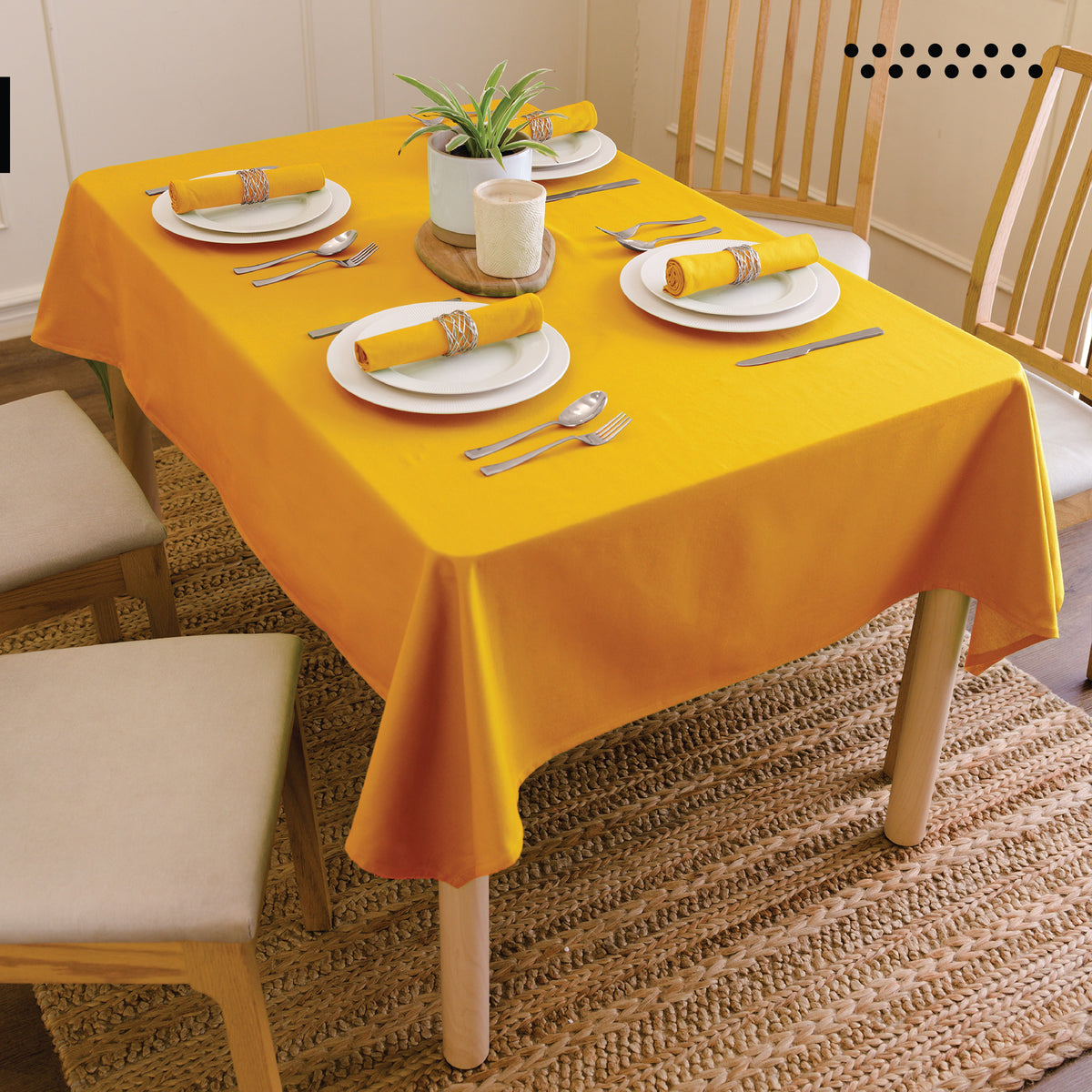
Take a dining table of 180 by 90 cm. You want the cloth to hang 25 cm over every edge, and you will fold a 1.5 cm hem over twice all round. So the finished cloth is 230 by 140 cm, and the piece you cut is 236 by 146 cm. A cotton canvas sold 150 cm wide covers that width in one piece. A 2 metre cut is too short, so you buy 3 metres, wash it, cut it, and hem four sides.
That is the whole job when the cloth is wide enough. To make a table cloth, measure the table top, add the drop twice and the hem twice to each side, and check that number against the width of the fabric before you buy. If the fabric is narrower than the cut, you need a seam, and where you put it matters.
How big to cut the cloth
The sum is the same for every rectangular table:
- Length to cut = table length + 2 drops + 2 hems
- Width to cut = table width + 2 drops + 2 hems
The drop is how far the cloth hangs past the edge. The tablecloth size chart explains why 20 to 30 cm suits a table people sit at every day, and why a longer drop ends up in laps. Pick your drop there, then come back to the sums.
The hem here is 1.5 cm folded over twice, so each edge uses 3 cm and each line of the sum gets 6 cm. Sewing guides use anything from about 1 cm to 5 cm, and a wider hem helps heavy cloth lie flat. Choose another and change the 6 cm.
For an oval table, measure the longest and widest points and make a rectangular cloth to those numbers. Its corners will hang a little lower, in soft points. A true oval is possible, but the curved hem is harder to sew.
Fabric width decides what you can make
Width is fixed on the loom, and it tells you whether your cloth needs a seam. Our guide to fabric width in cm and inches covers how widths are quoted.
Online, a second limit matters as much. Many cloths sell as 1 metre cuts only. Order three and you may get three separate pieces, and a dining cloth made from them has seams across the table. Check that the listing offers a 2, 3 or 5 metre piece.
Cotton adds one more step: wash it before you cut, because the first wash is when it shrinks most. The 3 to 5 percent commonly cited for cotton is a rough range, and on a tablecloth it lands on the drop.
Go back to the 180 by 90 cm table and the 150 cm canvas. Measure the width after the wash. Take away 96 cm (the 90 cm table plus 6 cm of hem) and halve what is left: that is your side drop. If the cloth still measures 150 cm, each side hangs 27 cm. At 146 cm it hangs 25 cm, and at 142 cm it hangs 23 cm. So every 2 cm the cloth loses in width costs 1 cm of drop on each side. The cloth still fits, it just hangs a little shorter. Keep the full width and fold the selvedges into the side hems, so you lose nothing more.
The length has room to spare. Three metres that shrink by 3 to 5 percent still give 285 to 291 cm, and the cloth takes 236 cm. The strip left over, about 50 cm before you square the end, can make three 40 cm napkins, each cut 44 by 44 cm and hemmed 1 cm twice. Measure it before you promise a matching set.
How to make a table cloth from narrow fabric
Now take a satin 110 cm wide. It is narrower than the 146 cm cut, so a satin cloth for the same table needs joins. Never put a single seam down the middle, where every plate sits on it. A common way, used in sewing guides such as Sew4Home's, is one full-width centre panel with a narrow strip on each side. With a 1.5 cm seam allowance on every joined edge:
- Centre panel: the full 110 cm width by 236 cm. After two seams it shows 107 cm.
- Side strips: you still need 146 minus 107, which is 39 cm, so 19.5 cm each, plus 1.5 cm for the seam. Cut two strips 21 by 236 cm.
- Both strips together take 42 cm of width, so they come out of a second 236 cm length.
That is 472 cm of cloth, which means a 5 metre cut. The leftover is a 68 cm wide strip beside the side strips and a short piece at the end, enough for napkins or a runner.
The centre panel is wider than the table, so each seam sits 8.5 cm past the table edge, down in the drop where nobody puts a glass. On a wider table the seams climb towards the edge, so work the sum before you cut.
Satin is slippery and frays, so pin inside the seam allowance and finish every raw edge. If your satin is polyester, as ours is, keep it well away from diyas and candles. Our satin guide has more on how it behaves.
The steps, from washed cloth to hemmed edge
- Wash and dry cotton first, then measure it again. Polyester tends to move much less in the wash than cotton, but follow the care label.
- Square the ends, because a shop cut may not be straight. Fold the cloth in half lengthwise, line up the selvedges, and trim the ends at right angles to the fold.
- Mark and cut on the wrong side, using your cut size, not the finished size.
- Join panels if you need to. A flat-felled seam is neat and strong: stitch the seam, trim one allowance to about half, fold the wider one over it, and stitch it down flat. A walking foot stops the long layers creeping.
- Press the hem: fold each edge over 1.5 cm and press, then fold again and press.
- Mitre the corners, or simply fold them. For a mitre, open out the second fold. Mark a point on each edge twice the hem width from the corner (3 cm here). Fold the corner in half, right sides together, so the two marks meet, and stitch straight between them. Trim the tip, turn the corner out, push the point square and press.
- Stitch the hem close to the inner fold all round, turning at the corners with the needle down.
Practise a mitre once on a scrap. A plain folded corner is thicker but looks fine on cotton.
Mistakes that spoil a home-made cloth
Measuring cotton before it has been washed is the one that hurts most. A cloth cut to the last centimetre from unwashed cotton shrinks after its first wash, and the drop shrinks with it.
A slanted shop cut is quieter: the cloth looks square on the table, then hangs lower at one corner.
Satin and velvet bring their own trap: direction. Velvet pile and satin sheen catch the light differently if one panel is turned, so a side strip cut the other way up can look like a different colour. Cut every panel the same way up.
And joined 1 metre cuts put seams across the table. That is fine on a buffet table under a row of dishes, and annoying under daily plates.
Which of our cloths can make a dining table cloth?
In our own fabric range, four lines sell one continuous piece longer than a metre. Widths and cuts are the listings' size options in late November 2026, so check before you order.
| Cloth | Width (from the size options) | Cuts sold | For a 90 cm wide table with 25 cm drops (146 cm cut) |
|---|---|---|---|
| Cotton canvas | 150 cm | 1, 2, 3 or 5 m (14 of 22 colours); only 1 m in stock in the rest | One piece, no seam |
| Embossed velvet | 150 cm | 1, 2, 3 or 5 m | One piece, no seam |
| Quilted polyester | 137 cm | 1, 2, 3 or 5 m | One piece if you accept about a 20 cm side drop |
| Satin (polyester) | 110 cm | 1, 2, 3 or 5 m | Needs two seams |
The other cloths, 122 to 160 cm wide, sell as 1 metre cuts, which still suit small tables, runners and napkins.

The canvas is the one to use for the opening example. Canvas Mango is listed at 150 cm wide, sells a 3 metre piece, and its page asks you to pre-wash it to allow for cotton shrinkage. For a party cloth in a colour you cannot buy finished, the satin sells in 5 metre cuts. Satin Gold is one of 27 colours at 110 cm, which is the satin worked through above.
When buying a table cloth is simpler
For an ordinary 6-seater, buying is the cheaper route at today's prices. The 3 metre cut of canvas costs ₹1,439, before thread. A finished Cotton Mango tablecloth in 91 by 56 inches (231 by 142 cm) costs ₹1,279, already hemmed, and on a 180 by 90 cm table it hangs about 26 cm at every edge, close to what you would have sewn. For a 4-seater of about 120 by 75 cm, 2 metres of canvas and a finished 72 by 56 inch cloth both cost ₹999.

Small tables are where sewing pays. Nothing in the tablecloth range is narrower than 56 inches (142 cm), and on a 60 cm square side table that hangs 41 cm on every side. A 90 cm cloth with 15 cm drops needs a 96 cm square, which one metre of any of our fabrics gives you. A washed cotton metre may come out a centimetre or so short, so plan on a 14 cm drop with cotton.
Long tables are the other case. The longest finished cloths, 118 and 120 inches (about 300 and 305 cm), leave only 15 to 17.5 cm at each end of a 270 cm table. A 5 metre cut of canvas covers that length, with side drops near 20 cm on a 100 cm wide table. And satin in a party colour you can only sew.
How to make a table runner from a metre of fabric
A runner needs no seam, because you cut it across the width. Velvet Grey sells as one metre, 152 cm wide. Cut two strips 38 cm deep across the full width, hem them 1.5 cm twice, and you have two runners of 32 by 146 cm from 76 cm of the metre. Cut both strips the same way up so the pile matches. The table runner size guide shows which lengths suit which tables.
FAQ
How much fabric do I need for a 6 seater table cloth?
For a 180 by 90 cm table with 25 cm drops, a piece of 236 by 146 cm. On 150 cm cloth that is a 3 metre cut. On 110 cm cloth it is about 4.7 metres, because of the side strips, so buy 5.
Can I make a round table cloth from a square piece?
Yes. Cut a square whose sides equal the table's diameter plus two drops and two hems. Fold it into quarters and mark a curve from the folded corner, using a string or tape as the radius. Cut along it and hem with a narrow hem, easing the curve as you go. For the sizes ready-made round cloths come in, see the round table cover size guide.
What fabric is best for a table cloth?
For everyday meals, a medium-weight cotton such as canvas, because it washes often and lies flat. Satin and velvet suit a party or festive table that does not need daily washing.


Leave a comment
This site is protected by hCaptcha and the hCaptcha Privacy Policy and Terms of Service apply.