
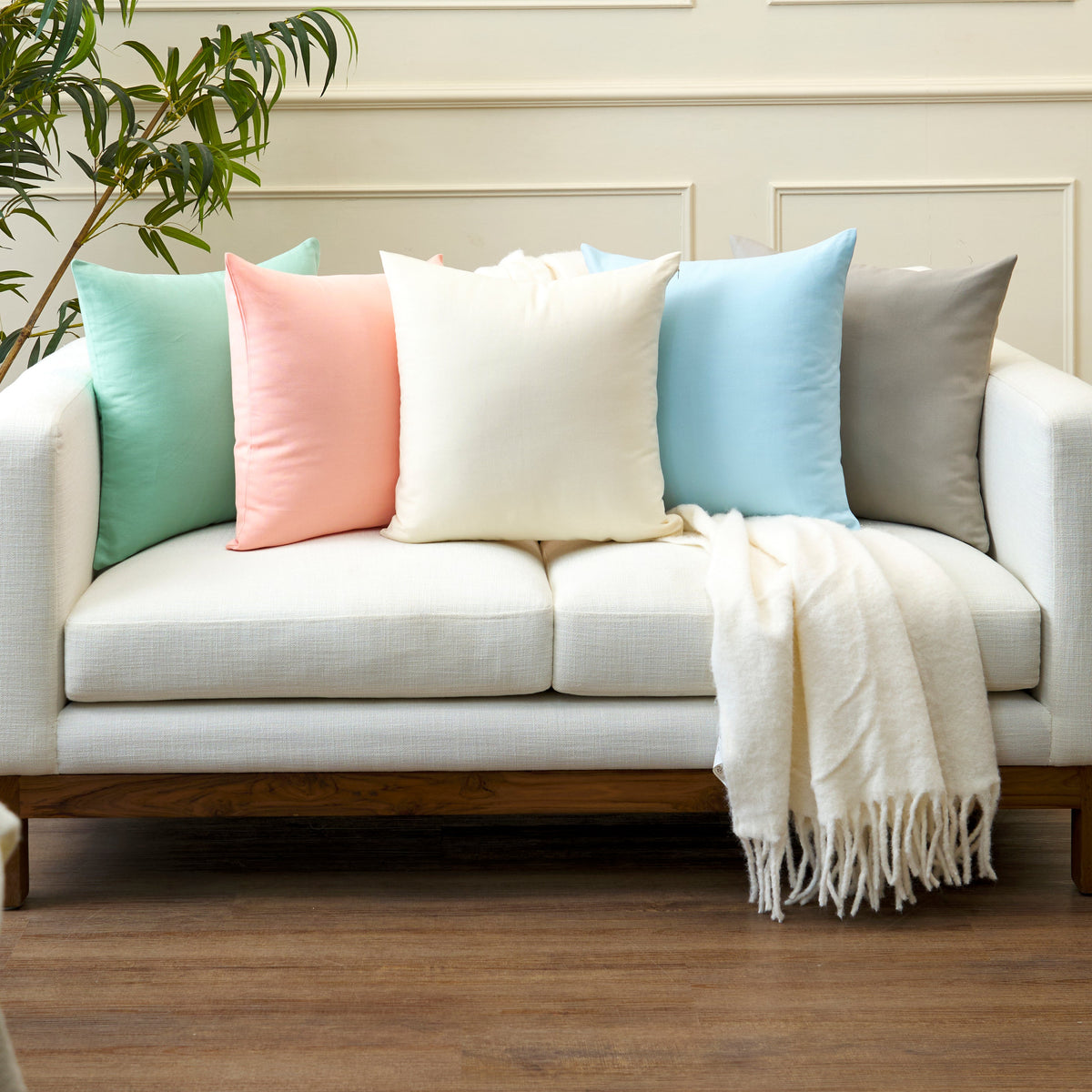
To make a 40 cm (16 inch) cushion cover, cut one front of 43 x 43 cm and two back pieces of 43 x 32 cm, then stitch them together with the backs overlapping by 15 cm. One metre of cloth 137 cm wide or more will usually make two covers. You need no zip and no special machine foot.
Sewing rarely saves money on a plain cover, since a ready-made pair often costs about the same as the cloth. Make your own for a print, fabric or size you cannot buy, or because you like the job. The cushion cover size guide helps you pick a size, and explains why a cover should be a little smaller than its insert.
Zip or envelope: which back should you choose?
An envelope back is two hemmed flaps that overlap across the middle. You push the insert in through the gap, and you buy nothing except thread. On a very full cushion the flaps can pull apart and show a line of insert.
A zip closes flat and holds a full cushion shut, which is why many finished covers have one. The price is a zip, a zipper foot for your machine and a few extra steps.
For a first cover, make the envelope, though a zip's shorter back pieces do use less cloth.
What size do you cut for each cushion cover?
The cut size is the finished size plus whatever the seams and hems use up. Sewing tutorials do not agree on those amounts: seams run from 1.5 to 2 cm, and overlaps from about 5 to 20 cm. This table uses one set throughout, a 1.5 cm seam, a hem folded over 1.5 cm twice, and a generous 15 cm overlap that helps the flaps stay shut.
| Finished cover | Front, cut 1 (cm) | Envelope back, cut 2 (cm) | Zip back, cut 2 (cm) | Envelope covers from 1 m of cloth, 110 / 137 / 150+ cm wide |
|---|---|---|---|---|
| 30 cm (12 in) | 33 x 33 | 33 x 27 | 33 x 18 | 3 / 4 / 4 |
| 40 cm (16 in) | 43 x 43 | 43 x 32 | 43 x 23 | 1 / 2 / 2 |
| 45 cm (18 in) | 48 x 48 | 48 x 34.5 | 48 x 25.5 | 1 / 1 / 2 |
| 50 cm (20 in) | 53 x 53 | 53 x 37 | 53 x 28 | 1 / 1 / 1 |
| 55 cm | 58 x 58 | 58 x 39.5 | 58 x 30.5 | 0 / 1 / 1 |
| 60 cm (24 in) | 63 x 63 | 63 x 42 | 63 x 33 | 0 / 1 / 1 |
The sums are simple to check. For a 40 cm envelope back, half of 55 (40 + 15) is 27.5 cm. Add 1.5 cm for the outer seam and 3 cm for the hem, and you get 32 cm. A zip half is half the cover plus two seams: 20 + 3 = 23 cm.
The overlap goes into the sum once, shared between the two flaps. This only holds if your seams really are 1.5 cm, so mark the first one and measure it.
How to make a cushion cover with an envelope back
This order is common sewing practice. Mark on the wrong side of the cloth.
- Wash and iron the cloth if it is cotton, then cut your three pieces.
- On each back piece, fold one long edge over by 1.5 cm, press it, fold it again by 1.5 cm, and stitch it down.
- Lay the front on the table with its right side up.
- Put one back on it with the right side down, raw edges level with the top. Put the other on with the right side down and raw edges level with the bottom. The hems will cross in the middle by 15 cm.
- Pin and stitch all four sides at 1.5 cm, going back and forth over the hem ends, where the insert pulls hardest.
- Trim the corners close to the stitching, then zigzag the raw edges if your machine can, since loose weaves fray in the wash.
- Turn the cover right side out through the gap, push out the corners and press.
How to stitch a cushion cover with a zip
Choose a zip about 5 to 10 cm shorter than the cover is wide, so 30 to 35 cm for a 40 cm cover. That is common practice and not a fixed rule. A shorter zip makes a full insert harder to push in, so stay at the longer end for a firm one.
- Put the two back halves right sides together and stitch along the long edge at 1.5 cm. Use your longest stitch where the zip will go and a normal stitch at each end.
- Press the seam open.
- Lay the zip face down on the pressed seam and pin or tack it in place.
- Fit the zipper foot and, from the right side of the cloth, stitch round all four sides of the zip.
- Unpick the long stitches so that the zip shows.
- Open the zip part of the way. People forget this step, and without it you cannot turn the cover.
- Put the back on the front, right sides together, stitch all four sides at 1.5 cm, trim the corners and turn it through the zip.
The mistakes that spoil the fit
Sew a 2 cm seam instead of 1.5 cm all round and a 43 cm front gives you a 39 cm cover, not a 40 cm one. You can catch that in time, but cutting errors are harder to undo.
Back pieces go wrong in three ways. If you forget to allow for the hems, each flap comes out 3 cm short and the overlap falls from 15 cm to 9 cm. Add the overlap to each flap and you cut 39.5 cm backs with a 30 cm overlap. Cut the backs the same size as the front and you get 37 cm of overlap and a stiff, thick middle.
Velvet and one-way prints add a fourth: a piece cut the other way up can look like a different cloth.
How much cloth do you need for one cushion cover?
Width decides this more than length does. The table's last column assumes you lose 2 cm of edge from each side and keep every piece the same way up. Three 40 cm pieces across the cloth need 129 cm of clean cloth, and three 45 cm pieces need 144 cm. So 137 cm cloth takes three 40 cm pieces across, while three 45 cm pieces need the 150 cm kind.
Two 40 cm covers take 75 cm on 137 cm cloth and wider, but 107 cm on 110 cm cloth. A 60 cm envelope cover fits in a metre once the cloth is 137 cm wide: the front goes on one side and the two backs stack beside it, using 84 cm. On 110 cm cloth the pieces run end to end and need 147 cm.
A zip back uses less: a 60 cm zip cover takes 66 cm on 137 cm cloth and wider, and a metre of that width gives three 40 cm zip covers.
Leave room for the first wash. The 3 to 5 percent commonly cited for cotton is a rough range, and on a metre it could mean 3 to 5 cm. Width matters more. A 150 cm cotton that loses 3 percent has less than 144 cm of clean cloth left, so a third 45 cm piece no longer fits across. Wash first, lay the cloth flat, measure it, and only then plan your cuts. If a listing's numbers are new to you, read how widths and metres work.
Many cloths sell only in 1 m lengths. Where the table shows 0, two of them still work: the front from one, both backs from the other.
Which fabric is easiest to sew for a first cover?

A stable woven cotton makes an easy start, because it stays where you put it and holds a pressed fold. Canvas does both, though it is thick where hems and seams stack up, so slow down at the corners. The Canvas Natural cloth is a cream half-panama weave, listed at 180 GSM on its own spec card and 150 cm wide. It also sells in cuts of 2 m and more, which helps when you want several covers.
Printed cotton sheeting is easy in a different way. The Blue Daisy cotton is 160 cm wide, and its flowers are scattered with no up or down, so there is nothing to match. Hold sheeting up to the light first, since a thin cloth can show the insert. If you pick something else from the fabric range, check its width against the table first, because that decides whether one metre is enough. The fabric by the metre guide goes through the other cloths.
Cloth that asks for more care: velvet and checks

Large checks cost you cloth. On Buffalo Red Checks, the squares are big enough that a front and two flaps cut at random will look wrong the moment the cover is closed. Lining them up means the neat layout in the diagram stops working. This cloth comes in 1 m lengths, so lay your pieces out before you cut, and plan on one cover per metre unless they clearly fit.
With velvet, the worry is direction. Pile catches the light differently depending on which way it lies, so every piece has to be cut the same way up, including the flaps. Pin it often, because the two pile faces creep against each other under the machine foot. Embossed Velvet Beige lists 170 GSM, is 150 cm wide, and sells in cuts up to 5 m.
Is it cheaper to make a cushion cover or buy one?

For a plain cover, usually not. A metre of the canvas above costs about ₹500 and gives two 40 cm covers before you pay for thread. A finished cotton canvas pair in 40 x 40 cm also costs about ₹500, with a concealed zip, and a printed polyester pair costs less, from a little over ₹300.
Cheaper cloth shifts the sums: the daisy cotton is about ₹350 for a metre and makes two covers. A longer cut helps a little too: 2 m of the canvas costs about ₹1,000 and gives five 40 cm covers, while a finished set of five costs about ₹1,200. If the size, print or fabric you want is there among the finished cushion covers, buying is the quicker answer.
FAQ
How much overlap does an envelope cushion cover need?
This guide uses 15 cm. Some tutorials go as low as 5 cm, which saves a little cloth but gapes more easily on a full cushion. If you change the overlap, change the back piece by half that amount, since each flap carries half of it.
How much fabric do I need for a 16 inch cushion cover?
On cloth 137 cm wide or more, one envelope cover uses 43 cm of length. On 110 cm cloth it uses 64 cm, because only two pieces fit across and the backs stack beside the front. A metre either way leaves room for a mistake.
Should I wash fabric before making a cushion cover?
Wash cotton first, because the first wash is when it moves the most. A cover cut from unwashed cotton can tighten around its insert later.

Leave a comment
This site is protected by hCaptcha and the hCaptcha Privacy Policy and Terms of Service apply.