
Say your round dining table measures 120 cm across, which is a common four-seat size in an Indian flat. A 56 inch round cover is 142 cm, so it hangs about 11 cm past the edge the whole way round. A 57 inch cover is 145 cm and hangs 12.5 cm. A 60 inch cover is 152 cm and hangs 16 cm. Those are the three answers, and no other detail about the cloth changes them.
All three came from the same subtraction: cover diameter minus table diameter, divided by two, is the drop on each side. Round covers are sold in very few diameters, so buying one is mostly a question of which size lands closest to the drop you want. The 56, 57 and 60 inch figures used through this guide are the diameters our own round covers are sold in, taken from the size options on the product pages.
Measure across, not around
Put a tape across the widest part of the top, edge to edge, straight through the middle. That number is the diameter, and it is the only table measurement a round cover needs. Seat counts are no help here. One maker's four-seater round is 100 cm and another's is 120 cm, and a 20 cm difference changes the drop by 10 cm on each side.
Two details can make that measurement less tidy than it sounds. If the top has a rolled or moulded edge, the cloth sits on the flat part and then bends over the lip, so it loses a little of its drop to the curve. If the top is a glass disc resting on a wider wooden frame, measure the glass, since that is what the cloth lies on, and accept that the frame will show below it. Neither is a reason to buy a different size, but both explain a drop that comes out shorter than the sum said it would.
Drop is the part that hangs below the edge, and it is the only thing you are really choosing when you pick a size. Somewhere between 20 and 30 cm looks settled on a dining table and stays clear of a seated person's knees. Under about 10 cm the cloth reads as a bit mean, as though it were bought for a smaller table. Much past 30 cm and it lands in laps.
What size round table cover fits a 2, 4 or 6-seater?

Here is the subtraction done for all three cover sizes against four round table diameters, from a small balcony table up to a six-seater. Find the row nearest your tape measurement.
| Your table across | 56 in cover (142 cm) | 57 in cover (145 cm) | 60 in cover (152 cm) |
|---|---|---|---|
| 90 cm, 2-seater breakfast or balcony round | 26 cm drop | 27.5 cm drop | 31 cm drop |
| 100 cm, compact 4-seater | 21 cm | 22.5 cm | 26 cm |
| 120 cm, full 4-seater | 11 cm | 12.5 cm | 16 cm |
| 150 cm, 6-seater | too small, the top shows | too small, the top shows | 1 cm, flush with the edge |
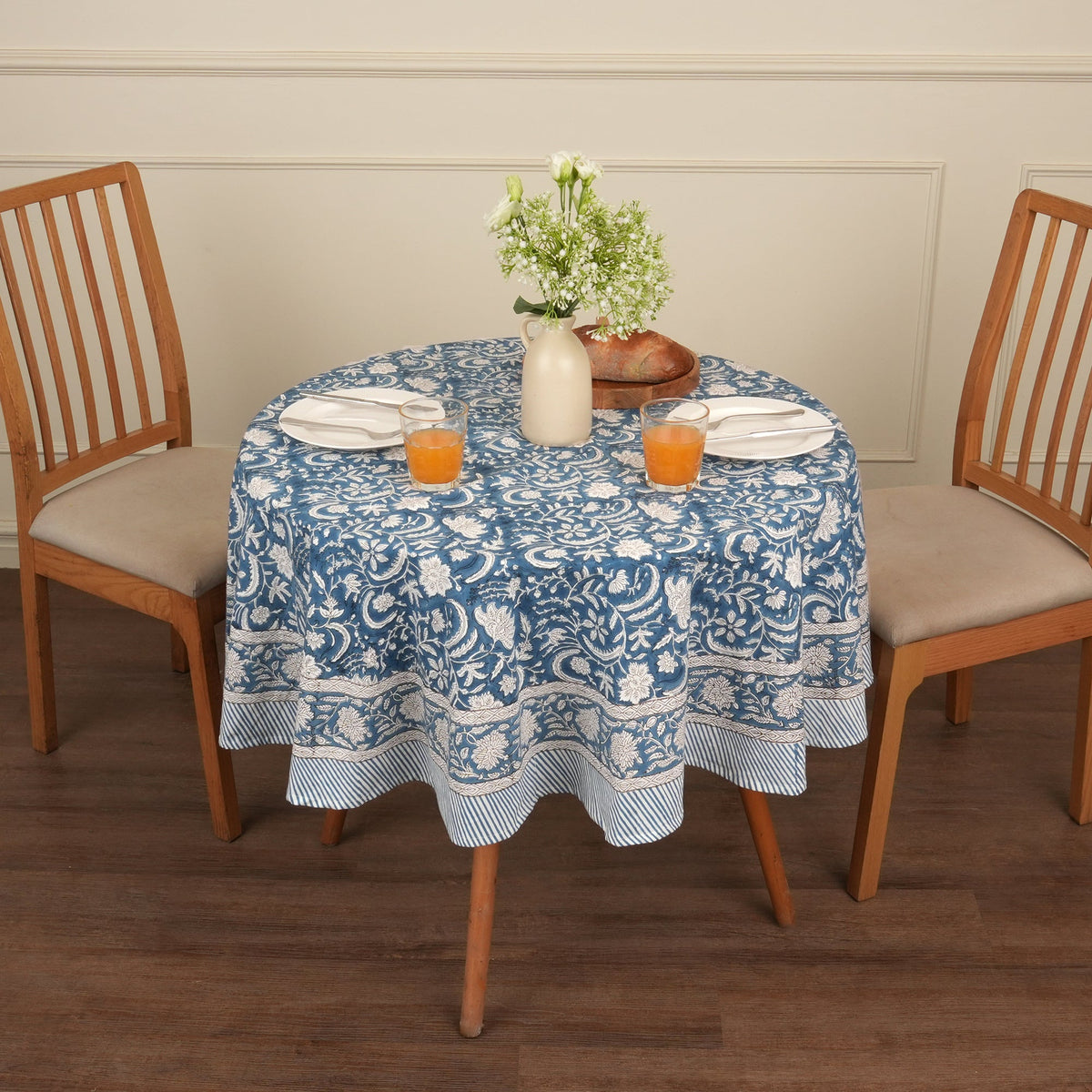
A four-seat round table is served by any of the three, which means the choice there comes down to print and price rather than fit. The 57 inch cloth is the one cut for the job: the grey chambray-weave round cover is sold in that single size and nothing else, and its page describes it as 145 cm round and sized for most four-seater dining tables. The arithmetic backs that up, though read "most" as written, because a 120 cm four-seater gets 12.5 cm and a 100 cm one gets 22.5 cm, and those two drops look quite different in a room. The photo above is that cloth, and the pattern is a jacquard floral rather than a plain grey.
The small end of the table is where the grid surprises people. A 90 cm breakfast round gets 26 to 31 cm of cloth hanging down whichever size you buy, which is at the deep end of what looks right and will brush a seated person's legs. On a small table, reach for the smallest cover rather than the biggest.
Where the round sizes run out
Round tables are made at 150 cm across, usually sold as six-seaters, and no round cloth in our range covers one properly. A 56 or 57 inch cover is smaller than the table top, so bare wood shows around the rim. The 60 inch cover reaches the edge with roughly a centimetre to spare, which is not a drop, it is a coincidence. It will slide off the moment somebody rests an elbow near the rim.
Our own round covers stop at 60 inches, and the 90 and 108 inch rounds that turn up in tablecloth size charts online mostly come from event and banquet linen suppliers rather than home ranges. A square cloth is the usual workaround for a round table, and it is a good one up to about a metre across, which our guide to what a cloth protects your table from works through in its questions at the end. It runs out here too. The biggest square in the table cover range is 60 by 60 inches, about 152 cm, so on a 150 cm round table it clears the rim at the corners and sits flush everywhere else. Which leaves mats. A round table takes mats well because there is no rectangle to line them up against, so each setting is simply spaced evenly round the rim, and the placemat range is where a big round table that no cloth fits usually ends up.
Glass tops, pedestal bases and the chair you push in

Round tables in Indian flats are very often glass topped, and a glass top changes how a cover behaves without changing the size you need. Fabric grips a wooden or laminate surface a little through friction. Polished glass gives it almost nothing to hold, so the cloth travels when somebody drags a plate or leans on the edge, and it goes on travelling because a round cloth has no corners to anchor it. A heavier cotton has more of its own weight holding it down than a light polyester does, and something solid set in the middle of the table gives the cloth a further reason to stay where you put it.
The base is worth a look before you decide on a drop. The table in the photo above sits on a single central pedestal, and the cloth falls straight down all round with nothing to interrupt it. That is the easy case. A four-leg round table has legs that splay outward as they go down, so a long drop rests against them and tents slightly instead of hanging, which shows most on the two legs facing the room.
Then there is the habit of pushing chairs all the way in between meals. On a 90 or 100 cm table with a 26 cm drop, the chair back meets the cloth rather than the table edge, and every push drags a little more of it to one side. If your chairs live tucked in, the shorter drop is the one that stays straight, which is an argument for the 56 or 57 inch cover on a compact table even when the bigger one would technically fit.
Which of the three sizes to buy

The 56 inch round is where the polyester covers sit, ₹499 for the plain colours and ₹689 for most of the prints. Polyester does not drink a spill the way cotton does, and it creases far less, which is the point of it on a table that gets wiped down twice a day. The apple print round cover is one of these at ₹689, and the same print comes in two rectangular cuts if a second table in the house needs matching. Cotton at this diameter runs ₹999.
If the table is a four-seater and you would rather stop thinking about it, the chambray-weave cover linked above and its three sibling colourways are the short answer: cotton, in grey, blue, red and beige, all ₹999 for the round cut. Three of those four colourways are made in no other shape at all, which says the size was drawn for round tables rather than adapted to them.
Going up to 60 inches means taking the hand block print look along with the size, because every 60 inch round cover here is one, printed by hand by artisans in Jaipur, at ₹1,199 to ₹1,599. The Kashmir cover at ₹1,199 is the cheapest of them, a white ground with scattered floral motifs and a wide patterned border. The indigo blue one at ₹1,599 is the darker, denser print, indigo with a striped border. Both are also cut square and rectangular, which matters if a round table and a long one have to be dressed for the same dinner.
Questions about round table covers
What size tablecloth fits a 4 seater round table?
For a four-seat round table measuring 100 to 120 cm across, a 57 inch (145 cm) round cover is the closest fit, giving 12.5 to 22.5 cm of drop. A 56 inch cover behaves almost identically. Measure your table before ordering, because four-seat rounds vary by 20 cm between makers.
What size cover suits a small round breakfast table?
Take the smallest round cover you can find. A 90 cm balcony or breakfast round gets 26 cm of drop even from a 56 inch cover, which is already deep. Anything larger hangs into the space where knees go.
Can I put a round cover on a glass round table?
Yes. Measure the glass across its widest point and size the cover exactly as you would for a wooden table. Expect to straighten it more often, since a polished surface offers a cloth very little to hold on to.
How do I stop a round cover hanging unevenly?
Fold the cloth in half and in half again to find its centre, then set that point over the middle of the table and smooth it outward from there. Judging the centre by eye is where the problem starts: 3 cm of error at the middle shows up as a 6 cm difference between opposite edges, which is enough to notice from across the room.


Leave a comment
This site is protected by hCaptcha and the hCaptcha Privacy Policy and Terms of Service apply.