
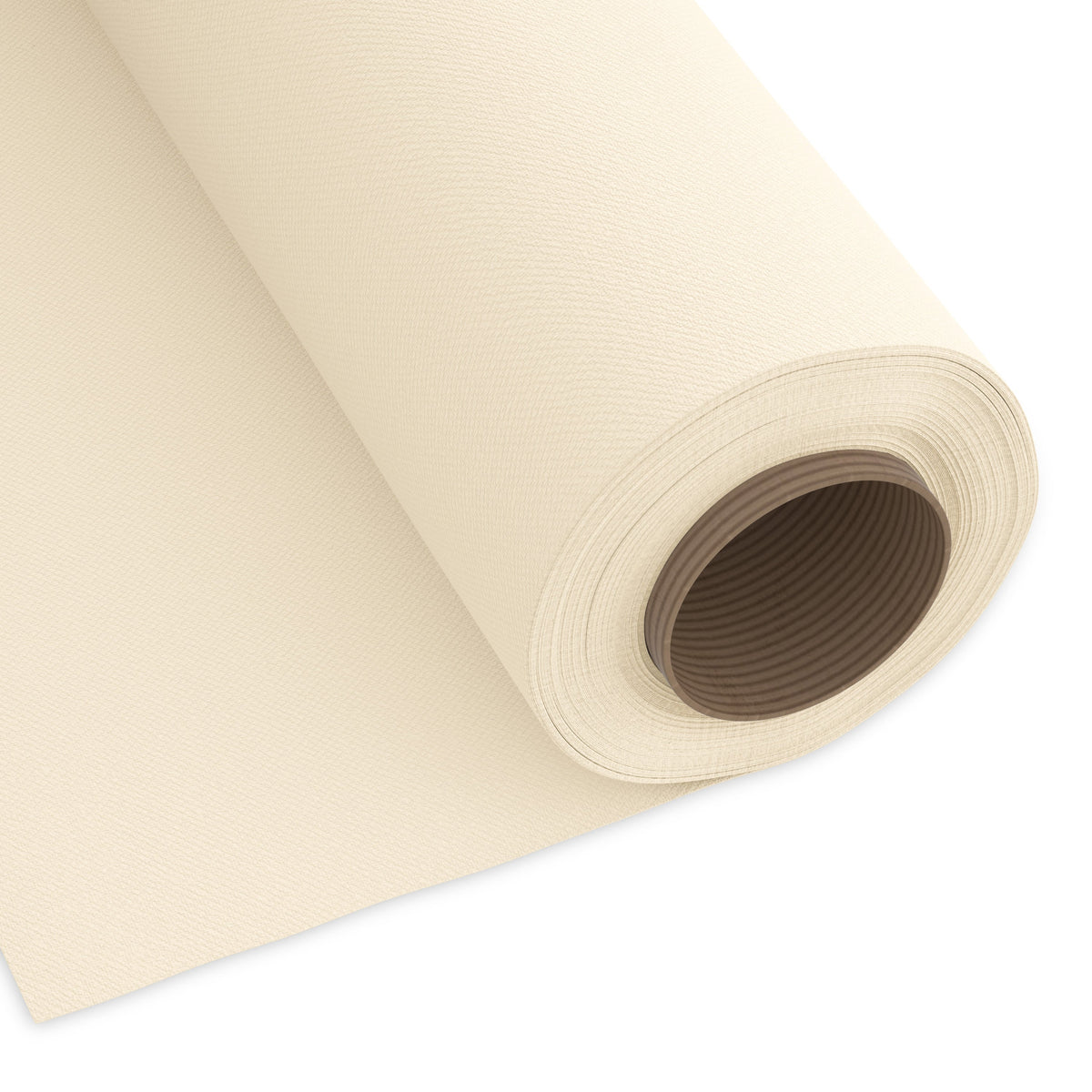
Is this actually canvas? The word carries a lot of freight. Canvas is what a school bag is made of, and a painter's stretched frame, and the tarpaulin lashed over a truck bed. Then you open a curtain listing that says cotton canvas, and the picture shows a panel falling in soft folds with daylight coming through it. Both are canvas. They are not the same cloth, and the distance between them is wide enough that a shopper who expected the first one often puts the second one down again.
Canvas is a plain weave, usually cotton, woven tightly enough that the cloth keeps some body instead of falling limp. Weight is what separates one canvas from the next. Suppliers to the tarpaulin and bag trade start their canvas at roughly 200 grams per square metre and run past 500: those are the bands in the weight guide published by King Canvas, an Australian canvas supplier. Encasa's canvas states 180 GSM, which puts it under the bottom of that scale rather than on it.
What is canvas fabric made of?
Cotton, in the home-textile ranges sold in India, though blends and synthetic outdoor canvas exist elsewhere. What makes it canvas is not the fibre but the weave and the tightness: warp and weft crossing one over one, packed close, with a firm hand and very little stretch. The same cotton spun finer and woven opener gives you a voile or a sheer. Woven with a pile it gives you velvet or corduroy. Canvas sits at the flat, dense end of that family.
Mercerising comes up in the descriptions for the metre cloth and both curtain lines. It is a caustic treatment that swells the fibre, so the cloth takes dye more deeply and picks up a faint lustre. You can see the result in the product frames for the plain canvas: a charcoal so dark it reads as almost black, with a shallow sheen running across it rather than a flat matte.
How canvas is woven, and what the weave names mean

Encasa's metre canvas calls itself a half panama weave, and the pack-of-two cotton curtains call themselves Panama weave. Panama, or basket weave, groups yarns in pairs or larger bundles instead of running them singly, which gives a slightly chunkier surface than a straight one-over-one plain weave. Half panama is the halfway version, doubled one way and single the other. It is a texture you feel more than you see from across a room.
The weave name most people have heard is duck, and duck is where a lot of the confusion starts. Duck canvas is finer yarns packed much more tightly, sold by graded numbers, and it is the canvas of tool bags and heavy covers. Encasa sells none of it, and nothing in the catalogue is graded by a duck number, so if you have arrived with duck weights in your head, set them aside.
On the buffalo blue checks cloth the weave grid is plainly visible in the white squares, and the blue squares are flecked where a white yarn crosses a dyed one. That is yarn-dyed cloth, coloured before weaving rather than printed afterwards, which is why the check looks the same on both faces. It sells at 152 cm wide in a one metre cut at ₹499, in eight checks and stripes, all in stock. Its title says canvas; its own description says homespun weave cotton and lists it for bed covers, curtains, cushion covers and dresses. That is a different construction from the mercerised half panama of the plain canvas, and neither page publishes a weight, so treat the two as separate cloths rather than the same one in a pattern.
What GSM is canvas fabric?
This is where the word misleads people most. Encasa prints one figure across all three of its canvas lines: 180 GSM, described on the cushion cover page as 5.5 oz medium-weight cotton with a sturdy canvas weave. Against the trade bands above, 180 sits below where a supplier of tarpaulin and tote cloth would even begin calling something light canvas.
A cloth that hangs in folds at a window and one that stands up on its own as a bag are being asked to do opposite things, and the bag needs a much heavier cloth to do it. The curtain page is straightforward about which side it is on: the cloth allows natural light to filter softly through without blocking sunlight entirely. For how weights map to uses across a whole home, what GSM means in home textiles has the bands.
The metre-sold canvas carries the same figure, in a place people miss. It is not in the description text; it is printed inside one of the images in the listing's own gallery, a spec frame giving 180 GSM cotton and a half panama canvas weave, and the plain canvas colours carry the same frame. So the yardage, the ready curtains and the covers are all quoted at one weight, and the number you want sits in the picture strip rather than the paragraph.
The three things Encasa calls canvas
So do not buy canvas by name. Buy it by the weight the page states, the weave it names, the width and the format. Encasa uses the word across three lines, and each answers a different one of those.
| Line | What the page calls the cloth | GSM stated | Sold as |
|---|---|---|---|
| Canvas by the metre | Mercerised cotton canvas, half panama weave | Yes, 180 GSM, in a spec image | 1, 2, 3 or 5 metre cuts, 150 cm wide |
| Canvas curtains, single panel | Solid dyed cotton canvas, rich canvas weave | Yes, 180 GSM | One panel, usually 5 or 7 ft, 9 ft in a couple of colours |
| Canvas cushion covers | Medium weight cotton, sturdy canvas weave | Yes, 180 GSM | Covers only, packs of 1, 2 or 5 |
There is a fourth line, and it is the one that catches people out. A whole range of curtains is titled Cotton rather than Canvas, sells in pairs, and describes itself as Panama weave cotton. Its description names the same mercerised cotton the canvas lines do. The title just does not say so.
Canvas by the metre, if you are getting something stitched
Plain canvas cloth runs to 22 colours in the fabric collection, every one of them 150 cm wide and cut to order in 1, 2, 3 or 5 metre lengths at ₹499, ₹999, ₹1,439 and ₹2,419. Pricing is identical across all 22, so the colour costs you nothing either way. Stock is where they part company: 14 colours currently have all four cut lengths, and the other eight sell only the one metre cut. If your project needs a single uncut length, open the exact colour and check its size options before planning around five metres.
The charcoal grey canvas is a fair first look at the range. How cut lengths work and how much to buy for a given project is worked through in the fabric by the metre guide, sofa cover included.
Ready-made canvas curtains sold as single panels

The canvas grey panel is a single curtain, not a pair, stitched with eight silver eyelets and a 1.5 inch bottom panel to steady the fall. It states the 180 GSM figure, and it sells in two lengths, a 5 ft window at ₹1,209 and a 7 ft door at ₹1,279, both in stock. Lengths vary from colour to colour across this line, so read the size options on the listing; they are the ground truth for length and width.
Singles are the right buy when one narrow window or one side of a doorway is the whole job. For two matched windows you are paying panel by panel, and the pairs below work out cheaper.
A warning about the colour images on this line, since it will cost you a return otherwise. The rich maroon panel is a solid deep wine, and the flat studio frames show that plainly, but the lifestyle frames are lit from behind and the same panel reads as a wine-to-blush gradient. Judge these colours from the flat frames, not the sunlit ones. Any curtain shown against a window flatters itself, and a light-filtering weave more than most.
The pairs that are titled cotton, not canvas

The cotton canvas curtains collection holds 17 colours, all sold as pairs, all described as mercerised Panama weave cotton. Every one of them is titled Cotton. None says Canvas. The charcoal grey pair runs from ₹1,739 for two 5 ft panels to ₹2,539 for two 9 ft ones, with the 7 ft door size in between, and all three sizes are in stock.
So the habit worth forming is to read the fabric line in the description before the product title. A title that says canvas may be describing a homespun cotton, and a title that says cotton may be describing a panama-weave canvas. And what a range actually sells, the lengths and the width and the colours, is settled in the size options rather than anywhere else on the page.
Canvas cushion covers

If you are still unsure how 180 GSM cotton feels in the hand, a cushion cover is the cheap way to find out before you commit to metres of it. The cotton canvas covers run from 30x30 cm to 65x65 cm, with a 30x50 lumbar as well, in packs of one, two and five, from ₹319 to ₹999, every size in stock. They are covers only, with a concealed zip and no insert. The canvas colours sit in the cushion cover collection alongside the velvet and chenille ranges, which is where the difference between a flat weave and a pile becomes obvious.
Washing canvas without shrinking it
The metre cloth carries one instruction the finished goods do not: pre-wash recommended to allow for natural cotton shrinkage. The order matters. Wash and dry the cloth before it goes to the tailor, not after it comes back, because a curtain measured and stitched from unwashed canvas is being cut to a length it will not keep. The same page asks for a cold machine wash or a hand wash, dark colours washed separately with a mild detergent, line drying, and a warm iron if needed.
The finished goods say something slightly different. The single-panel curtain page allows a tumble dry but rules out a hot dryer, and the cushion covers ask to be kept out of prolonged direct sun indoors. Follow the instruction on the thing you bought. A shrunken cover stops going over its insert; a shrunken curtain stops reaching the sill; neither comes back. How cotton shrinks and how to prevent it covers the mechanics if you want the reasoning behind the cold water.
Common questions about canvas fabric
What is the difference between canvas and cotton?
Cotton is the fibre; canvas is one way of weaving it. Every canvas named in this guide is cotton, and plenty of cotton is not canvas. When a curtain is described only as cotton, that tells you what it is made of and nothing about how heavy or tightly woven it is.
Is cotton canvas good for curtains?
For windows with indirect light, yes. It has enough body to hang in proper folds, it filters light rather than blocking it, and it washes plainly. Direct sun is the limit. The canvas cushion covers carry their own warning about prolonged direct sunlight, and the same dye in a curtain is exposed to a great deal more of it. Which fabric suits which room sets that against the synthetic options.
Does canvas fabric shrink?
Being cotton, yes, and mostly in the first wash. No percentage is published for this cloth, so treat it as real rather than trivial. The expensive version is stitching unwashed yardage into something measured, which is why the metre fabric asks for a pre-wash and the ready-made items do not.
Can canvas curtains block sunlight?
No, and they are not sold as though they could. A deep colour in the same cloth will cut more light than a pale one, and two panels overlapped cut more than one, but you are adjusting a filter rather than switching it off. For a bedroom you want properly dark, or a room with a screen in it, buy a blackout fabric and use canvas somewhere else.

Leave a comment
This site is protected by hCaptcha and the hCaptcha Privacy Policy and Terms of Service apply.