
Someone always aims for the groom's forehead and gets the tablecloth instead. At a haldi ceremony the paste is thick, oily, and flying in fistfuls, and by the time the photos are done, the linen underneath usually has a yellow bloom that no amount of hot-water scrubbing seems to shift. Plenty of hosts assume they did the wash wrong. Usually they didn't. Turmeric behaves less like food and more like a dye, and dye doesn't come out the way spilled dal does.
The version that actually works: rinse the fresh stain in cold water and work in a grease-cutting dish soap within the first hour, then let the item dry in full sun rather than a hot dryer. Heat sets the pigment into the fibre; sunlight is what breaks it back down. Nothing pulls a haldi stain out in one go, and no single home remedy is a fix on its own. What changes the outcome is what you do in the first hour, and what the linen was made of and coloured before the turmeric ever landed on it.
Why turmeric stains refuse to behave like other food stains
The pigment in turmeric, curcumin, is fat-soluble. Haldi paste is usually mixed with a little oil or ghee, and that oil coats the fibre and shields the pigment from plain water, which is why a quick rinse alone barely touches a fresh stain. Curcumin also bonds directly onto cellulose fibre rather than sitting on top of it. Cotton, the most common fibre in table and kitchen linen, takes it up much the way it takes up a dye: the pigment diffuses into the body of the fibre instead of resting on the surface, which is why wiping and surface cleaning do so little. Heat speeds all of this up: a hot wash or a spin in the dryer on a stain that hasn't fully lifted essentially locks the colour in.
The one thing curcumin doesn't hold up against is ultraviolet light. Sunlight breaks the molecule down into colourless byproducts, which is why a stain that's been rinsed, soaped, and then left out in bright sun for a day or two fades in a way a hot wash on its own never manages. None of this responds to scrubbing harder. It responds to getting the oil out early and then giving the sun time to do the rest.
Does soaking or scrubbing actually get a haldi stain out?
Rubbing a fresh stain pushes the oily paste deeper into the weave, so the first move is to lift off whatever paste is sitting on the surface with a spoon or blunt knife rather than wipe it. After that, cold water from the reverse side of the fabric pushes the pigment back out the way it went in, which plain front-side rinsing doesn't do as well. Dish soap, worked in and left for a few minutes before rinsing, is doing real work here, because it's formulated to cut oil, and the oil is what's holding the pigment against the fibre in the first place.
Hot water and the tumble dryer are the two things to avoid until the stain is genuinely gone, since either one can bake a faint stain into a permanent one. Once it's rinsed and soaped, dry the item flat or on a line in direct sun instead. If a pale shadow is still there after the first wash, another day or two of sun exposure often finishes what one wash cycle didn't, and that's usually a better bet than reaching straight for bleach on coloured or printed linen.
Lemon juice and salt turn up in a lot of haldi stain-removal advice. There isn't good evidence either does more than the cold rinse and sun exposure would do on their own, so treat them as optional rather than the actual plan.
The linen choice matters more than the stain remover
Two separate things decide how badly a haldi stain shows up at your own hosting: how well the fabric hides a stain visually, and how much treatment the fabric can survive afterwards. They don't always point to the same fabric.
Plain cotton, oddly, often looks worse at first than a delicate weave, because the pigment diffuses into the fibre rather than staying on the surface. But cotton is also the fabric that can take the treatment that actually works: repeated washing once the stain has lifted, full sun for a day or two, dish soap worked in without damaging the weave. A hand-embroidered runner or a velvet piece can't take days in direct sun or a vigorous soap treatment without the pile flattening or the thread work suffering, so a stain that lands on those pieces tends to become close to permanent faster, even if it looked lighter to begin with.

Colour and pattern are the more reliable defence during the ceremony itself. A pale solid tablecloth shows every fleck of turmeric the moment it lands. A busier print or a deeper festive ground, gold and maroon table linen like Damask Cotton Festive Gold & Silver Table Napkins from the table napkin collection, hides a fresh stain long enough for you to treat it properly instead of pulling it off the table mid-ceremony.
| Linen type | Hides a fresh haldi stain | Takes hot wash + full sun afterwards | Where it belongs during haldi season |
|---|---|---|---|
| Plain pale cotton | Poor | Good | Everyday use, not the ceremony table |
| Printed or dark cotton | Good | Good | Ceremony table and kitchen prep |
| Velvet | Fair | Poor | Post-ceremony dinner, not the paste stage |
| Embroidered or silk runner | Fair | Poor | Keep off the ceremony table entirely |
| Natural fibre (madur kathi, jute-blend) | Good | Good, wipeable | Ceremony table base layer |
If you already own the kind of good table linen worth investing in for regular dining, the haldi ceremony is the one occasion to leave it in the cupboard rather than on the table.
What should be on the table during the ceremony, and what should wait for dinner
The simplest fix is to run two different sets of linen for the day rather than one. For the ceremony itself, use a washable cotton base layer you're not precious about, in a colour that can absorb a hit. A Cotton Red Table Cloth does this well: red hides a fresh bloom in a way pale cotton can't, and cotton takes the cold-rinse-then-sun routine without complaint. Under the ceremony thalis and bowls, a Madur Kathi Red Placemat from the placemat collection is a sensible base layer too, since the woven natural fibre wipes clean and doesn't need the same careful treatment as a printed cotton weave.

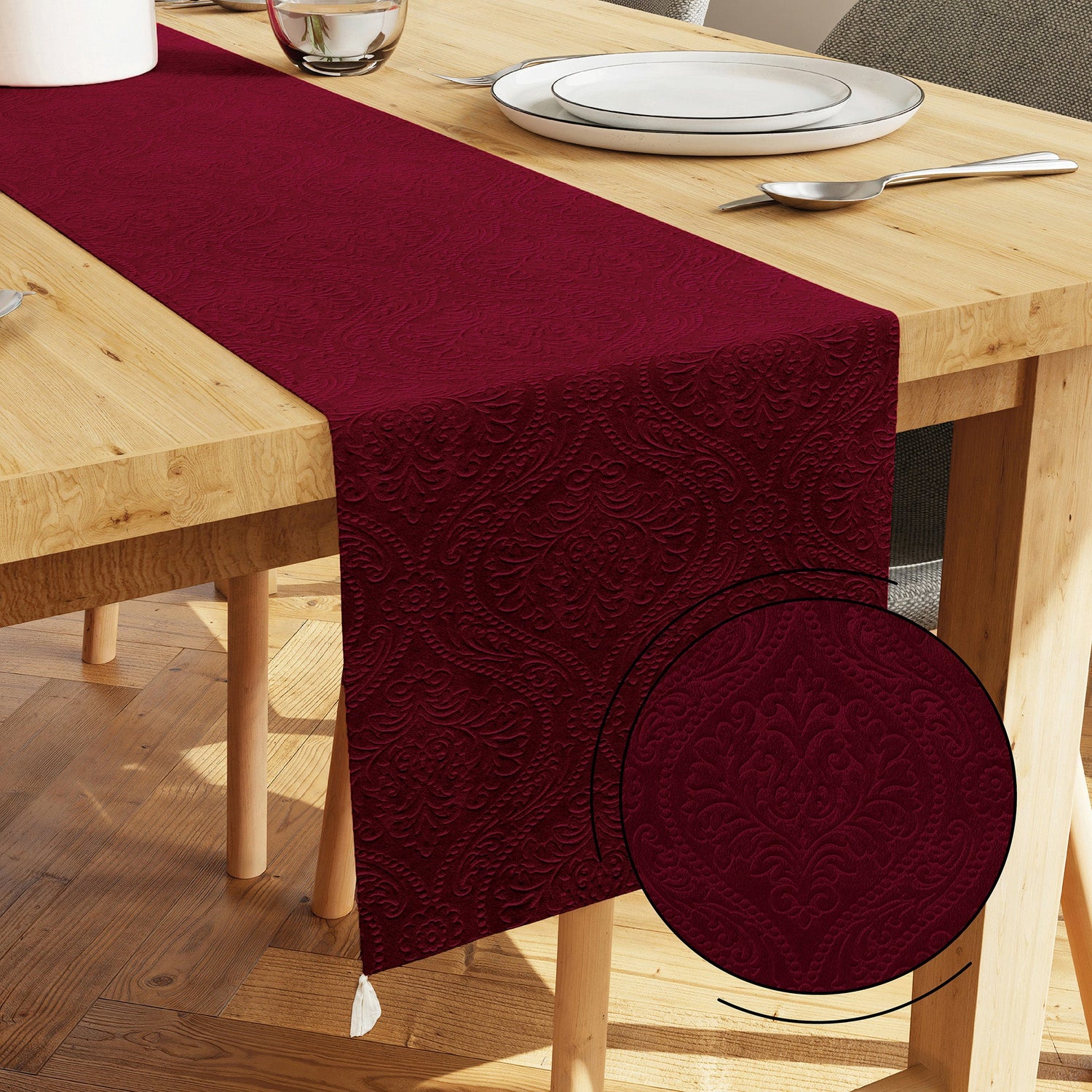
Save the nicer pieces for the dinner that follows once the ceremony mess is cleared. An Embossed Velvet Maroon Table Runner reads exactly right for a wedding-season dinner table, but it isn't a fabric you'd want anywhere near the actual haldi application, since it can't take the sun-and-wash sequence a stain on it would need. Setting the table twice in one day sounds like extra work, but it's less work than trying to nurse a stain out of the good linen the next morning, and if you're dressing the table at all, splitting it into a ceremony layer and a dinner layer is the version that actually holds up.
Kitchen linen for the turmeric-heavy prep, not just the table
The paste gets mixed in the kitchen before it ever reaches the ceremony space, and that's where hands, counters, and towels take the first hit, well before any of it lands on the table linen. Since curcumin bonds to any cellulose fibre it touches, a white kitchen towel used to wipe turmeric-stained hands during prep is likely to carry a permanent yellow tinge within one wedding season, no matter how carefully it's washed afterwards.

A patterned towel does the same wiping job without showing every mark. Cotton Buffalo Blue Checks Kitchen Towels from the kitchen towel collection are a reasonable pick for the run-up to any turmeric-heavy cooking or ceremony prep, and the check print means the towel is still presentable for guests in the kitchen, not just functional.
Frequently asked questions
How do you get a haldi stain out of table linen at home?
Scrape the excess paste off with something blunt instead of wiping it, then flush the mark from the back with cold water so the pigment moves out the way it came in. A soap made for cutting grease, left on for a few minutes before rinsing, handles most of the work from there. Keep the item away from the dryer and a hot wash until it's finished; sun does the rest, usually over a day or two rather than one cycle.
Why does a haldi stain look lighter right after washing but come back later?
Detergent often brightens the fabric enough that a faint stain seems to disappear straight out of the wash, but if any of the oily paste is still trapped in the fibre, the pigment that didn't fully break down becomes visible again once the item dries. Full sun over a couple of days, not one wash cycle, is usually what finishes the job.
Do lemon juice or salt remove haldi stains?
Both show up constantly in kitchen advice, but neither has good evidence behind it as a fix for curcumin specifically. If you have them on hand, adding either does no harm, but the cold rinse, grease-cutting soap and sun exposure are doing the actual work either way.
What colour table linen hides haldi stains best during the ceremony?
There's no colour that's actually stain-proof, but a busy print or a deep ground colour, the gold, maroon and mustard shades that wedding season already leans on, camouflages a fresh mark for long enough to get it to a sink before a guest notices. That head start is what makes the difference, not any special resistance in the dye itself.


Leave a comment
This site is protected by hCaptcha and the hCaptcha Privacy Policy and Terms of Service apply.