
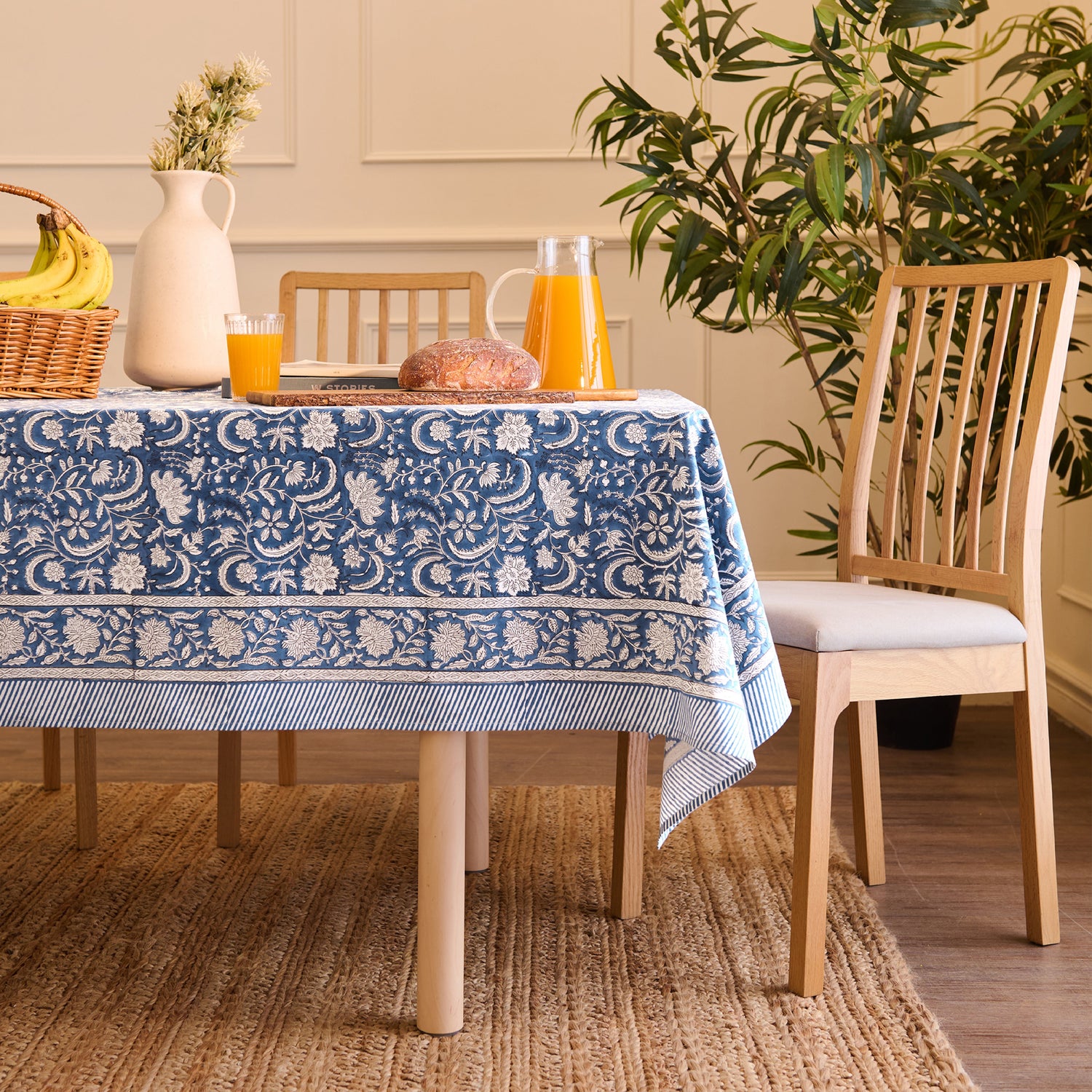
Cover the table if you intend to keep it. A washable cotton cloth, or placemats if you would rather see the wood, takes the water rings, heat marks and haldi splashes that would otherwise go into the finish, and it leaves for the machine when it has had enough. The trade-off is real: cotton creases, and you will occasionally have to iron it.
Most writing about table linen treats the cloth as decoration. Read what people say about their own dining tables and the order reverses: protection first, styling second. Six reasons, starting with the damage that cannot be undone.
1. Water rings sink into the finish, and they do not wipe off
A photograph of a wooden dining table covered edge to edge in white cup rings drew more than a thousand comments on r/CleaningTips, most of them some version of "what uncouth, coasterless heathens were sitting at this table?" One reply explained the anger: the marks appear because moisture gets under the topcoat, so the repair is not cleaning but sanding the surface back and refinishing it.
The ring is damage inside the finish rather than dirt on top of it, so everything sold in a bottle is working on the wrong layer. Coasters help in the circle where the glass lands, and nowhere else: not the condensation puddle spreading past the rim, not the jug set down mid-pour. One commenter's joke prescription was "a tablecloth of denial. Surprisingly effective". If a ring is already there, our guide to white marks on a wood table covers what actually lifts it, and when it will not.
2. On a table you cannot replace, the cloth is the cheap part

The tables people bother to protect are the ones they cannot casually replace, the inherited one or the one that cost more than everything else in the room. In a 359-comment thread on tablecloths and placemats, the most-agreed reply was "tablecloth during a special occasion but normally placemats to protect the wood table", and one commenter whose table was hand-built as a wedding gift credited nineteen years of daily placemats for it still looking new.
What is left to decide is how much wood you want to look at. If you chose the table for its grain, a full cloth defeats the purpose, and mats are the honest middle: they cover where a plate and a hot dish touch down, and leave the rest on show. A pack of six cotton rib placemats dresses a six-seater, at 48 x 32 cm each, enough for a plate and a glass without crowding. They use a 12-ply cotton yarn, finer than the standard four or five-ply rib, and they machine wash, which matters: a mat you are reluctant to wash stops being used. If a full cloth feels like too much, the placemat range is where to start.
3. Cotton creases, which is the honest cost of a cotton tablecloth for a dining table

It is a fair objection, and the ranking behind it is not flattering. Stallholders swapping tips on keeping their cloths presentable sorted the fabrics without sentiment: wrinkles set into cotton and linen very easily and need higher heat to come out, while polyester resists them. We sell cotton, so read that as true of ours.
The reason sits in the fibre. Cotton is cellulose, and its bonds re-form in whatever shape the fibre holds as it dries, so creases are set by drying rather than by use, and the moment to intervene is the wash. Pull the cloth out still heavy with water, spread it on the table, square it up and let it dry there. Most of the crease never forms, and what survives needs pressing only where it shows. Anyone ironing a big cloth on a normal board knows the other defeat, the ironed half slithering onto the floor to be creased again; that thread's workaround is to use a bed instead. Pattern covers the rest, and several commenters had given up ironing for prints and dark colours, since a busy motif absorbs a crease a flat white panel would broadcast.
The Jaipuri hand block print cloth is that sort of cloth: 100% cotton, block-printed by hand by artisans in Jaipur, in a floral vine motif forgiving of an unironed Tuesday. It comes in four sizes.
Which one depends on the drop, how far the cloth hangs below the table edge: 20 to 30 cm each side is the everyday range.
| Table | Typical top size | Cloth size | Drop each side |
|---|---|---|---|
| 4-seater, square or round | 90 to 100 cm across | 60 x 60 in (152 x 152 cm) | 26 to 31 cm |
| 4-seater rectangular, or a compact 6 | up to 135 x 90 cm | 72 x 56 in (183 x 142 cm) | about 25 cm |
| 6-seater | up to 180 x 100 cm | 90 x 60 in (229 x 152 cm) | about 25 cm |
| 8-seater | up to 225 x 100 cm | 108 x 60 in (274 x 152 cm) | about 25 cm |
Measure your own top rather than trusting the seat count, since one maker's six-seater runs a good 20 cm longer than another's, and if you fall between two rows, size up.
4. A cloth takes the haldi stain so the table does not
There is an entire genre of Indian cleaning question that opens with turmeric. One r/CleaningTips post describes a kitchen laminate "catching every haldi splatter and oil mark", with dish soap and kitchen-safe chemicals tried and "the yellow tinge just won't fully go". The poster was "scared to use anything harsh and ruin the finish". That fear is the trap: on a fixed surface, the next thing you could try might wreck the finish, so you stop and live with the tinge.
Cloth changes the shape of the problem: the stained thing detaches and goes to the sink, where you can afford to be patient. The rule, from a thread on a stained linen tablecloth: wash cold first, always cold for food stains, and only go hotter once the mark has gone, because heat locks in whatever is left. The dryer counts as heat.
Napkins take the first hit, which is why their wash rating is not a detail. The cotton table napkins are mercerised and dyed colour-fast to a 30 degree machine wash, exactly the wash food stains need. They come at 180 gsm, in 43 x 43 cm for meals with gravy involved and 23 x 23 cm for tea and snacks.
5. A glass or granite top means scrubbing three times a day, or one wash a week
Hard tops were supposed to be the low-maintenance choice. A parent of small children put the counter-case on r/CleaningTips, asking whether to give up a glass dining table for cotton cloths, with yoghurt and chicken fat landing on it several times a day. One reply summed it up: "far easier to toss a couple tablecloths in the washer than scrub a table down 3 times a day."
Glass makes it worse by being honest: every smear and dried droplet catches the light, so the surface only cycles between wiped and needing wiping. Fabric collects the same mess and leaves with it.
That word "couple" is doing real work. One cloth means the table sits bare on wash day, which is reliably the day something gets spilled on it. Two in rotation is what survives a house with children in it, and it is not a large outlay: cotton tablecloths run from about ₹1,000 for the square to just under ₹2,000 for the 108 inch.
6. Napkins and a runner do the same job for a fraction of the effort

Cloth napkins have quietly stopped being a hosting thing. In that same tablecloth thread, one of the most upvoted replies was "we just use the cloth napkins for everyday napkins now. They work better, anyway." Another described the layering habit that runs alongside it, a runner with placemats on top.
Damage concentrates in the middle third of a table, where the serving dishes go and the pan arrives from the stove. A runner covers that strip and nothing else, so it is a quarter of the fabric to wash, and a ribbed weave has enough texture of its own that it never has to look pressed. The cotton striped runner is 32 cm wide at every length, in lengths from 150 cm to 264 cm; the runner collection carries the rest.
Do the sums as a layer rather than a purchase: runners between about ₹370 and ₹700, six placemats about ₹690, twelve napkins ₹800 to ₹1,000, a full cloth ₹1,000 to ₹2,000. All four together still cost a fraction of the table, and unlike the table, each piece is meant to be replaced.
Where you start depends on the table in front of you. Wood you are proud of: placemats now, a cloth for the days food goes out family style. Glass or laminate: a full cloth plus a spare. Covered already and tired of how it looks: a runner, or cotton napkins in a colour that argues with your crockery.
Frequently asked questions
What size tablecloth fits a six-seater dining table?
Add about 50 cm to each dimension of the table top, which gives a drop of roughly 25 cm all round. A 180 x 90 cm six-seater therefore wants something near 230 x 140 cm, which a 90 x 60 inch cloth covers. Measure rather than trusting the seat count.
Is cotton or polyester better for a dining tablecloth?
Polyester creases less and dries faster. Cotton absorbs a spill instead of letting it run off the edge, and takes a hot dish more calmly. If ironing is the chore you will never do, polyester is the pragmatic answer, or cotton in a print that hides a crease.
How do you stop a turmeric stain setting into table linen?
Reach it while wet and keep everything cold. Rinse from the reverse side under a cold tap, so the stain is pushed back out of the weave rather than through it, then machine wash cold. Keep it out of the dryer until the mark has gone, because heat fixes whatever is left.
Can a square tablecloth work on a round table?
Yes, and it is often the practical answer, since round cloths are hard to find, a frustration that surfaces regularly in tablecloth threads. A square cloth hangs longer at the corners than at the sides, which reads as chosen rather than mistaken as long as the corners clear the seats. A 152 cm square suits a round top of 90 to 100 cm.
Encasa XO is our own brand, and the table linen named above is ours.

Leave a comment
This site is protected by hCaptcha and the hCaptcha Privacy Policy and Terms of Service apply.