
Most napkin fold guides quietly assume you own a large, stiff, hotel-style napkin and a can of spray starch. Then you try the same fold on the soft cotton napkin actually sitting in your drawer, and it slumps the moment a plate lands next to it. The fold did not fail because you lack the knack. It failed because the cloth could not hold the crease you asked it to.
So here is the short answer before the steps. Pick the fold to suit the napkin you have, not the other way round. Flat and tucked folds (a plain rectangle, a roll, a pocket) hold on almost any cotton napkin, including a normal 43x43 cm one, and they survive a real meal. Standing and sculpted folds (a fan, a lotus) need more cloth and more body, and they are best set right before guests sit down. Get that match right and the folding itself takes seconds.
Why a folded napkin matters at an Indian table
A napkin does ordinary work at every meal: it catches the drip off a katori, wipes chutney off fingers, sits on a lap through a long Sunday lunch. A fold is the difference between it looking considered and looking like it was thrown down in a hurry. For most days a clean flat fold under the fork is plenty; it is the occasions that earn more, a Diwali thali for the family, a wedding-season buffet, a small dinner you want to feel finished. None of that needs skill you lack, only the right fold on a napkin that can take it.
One honest note on the phrase "restaurant style," since it appears on every guide including this one. It describes a look, an upright or crisply pressed napkin of the kind you see plated in a nicer restaurant. It is not a standard anyone certifies, and the folds below are the common ones passed around, not a formal trade specification.
The basics of napkin folding: size, weight, and a firm crease
Three things decide whether a fold holds, and only the last is fully in your hands. The first is how much cloth you have. A 43x43 cm napkin (about 17 inches, a common everyday size) completes every flat and tucked fold comfortably, while the tall display folds, a standing fan or a full lotus, want a larger 45 to 50 cm square, because folding eats length fast and a small napkin runs out of height.
Then there is the body of the fabric, usually quoted as GSM. Lighter cloth around 140 to 180 GSM drapes and rolls nicely but will not stand on its own; heavier or well-pressed cloth holds a sharp edge and can stand up. Encasa's cotton napkins sit at 180 GSM, a medium weight that makes a useful reference point, firm enough to take a clean crease for the flat and tucked folds, soft enough that a standing sculpture needs a good press or a little starch first. Treat these as rules of thumb rather than hard limits, since plenty of folds work outside them.
The crease is the part you control, and it is the whole game. Run a hot iron along each fold as you make it and the napkin remembers the shape; skip the iron and even good cloth relaxes back toward flat.
If you want the plain version as a lookup, here it is.
| Fold | Works on 43x43 cm? | Body it likes | Holds through a meal? |
|---|---|---|---|
| Book / rectangle | Yes | Any, incl. 180 GSM | Yes, sits flat under cutlery |
| Simple roll | Yes | Light to medium | Yes |
| Yes | Medium (180 GSM good) | Yes, holds cutlery or a card | |
| Envelope / diamond | Yes | Medium | Yes |
| Upright triangle | Yes, larger is easier | Medium, pressed | Mostly, leans if knocked |
| Bishop's hat | Workable, 45 cm+ easier | Medium to heavy, pressed | Mostly |
| Standing fan | 45 cm+ | Heavier or starched | No, collapses when handled |
| Lotus / water lily | 45 to 50 cm | Heavier or starched | No, a few-minute display |
What you need before you start

Not much. A clean, dry napkin and a hot iron cover most of it. Cotton is the easy material to fold because it takes a crease and keeps it. Very shiny polyester tends to slide against itself and shrug the fold off, so if a fold keeps opening on you, the fabric may be the reason rather than your hands. If you are buying a set mainly to fold and set nicely, a plain cotton square is the safer pick, which is why the white cotton napkins at 180 GSM and 43x43 cm make a sensible default: enough body for a crisp edge, in a pack of twelve that dresses a full table in one colour. If you seat four or six rather than twelve, the wider table napkins range has smaller packs and other colours.
Ironing deserves a word in Indian weather. Humidity works against you: cotton reabsorbs moisture from the air, so a crease that looked sharp an hour ago softens as it does. The fix is timing, not force. Press the napkins close to when you will lay the table, iron each fold while the cloth is warm, and let it cool flat under a light weight for a minute if you can. A very light spray starch helps the standing folds; for everyday flat folds a hot dry iron is enough.
If you have no napkin rings, you do not need them, since the tucked folds below hold themselves. When you do want the ring look, a loop of jute twine, a ribbon, or a sprig of curry leaf or a single marigold through a rolled napkin does the same job, and suits a festive table better than a plain metal ring anyway.
Three everyday folds that hold through dinner
These are the workhorses. All three sit flat or tuck into themselves, so a plate, a hand, or a passing elbow will not undo them.
Start with the book fold when the table is big and the clock is against you. Fold the napkin in half, then in half again into a neat square or rectangle, press it, and lay it under the fork. It vanishes into a tidy setting and never comes undone, so it carries a crowded Sunday lunch without a second thought.
Rolling is the move for a relaxed table, and it takes to decoration. Fold the napkin into a long rectangle, roll it up firmly, then lay it across the plate or slip a twine loop, a ribbon, or a flower around the middle. Rolled tight it holds for hours, which makes it the one to do ahead while you are still cooking.
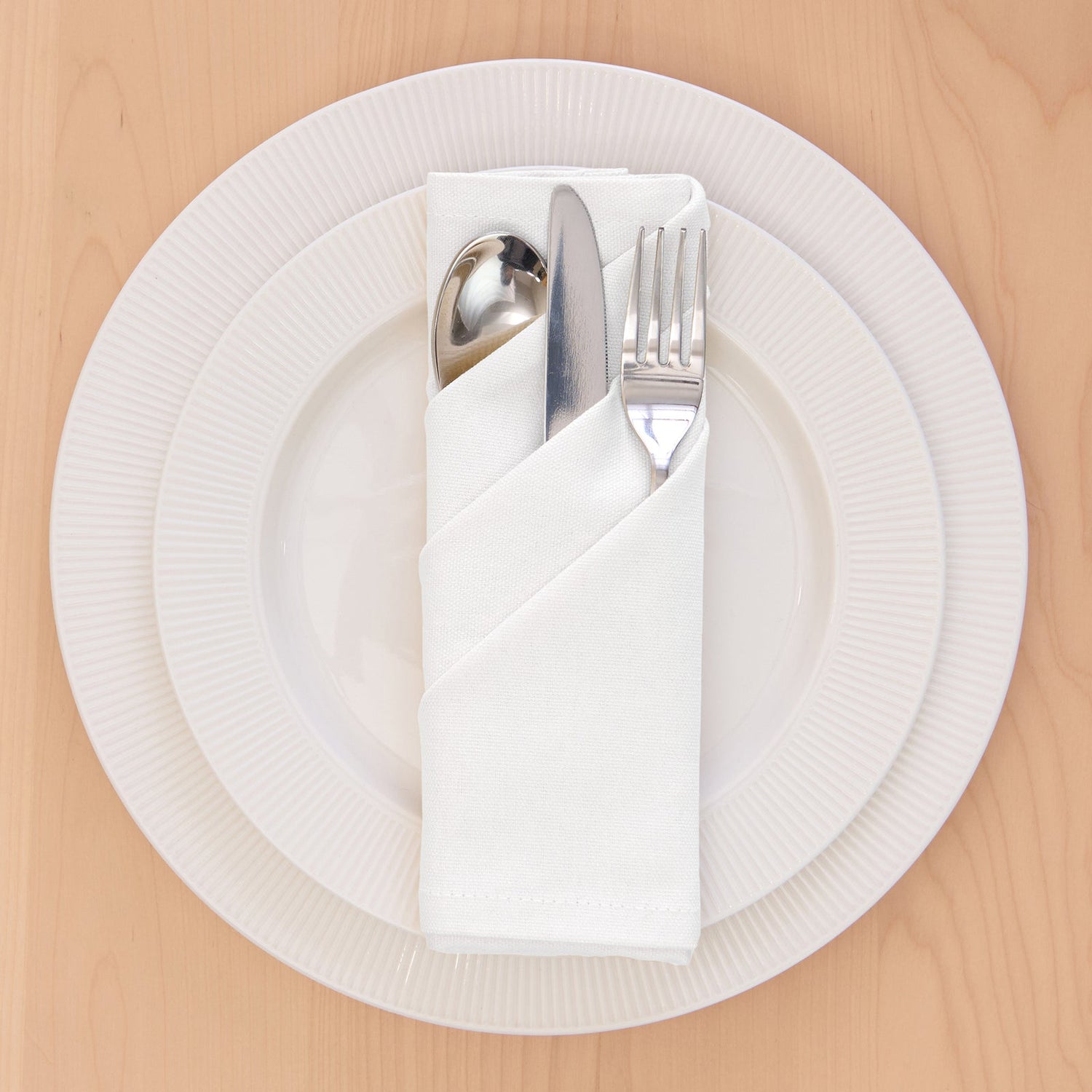
The pocket earns its extra steps by doing a job: a small square with a slot that keeps each guest's fork and spoon together, or holds a place card. At 180 GSM it is usually firm enough to keep the pocket open rather than sagging shut. Follow the four steps above.
Three restaurant-style folds for guests
These read as more formal, and as long as you press each crease they stay put instead of leaning over or slumping into the plate.
The upright triangle is the classic plate fold. Fold the napkin into a triangle, bring the two base points up to meet the top point, turn it over, then fold the sides back and stand it on the plate. It leans a little if someone knocks the table, but a firm press keeps it upright through the meal.
The envelope, sometimes called the diamond, stays flat and looks deliberate. Fold to a square, turn it so a corner points at you, then fold each loose layer up in turn to make stepped diagonal bands across the front. Slip a menu, a name card, or a flower stem into the top band. Because it lies flat it holds indefinitely, so it is a good choice for a buffet where napkins wait on the table before anyone arrives.
The fan is the show-off of the group, and it comes with a caveat. Pleat the napkin into an accordion, fold it in half with the pleats facing out, and stand it so it spreads. It looks striking, but it is a display fold rather than a working one. It needs a larger or starched napkin to stand at all, and it usually collapses once a guest handles it, so set it in the last few minutes before people sit, not an hour ahead.
Two folds for a festive table
When the table is the event, a Diwali thali or a wedding lunch, two folds earn the extra effort. Both want a crisper, well-pressed napkin, so this is where a firm iron and a heavier cloth pay off.

The lotus, or water lily, is the festive centrepiece, folded to sit in the middle of a thali or hold a bread roll. Fold all four corners of the open napkin into the centre, turn it over, fold the new corners in again, then reach under each corner and pull the flaps out to open the petals. It is genuinely a photo fold, striking for the moment guests sit and quick to lose its shape, so make it last and make it on a well-pressed napkin. The deep red cotton napkins suit it: the hemstitched, mitered-corner edges give the petals a defined line to open along, and the deep colour reads richer against a festive spread than a thin, pale cloth.
The bishop's hat looks elaborate and is steadier than it appears. Fold the napkin into a triangle, bring the two base corners up to the apex, flip it, fold the bottom point up and tuck one side into the other so it stands in a ring. Pressed firmly it holds through most of a meal, which makes it the more practical of the two festive folds. A runner under the folded napkins often does more for the look than the fold itself, especially on a bare or glossy dining table where the setting has nothing to sit against; the mistake to avoid is a busy runner that fights the napkins for attention, so keep it plain when the fold is meant to be the feature. Encasa's table runners come in the same cotton as the napkins if you want them to match rather than clash.
When a fold won't hold: quick fixes
If a fold keeps opening, press a firmer crease first; if it still will not behave, switch to a tucked fold like the pocket or envelope that locks into itself instead of relying on the cloth to stand.
If the napkin feels too small for the fold you want, choose a flat fold instead of fighting it. Standing folds need length, and forcing a 43 cm napkin into a tall fan just gives you a short, sad one.
If there is no iron to hand, lean on the roll, the fold that forgives a soft, uncreased napkin. A tight roll with a twine tie looks intentional even on cloth straight out of the drawer.
FAQ
Can I fold napkins ahead of time?
Flat and tucked folds, yes. A book fold, a roll, or a pocket will sit happily for a few hours, so you can set the table well before guests arrive. Standing and sculpted folds, a fan or a lotus, lose their shape as they relax, so leave those for the last few minutes.
What size napkin should I buy for folding?
A 43x43 cm square (about 17 inches) handles nearly every fold in this guide and is the standard everyday size. Only reach for a larger 45 to 50 cm napkin if you specifically want the tall standing display folds, which need the extra length to stand up. Our table napkin size guide lists the dinner and cocktail sizes in cm and inches, and how many to buy for a four or six-seater table.
Do napkins need to be starched to fold well?
Not for the everyday flat and tucked folds, which hold on plain pressed cotton. A light spray starch only helps the standing folds, the fan and the lotus, where you are asking the fabric to keep its own shape in the air rather than lie flat.
Is cotton or polyester better for folding?
Cotton takes a crease and keeps it, which is what a fold relies on. Very shiny polyester tends to slide against itself and let the fold slip, so if you fold often, a plain cotton napkin is the more forgiving choice.

Leave a comment
This site is protected by hCaptcha and the hCaptcha Privacy Policy and Terms of Service apply.