
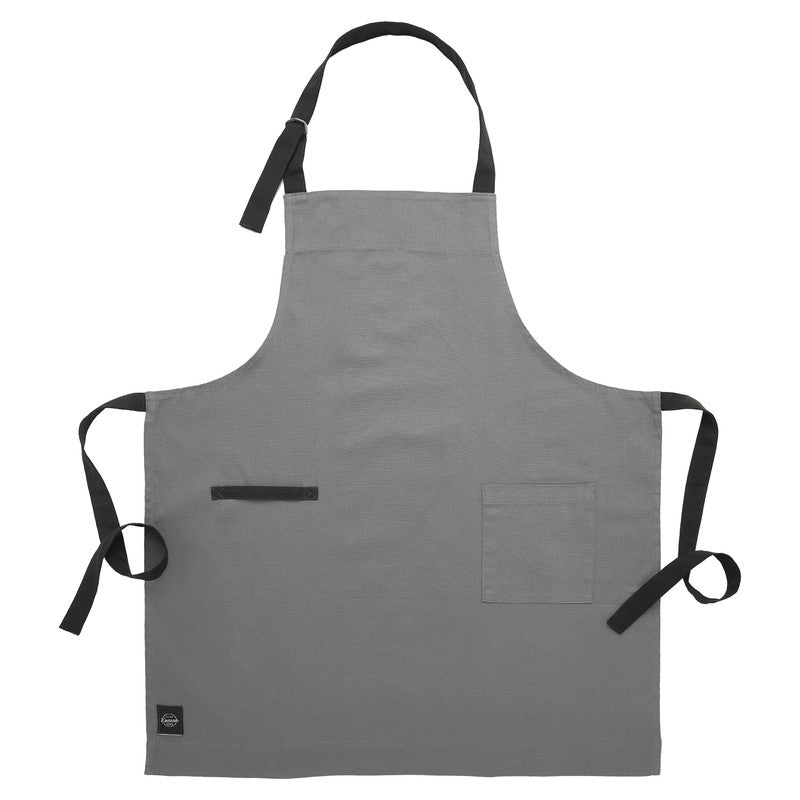
An apron does not fail because of the oil. It fails because of what happens after the oil, when a turmeric-stained splash gets forty minutes in a warm kitchen before anyone gets round to washing it. By then the damage is already done, and no amount of scrubbing on laundry day will undo it.
The apron that holds up to Indian cooking is heavy, tightly woven cotton, because that is what stops hot oil at the surface instead of letting it soak through. But fabric only wins half the fight. The other half is what you do in the first ten minutes after a splash lands, and that part has nothing to do with which apron you bought.
What actually happens when hot oil hits the fabric
A tadka splutters because water in the spices flashes to steam the instant it hits hot oil, and that tiny explosion throws droplets well past the pan. Deep-frying does the same thing on a larger scale. Those droplets are hot and carry oil, and what happens next depends entirely on the weave underneath.
On a thin or loosely woven fabric, the droplet finds gaps between the yarns and pushes through them while it is still hot and low-viscosity. It reaches the fabric behind, and sometimes your skin, before it has time to cool and thicken. On a dense weave, over roughly 200 gsm, the yarns sit close enough that the droplet has nowhere obvious to go. It cools on the surface, thickens, and sits there as a bead you can wipe or blot off rather than a stain that has already travelled through.
This is a purely physical block, not a chemical one, which is why weight and weave density matter more here than any stain-resistant coating. A thick fabric with a loose, open weave still lets oil through; a firm, close weave does the blocking even at a moderate weight.
Why turmeric and masala outlast the oil that carried them
Plain oil is the easier problem. It sits on the surface of a tight weave and a dish-soap pretreat lifts most of it before a wash ever happens. Turmeric is a different kind of attack.
The colour in turmeric comes from curcumin, a pigment that is fat-soluble rather than water-soluble. That single fact explains most of what makes haldi stains stubborn: curcumin dissolves readily into oil and travels wherever the oil goes, including into the fibres of a fabric the oil has managed to penetrate. A dry sprinkle of turmeric powder brushes off a cotton apron with barely a mark. The same turmeric riding along in a splash of hot ghee or oil, the kind a tadka or a bhuna throws off, ends up carried past the surface and bonded into the fibre before you have even noticed the splash.
That is the real reason a chana masala or dal tadka splatter is worse than either an oil splash or a dry turmeric spill on its own: the oil does the carrying, and the turmeric is what stays behind once the oil itself has washed out. Red chilli powder behaves the same way, riding in on oil and left clinging to the fibre after.

The first ten minutes decide the stain, not the wash
Waiting for laundry day is the single biggest reason turmeric stains become permanent. Curcumin needs time and warmth to bond fully into cotton fibre, so the window right after a splash is when you have the best chance of stopping it, not the wash cycle three days later.
| Splash type | Do straight away | Skip this | Why |
|---|---|---|---|
| Plain hot oil | Blot, don't rub; work a little dish soap into the spot | Hot water immediately | Dish soap is built to break oil's grip; rubbing just spreads it wider before it has cooled |
| Turmeric or masala powder (dry) | Shake or brush it off outdoors | Wiping with a damp cloth | A damp cloth turns loose powder into a paste and pushes the pigment in |
| Turmeric or masala in oil (a splutter or curry splash) | Cold-water rinse from the back of the fabric first, then dish soap on the oil | Hot water or direct sun before rinsing | Hot water can set the pigment further in; cold water flushes the carrier oil out before curcumin gets a chance to bond |
Once the fresh treatment is done and the mark has actually gone, an ordinary hot wash on the fabric's care label finishes the job. Check before you put it through, though: if a shadow is still there, treat it again first, because heat on a stain that has not fully lifted sets whatever is left of it. Sun-drying afterwards helps too, and it is not an old wives' tale: curcumin is genuinely light-sensitive and fades under UV exposure, which is the real chemistry behind hanging a stained apron out in full sun rather than the shade.
Which apron for cooking takes a hard wash best?
Heavy cotton is not only better armour against splashes, it is also the more forgiving fabric to wash hard. A dense, tightly woven cotton like the cotton grey apron takes a repeated hot wash and a firm scrub at a stain without the weave loosening or the colour lifting, which matters if turmeric is going to be a weekly visitor.
Cotton chambray, the lighter weave behind aprons like the cotton blue apron, washes more gently. It is thinner to begin with, so a hot wash and hard scrubbing wear it faster, and its dye can shift a shade over many washes in a way heavy cotton mostly doesn't. That is not a reason to avoid chambray. It is a reason to reserve it for the cooking that does not throw much at it, kneading dough or plating up, and to keep the heavy-cotton apron for the days tadka and deep-frying are on the menu. If you haven't settled on which shape and length actually covers you best, the full buying guide walks through coverage and gsm in one place; this piece assumes you have already got an apron and is about keeping it wearable.
Coverage that matters when you're standing over a hot kadai
Most of the coverage conversation stops at chest-to-knee, and that is the right call for the torso. It leaves out the forearms, and forearms are exactly where oil lands when you are stirring or turning something in a kadai at elbow height.
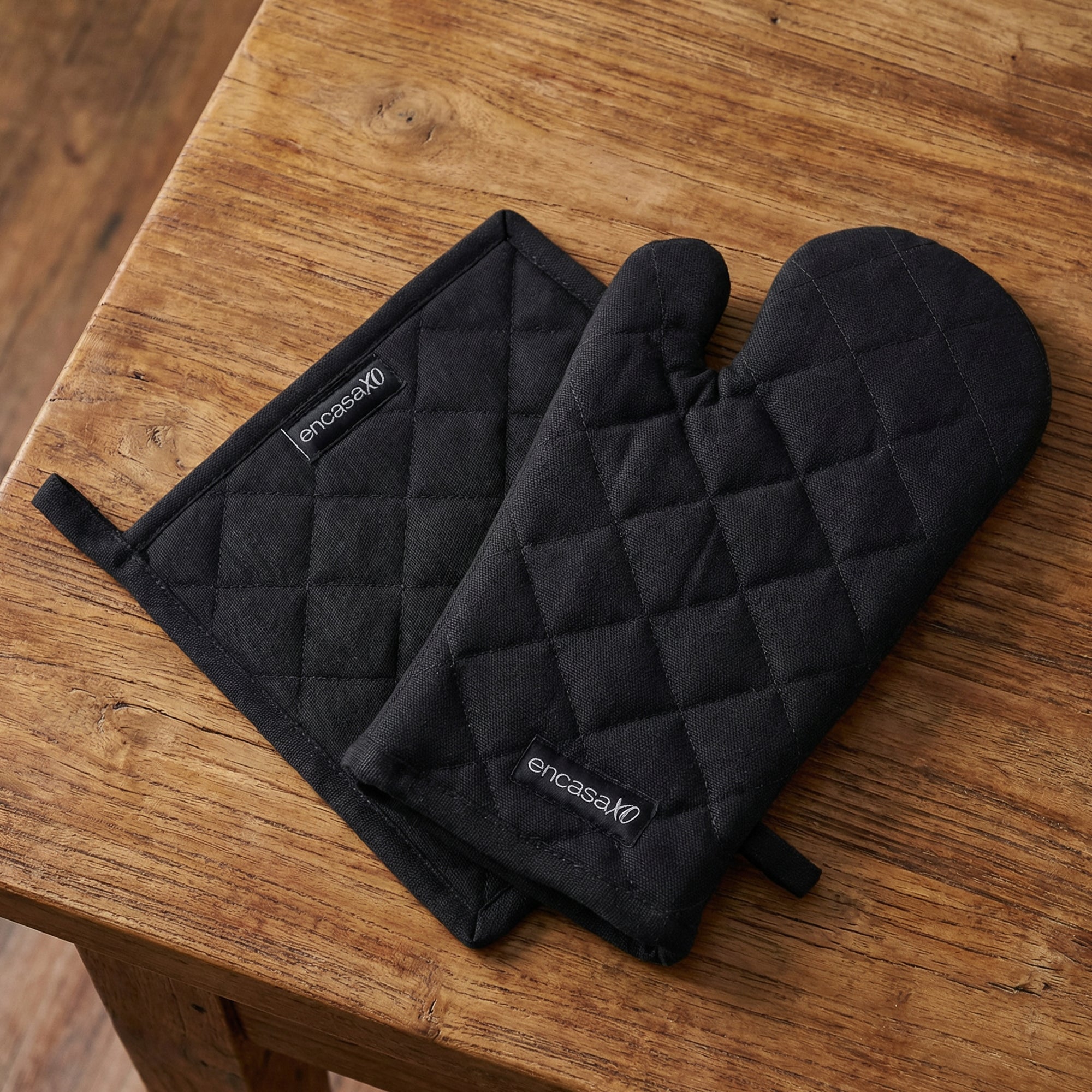
An apron alone cannot solve this; no bib apron in the catalogue has sleeves, and it shouldn't, because sleeves would trap heat over a long cook. The practical fix is smaller than a garment change: roll sleeves up past the danger zone rather than down into it, and treat a quilted oven glove as part of the same kit rather than a separate purchase, since it covers the hand and lower forearm an apron never reaches. The oven gloves are worth keeping by the stove for exactly this, not just for lifting a hot handle.

The towel loop matters here for a different reason than the obvious one. The first ten minutes only work if something dry is already within arm's reach; if you have to go and hunt for a cloth, the splash has had its head start before you have touched it. A kitchen towel hanging where your hand already goes is what turns blotting into something you do immediately rather than something you get round to.
FAQ
Does hot water set a turmeric stain?
It can, if the stain hasn't been rinsed first. Curcumin bonds more readily to cotton with heat and time, so running hot water over a fresh splash before any cold rinse or soap risks locking the pigment in rather than lifting it. Cold water first, hot wash after, is the safer order.
Should oil and turmeric stains be treated the same way?
No. A plain oil splash responds to dish soap worked in directly, because soap is what breaks oil's grip. A turmeric or masala splash needs a cold rinse first to flush out the oil carrying the pigment, and only then a soap treatment on what's left. Treating a combined splash like a plain oil stain, straight to soap with no rinse, leaves the pigment more time to bond.
How often should a daily cooking apron be washed?
Every two to three days of regular tadka-and-frying cooking is reasonable, sooner if there is a visible stain to treat. Waiting a full week lets minor splashes accumulate and gives any turmeric that landed unnoticed far longer to set than the first ten minutes it actually needed attention.
Can a heavy cotton apron go in the wash with other clothes?
Yes, once any spot treatment is done first. A colourfast heavy cotton apron in a normal hot wash with similar fabrics is fine. What causes trouble is skipping the pretreat and hoping a standard wash cycle will lift a two-day-old turmeric stain on its own; by then the cycle is cleaning around the mark, not out of it.

Leave a comment
This site is protected by hCaptcha and the hCaptcha Privacy Policy and Terms of Service apply.