
You soaked it in bleach. The smell sat in your eyes for an hour, and when the curtain went back on the rail the black speckles along the bottom were still there, except now the fabric had a yellow cast to it. Somebody posted that exact result on r/CleaningTips and got 432 upvotes and 85 replies. One of the most-upvoted answers, at 348, explained it in four words: bleach turns polyester yellow.
Here is the short version. Mould does not eat your shower curtain. It eats the film of soap, shampoo and skin oil that runs down the curtain and settles in the bottom few inches, and it only needs that film to stay wet long enough to get started. The hem is where the water arrives last and leaves last. So the hem goes first, every time, whatever the curtain cost.
Why shower curtain mould starts at the hem
Think about where the water goes. It runs down the face of the curtain carrying the soap you rinsed off, the conditioner, the oil off your skin. All of it collects in the lowest stretch of fabric, which is also the stretch that touches the wet tub wall or the wet tiles, and the stretch that ends up bunched into folds when you push the curtain aside and walk out. The food and the water land in one place, and that place then stays shut against something wet for hours. Mould is not fussy about the surface it grows on. Polyester and vinyl are not food. The film sitting on them is.
That is why the misdiagnosis is so common. Most people looking at a black hem land on one of two explanations: the curtain was cheap rubbish, or they have not been cleaning enough. The second is half right, since washing does strip the film. The first sends you shopping for a better curtain while you carry the same habit across to it, and three months later you are looking at the same line in a nicer colour.
Not everything down there is mould, either.
| What you see | What it actually is | What changes it |
|---|---|---|
| Black speckles along the bottom edge and in the seams | Mould, growing in the soap and oil film that collected there | Drying the hem out, and washing before the film builds |
| Pink or orange slime near the floor or in the folds | A bacterium, not a fungus. On cleaning forums the correction that the pink is Serratia marcescens draws 118 upvotes | An ordinary wash. It lifts far more easily than mould does |
| A dull, cloudy band across the lower third | Mineral film from hard water, mixed with soap | A wash. It is not growth and it will not spread |
| A yellow cast that appeared after bleaching | Bleach reacting with the polyester itself | Nothing. That one does not come back out |
Why the bleach did not work
On a light pink bloom caught early, bleach often does the job. On black mould that has sat in a hem for months it does something less useful: it takes the colour out of the stain without taking the growth out of the fabric. Further down that same yellowed-curtain thread, one reply said mould cannot be bleached out of fabric at all, and that they had bleached cloth until it fell apart with the spots still visible on the pieces that survived.
Machine washing with a couple of towels for scrubbing action works better, and in those threads it is the method reported as working most often. It is not risk-free: one poster in a thread of 148 replies described their curtain coming out of the drum shredded.
None of it touches the reason the hem went black. These methods remove growth that has already happened, and the condition that produced it is still in your bathroom.
This week it is a smell you notice when you open the door. This month it is a second bottle of bathroom cleaner and a Sunday afternoon spent scrubbing a curtain back to almost-white. By the end of the year you have bought two replacement curtains, and the black line has come back along the hem of both, in the same place, for the same reason.
If your bathroom has a window you leave open and the curtain is dry by lunchtime, none of this is your problem. Buy on looks.
What actually changes the outcome

Everything that helps works on one variable: how many hours a day the bottom of that curtain spends wet.
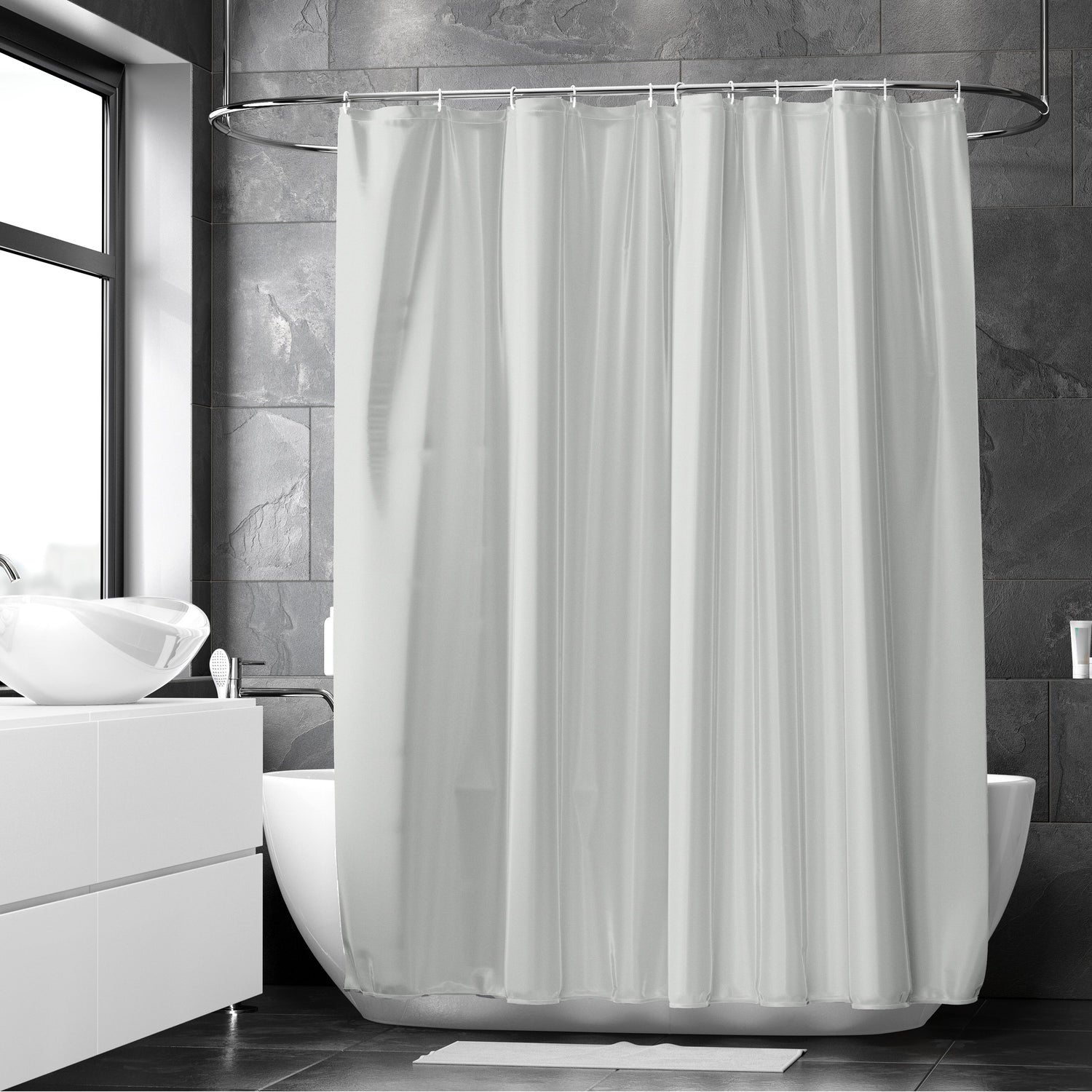
The first lever is the fabric. A water-repellent woven polyester sheds most of what hits it and gives the film less to key into than a soft, absorbent face does. Ours are woven polyester with a water-repellent finish, and the heavier weaves like the striped grey hang with enough weight to fall straight, which means fewer folds for water to hide in. Parts of the range are finished to resist mildew as well. That slows colonisation down. It does not make a curtain immune, and no curtain on the market is.
The second lever is length, and it is the one almost nobody thinks about. A curtain that is too long cannot hang straight down. It reaches the floor or the base of the tub, folds over, and sits in the water instead of above it, which turns the hem into a wet compress for hours. Our plain polyester range comes in three lengths off the same 142 cm width, at 183 cm, 213 cm and 244 cm, so you can pick the one that stops short of your floor. All three are machine washable, which is the other half of the job, since the film has to come off periodically however well the curtain dries.
Then there is the habit, which costs nothing at all. Pull the curtain flat across the rail when you leave, instead of shoving it into a bundle at one end. Spread to full width it has air on both sides and dries in a fraction of the time. If the room has an exhaust fan, leave it running ten or fifteen minutes after you are out.
What that looks like on an ordinary Tuesday: you shower, sweep the curtain flat on your way out, and the next time you walk past it the fabric is dry to the touch and the bottom edge is the same colour as the top. Nothing to scrub before guests arrive. Nothing you stand in front of to hide.
Does a better curtain really help?
Partly, and the limits show up clearly in what long-suffering owners tell each other. On a Reddit thread asking for a genuinely mould-proof shower curtain, one of the two most-upvoted answers, at 139, was blunt: nothing is mould-proof, and the only way to stay mould-free is frequent cleaning. Further down the same thread, a reply with 15 upvotes gave the length mechanism almost word for word: a curtain that is too long will not hang straight, so water puddles where the curtain follows the bottom of the tub, and the fix is to trim an inch or two off the hem. Another poster, in a reply that drew only three upvotes, said they had bought a smaller curtain, cut the excess off the bottom and started closing it flat after each use, and their mould problem was gone.
The reverse shows up too. In a thread of 153 replies on the same subreddit, someone described buying good fabric liners, washing them twice a month with towels, and still getting about three months out of each before mould set in. Their bathroom had no fan and the climate was humid. In a sealed bathroom in July, the habit carries most of the load and the curtain carries the rest.
These are mostly American and British threads, where the bathroom has a tub and a separate liner. The mechanism travels to a floor-drain Indian bathroom intact. Whether you need the liner at all is a different question, answered in the guide to shower curtain liners: in most bathrooms here, you do not.
Which length to buy

Measure from the rail down to the floor, then buy the length that lands a few centimetres short of it. For a rail at the usual height over a floor-drain bathroom, that is the 183 cm curtain. With a rail mounted high or from the ceiling, go to 213 cm and check the hem still clears the tub base.
Between two sizes, take the shorter one. A hem that hangs a little high looks slightly odd and costs you nothing; a hem that pools on wet tiles is the thing this article is about. The printed curtains like the sage boho maze come in more than one length for the same reason, and single curtains across the shower curtain range sit under ₹1,000 with hooks included, so the length is a cheap thing to get right.
A faded stain is not a clean curtain

There is a second reason the bleach route is a poor deal, and it is not cosmetic. US workplace safety guidance on mould says a biocide such as chlorine bleach is not recommended as routine practice, and that porous materials with mould growing on them may have to be discarded, because mould gets down into the material rather than sitting on top. It adds the point that usually gets missed: killing the mould is not the end of it, since the proteins that cause a reaction in people are present in dead mould too.
So a hem you have bleached pale is not a hem you have cleaned. It is a hem where the growth is harder to see. In a small room you breathe in twice a day, that distinction is worth something.
The rest of the bathroom matters too, because a curtain dries at the speed the room dries. Water tracked onto the tiles keeps the space humid for hours, and an absorbent mat that holds it and then dries out is doing the curtain a quiet favour. Our curtain and bathmat sets pair a waterproof curtain with a microfibre bathmat and a U-shaped contour mat for around ₹1,500, and the wider bathmat range covers the same job alone.
Against that, the running cost of doing nothing is easy to see. A curtain here costs under ₹1,000. A year of cleaning sprays plus the two curtains you bin anyway comes to more, and the black line is still there at the end of it.
Common questions
Will a new shower curtain just go mouldy as well?
If nothing else changes, yes, on roughly the same timetable. A water-repellent curtain in the right length gives mould a worse surface and less standing water, but the drying decides the outcome. Change the habit in the same week you hang the new curtain, or you are buying the same problem again.
Is it cheaper to buy a plastic sheet and throw it away every few months?
On shelf price, yes. Over a year of replacements it stops being cheaper, and you handle a mouldy plastic sheet three or four times a year to do it. The throwaway approach genuinely wins in a rented flat you are leaving in two months.
Can I put a shower curtain in the washing machine?
Ours are machine washable, and a wash with a few towels in the drum does more than scrubbing by hand, because the towels do the work. Avoid bleach, which yellows polyester permanently, and a hot fast spin, which produces the crumpled finish people complain about. Wash cool, spin gently, hang it back on the rail.
Is a fabric shower curtain not just plastic anyway?
Polyester is a plastic, and it is fair to say so. The difference is what happens to it. A woven polyester curtain goes into the machine and comes back out; a PVC sheet gets thrown away several times a year.
When to stop cleaning and buy a new one
Give it one proper wash with towels, cool, no bleach. If the black comes out, you caught it early and the habit change will keep it out. If the speckles are still in the seams afterwards, they are in the fabric rather than on it, and the third attempt will not go better than the second. The threads quoted above reach the same verdict, and pair it with the same second half. The top reply on one of them, at 1,991 upvotes, told the poster to get a new one and start over, then to wash it regularly so nothing could build up again and to run the bathroom fan after showers.
So bin it. Measure your rail, buy the length that clears your floor from the shower curtain range, and pull the new one flat every time you step out. That last part is what keeps you from doing all of this again next July.
Encasa XO is our own brand, and the shower curtains and bathmats named above are ours.


Leave a comment
This site is protected by hCaptcha and the hCaptcha Privacy Policy and Terms of Service apply.