
Picture four dining chairs re-covered in a pretty, light cotton print. This is how it usually goes wrong: the pattern still looks crisp when the first seat loosens over the foam, and the threads near the front edge start to pull apart where people slide in and out. The print is fine. The cloth under it was not made for that rubbing.
Printed fabric wears well at home when you choose the cloth first, by how much rubbing and washing the piece will get, and then pick a print that hides the marks that use leaves. A busy, mid-tone, all-over print on a sensible cloth will usually outlast a prettier one chosen from a photo alone.
If you came here for kurta or dress material, this guide is not for you. Some of the listings below name dresses among their uses, and one gallery shows a printed dress, but they say little beyond "soft" and give no way to judge how the cloth falls or feels on skin. They are judged here for cushions, tables and chairs. A dress-material shop where you can hold the cloth against yourself will serve you better.
What is printed fabric, and what does the word leave out?
Printed fabric is cloth whose pattern is added after the cloth is made, by block, screen or digital printing. The base can be a plain weave, a twill or something else. So "printed" tells you how the design got there, and nothing about the fibre, the weave or how thick the cloth is.
Two prints can behave very differently: one a light sheeting that drapes over your hand, another a thick layered polyester that holds its folds. On a phone they can look alike. For the fibres themselves, types of fabric in home textiles has the full comparison.
A woven check or stripe works differently. Its colour is in the yarn, so the pattern is the same on both faces and follows the threads. A printed check can sit slightly off the threads, and when it does you have to choose whether to cut straight to the pattern or straight to the cloth. Follow the pattern, because the eye sees that first.
Which prints wear well, and which show every mark?
Start with the ground colour, because it decides which marks you will see. On a dark ground, rubbing tends to show as a paler line along edges and folds, because the threads underneath are lighter than the dye on top. A white ground hides that kind of wear and shows every tea ring instead. So a cushion that gets leaned on all day often looks better for longer on a mid-tone or pale ground, while a table cloth does better with colour covering most of the cloth.
Busyness is next. A dense print with several colours gives a stain nothing clean to stand out against. A few neat shapes on a wide plain ground do the opposite, because the eye goes straight to anything that does not belong.
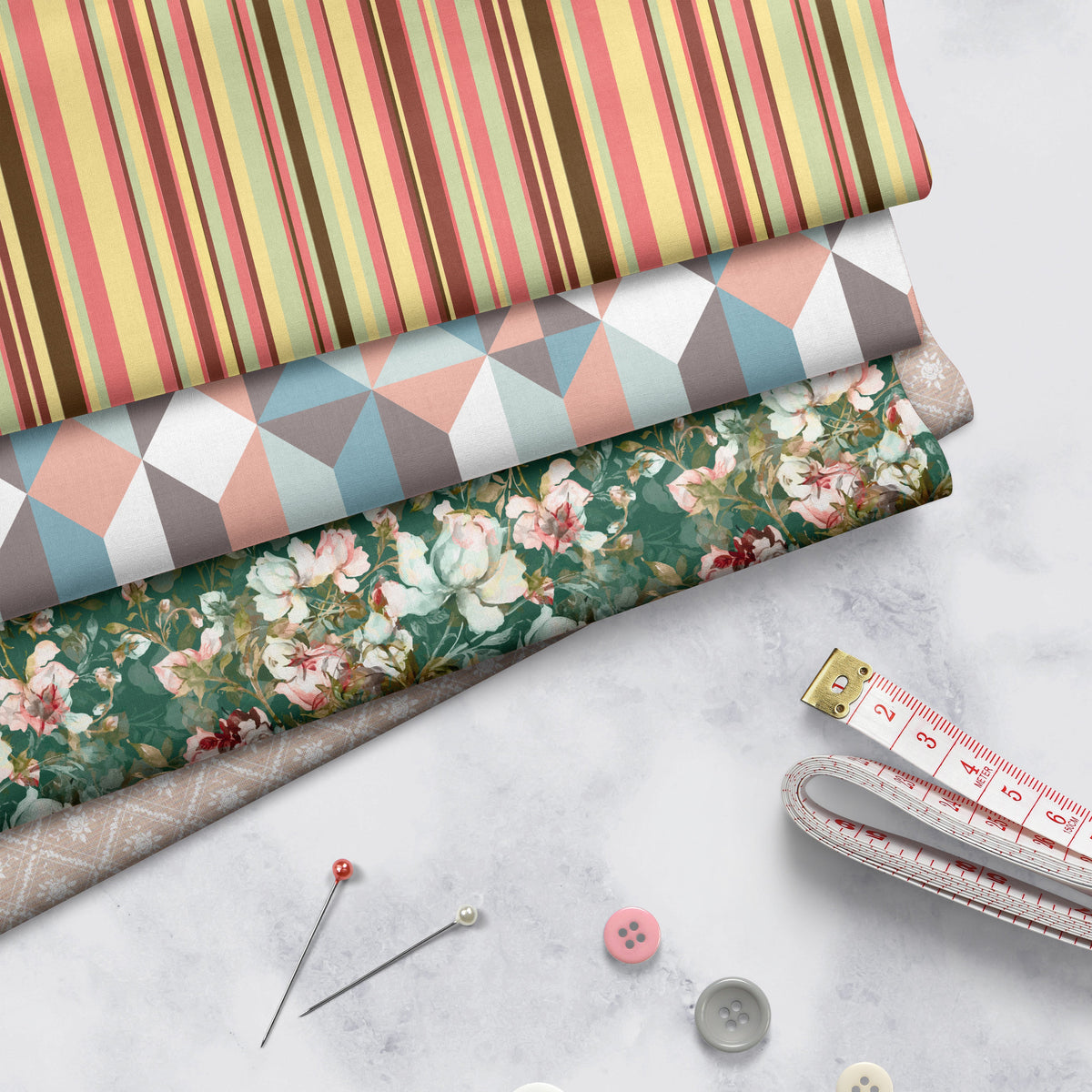
Scale is the one people forget. A motif that looks lovely on a roll can be cut to pieces on a 40 cm cushion, where you may see half a flower and a lot of stem. Many listings include a frame with a tape measure along the edge. Treat it as a rough hint and not a measurement, then measure one motif on your first metre, hold your hands 40 cm apart and picture it.
None of these tells you the weight, and no printed spec card in the range below gives a GSM. So use your hands when the cloth arrives. Hold one layer up to a window: if you can clearly see your fingers through it, it needs a lining or a lighter job. Bunch a corner in your fist for a few seconds: deep creases there mean it will crease on a table too. If you are unsure, test one metre, then order the full amount together and use the test metre for cushion backs, so any colour difference between batches stays out of sight.
One-way prints: why the pattern changes how much cloth you buy

An all-over print looks right from any side: dots, marbling, tossed flowers, half-circles facing every way. A one-way print has a top and a bottom. Palm fronds that all point up are the plain example.
People sit on both sides of a dining table, so a one-way print is upside down for half of them. Use an all-over print there.
On a cushion the direction costs you cloth. Take the Palm Leaves polyester, which is 147 cm wide at ₹349 a metre. A 40 cm envelope cover is commonly cut as one 43 x 43 cm front and two 43 x 32 cm backs. Leave 2 cm clear at each edge of the cloth and you have 143 cm to work with.
If you do not mind where the fronds fall, a pair of covers takes two rows: two fronts and a back in the first, three backs in the second. That is 43 + 32 = 75 cm of length, well inside one metre.
Now say you want both fronts to match. The listing gives no repeat size, so you have to measure it on your own cloth. For the sums only, take a repeat of 32 cm: that is an example figure, not a measure of this print. Two 43 cm fronts cannot sit one repeat apart, so they must sit two repeats apart, 64 cm. That leaves only 36 cm of width beside them, too narrow for an upright back. With every back kept upright, the pair now takes 43 + 32 + 32 = 107 cm. That is 7 cm more than the metre you ordered.
The cheap way out is to turn one back sideways in that 36 cm gap, which brings you back to 75 cm. That back sits against the sofa, where nobody will read the fronds. If the backs will show, buy the second metre.
Which printed fabric for cushions, a table or a chair?

These are the printed cloths in Encasa's range, with widths and prices from the size option on each listing. Each sells as a one metre option, so you raise the quantity to buy more.
| Cloth | Width | One metre | Example print | Where it fits at home |
|---|---|---|---|---|
| Cotton sheeting | 160 cm | ₹349 | Yellow Moon: mustard, olive and grey circles and half-circles on white | Cushions, a table cloth |
| Printed polyester | 147 cm | ₹349 | Palm Leaves: slate and grey fronds on white | Cushions |
| Cotton twill | 150 cm | ₹659 | Green Roses: pink and cream roses on dark green | Cushions in daily use, a lightly used chair |
| Polyester, three layers | 122 cm | ₹459 | Trellis Navy: silver-grey trellis on a navy sheen | Cushions for show |
| Polyester, three layers, grey back | 137 cm | ₹459 | Marble Lime: lime, olive and purple swirls on cream | Cushions |
Cushions give you the widest choice, because a cover is small, comes off for washing and takes less strain than a seat. On a sofa used all day, the twill's busy rose print has the most going for it, at nearly twice the price of the sheeting, though its dark ground is the one to watch along the edges. For a side chair or a spare room, the sheeting is plenty. Best fabric for cushion covers goes further.
The Trellis Navy's card shows a printed front layer, a dense black yarn in the middle and a back layer, and its gallery shows it made up as a cushion. No listing says how that silver line stands up to daily rubbing, so keep it for a cushion that gets looked at more than leaned on. It is also the narrowest here. At 122 cm only two 43 cm pieces fit across, so the same upright pair of covers takes 107 cm, even without matching. Buy two metres, unless the backs can turn sideways, which brings it down to 86 cm.
A chair or sofa is the hard case. The twill's card shows a sofa, though in a different print from the roses, and a twill weave often gives a firmer cloth than a plain weave of similar weight. Still, no printed listing gives a rub figure, so treat it as a cloth for a chair that gets occasional use. For a seat used every day, leave print behind and pick a heavier plain cloth from the fabric by the metre range; the sofa fabric guide compares them and works out the metres.
A printed table cloth, worked out

Take a 150 x 80 cm table and a 25 cm drop on every side, which is the sum from the tablecloth size chart: a 200 x 130 cm cloth. Add a 3 cm folded hem on every edge and you must cut 206 x 136 cm.
Two metres is 6 cm short, so you order three. In the Yellow Moon that is ₹1,047 before stitching. Cotton can shrink 3 to 5 percent, so wash it first. Three metres then comes down to 285 to 291 cm, which leaves about 80 cm after the cloth is cut. That is enough for a matching pair of cushion covers. Those half-circles face every way, so the table works from both sides. The white ground will show tea, so this one suits a family happy to wash it often.
Order all three metres together and check the piece comes uncut, because a join across a table is hard to hide.
The same three metres in the Green Roses twill is ₹1,977, and that changes the decision. A hemmed hand block print cotton cloth at 72 x 56 inches (183 x 142 cm) costs ₹1,319, which is ₹658 less, with no tailor to pay. On this table it hangs about 16 cm at the ends and 31 cm at the sides, so measure before you settle on it. If your table fits a trade size, start with ready-made table cloths. Buy printed cloth for a table when the size is odd, or when you want the cushions to match.
Does printed fabric fade or bleed in the wash?
Any print can lose colour. How fast depends on the dye, the fibre, your water and the sun, and a listing cannot settle that for your home. The sheeting, polyester and twill listings say hand or machine wash, and the first two add that dark colours go separately. So test first.
Rub a damp white cloth firmly on an offcut, then look at the cloth in daylight. Any colour on it means loose dye, so the first wash goes alone. That test only checks the surface; colour bleeding in the wash adds a soak test and what to do next. A dark ground like the Green Roses needs this most. Turn covers inside out before washing, so the printed face rubs less against the drum, and dry them in shade.
Sun is the harder test, and the window is where any print gets the most of it. Curtains are their own subject: blackout or sheer curtains starts that decision.
Common questions
What GSM should printed fabric be?
There is no single right number, and the printed lines here show none on their spec cards, so judge by use and by hand. For what the figure means when a listing does state one, see the GSM guide.
How much printed fabric do I need for two cushion covers?
A pair of 40 cm covers usually fits in one metre when the cloth is 137 cm wide or more. Allow more when the cloth is narrower or when both fronts must match. Other sizes are in the cushion cover size guide.
Should I wash printed fabric before stitching?
Wash cotton first, in cold water and on its own, because it can shrink and a first wash shows any loose dye. Polyester shrinks very little, so a pre-wash matters less.

Leave a comment
This site is protected by hCaptcha and the hCaptcha Privacy Policy and Terms of Service apply.