
Plenty of homes end up with one textile that gets washed on its own. The maroon tablecloth waits, or the indigo block-print cover does, because something came out pink once and nobody has trusted it since. The rule gets passed around without ever being written down, and it sits beside a habit that cancels it out: the long soak in a bucket before the machine is even switched on.
The soak is the part worth changing. Colour bleeds because the dye never bonded properly to the fibre, and that happened at the mill, not in your washing machine. Nothing you add to the water at home re-bonds it. What you control is how long the loose dye spends in water, how warm that water is, and what else is sitting in it.
Why colour bleeds, and why your machine is not the culprit
Iowa State University Extension's AnswerLine service sets the causes out plainly: poor quality dye, the wrong dye for that fibre, dyeing done badly, poor rinsing after dyeing, or a missing or improper mordant, which is the agent that binds dye to fibre. All of those are decisions made in a dye house. By the time an item reaches your home the dye has either bonded or it has not, and the part that never bonded is waiting for water.
That is why deep, saturated colours are the usual offenders. A dark maroon, an indigo, a strong mustard, a bottle green: the darker the shade, the more dye had to go in to get there, and the more of it can sit loose in the weave if the process was rushed. A pale grey napkin can be badly dyed too, but it has far less colour available to move.
Heat and time do the rest. Warm water swells and opens the fibre, which is how dye is persuaded in during manufacturing and also how it comes back out.
Bleeding, crocking or fading?
Three different problems get described as "the colour ran".
| What you notice | Where it shows up | What is happening | What helps |
|---|---|---|---|
| Bleeding | Tinted wash water, or a pale item in the load comes out stained | Dye leaches out into the water | Cold, short, separate washes and sorting by colour |
| Crocking | A mark on a sofa, a pale wall, or your hands after handling the fabric | Dye rubs off dry, through friction | Wash the item to shift loose surface dye, and keep it off pale upholstery until it stops marking |
| Fading | The whole piece goes paler and flatter over months | Colour lost through wear, washing and light | Dry in shade, and keep bright dyes out of hard afternoon sun |
If a curtain is fading, washing it less often helps. If the same curtain is crocking onto a white wall, washing it is exactly the thing to do. Read the symptom wrong and the fix you pick makes it worse.
What actually stops colour bleeding
Wash a new deep-coloured item on its own for the first wash or two. Cold water, the shortest cycle that will clean it, out of the drum as soon as it finishes. Loose dye needs warmth and time in water before it goes anywhere, and it needs something pale to land on once it does. A short cold cycle denies it all of that.
Skip the pre-soak on anything new and deeply dyed. A long soak is the condition that lets the most dye out, and on a first wash there is no soil to loosen anyway. Save the bucket for the haldi stains and the dal.
Hard water works against you here too. When detergent lathers badly the reflex is to add more, run longer, then rinse twice because the fabric still feels coated, and each of those adds time in water. A good liquid detergent, dosed properly, gets the load out sooner.
Then sort by colour, strictly, for the first few washes. The Iowa State page is blunt about the ranking: washing with like colours is the only way to prevent colour transfer. Everything else reduces the risk rather than removing it. That page also names two commercial dye fixatives, Retayne and Rit ColorStay, as products that cut bleeding on commercially dyed cotton, and notes Retayne does not work in energy-efficient front-loading machines.
Does salt or vinegar stop colour bleeding?
No, and this is probably the most repeated piece of laundry advice going. The Iowa State page calls it a myth in those words, and gives the reason: salt is used during dyeing to open the fibre so it takes up colour, and it has no effect on fixing that colour once dyeing is finished. Vinegar runs into the same wall. The bonding step happened in a dye house months before you bought the thing.
The first wash of a new item carries away a good deal of the loose surface dye whatever you put in the water. Do that wash with half a cup of salt in it, see clear water the second time, and the salt collects credit the first wash had already earned.
Do colour-catcher sheets work?
They do something real. A colour-catcher sheet is a dye trap rather than a fixative. It absorbs free dye out of the wash water so there is less available to settle on your white napkins, which is why the sheet comes out stained and the load does not. Nothing about the dyeing of your item has changed.
The limit comes from the same source: Iowa State says the sheets work well but are not totally reliable. Treat one as insurance on a load you are already fairly confident about, not as permission to put a new maroon tablecloth in with the whites.
How to test a fabric before you risk a whole load

Two minutes with a white cloth tells you more than any care label will.
Take a white cotton cloth, damp rather than wet, and rub it firmly for a few seconds against a hidden part of the item: a hem, the underside of a curtain header, the inside of a cushion cover. Then look at the cloth in daylight. Any colour on it at all means that fabric will mark whatever it touches.
If the rub comes back clean and you still want certainty before a mixed load, soak one corner in a bowl of cold water for ten minutes and hold the bowl against something white. Tinted water means the first wash goes solo.
Hand-block prints are worth testing. The Jaipuri hand block print cotton blue tablecloth is a fair example: a strong indigo ground under white floral motifs and a striped border, printed by hand with a carved wooden block, ₹1,000 to ₹2,000 across its five sizes. A ground that dark is carrying a lot of dye, and its page says nothing about colourfastness in either direction. That is the usual situation across home textiles.
What bleeding costs on a dining table

Table linen shows a mistake faster than anything else in the house. Dark napkins, a pale cloth, white plates and wet hands all occupy about a square metre, and they usually go into the same wash afterwards because they came off the same table.
The cotton rich maroon table napkins are the case to be careful with: 43 x 43 cm, six to a pack, 180 GSM cotton, under ₹900 for the set. Their page allows a warm machine wash and a hot iron, which is fine once they have settled down. For the first wash, take them cold and alone, and keep them away from the white cloth until you have seen what the water looks like. The same caution runs across the table napkin range, where the naturals and the whites carry little dye to lose and the indigo, the emerald and the jet black carry a great deal.
Cushion covers, and a page that makes a promise
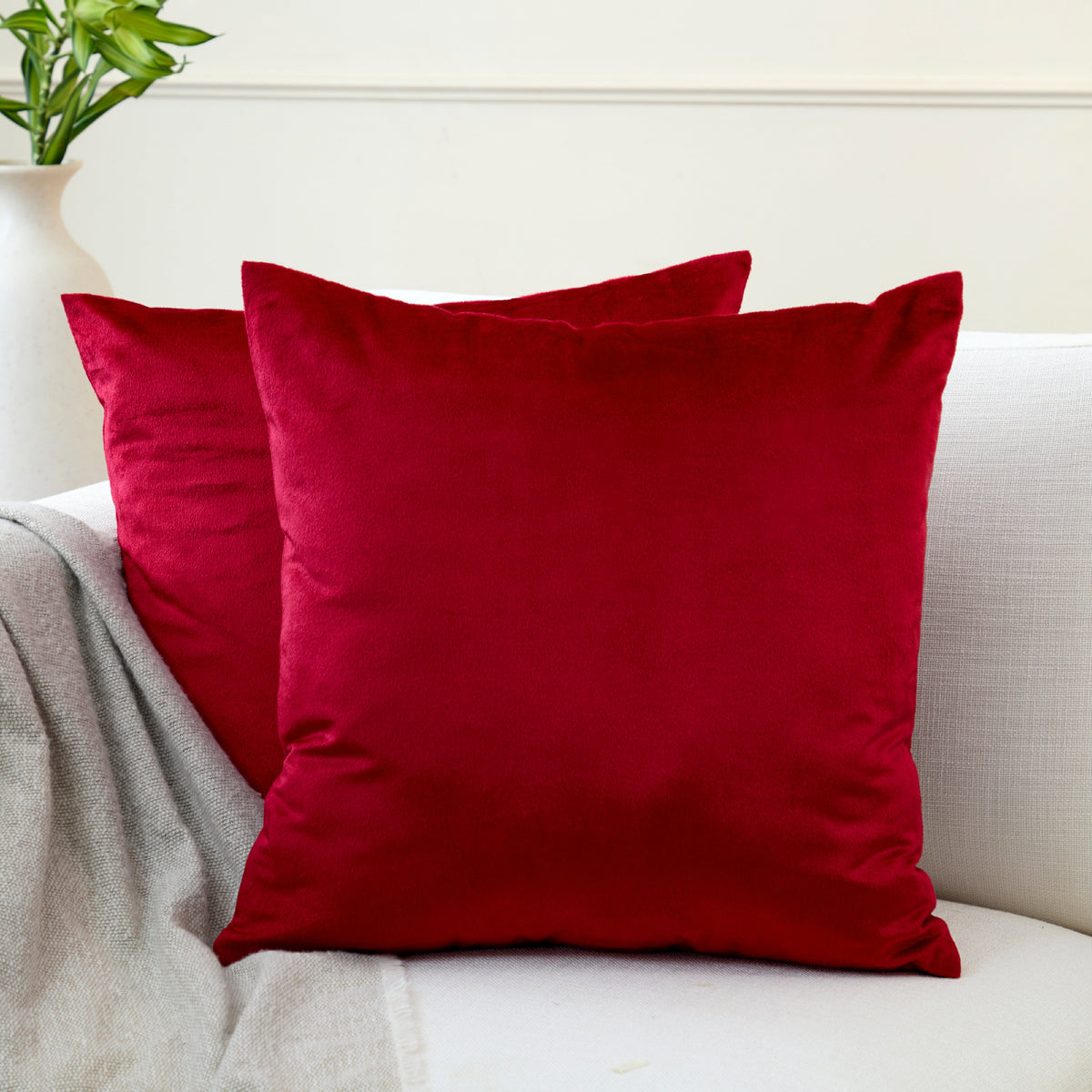
Most of our product pages say nothing about colourfastness in either direction. A couple do. The velvet red cushion cover, a polyester velvet at ₹460 to ₹810 for a pair in 40, 45, 50 and 60 cm, states "Will not bleed onto your light-colored sofas", and further down, "They do not bleed or shrink but we recommend washing with similar colors". The first line is about the cover living against light upholstery, the second is ordinary laundry caution.
That first line is doing more work than it looks, because a cushion's risk is not only in the machine. A deep-dyed cover rests against pale upholstery for months, gets leaned on, gets warm, and any dye that never bonded has somewhere to go with no water involved at all. That is crocking rather than bleeding, and no wash routine touches it.
The claim covers that listing and nothing further. Across the rest of the cushion cover range, a deep cotton or a printed canvas is an unknown until you have rubbed a damp white cloth over a seam.
Curtains, the wall behind them and the panel beside them

A curtain is the slowest of these to spot. The panel rests against a painted wall for a year, or hangs against a white sheer, and the transfer arrives as a faint tint you eventually cannot stop seeing.
The canvas rich maroon curtain is worth a look, because a photograph can mislead you badly about colour. In the frames shot in ordinary room light the panel is a flat, even deep wine from header to hem. In the frames shot against a bright window the middle of the same panel reads as a soft pink wash, and the wine comes back at the edges and along the hem where the cloth drops below the sill onto the wall. That is daylight coming through cotton canvas, not dye that has gone anywhere. The page states "Colors are tested for color fastness", alongside a care line of cold machine wash with normal detergent, no bleach and no hot dryer. Read that as written, tested rather than guaranteed, and follow the cold wash it asks for. It is 100% cotton canvas, ₹1,200 to ₹1,300 a panel.
Whatever you pick from the curtain range, the pale-wall question comes before the washing question, and a curtain gets hung once and washed twice a year. Settle it on the day the panel arrives.
Already bled? The next hour matters most
Speed beats technique here. Do not dry the affected item, and do not iron it. Heat is what turns a wet tint into something permanent.
Rinse it in cold water straight away, then rewash it alone, cold, with detergent and no bleach on anything coloured. Repeat while the mark is still shifting. Check it in daylight while it is damp; a mark that looks gone under a tubelight can reappear as the fabric dries.
A stained item sitting in the wet pile for another day is a nuisance. The same item pressed while the mark is still there is usually finished.
Common questions
Does hot water make colour bleeding worse?
Yes. The hotter the water, the faster a badly bound dye lets go. Cold water is the easiest change on this list and the only one that costs nothing.
Why has something that never bled before suddenly started?
Look at what else was in the load before you blame the item. A colour that always shed a little only announces itself on the day it meets a white napkin. Chlorine bleach is the other common answer: on anything dyed it strips colour rather than cleaning it, and a patchy pale mark is easy to read as a bleed from something else in the load.
Can a bled stain come out after it has dried?
Sometimes, and the odds fall with every heat cycle it goes through afterwards. A piece that has already been through a dryer is the hard case; one that only air-dried often still shifts.
Do I have to wash new items alone forever?
No. The loose dye mostly lives in the first wash or two. After that, sorting by colour handles it, and only a piece that keeps tinting the rinse water needs its own cycle.



Leave a comment
This site is protected by hCaptcha and the hCaptcha Privacy Policy and Terms of Service apply.