
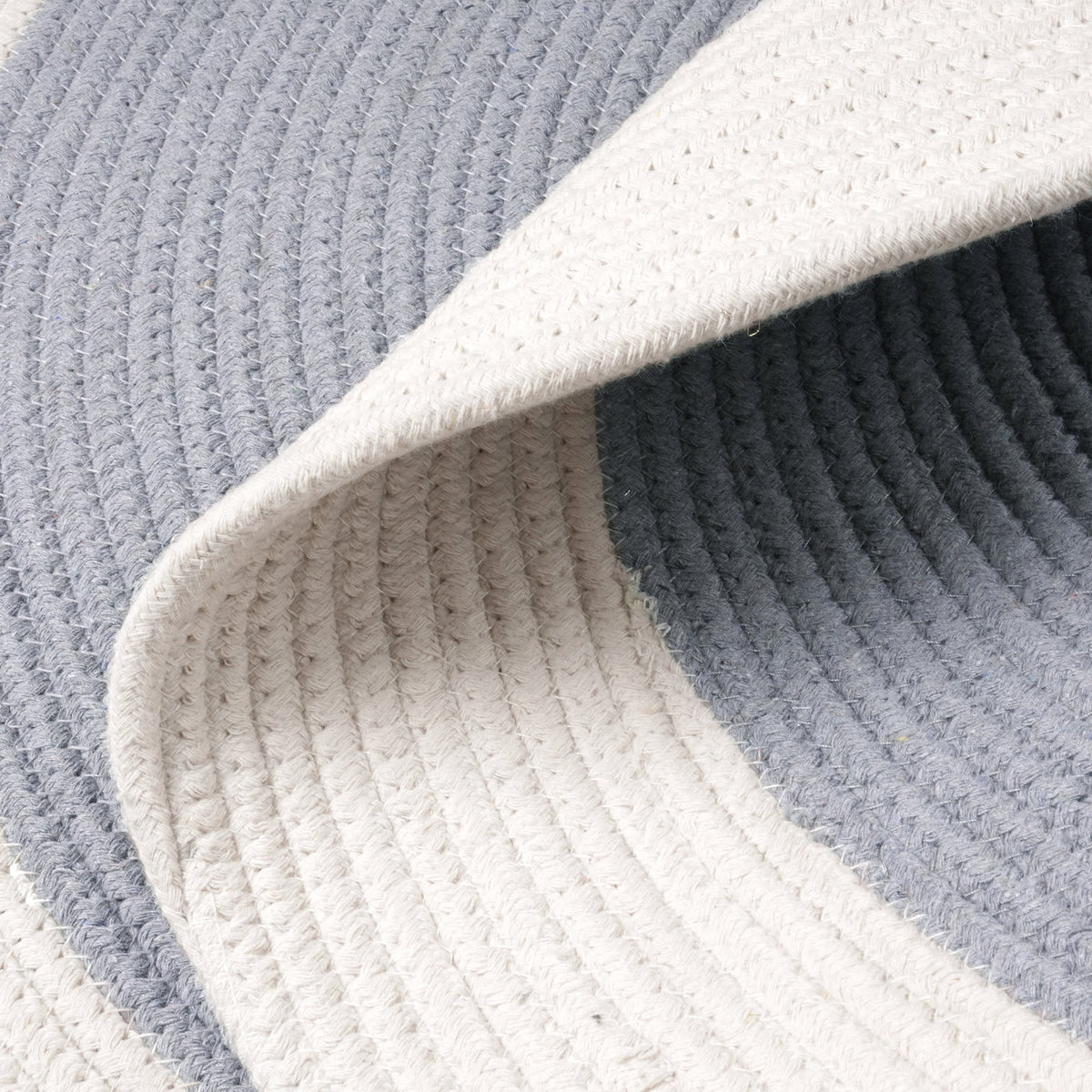
Put the bucket away. Water feels like the obvious first step, and for a coiled cotton, jute or chindi rug it is the wrong place to begin. These rugs are made of thick braid wound tightly together, so water goes deep and comes out slowly. Washing is rarely the step that ruins one. Drying is.
To clean a rug at home without a machine, get the dust out first by shaking, brushing or vacuuming both faces. Treat stains with a barely damp cloth, and dry each spot fully before the rug goes back on the floor. Wash a whole rug only if it is cotton, small enough to lift when wet, and dry weather is on the way. Use only as much water as you can dry.
How to clean rugs by what they are made of
Look at the braid before you do anything else, because "rug" covers three different objects.
| Rug | How to recognise it | Getting the dust out | How much water | What goes wrong |
|---|---|---|---|---|
| Cotton rope | Smooth, even cord in neat rings, usually one or two solid colours | Shake and vacuum; grit tends to sit near the surface | Spot-cleaning, or a hand wash if the rug is small | It holds a lot of water and stays damp in the middle |
| Jute braid | Coarse, straw-coloured braid with a dry, hairy feel | Vacuum on low suction, with no rotating brush | A barely damp cloth on one spot, and no more | Water can darken and damage the fibre |
| Chindi | Plaited strips of cloth with raw cut ends, often in many colours | Vacuum along the braid, so the nozzle does not catch the strip ends | Spot-cleaning first; a wash only after a colour test | Colours can run into each other, and scrubbing frays the ends |
A rug that mixes two materials should be treated as the fussier of the two, and that is usually the jute. Wool, hand-knotted and shag rugs and wall-to-wall carpet are a different job, better left to a specialist cleaner. Rubber-backed rugs have their own trap, which our Diwali cleaning guide explains.
The dry clean that does most of the work
Start outside or on a balcony, after checking that nobody's washing is hanging below you. Two people should shake a large rug together, holding opposite sides. Do not hang a heavy rug from one edge and beat it, because the coils are held together by stitching and that puts the whole weight on the stitches along that edge.
Then vacuum both faces on low suction, moving along the rings. No vacuum at home? A stiff, clean hand brush and a dustpan will shift the surface grit, more slowly, though less of the fine dust. Do the back as well, because fine dust works its way through and collects there.
For a stale smell, sprinkle baking soda over the dry rug, leave it for a while, and vacuum or brush it out from both faces. It freshens but does not remove stains, and any left deep in the braid will show as white dust later.
Finish by turning the rug around, so the part that takes the foot traffic changes places with a quiet part.
How do you get a stain out of a rug without leaving a ring?
A ring forms when water spreads out, carries dirt to the edge of the wet patch, and leaves it there as it dries. So the aim is to wet a smaller area than the stain, then work from the outside towards the middle.
Blot a fresh spill with a clean cloth. Press straight down, because rubbing pushes the liquid into the braid. Add a few drops of mild detergent to a bowl of water, wet a cloth, and wring it until it barely feels damp. Test it on a hidden edge first. Then dab the stain, follow with a clean damp cloth to lift the soap, and press a dry towel on the spot with your full weight.
Say a cup of milky chai goes over a 90 cm rope rug on a Sunday in July, with rain forecast all week. A full wash is off the table, because the rug would sit wet for days. So blot until the towel stops picking up colour, then use the damp cloth and the plain one. Check the back, because chai soaks through. Lay the rug across two chairs under the fan so air reaches the underside. If a faint mark is left once it is dry, turn the rug over and use the other face until a dry spell comes along. Do not skip the plain-water step, since milk left behind can start to smell.
Other marks need a different start. Let mud dry completely and brush it off before any water touches it. Oil will not move with water alone, so use a drop of dish soap on the damp cloth instead of detergent, for the reason our oil stains guide explains. Haldi in a curry spill often leaves some yellow behind, and scrubbing harder tends to damage the braid before it shifts the colour. Vinegar can pull colour from dyed strips, so test an edge before trying it on a coloured rug.
How big a rug can you wash by hand?

A 180 cm round rug is only twice as wide as a 90 cm one, but it has four times the cloth, about 2.54 square metres against 0.64. That is four times the cloth to wet, rinse and lift, on a floor that may be narrower than the rug.
So before you wet one, ask two things. Can you lift it wet, and do you have a flat, airy place to dry its full width? For a 60 or 90 cm rug the answer is often yes. In many flats, for 150 or 180 cm, it is no: keep to dust and spot-cleaning, and use a professional cleaner when it truly needs more. Jute stays out of this: Home Depot's guide to cleaning a jute rug says washing, steam cleaning and wet shampoo are not recommended, and warns that drenching will damage and discolour the fibre.
The care note on our chindi rug covers dust and sun but names no wash, so washing one is your call. If you have a small cotton rug, or a small chindi rug such as the 91 cm multicolour chindi round, and the forecast is dry, do it in this order:
- Finish the dry clean first. Wet dust turns to mud inside the braid.
- Press a damp white cloth on each colour and look at the cloth. If colour comes off, stop and stay with spot-cleaning. On a chindi rug, do this strip by strip, since the strips can come from different cloths and one passing colour does not clear the others. Our guide to colour bleeding explains why it matters.
- Start in the morning. Lay the rug flat on the bathroom floor and wet it with cool water.
- Work in a little mild detergent with your hands or a soft brush, along the rings. Chindi gets pressing only, with no brush.
- Rinse by pouring clean water and pressing until no suds come out.
- Do not wring it. Press out the water, then roll the rug in old towels and kneel on the roll.
- Lift it with both arms under it. A wet rug is much heavier than a dry one.
Drying a rug in an Indian flat
Dry it flat, in shade, with air underneath. A drying rack works for small rugs, and so do two chairs with a couple of sticks or a rod across them. A balcony railing looks convenient, but a rug folded over it holds water at the crease, and the fold can still show after it dries.
Turn it over about halfway through, and again if the underside still feels cool. Push your fingers into the coils near the middle, because the middle is the last part to dry and the outer face can feel ready well before it is. Run the ceiling fan. The rug goes back only when both faces and the middle are dry.
In the monsoon, the best move is often to wait. Starting a wash in a week of rain gives you a wet rug with nowhere to go, while a spot-clean under a fan can still dry.
Why does a rug smell damp, and what can you do?
The cause often lies under the rug. It sits flat on cool tile, damp collects between the two, and nothing can dry out. Lift it, dry the floor and the rug separately in moving air, and then try baking soda. In humid weather, lift it every few days. If the smell returns each time it is dry, or you can see dark patches of mildew in the braid, show it to a professional cleaner before you spend more effort on it.
Applying this to our rugs

The rope rugs are the simplest case, because their listing images state it directly: hand wash only, and water absorbent. Believe both. The blue-grey and cream rope rug comes in 90 to 180 cm rounds, so its size decides how you treat it. The beige and cream rope rug also comes in 60 cm rounds and ovals up to 122x183 cm. Try the white-cloth test on the coloured bands before you wet the whole rug.
The jute rug with black bands never gets washed. Its care note asks for vacuuming, turning, a gentle shake and no direct sun. An odd spill gets a barely damp cloth. The black bands sit right next to pale jute, so test before that cloth goes near the border.
All of these rugs are reversible, so a marked face can go down until you have time to deal with it.
Grit that never reaches the rug never has to come out of it, so shake the entrance mat often too. Our doormat and dust guide goes further.
The two rugs to colour-test most carefully

The round rug of jute and blue denim strips needs a little more thought. It follows the jute rules, and blue can rub onto the pale jute beside it, so a spot-clean here needs less water and a colour test every time.
The multicolour chindi rug is the other one to test with care, since its reds and pinks sit right against cream and pale green. If a strip fails the white-cloth test, stay with spot-cleaning and the same care routine as the jute.
Questions people ask
Can a jute rug be washed?
It is best not to. Jute takes up water and dries slowly, and soaking can leave it discoloured and damaged. A vacuum or brush handles the dust, and spills get a barely damp cloth.
Can a cotton rug go in the washing machine?
A rope rug marked hand wash only should stay out. For any other coiled rug, the drum and spin put strain on the stitching that holds the rings together, and a thick rug can hold more water than a home machine handles well.
How often should a rug be cleaned?
It depends on where it lies. A rug near an entrance or under a dining table may need shaking every week, while a bedside rug can go much longer.
Can I put a rug in the sun?
Sun freshens a dry rug, but it also fades colour, and the care note on our chindi and jute rugs says to avoid direct sun. Airing in shade with a breeze is the safer habit. Our rope rug listings give no sun advice, so if you use sun on one of those, keep it short.


Leave a comment
This site is protected by hCaptcha and the hCaptcha Privacy Policy and Terms of Service apply.