
The question people type after a tadka goes wrong is how to get the stain out. It is a good question while the splash is still wet, and a losing one by the time anybody gets round to laundry day.
On r/CleaningTips, someone posted the mess left behind after blending a ginger shot with lemon juice and turmeric, asking how to lift the stains, because normal dish soap was not cutting it. The thread ran to 206 comments. The most-agreed reply, at 1,096 upvotes, said turmeric never goes away. Further down, a commenter with 123 upvotes had already landed on the real answer without meaning to. "I need to wear like a full body bib, or all black, when I eat anything with turmeric in it."
The short version is this. A fresh plain-oil mark on cotton usually does come out: blot it, work dish soap into the spot, then wash. A turmeric splash that arrived inside hot oil often does not, because the colour is a dye that dissolves into fat and travels into the fibre with it. Removal is a partial answer to a problem that is far easier to keep off the clothes in the first place.
Two different stains arrive in the same splash
When a kadai spits, one droplet lands and two unrelated problems land with it.
The oil part is mechanical. Oil will not mix with water, so water alone runs straight over it, and soap is what changes that: each soap molecule has one end that grips oil and one that holds water, so the grease ends up wrapped in droplets small enough for the rinse to carry off. Dish soap, built for greasy pans, does this better than a scoop of detergent.
Turmeric is not that kind of problem at all. Curcumin, the yellow in turmeric, is a dye, and it is fat-soluble rather than water-soluble, so it dissolves into the oil and goes wherever the oil goes. Our care guide on cooking Indian food in an apron works through that mechanism properly. The consequence is what matters here: once the oil has washed out, the colour it carried in is still sitting in the cotton, bonded to the fibre.
Many people treat both halves with one move, usually soap, sometimes nothing until laundry day. That is the misdiagnosis, and the Reddit thread above is it happening in real time. Dish soap is built for grease and does nothing to a dye that is already in the fibre.
Heat is the second thing people get wrong. It does not set every stain: hot water helps a plain oil spot once soap is already in it, because warm oil is thinner and easier for soap to lift. What heat ruins is an oil mark nothing has been done to yet, and where there is no tumble dryer in the house, the damage gets done by the iron and the hot wash instead. A hot wash has a second cost on dyed cotton, because warm water is also what makes a deep colour run, which our guide to colour bleeding in the wash deals with.
This week it is one top you liked. Over a month, two or three more join the pile that only gets worn for cooking, and the good kurtas start getting changed out of before you go anywhere near the stove. Give it a year and the wardrobe has quietly sorted itself into clothes and cooking clothes, and the replacements you bought are working their way into the second list.
How do you remove oil stains from clothes that have already set?
Everything below works on grease. Almost none of it works on the colour that came in with the grease.
| What you do | What the heat is doing | What you get |
|---|---|---|
| Iron a garment with an untreated oil mark on it | Nothing is there to absorb the oil, and heat and air toughen what is left in the fibre | The mark darkens and gets harder to shift later |
| Cover the mark with baking soda and parchment, then iron | Heat, fat and an alkali powder react together, and the powder and paper pull the loosened grease up out of the cloth | The grease lifts |
| Hot water on a plain oil spot, after soap has gone in | Thins the oil so the soap can carry it away | Helps |
| Hot water on a fresh turmeric splash, before any rinse | Drives the colour deeper into the cotton | Sets it |
| Full sun on a washed turmeric shadow | UV light breaks the curcumin down | Fades, over repeated wash-and-dry rounds |
The second row is the one Reddit is currently in love with. It does nothing for a dye, and it needs a working iron and a mark that has not already been pressed once. On plain grease it earns the enthusiasm. A post titled "Tried the baking soda + parchment paper + iron trick for oil stains and I'm genuinely shook" pulled 5,934 upvotes and 325 comments. The top reply, at 1,311 upvotes, describes a three-year-old coconut oil stain on a linen shirt that had survived several washes and one earlier attempt with dish soap, gone completely. Another commenter, 100 upvotes, put it down to saponification: fat plus an alkali plus heat makes soap, which turns a greasy mark that repels water into a soapy one that water can rinse away.
Every example in that thread is grease of some kind, and nobody in 325 comments reports it clearing a turmeric stain, which is what an Indian kitchen actually produces.
The haldi side of the ledger is bleaker. In an r/laundry thread with 17 upvotes and 14 comments, the poster soaked a turmeric stain overnight in an oxygen bleach powder, soaked it again for about seven hours, and reported that the stain had turned purple instead of lifting. One reply described a chilli-sauce stain that did clear, but only after three rounds of washing and hanging it out to dry.
What an apron does, and what it doesn't

An apron is not chemistry. It is a piece of cotton standing between the pan and the shirt, and its whole job is that the droplet lands on cloth you have already agreed to sacrifice. The stain still happens. It happens somewhere you do not mind.
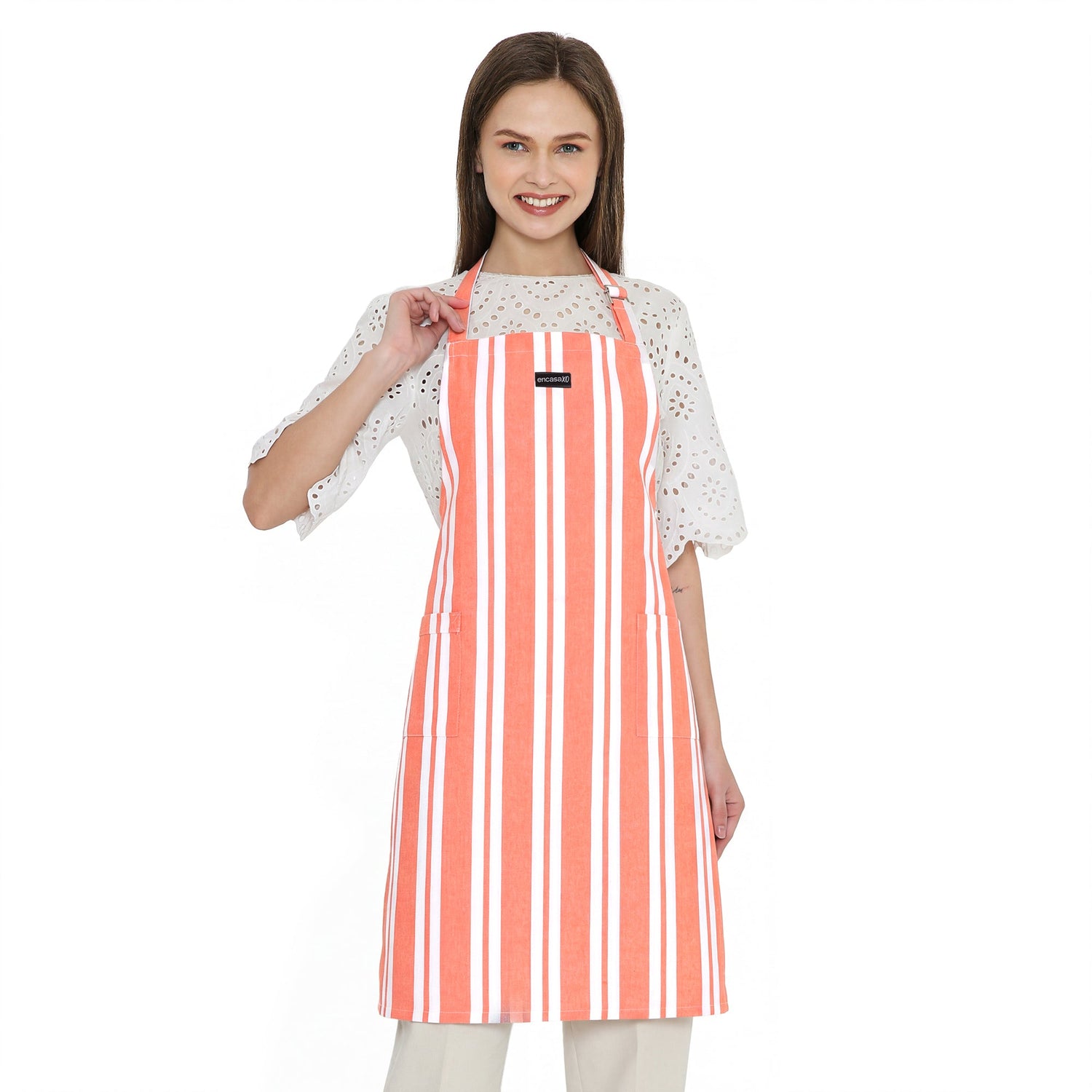
The sizes tell you how much of the problem that covers. The printed cotton triangles apron is 64 x 86 cm, and the others named here are 68 x 85 cm, which on an average adult is chest to somewhere around the knee. That is the zone tadka splatter reaches from a standing position. Forearms are not in it, which is why an oven glove earns its place by the stove. The front pocket and the towel loop most of them carry are doing more work than they look like they are, too, because blotting while the splash is still wet is what keeps a mark from turning into a stain, and that only happens if a dry cloth is already hanging on you and not two rooms away.
What changes is small. You stop checking what you have on before you start cooking, because the thing that would have taken the splash is hanging over it, and the shirt goes back in the cupboard afterwards instead of into the wash with a mark to work on.
Which one to get if haldi is a daily visitor

What matters here is how often oil and turmeric are actually in the pan.
If you are frying or tempering most days, take one of the heavier cottons. The sage and coral apron and the Franca orange stripe canvas are both heavy cottons, over 200 gsm. Weight is a proxy for the thing that actually does the work: what stops a hot droplet is a close weave, with no gaps between the yarns for it to push through on its way to the shirt, and heavier cotton is where that weave usually sits.
If it is two or three cooked meals a week, the printed twill is the more comfortable pick, and a busy print hides the marks a solid colour keeps showing after every wash. The apron collection runs roughly ₹450 to ₹700 across both.
Sizing is the low-risk part of this. These come one size, with an adjustable neck strap and long waist ties, so the only decision carrying any risk is the fabric weight, and the cost of calling that wrong is an apron that feels heavier than you wanted on a hot evening.
The clothes you have already stopped wearing to cook
There is usually a shirt in these stories that still gets worn, with the mark turned away from the light or sitting under a dupatta. That one has not been given up on yet.
Then there is the mark that arrives late. An oil spot that looked like it washed out can come back yellow long after the wash, because whatever stayed down in the fibre has had time and air to work on it, and a hot wash and an iron have toughened it in the meantime. Nobody remembers getting that stain. This is also why the pile grows in weeks when nothing was spilled.
Common questions
Isn't an apron too hot for an Indian kitchen?
It comes up unprompted, and it is the objection an apron has to answer first. A small r/IndianCookingTips thread on wearing aprons, only 3 upvotes and 8 comments, had one commenter say an apron "makes the already hot kitchen environment more hot", and another say "I really want to use aprons because I'm the person who always spills stuff on herself but it's just too hot! If I can find a thin cotton apron maybe it would become possible." It is a thin thread, but it rings true for a kitchen without air conditioning. The answer is not to reach for the heaviest thing in the drawer out of principle. A printed twill sits lighter than a canvas, and a bib apron leaves the arms and back open.
Is fast treatment enough on its own?
For plain oil, often yes, and it is a skill worth having. For turmeric it improves the odds without making them good, and it needs you in the room with a cloth to hand while the splash is still wet. Prevention does not require any of that to go right.
Do I need one if I mostly reheat and boil?
Boiling and reheating throw very little, and dry masala powder brushes off cotton without much fuss. The case for an apron is hot oil: tadka, bhuna, deep-frying, anything that goes into a kadai at temperature. If none of that happens in your kitchen in a normal week, this is not your problem to solve.
Does bleach or hydrogen peroxide take turmeric out?
Sometimes, and at a real risk to the cloth. In that same r/laundry thread, a commenter with 8 upvotes reported that hydrogen peroxide plus sun destroyed a garment they were treating for a different stain, badly enough to be worse than the mark had been. Alkaline and oxidising cleaners do attack curcumin, which is why they look promising at first, but they attack dye and fibre alongside it. On a garment you actually like, you are gambling the whole thing to save the mark.
Does an apron have to look like a restaurant apron?
That picture is mostly a hangover from the plain white and black ones. The printed and yarn-dyed cottons are ordinary kitchen textiles in ordinary colours. If it looks like something you would happily leave hanging on a visible hook, you are more likely to actually put it on.
The cost, both ways

It is worth putting the two costs next to each other. One is a removal habit: dish soap near the sink, a couple of minutes at the moment of the splash, and on the haldi days a soak and a sun-dry with a decent chance of a shadow anyway, plus the clothes already written off and the ones on their way there, at whatever you paid for them. The other is a piece of cotton in the ₹450 to ₹700 band, worn on the days that matter, which does no cleaning at all and just stops most of it landing on you.
There is also a version that covers the hands, which is where an apron gives up. The red apron set pairs a 68 x 85 cm apron with a quilted oven glove and a pot holder for under ₹700, and the other apron, oven glove and pot holder sets are put together the same way. Pick one, hang it where your hand already goes, and stop deciding what you are allowed to wear to cook.
Encasa XO is our own brand, and the aprons named above are ours.

Leave a comment
This site is protected by hCaptcha and the hCaptcha Privacy Policy and Terms of Service apply.