
You unroll the rug in front of the sofa, step back, and something is wrong. Search for the fix and the same answer comes back: it is too small. Buy the 8 by 10 foot one. Get the front legs of the sofa onto it.
That rule comes out of the American furniture market, where rugs are sold by the foot in sizes meant to fill a floor. It is also the wrong ruler for the rug you are probably choosing between. If your options are round and quoted in centimetres, somewhere between 60 and 180 cm across, the overhang rule stops applying altogether: even a 180 cm circle covers only about a third of the floor an 8 by 10 foot rug would.
So the size is usually not the fault. The fault is that the rug is holding nothing. A 90 cm circle sitting on open tile with clear floor on every side reads as something dropped there by accident. Push that same rug under the coffee table until the table's feet stand on it and it stops looking like a mistake, without a centimetre changing anywhere.
Which gives you something better to shop with. Pick the thing the rug has to sit under, measure that, and buy the smallest rug that swallows it with a border still showing. For a coffee table this means measuring corner to corner, because a round rug meets a rectangular table at its diagonal. For a floor-seating room it means measuring the circle that people's knees make when they sit down.
Choosing rugs for the living room: measure the thing, not the floor
Say your coffee table is 100 cm long and 55 cm deep. Neither number is the one you shop with. The corner-to-corner measurement is, and for that table it comes to 114 cm. A 90 cm round rug cannot take it: two corners hang off, and the table looks like it is climbing out of the rug. A 120 cm rug clears the diagonal by less than 3 cm at each corner, which counts as on but looks tight. Go to 150 cm and roughly 18 cm of rug shows past every corner. That is where it starts to read as chosen rather than squeezed.
A round table is easier, since its width and its diagonal are the same number: add about 20 cm all round. If the centre table has a glass top, remember you will be looking at the rug through it, so the middle of the pattern is on display rather than hidden.
None of this has involved the sofa, which is the part that trips people up. In a room with a three-piece sofa set pushed back against three walls, no round rug reaches under the front legs of everything at once, and stretching for it only makes the rug look strained. Let the sofa set hold the edges of the room and the rug hold the middle. Where the seating is on the floor instead, the job is clearer: the rug marks the zone people sit in, so measure the outer edge of where knees land and size up from there.
What is a chindi rug, and how is it different from a cotton rug?

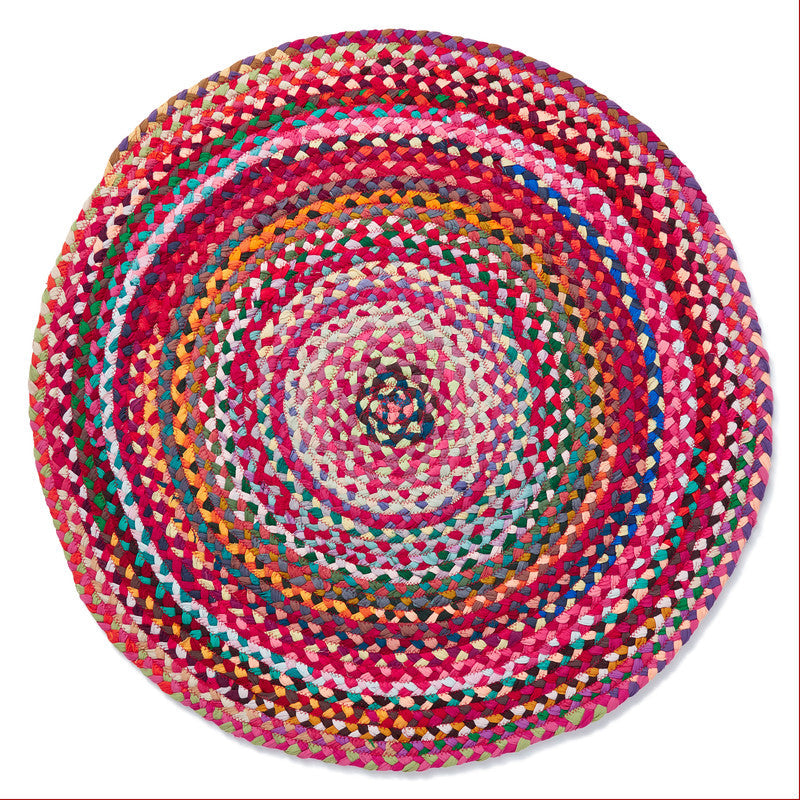
Chindi is the Hindi word for a scrap of cloth, and it names both the material and the technique. Leftover fabric strips from garment production are plaited into one long braid, the braid is wound into a flat spiral, and the coils are stitched together. You can see every stage in the finished rug.
Look at the join between two coils on the multicolour chindi rug and you will find a zigzag machine stitch holding them together, and the raw cut edges of the strips poking out of the plait. That is not a flaw, it is the construction. In English the same object is usually called a rag rug, so chindi and rag rug name one thing, and Indian listings tend to use the first.
A cotton rope rug is a different thing that ends up looking related. Cotton yarn is plaited into a smooth, even cord first, then coiled and stitched. There are no fabric strips and no raw edges, so the surface comes out as clean concentric rings in one or two solid colours.
The difference you feel is density. The rope version is packed tighter and heavier for its size; the chindi braid is softer and more uneven underfoot, and a corner will lift if nothing is standing on it. Both arrive folded from packing. The chindi listing says those creases drop out on their own after a few days; the rope one asks for a light iron to settle the edges flat. Beyond that it is mostly a decorating question, and the two are hard to mix in one room: a multicoloured chindi rug is the loudest thing on the floor, while a two-tone rope rug is deliberately quiet. Both ranges here are listed as reversible, so either can be turned over once one face has taken more sun than the other.
Will a cotton rug slide on marble?

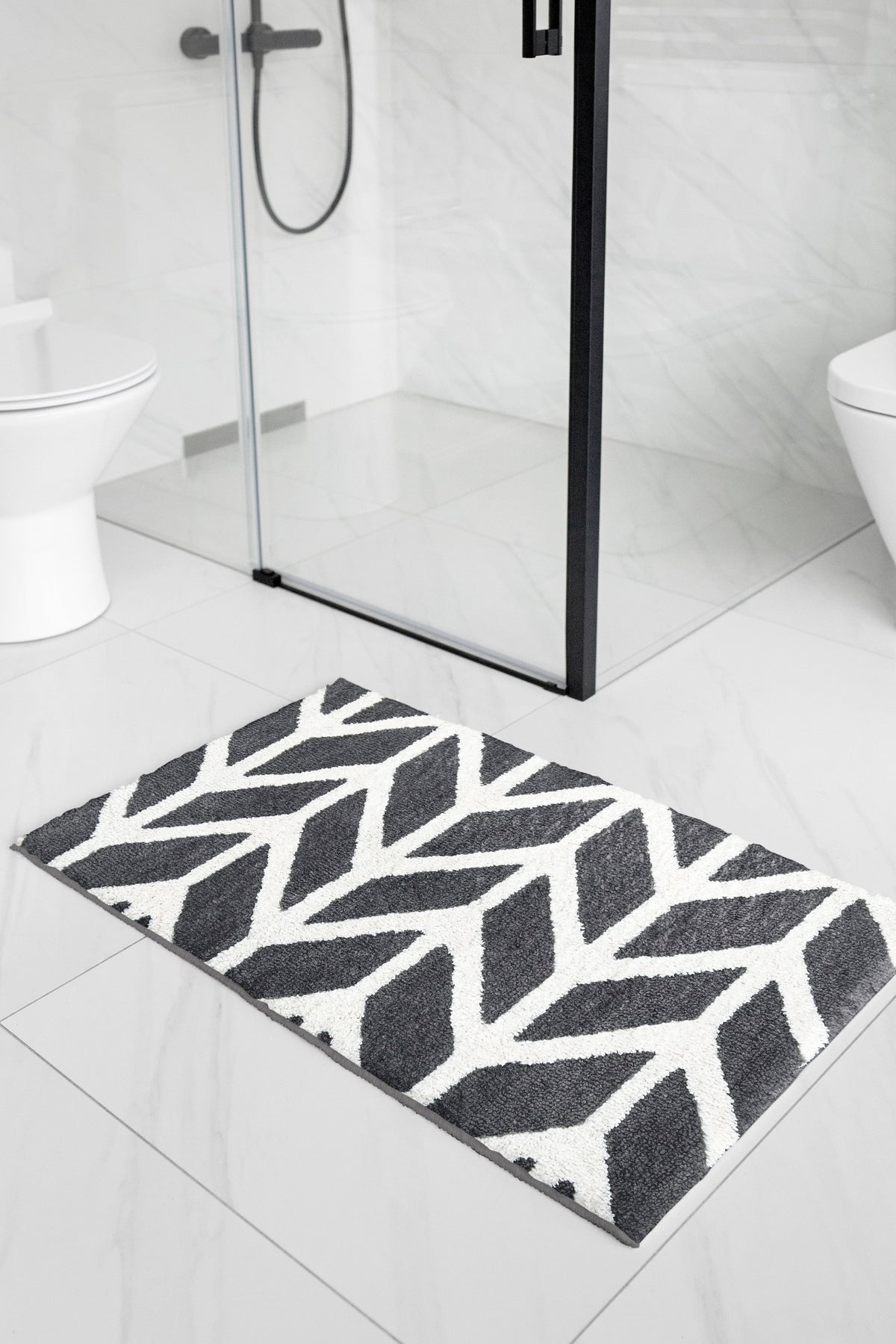
Yes, and you should plan for it. None of these seven listings describes a backing, a grip coating or an anti-slip layer, so treat any of them, the grey and off-white cotton rug above included, as a plain cotton surface and supply the grip yourself. Cotton on polished marble or vitrified tile has very little to hold on to, and a rug this light carries no weight of its own to help.
The reliable fix is a non-slip rug pad or grip liner, sold separately at hardware shops, cut two or three centimetres smaller than the rug so it does not show at the edges. Furniture helps too, and the sizing question comes back around here: a rug with the coffee table standing on it is already held down, which is one more reason to buy the size that fits the table rather than the size that was on offer.
Where you put it matters as much as what goes under it. A small loose round rug at the top of a step, in a doorway, or on the turn into the kitchen sits exactly where people pivot, and that is the one that slides. With children or older parents in the house, treat the pad as part of the purchase.
Dust, fans and the cleaning you will actually do

A ceiling fan running most of the day keeps fine dust circulating instead of letting it settle once and stay put, and a rug holds on to that dust in a way bare tile does not. That is part of what a rug is for, and also why it adds a job to the week.
The rope construction is the easier of the two. Grit sits on top of the dense coils of something like the beige and off-white cotton rug, so carrying it out to the balcony and shaking it hard gets most of it out. Chindi needs more patience, because the plaits have gaps and dust works down between them. Vacuum it along the direction of the braid rather than across it, or the nozzle catches the raw strip edges and pulls at them. A rug pinned under a table also holds still while you vacuum, where a loose one rucks up.
Neither product page carries a wash instruction, so do not assume a machine can take one. The chindi listing goes as far as regular vacuuming, the odd shake and keeping the rug out of direct sun, then stops; the rope one says nothing about cleaning at all. A cotton rug this size holds a lot of water once soaked, and with no stated washing method there is nothing to fall back on if it comes out of the drum misshapen. Spot-clean, shake out, air it, and ask before anything more ambitious. Through the monsoon, lift the rug every few days: cotton holds damp, and one lying flat with no air under it starts to smell well before it looks dirty.
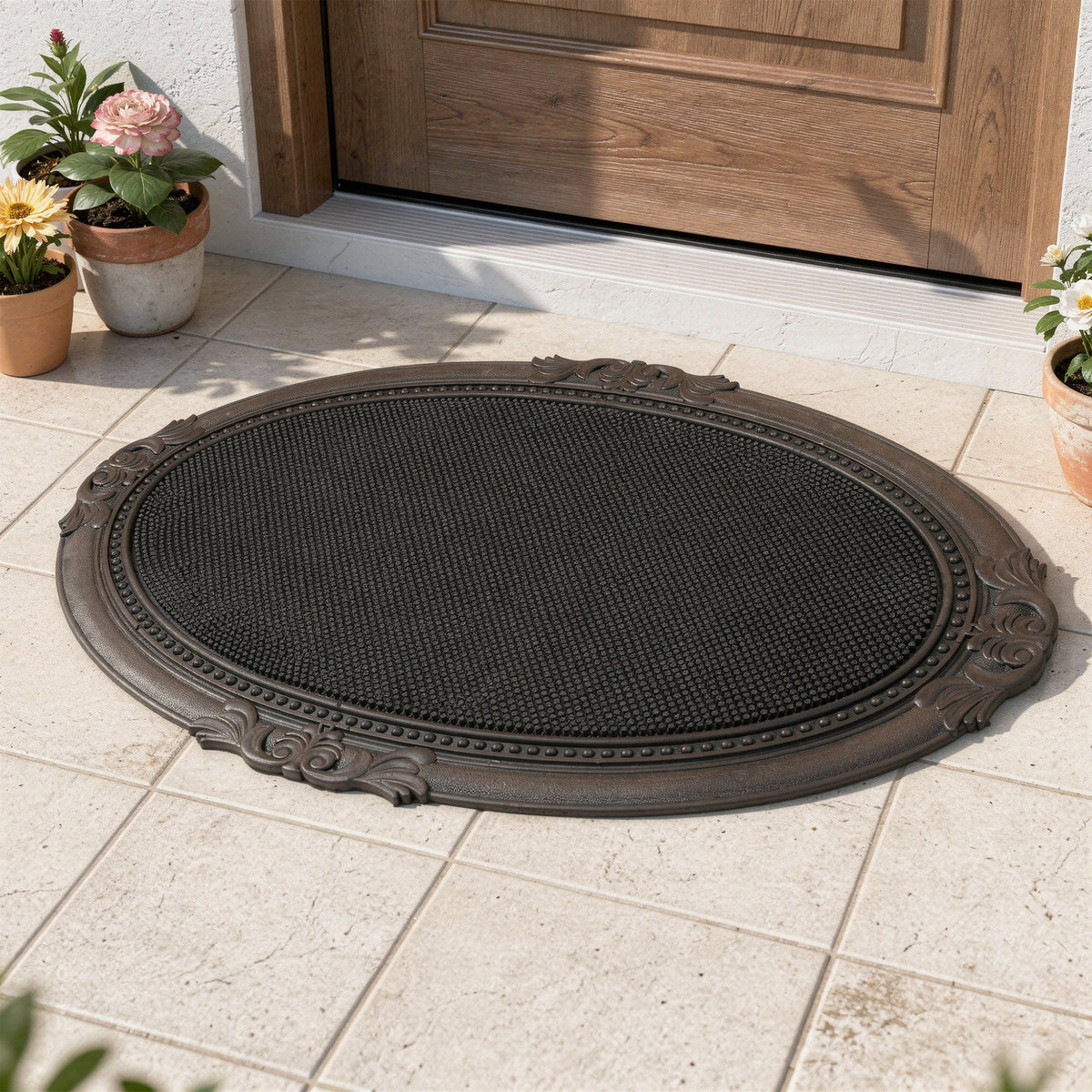
Most of the grit that wears a rug down walks in on shoes, so the mat at the door decides how often the rug needs any of this. A mat only helps if it is stiff enough to scrape a sole, and a coir mat walked flat has stopped doing that while still looking like a doormat. Replacing a flattened one from the door mat range saves the rug more work than anything you do to the rug, and our guide to the best doormats in India sets out which material stops what.
What the range covers, and what it does not

Seven rugs in two constructions. The sizes below are the ones the listings state, feet rounded, prices as sold.
| Size | Roughly | What it can anchor | Where it exists | Price |
|---|---|---|---|---|
| 60 cm round | 2 ft | Nothing by itself. A bedside or step-out mat | Beige and off-white only | Under ₹600 |
| 60 x 90 cm oval | 2 x 3 ft | The footwell of one armchair | Beige and off-white only | Under ₹1,000 |
| 90 cm round | 3 ft | A small round table, or one floor cushion and a tray | All four cotton rope colours | Under ₹900 |
| 91 cm round | 3 ft | The same footprint, in chindi | All three chindi colours | Under ₹900 |
| 60 x 121 cm | 2 x 4 ft | A narrow walkway, or the front of a two-seater | Chindi multicolour only | Under ₹900 |
| 60 x 150 cm oval | 2 x 5 ft | A runner along a sofa front or beside a bed | Beige and off-white only | Under ₹1,500 |
| 120 cm round | 4 ft | A coffee table whose diagonal is under 120 cm | All four cotton rope colours | Under ₹1,400 |
| 150 cm round | 5 ft | The same table with a clear border past every corner | Three cotton rope colours | Under ₹2,000 |
| 180 cm round | 6 ft | A low table with people seated around it | Three cotton rope colours | Under ₹3,600 |
The sizes are not spread evenly across the colours, so it is possible to settle on a colour and then find your size is not made in it. If you want the smallest circle or either of the ovals, the beige and off-white cotton rug is the only listing that carries them, and it stops at 120 cm. If your table's diagonal came out over 120 cm, or you are sizing for a seating circle, you need one of the other three colourways: the grey and off-white cotton rug runs up to 180 cm, and sage and a second beige do the same.
On the chindi side the choice is colour rather than size, since all but one variant is the 91 cm circle. The multicolour chindi rug is the one that takes over a room, and it is also the only listing offering the 60 x 121 cm rectangle. For the same braided construction without the noise, the denim chindi rug works recycled blue strips into a jute body and sits far quieter under a plain sofa. Colour is the one decision a size chart cannot make, so open the chindi collection, where the rugs currently sit in among the door mats, and look at the photographs full size rather than a thumbnail.
One trend worth resisting: layering a small rug over a larger one photographs beautifully and behaves badly in a house people walk through. The top layer creeps until it sits crooked, the edge lifts exactly where traffic crosses it, and through humid months the layer underneath dries long after the top one has. It works in one arrangement: a flat rug underneath, the top one pinned by the coffee table, in a corner nobody crosses.
Questions people ask
What size rug works in a small living room?
Work from the furniture, not the floor area. A 90 cm circle suits a small round table or a single seat; 120 cm suits a compact rectangular coffee table; 150 cm is the first size that looks generous in a room with a full sofa set. Going bigger than the piece you are anchoring rarely helps, because the rug then runs into the sofa legs and has to be tucked.
What does chindi mean?
It is the Hindi word for a scrap or offcut of cloth. A chindi rug is made from those offcuts, cut into strips, plaited and coiled. The English name for the same thing is a rag rug.
Do cotton rugs slip on marble floors?
On polished marble or vitrified tile, a light cotton rug with no backing will move. A separate grip pad underneath solves it, and standing a piece of furniture on the rug helps. Doorways and step edges are the worst places for an unpadded one. On marble or tile a rug does a second job in winter, keeping feet off a floor that stays cold long after the air warms up, which our guide to winter home textiles covers alongside curtains and cushions.
Can you put a cotton rug in the washing machine?
Only if the seller says so on the listing, and plenty say nothing about washing at all. A large cotton rug holds a lot of water once wet, and with no stated washing method there is nothing to fall back on if it comes out of shape. Spot-cleaning and regular shaking out do most of the work.

Leave a comment
This site is protected by hCaptcha and the hCaptcha Privacy Policy and Terms of Service apply.