
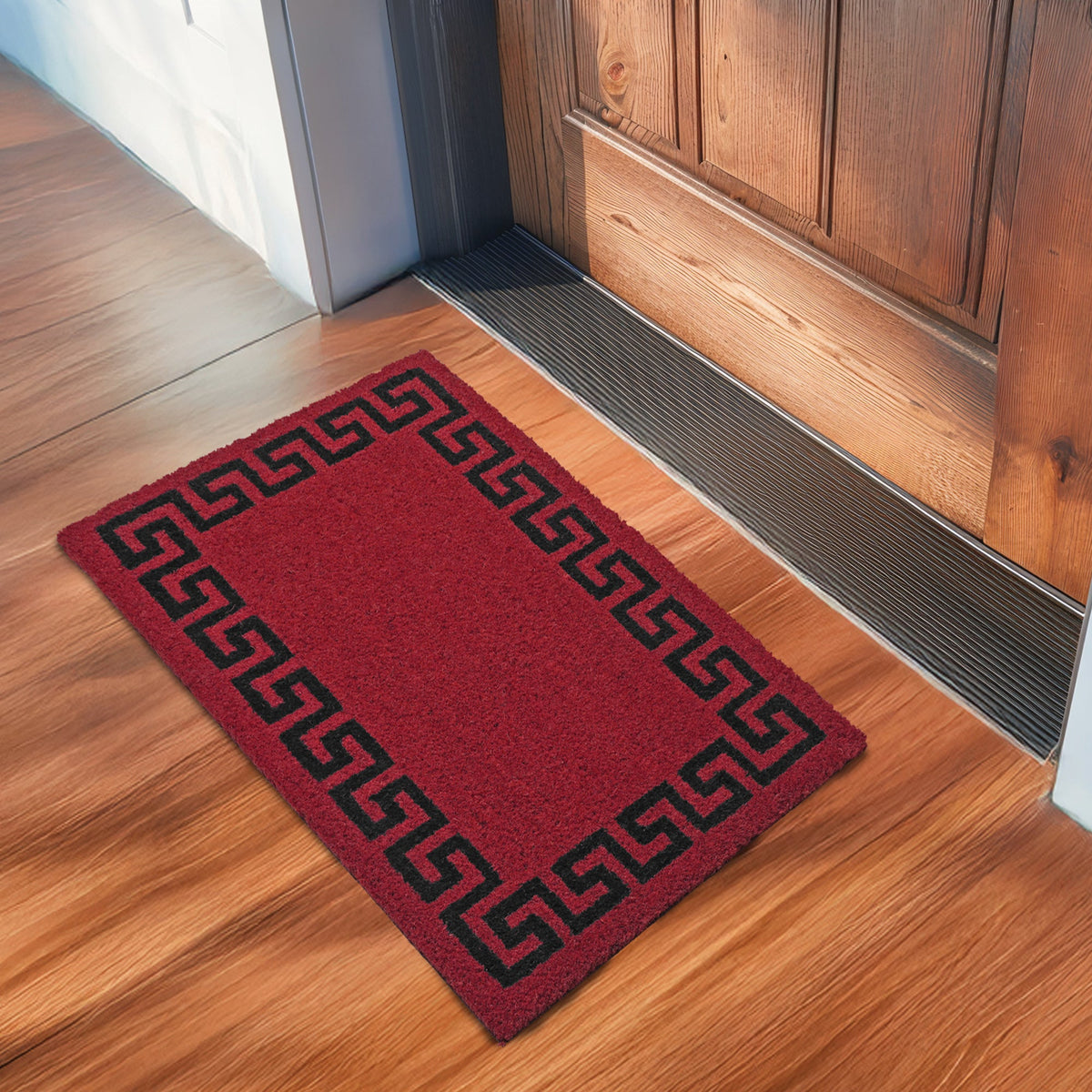
By nine at night the rangoli outside the door has a heel print through one corner, the pink from that corner has been carried two steps onto the doormat, and the door curtain, pushed aside by the twentieth guest, is swinging a little too close to the diya on the step. Nothing has gone wrong exactly. Three things that each look lovely on their own have simply been asked to share the same metre of floor.
Loose colour powder, open flames and a steady stream of feet all meet at a Diwali threshold, and each textile there should be chosen for the one it actually has to deal with. The doormat deals with feet and powder, the curtain deals with the breeze from an open door, and the diyas need clear space from both. Sort out where each one sits first. Colour and pattern come after.
What actually happens at the front door on Diwali night
For most of the year a front door has one job: let people in and keep the corridor dust out. The festival adds a lot to that.
Rangoli colour is a fine, dry powder, and fine powder travels on the soles of shoes and bare feet much further than you expect. It also settles into anything with an open pile, which is exactly what a scraping doormat is.
Then there are the diyas. Diyas on the step, on the ledge beside the door or along the rangoli border are the most traditional part of the entrance, and the part that sits nearest to fabric. A doormat burns. A curtain burns. A polypropylene or rubber mat melts. None of that is a reason to skip diyas, only a reason to measure where they go.
Foot traffic is heavier than on a normal evening, too. Guests take off their shoes at the door, the door stays open for long stretches, and the same small patch of floor gets walked over, stood on and used as a shoe rack all at once.
How do you lay out a Diwali entrance so rangoli, diyas and the mat don't collide?
Start with one measurement. The US Fire Administration's candle guidance is to keep candles at least 12 inches, about 30 cm, from anything that burns, and a diya is a candle as far as a doormat or a curtain hem is concerned. So the doormat gets a 30 cm no-flame band around it, and the diyas go outside that band.
Here is how that plays out in a flat corridor. Say the door is about 91 cm wide, a common size for a single door, and the corridor gives you 120 cm of floor in front of it. A 75x45 cm mat sits against the door. Add the 30 cm band and the first diya can't go closer than 75 cm from the door, which leaves only 45 cm of corridor for the rangoli and the diyas together. That is not enough room for both, and it is also the strip everyone walks through.
The fix is to stop stacking everything in a line in front of the door. Move the rangoli to the side, against the wall, and put the diyas on its far edge, away from the mat and away from the walking line. Guests then step straight onto the mat without crossing the colour. In an independent house with a porch or steps, you have more depth to play with, but the order stays the same: walking line clear, mat at the door, flame at least 30 cm from anything woven.
Coir, jute or polypropylene: which doormat for Diwali week?
The mat at a festive door is doing two jobs that pull against each other. You want it to grab grit and powder off feet before they reach the floor inside, and you want it to let go of that powder when you clean it. Stiff, open fibres are good at the first and bad at the second.
| Mat | Scraping shoes | Rangoli powder | Cleaning after the festival | Best spot |
|---|---|---|---|---|
| Coir | Strong; stiff fibres knock off dried dirt | Works deep into the pile and stays there | Shake, then vacuum with a brush; no soaking | Outside the door, under cover |
| Jute (braided) | Weak; soft and smooth | Sits in the grooves of the braid | Shake, vacuum or spot clean | Just inside the door |
| Polypropylene | Moderate; ridged surface | Sits on top of the grooves | Can be rinsed with water | Outside, or under a low door |
| Moulded rubber | Moderate | Easy to see and wipe | Can be hosed down | Wet or uncovered steps |
Colour matters more than people think, and for a practical reason. A natural beige coir mat shows every grain of pink and yellow powder that lands on it, and gulal pressed into a pale pile can leave a stain that lasts well beyond the festival. A red or brown mat hides most of it. If your rangoli is right next to the door and the mat is going to take colour no matter what, the Coir Greek Key Red is the more forgiving buy: it scrapes like any coir mat, the red base hides spilled powder, and the black border reads as festive without a printed "Shubh Deepavali" on it. It comes in 60x40 cm and 75x45 cm, at about ₹549 and ₹789.

A pale printed mat like the Welcome Leaf design above makes the opposite trade. It looks bright and friendly by day and shows dust and colour quickly. It's a good choice for a door that has its rangoli well to the side, and a poor one for a door where the rangoli touches the mat's edge.
For a flat door that opens inwards over the mat, thickness matters too. Shut the door and look at the gap underneath it. A thick coir mat on the inside can catch the bottom of the door every time it swings, and on a busy evening that means a mat shoved into a heap. The Polypropylene Maroon is sold as a low-profile mat that fits under doors with little clearance, and its page says it can be rinsed with water, which is the easiest clean-up of any mat here once the colour has been walked in. It costs about ₹439 for 60x40 cm and ₹659 for 45x75 cm.
Two mats, one at each side of the door
One mat outside the door can't catch everything. The fine powder that gets past coir is exactly the kind a second, softer mat inside picks up, and that inside mat is also the one guests see as they walk in.

The inside mat doesn't need to scrape. It needs to look right and be soft underfoot for bare feet. The Jute Half Round Natural is a handwoven, braided jute mat with a scalloped edge, 75x45 cm, about ₹789, and reversible, so you can turn it over once the festival has marked one side. Treat it as the decorative mat and keep the coir outside doing the rough work. It is also the mat to keep furthest from diyas: braided natural fibre near a flame is the arrangement the 30 cm rule exists for. The full range, with both the scraping and the decorative mats, is in the door mat collection.
A word on shoes. On a busy night, footwear tends to end up on the mat itself, and a pile of shoes on a coir mat flattens the pile and leaves the next guest nowhere to wipe their feet. A shoe rack or even a tray just beside the door keeps the mat free to do its job.
How should a door curtain hang during Diwali?
The door curtain changes jobs on festival night. Normally it gives privacy while the door is open for a delivery. On Diwali the door is open for hours, people walk through all evening, and a ceiling fan or a draught through the open door pushes the curtain outwards, towards the step where the diyas are.

Tie it back for the evening, on the side away from the diyas, and keep the hem clear of the threshold. One panel swept to one side works better here than a pair, because there is nothing to drag across the doorway every time someone walks in. The Canvas Rich Maroon single panel is cotton canvas in a 7 ft door length at about ₹1,279, with eight metal eyelets, and its page says it is not see-through from outside at night. That last point matters once the corridor lights are on and the hall is lit behind it. A deep maroon also tends to hold its colour under the warm, low light of diyas and fairy lights, where a pale shade can look washed out. If the door needs a pair, the curtain collection lists the 7 ft door length on most designs, and our door curtain size guide covers rod height and how many panels a wide door needs.
The morning after
Clean the mats before the colour sets. Take the coir mat out, turn it face down and shake it hard, then vacuum it with the brush attachment, going against the lay of the fibre as well as along it. Don't hose a backed coir mat: water goes in through the pile and has nowhere to drain, and our coir doormat guide explains why that leads to smell. Rinse the polypropylene mat and let it dry fully before it goes back down. If a diya dripped wax onto a mat or the curtain hem, let it harden and lift it off before you try anything with heat or water; the wax and rangoli stain guide walks through the method.
Questions people ask about Diwali entrance decoration
Can I put diyas on or right next to the doormat?
No. Coir, jute and cotton all burn, and polypropylene and rubber melt. Keep each diya at least 30 cm from the mat's edge and put it on a metal or clay base, never on the mat itself, even for a photo.
What colour doormat hides rangoli powder best?
Darker, warmer shades. Red, maroon and brown mats hide pink, orange and yellow powder far better than natural beige coir, which shows every spill. If you love a pale mat, keep the rangoli well away from it.
Should the door curtain stay closed during the festival evening?
Tied back is usually more practical while guests are arriving, because the door stays open and a loose panel drifts in the breeze. Tie it on the side away from any diyas, and let it down again once the door is shut for the night.
Do I need a new doormat for Diwali?
Not if the one you have still scrapes. A worn mat that has gone flat in the middle won't catch powder or grit, and that is the reason to replace it, not the festival. A second, decorative mat inside the door is the cheaper way to make the entrance look new.

Leave a comment
This site is protected by hCaptcha and the hCaptcha Privacy Policy and Terms of Service apply.