
For a sit-down dinner you dress the table. For a buffet of fifteen people you dress the room, because the food stays on one table and everything else goes walking. Plates end up on laps, glasses end up on the arm of the sofa and the top of the TV unit, and the serving table takes a row of hot kadhais and a steady drip from every ladle.
So the linen goes where the heat and the wet land, not where people sit. For a Diwali buffet that usually means one dark, easy-to-clean runner under the serving line, a trivet under every hot pot, more coasters than you think, spread across every surface where a glass can be put down, and napkins counted at two a head. Placemats matter much less than they do at a sit-down meal.
Diwali falls on Sunday 8 November this year, so sort the textiles a week before the party. New cotton napkins absorb better after a wash or two, and that is not a job for the morning of the party.
Why is a buffet harder on table linen than a sit-down dinner?
At a seated meal the mess stays near each plate. A placemat or a tablecloth catches it, and the damage is spread thinly over the whole table.
A buffet concentrates it. Every guest serves themselves from the same dishes, and the spill happens in the gap between the pot and the plate: a ladle of dal lifted, a drip on the way, the ladle put back down on the table instead of in the pot. Multiply that by fifteen guests going back for seconds, and nearly all the spills of the evening land on one strip along the front of the serving table. Heat is concentrated in the same way, with the same hot pots standing in one place for most of the evening.
Drinks behave differently too. Nobody carries a plate and a glass to a chair for long, so the glass gets put down wherever there is a flat surface. Cold glasses sweat, and condensation on a polished or veneered surface can leave the white ring you notice the next morning. Our guide to white marks on wood tables explains what causes them and what lifts them.
The serving table: a runner along the line of dishes

Lay the runner along the table where the dishes go, not as a decoration in the middle with food around it. On a buffet the runner is a spill strip. It should sit under the pots and stretch a little in front of them, where the ladles come back down.
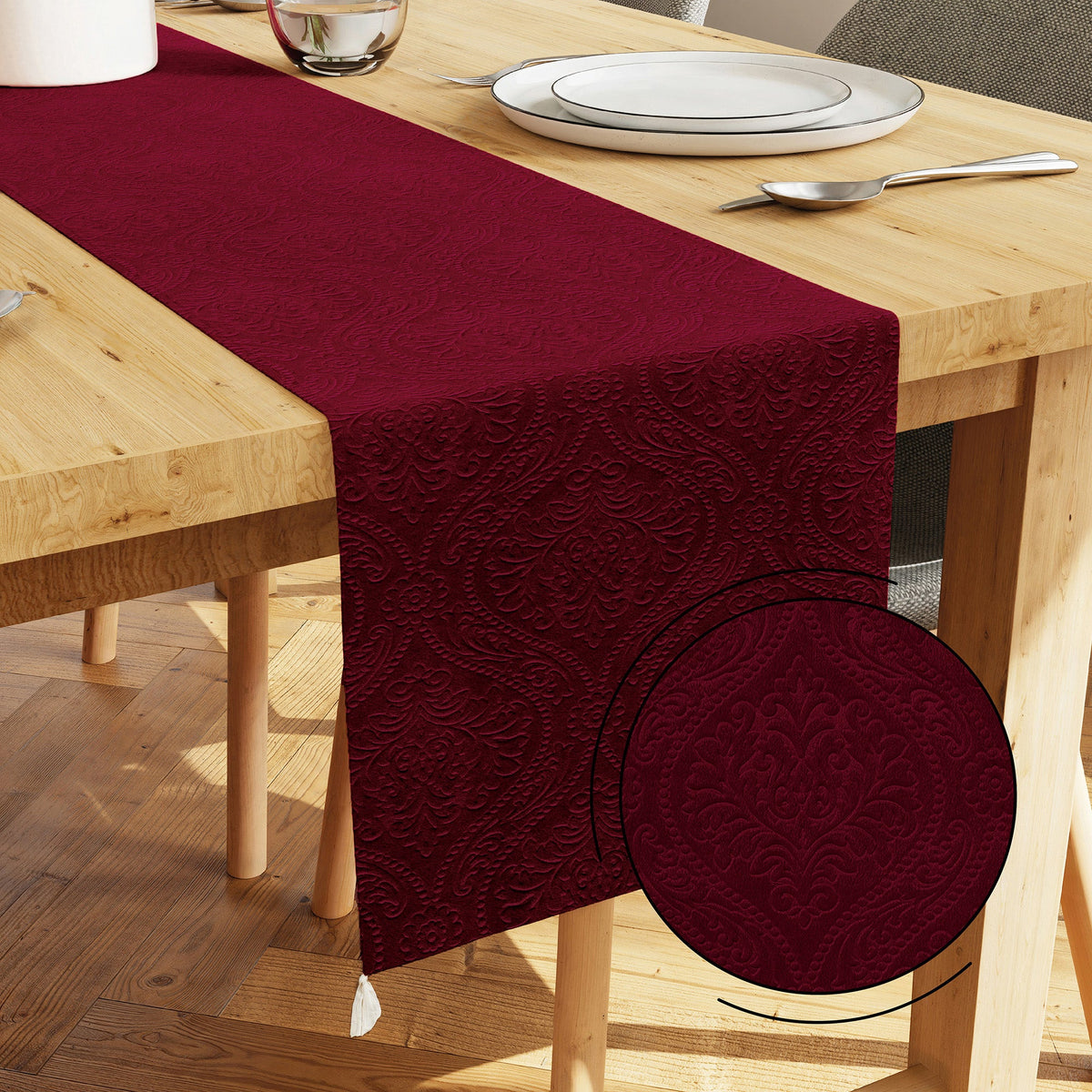
That changes what makes a good runner. Velvet and embroidered runners are lovely at a seated table, but a velvet pile holds turmeric and oil, and you don't want to wash it the morning after. A woven grass runner suits a buffet better. The Madur Kathi Red runner is handwoven from river grass, sold as heat resistant, and cleaned with a damp cloth rather than a wash, so a dal drip wipes off. The red border also looks festive without competing with the food. It comes in 32x150 cm, about ₹439, and 32x240 cm, about ₹659.
Size it to the table. Our table runner size guide gives 150 to 180 cm as the typical top length of a 6-seater table. A 180 cm table with the 240 cm runner leaves 30 cm hanging at each end. At a seated table that is a deliberate drop; at a buffet table it is a tail that guests brush past and drag. Fold the ends under so the runner stops just short of the table edge, or use the 150 cm length and centre it under the main dishes.
Trivets under every hot pot

Count your hot dishes, then add one. A typical Diwali buffet has the dal, a paneer or vegetable dish, rice or pulao, and puris or something fried, often in the same kadhai or handi they were cooked in. Each of those needs a trivet, and the spare is for the second batch of puris that comes out halfway through.
Before you buy, measure the flat base of your biggest serving pot. The Cotton Sage trivets are 18 cm across and 0.5 cm thick, in packs of 3 (about ₹299) or 6 (about ₹499). A pot whose base is about that size or smaller sits well on one. A wide handi or a big kadhai can sit on two trivets side by side, which spreads the weight and keeps the rim of the pot off the runner.
A thin cotton trivet is for serving heat, not for a pan straight off a high flame. Let a kadhai sit on the stove for a little while before it goes to the table, or stand it on a steel plate on top of the trivet. Cotton protects the table from a hot dish. It is not meant to be a hotplate.
The 11-piece combo, and where its pieces go at a buffet

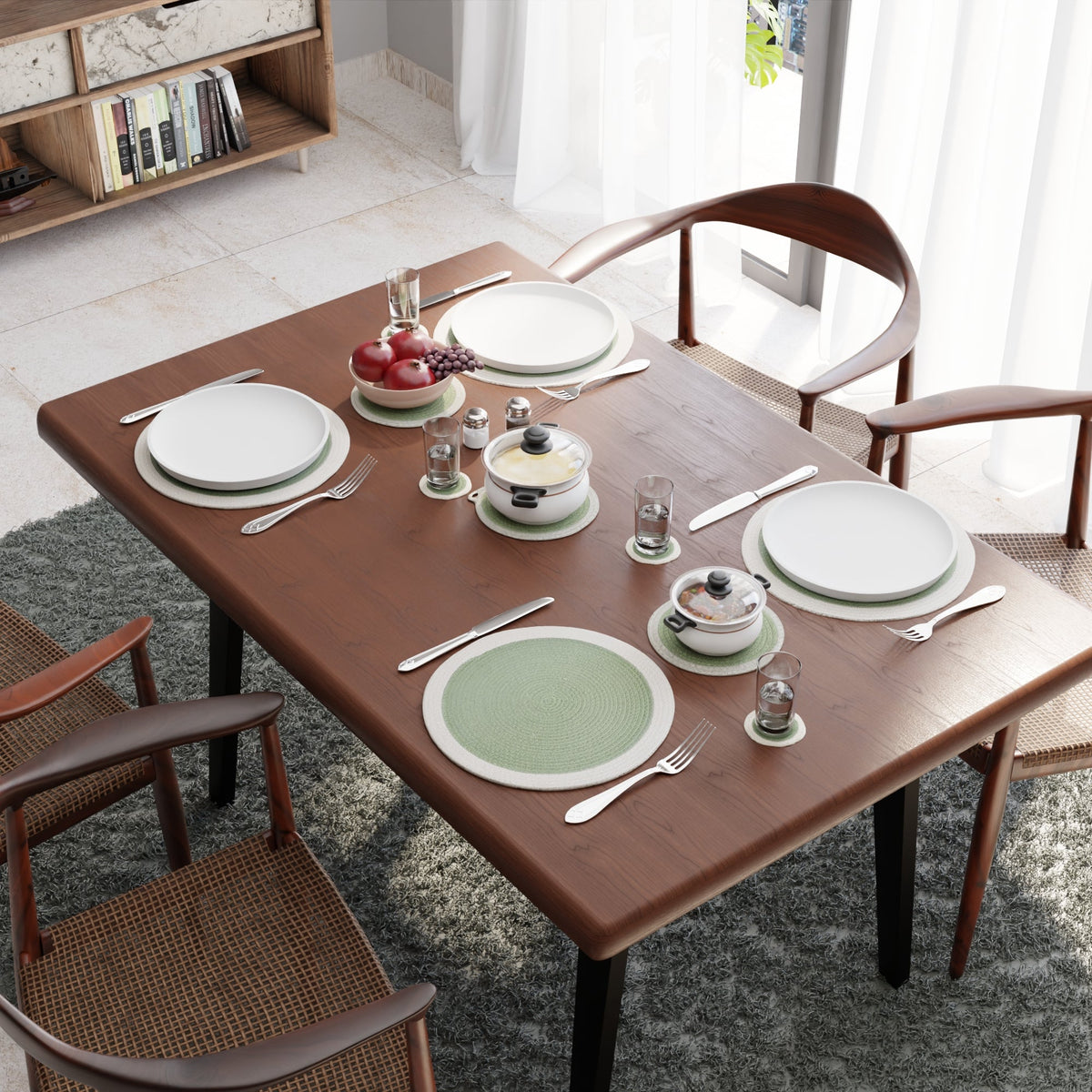
The Cotton Beige & Off White dining combo is a set of 11 ribbed cotton pieces for about ₹999: 4 round placemats (33 cm on the size drawing), 4 coasters of 9 cm and 3 trivets of 18 cm. It is sold as a four-place dining set, and for a family of four that is exactly what it is. At a buffet, use it differently. The three trivets go under the hot dishes. Two of the placemats go in front of the dal and the main curry, as landing spots for the ladles. The other two sit under the cold dishes, the raita and the salad, which sweat onto the table as they warm up. The four coasters go on the drinks counter. The same set also comes in sage and grey, if the beige doesn't suit your table.
One thing to know about cleaning: the combo page says the placemats and trivets can be machine or hand washed, while the standalone trivet listing says hand wash only. Hand wash the whole set and you won't go wrong.
Coasters: count the surfaces, not the guests
Glasses at a buffet don't stay on the drinks table. They end up wherever people stand and talk: the coffee table, the side tables, the shoe cabinet near the door, the window sill. Walk around the room before the party and count every flat surface where someone might put a glass down. Two or three coasters per surface is a fair rule, more on the coffee table.

For a living room with a coffee table, two side tables and a console, that comes to around ten or twelve coasters, which is far more than the four in the combo. The Cotton Off White coasters come in packs of 6 (about ₹399) or 12 (about ₹699), 9 cm across, in the same ribbed cotton as the combo. Cotton absorbs the water that runs down a cold glass, which is the thing that marks wood. If off-white feels risky with a room full of guests, the coaster collection has darker solid colours in the same size. Our tea coaster guide compares cotton with cork and wood.
Napkins: two sizes, two per guest
A buffet goes through napkins faster than a seated meal. People take one with the snacks, another with the main course, and a fresh one when the sweets come out, because the first is already stained with oil and chutney.
Plan for two sizes. Small 23x23 cm cocktail napkins work for the snacks and drinks part of the evening, when people are holding a glass and something fried. Full 43x43 cm dinner napkins are for the main meal, when a plate is balanced on a lap. Our table napkin size guide has the details. Count two dinner napkins per guest. For fifteen guests that means thirty, so three packs of twelve, with a few to spare.
The Cotton Deep Red napkins come in packs of 12 in both sizes, 43x43 cm (about ₹999) and 23x23 cm (about ₹809). A deep red hides turmeric and chutney better than white or beige, and stays festive under warm light. The cocktail napkins collection has the small size in other colours if red doesn't suit your table.
Festive table decor for a buffet of 15, item by item
| Where | What goes there | How many for 15 guests | Why |
|---|---|---|---|
| Serving table | One runner under the line of dishes | 1 | Catches drips where the ladles come down |
| Under hot dishes | 18 cm trivets | One per hot dish, plus one spare | The pots stand there all evening |
| In front of main dishes | Round placemats as ladle rests | 2 to 3 | Stops the ladle drip from reaching the runner |
| Living room surfaces | 9 cm coasters | 2 to 3 per surface | Glasses get put down everywhere |
| Snacks and drinks | 23x23 cm cocktail napkins | 15 to 30 | Small, for one hand and one glass |
| Main meal | 43x43 cm dinner napkins | 30 | Two per guest, one for each round |
If you're having a seated meal for close family on Diwali night and a buffet for friends the next day, the two need different setups. Our Diwali table setting guide covers the seated version: layering order and keeping diyas at a safe distance from the cloth.
The morning after
Deal with the napkins first. Oil and turmeric set into cotton the longer they sit, so pre-treat stains with dish soap and soak them before a wash. Wipe the madur runner with a damp cloth and let it dry flat; don't fold it while it is damp. Hand wash the cotton trivets, coasters and placemats in mild soap and let them dry fully before stacking. If a diya or candle dripped wax onto the linen, our wax, oil and rangoli stain guide has the steps.
Questions people ask about Diwali party table linen
Do I need a tablecloth under a buffet?
Usually not, as long as a runner and trivets cover the line of dishes. A full cloth earns its place on a table whose surface marks easily, but it can slide when people lean on the edge to serve.
How many napkins do I need for a Diwali party of 20?
Plan on about 40 dinner napkins, two per guest, plus a set of smaller cocktail napkins if you're serving snacks and drinks before the meal. In packs of 12, that's three or four packs of the dinner size.
Can I put a hot kadhai straight on a cotton trivet?
Wait until it has stood off the flame for a bit. At half a centimetre thick, the cotton is there to keep a serving dish from marking the table, and a pan that has just left a high flame is a lot hotter than that. If the kadhai has to come straight to the table, a steel stand or a wooden board under it is the safer choice.
What festive table decor works without crowding the food?
Keep the decor at the ends and the back of the serving table, not between the dishes. A runner in a festive colour, a few marigolds at one end and diyas on a separate shelf or ledge, away from where people reach across, give a festive look and leave room to serve.

Leave a comment
This site is protected by hCaptcha and the hCaptcha Privacy Policy and Terms of Service apply.