
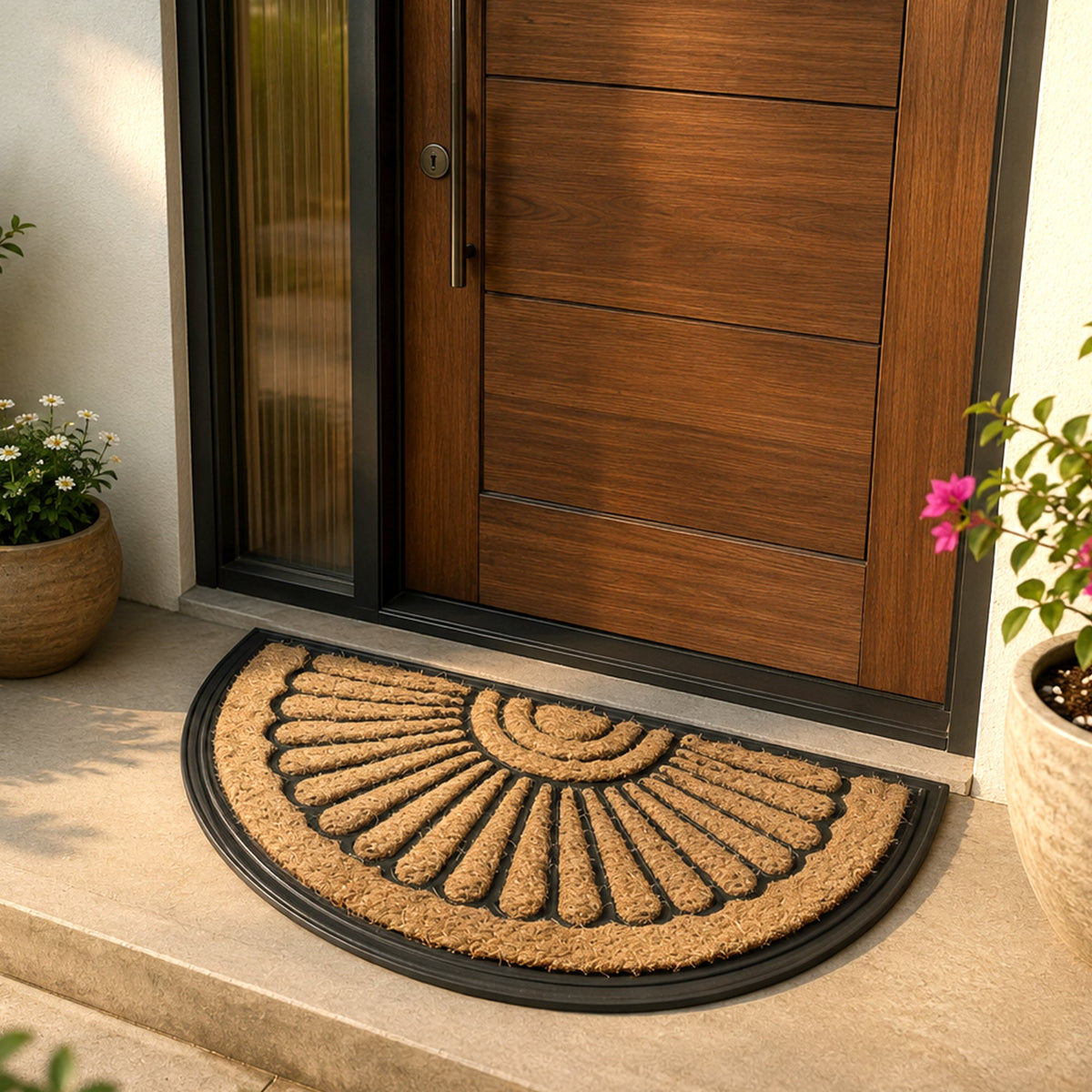
In some households the coir mat goes out to the balcony every Sunday, gets hung over the railing and hit a few times with whatever is to hand, because that is how it was done at home. In others it has not been touched in years, on the reasonable grounds that it never looks any cleaner afterwards. Coir is the one mat in the house that visibly holds on to dirt, and neither household has ever been told which of them is closer to right.
A coir doormat is coconut husk fibre, stiff enough to knock dried mud off a shoe sole and cheap enough to replace when it gives out. Most of the mats in our own range are 60x40 cm or 45x75 cm and cost between ₹500 and ₹800. It is a good buy for an entrance that stays covered and dries out, and a poor one anywhere it cannot, which is the part the listings tend to leave out.
That last line is not a hedge. The coir strand copes with wet far better than you would expect. The finished mat, with a sheet of PVC bonded across its underside, does not. That gap is where coir mats go wrong.
What a coir doormat is made of

Coir is the fibre packed between the outer skin of a coconut and the hard shell. Getting it out is slow, wet work. The FAO's account of coir fibre processing describes husks retted in ponds of brackish water for three to six months, which softens them, after which the fibre is beaten free, usually by hand. The same document puts brown coir at about 35 per cent cellulose and 32 per cent lignin, a high lignin figure for a plant fibre, and says its resistance to microbial degradation and salt water is unique.
Lignin is the stiffening in a plant's cell walls. It is why the strand is hard instead of soft, so it is why coir scrapes and why cotton does not, and it is why coir rope and coir netting are used in wet ground without simply dissolving. Worth holding on to, because it is not the same statement as "a coir doormat is fine wet". One is about a strand. The other is about a strand with a plastic sheet glued under it.
Everything you see on a coir mat sits on top of that fibre as dye or print, which changes how wear shows. A plain mat like the undyed Coir Natural simply thins in the middle. On a printed one the pattern breaks up as well, and direct sun tends to bring that on sooner.
The sizes and prices coir doormats come in

Our own door-mat collection runs to 24 products and 15 of them are coir, in plain dyed colours, printed borders and half-round shapes. Three sizes cover all 15.
| Size | Which coir mats come in it | Selling price |
|---|---|---|
| 60x30 cm | one printed mat sold singly, plus a plain mat in a ten-pack | ₹499 single, ₹2,499 for ten |
| 60x40 cm | every rectangular mat sold singly | ₹549 |
| 45x75 cm, listed as 75x45 on everything but the plain colours | plain dyed colours at ₹689; printed borders, the Welcome Leaf and the half-rounds at ₹789 | ₹689 to ₹789 |
The bottom row catches people out. That 45 by 75 cm mat is written 45x75 on the plain colourways and 75x45 on the printed ones, so two listings that look like different sizes often are not. At that size, the printed border costs ₹100. The Greek Key Natural listed at 75x45 cm for ₹789 and the solid Coir Red listed at 45x75 cm for ₹689 are the same footprint, the same fibre and the same backing. The border is surface colour rather than a different weave, so the extra hundred buys the pattern.
Nothing in the coir range goes above 45x75 cm. A wide double-door entrance needs more mat than this line makes, and our doormat roundup names an outside brand for that job. There is also one bulk listing, ten plain 60x30 cm mats for ₹2,499, near ₹250 a mat against ₹499 for the only 60x30 cm sold on its own. That is a landlord or an office manager's buy.
Does a coir doormat need a backing?
Two coir mats can scrape identically and then behave completely differently on your floor, and the difference is underneath. A backed mat has a PVC sheet bonded across the base. Loose coir, the kind still sold at hardware shops and roadside stalls, is fibre and nothing else.
What the backing buys is ordinary and useful. The mat stays where you put it on smooth tile, marble or stone instead of skating off when someone wipes their feet properly. Grit that works down through the pile sits on plastic rather than on your floor, and an edge bound into something frays more slowly than a raw cut edge. What it costs you is drainage. The sheet is not permeable, so water that soaks into the pile has no route downwards and has to leave the way it came in.
All fifteen coir mats in our door-mat range list an anti-skid PVC backing on their product pages, so backed is the only version you can buy from us. The one that takes the idea further is the Coir Half Round Sunrise, where the coir sits inside a moulded rubber rim instead of stopping at a cut edge, and its own size drawing puts the mat at 1.5 cm thick at that rim. A held-in edge matters most at a door that sweeps across the mat twice a day, which is where plain-edged mats start to shed from the corner in. It is listed at 75x45 cm for ₹789.
Where a coir doormat can dry, and where it cannot
A product page that says "suitable for outdoor use" is describing a porch, a balcony and a building corridor as though they were one address. They wear a coir mat out differently.
An independent house porch takes the full downpour, and the mat gets properly soaked, sometimes more than once on a bad monsoon day. It usually gets sun and moving air for the rest of that day, so it comes back from each soaking. A covered corridor outside a flat door does not get rained on. It also gets little sun, little air movement, and often a wet mop going past. For rain the corridor is plainly the safer address. For drying it is the worse one, because the mat tends to stay a little damp and rarely gets right through to dry.
The fibre is not rotting through any of this. Lignin sees to that. What goes wrong is water sitting between densely packed coir and an impermeable backing with nowhere to drain, which is where the smell starts and why the pile goes flat and greasy instead of springy. No cleaning routine fixes it, because it is a question about the doorway rather than about the mat.
How do you clean a coir doormat?
The order matters more than the effort, because each step reaches a different depth of the pile.
- Shake it out, every few days. Turn it face down over a railing or a step, well away from the door you just cleaned, and let the loose surface dust drop. This is the only step that needs doing often.
- Vacuum it about once a week, with the brush attachment fitted. This lifts the finer dust and sand that has worked down between the fibres, which shaking will not reach. Go against the lay of the fibre as well as along it.
- Beat it occasionally, not weekly. Face down, outdoors, for grit that is packed into the base of the pile. Beating is literally the action used to free coir from the husk in the first place, so it does pull fibre out. That is the reason to keep it occasional, and it is also the only thing that shifts deep sand.
- Spot-clean a stain with a cloth, a little mild detergent and as little water as you can manage. Blot, do not scrub.
- Turn the mat end for end every few months. People walk the middle of a doorway, so the middle flattens first.
You will find advice online saying never to beat or brush a coir mat at all, because it destroys the fibre. Beating does pull fibre out, so the warning is not invented. Taken as a blanket rule, though, it leaves you with nothing that reaches packed sand. Spend the beating on that and not on habit.
What does not belong anywhere in that list is soaking, hosing or a washing machine. Water enters a coir mat through the pile much faster than it leaves through a PVC-backed underside. If a mat does get drenched, bring it inside, stand it on edge where air can reach both faces, and let it dry all the way through before it goes back down.
When to skip coir altogether

Some entrances beat coir whatever you do. An uncovered balcony ledge takes rain directly with no cover at all. A ground-floor doorway where water pools in a downpour puts the mat in standing water rather than under it. A corridor that gets mopped daily right through the monsoon never offers a dry window at all. None of that is solved by cleaning the mat better, or by buying a better coir mat.
Moulded rubber is. The Rubber Black 1 Door Mat is an oval with a studded black centre inside a scrolled bronze-brown rim, 45x75 cm at ₹749, and its page states that it handles rain, mud and moisture without rotting, smelling or degrading, and that you can wash it with a hose. Nothing in the coir range says that.
Questions people ask about coir doormats
Is coir or jute better for a doormat?
For scraping shoes, coir, by a distance. Jute is finer and softer, which makes it pleasant underfoot and weak at knocking dried mud off a sole. One thing to know while shopping here: all fifteen of our coir mats carry a "jute carpet" tag in the catalogue, and that is a shop tag rather than a material. We sell exactly one genuine jute mat, the Jute Half Round Natural, a handwoven braided rope piece listed at 75x45 cm for ₹789. It is decorative rather than a scraper.
Can you wash a coir doormat with water?
Not by soaking, hosing or machine washing. Coir absorbs readily and a backed mat has no way to drain, so the middle stays wet long after the surface looks dry, and that is where the smell begins. A damp cloth on a mark is as wet as one should get.
Why does my coir doormat smell after the rains?
Trapped moisture, not decaying fibre. Water held between packed coir and the backing sheet gives mould something to live in, and the smell follows within days in humid weather. Standing the mat on edge indoors until it is dry through usually clears it. If your entrance never allows that, the mat is in the wrong place rather than in the wrong condition.
How long does a coir doormat last?
Longer under cover than out in the weather, and no honest single number covers it. What finishes most coir mats is not the fibre failing. It is the middle of the mat getting trodden down until it stops scraping, and the edge fraying where the door drags over it. Both arrive sooner on a mat that spends months damp than on one that dries between soakings.
Encasa XO is our own brand, and the mats named above are ours.

Leave a comment
This site is protected by hCaptcha and the hCaptcha Privacy Policy and Terms of Service apply.