
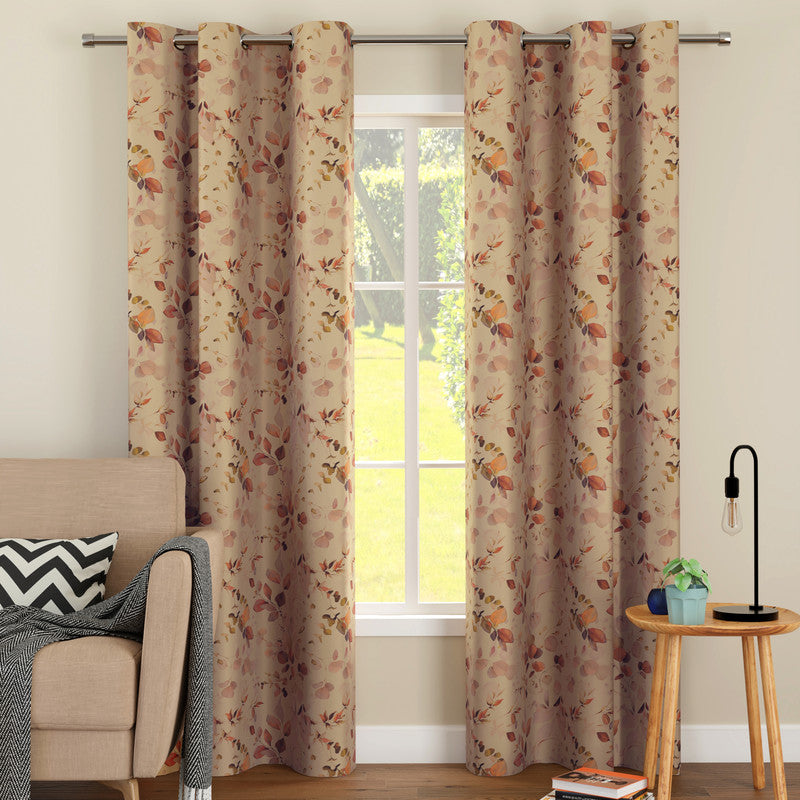
A door frame in an Indian flat usually stands about 210 cm tall, a shade under seven feet. That is why door curtains are sold at seven feet, and for an ordinary bedroom door, main door or internal door, seven feet is the size to buy.
Nine feet is a different job. It belongs to openings genuinely taller than a door: a full-height balcony slider, a French door running close to the ceiling, or a rod fixed near the ceiling instead of just above the frame. If you are standing in front of a normal door wondering whether to size up, the answer is no.
What settles it is the height of the rod, not the height of the door, and a door gives you much less room to move a rod than a window does.
The four doorways people mean by door curtains
Shops sell all of it as one category. Four fairly different openings hide behind that label.
The main entrance does privacy work while the door is open, which happens more often than people plan for: the delivery, the milk, the person who has come to fix the geyser. It gets pushed aside by hands that have just been in the kitchen. If your entrance door opens inwards, as many flat doors do, the curtain also hangs in the path of the swinging door, so the brackets have to stand the rod far enough off the wall for the open door to pass behind it.
A balcony or sliding door is the tall, wide one, taking the afternoon sun and the rain that blows in sideways during the monsoon. With the door open and a fan running, a light panel lifts, wraps around the grille and ends up outside in the wet. A partition, splitting a hall or screening a study corner, stays closed most of the day, so how it hangs matters more than how it slides.
The kitchen doorway gets the least thought of the four, though a great many flats have one: an opening with no door in it at all. That curtain hides the mess and slows the smell of the tadka reaching the sofa while still letting air move, and it gets washed more often than any other panel in the house.
| Doorway | The length that usually fits | What decides the buy |
|---|---|---|
| Main entrance door | 7 ft | Daytime privacy, and fabric that survives handling |
| Balcony or sliding door | 9 ft, or 8 ft if the opening stops short of the ceiling | Light, heat, and width enough to close |
| Kitchen doorway with no door | 6 or 7 ft | How fast it washes and dries, and airflow |
| Room partition | 7 ft, or 9 ft under a ceiling-height rod | How it hangs, closed all day |
When do you need 9 feet curtains instead of 7 feet curtains?
A curtain's length is a drop, measured from the rod down to where you want the hem, which is why the step-by-step measuring method starts at the rod rather than the frame. Over a window you can lift the rod 10 to 15 cm and the drop grows with it. Over a door there is far less wall above the frame, so the rod lands close above it and the drop is decided for you. A door frame around 210 cm, a rod fixed 10 cm above it, and you are hanging from 220 cm off the floor. Here is what each ready length does from that rod.
So the 7 ft panel is not a rough fit at a door. It is cut for exactly this rod. The 5 ft window length leaves a gap you could post a parcel through, and 9 ft puts half a metre of fabric on the floor to collect dust. Between them sits an 8 ft length that many ranges carry and the 7-or-9 question skips over, for openings taller than a door but short of the ceiling, which is what a lot of newer flats have at the balcony. Nine feet makes sense from about 275 cm of rod height upwards, which means a floor-to-ceiling slider or a ceiling-mounted rod. In between, at a rod near 255 cm, nothing lands well: 8 ft floats a hand's width off the floor, 9 ft heaps on it, and you pick the compromise that annoys you less.
Check the size dropdown before you fall for a print. Nearly every range in the curtain collection offers a 7 ft door length and far fewer go all the way to 9 ft. The cotton mint green pack stops at 7 ft, which is fine for a bedroom door and no use at all for a balcony. The blackout L1 orange pack runs the whole ladder from 5 ft to 9 ft, its door and long-door sizes between roughly ₹2,300 and ₹2,800, which is the easier buy when two openings in one room want matching fabric at different heights. For the windows in that room, the curtain size guide walks through where each hem lands.
How many panels does one door need?

Width is a separate sum, and it starts at the rod again: rod width times 1.5 for the minimum, or times 2 for a fuller look, divided by the flat width of one panel and rounded up to a whole pack.
Two things make a door different from a window here. The overhang is often lopsided, because doorways sit in corners, next to switchboards or behind a shoe rack, so you may get 15 cm of rod past one side and 5 cm past the other. And panel widths vary more than people expect: across the Encasa packs named here, the blackout polyester panels are 117 cm wide, the cotton ones 137 cm, the printed polyester twill 142 cm. Same rod, same pack of two, three different results.
Take a single door leaf, commonly about 91 cm of opening and roughly a metre of frame. Add a modest overhang and the rod is near 130 cm, so the minimum flat fabric is 195 cm. A pack of two 117 cm panels gives 234 cm, or 1.8 times the rod; a pack of two 142 cm panels gives 284 cm, or 2.18 times. Both land where you want them, so one pack does a normal door whichever of these you pick.
The main door of a flat is where that stops being true. Say 137 cm of opening and a rod near 176 cm: the minimum is now 264 cm of flat fabric. Two 117 cm panels give 234 cm, only 1.33 times the rod, and will hang closer to a flat sheet than a curtain. Two 142 cm panels give 284 cm, or 1.61 times, and look right. A second pack of the narrow ones takes you to 468 cm, or 2.66 times, heavy and expensive but full. On a wide door it is the flat width of one panel that settles the buy, rather than the price.
Packs of two do not cover the third case, the doorway you want one panel on, swept to a side and tied back. The canvas white single panel is 137 cm flat and ₹1,200 to ₹1,300 in any of its three lengths, which on a 110 cm rod is about 1.25 times the rod width. Closed, it reads as a drape rather than a gathered curtain, which suits a partition and disappoints anyone who wanted folds. When your own sum lands between packs, the fullness guide works that problem through for windows.
Fabric at a door is mostly a handling decision

A window curtain is chosen for light and looks. A door curtain is chosen for those and for how often a hand lands on it.
Cotton takes that handling well and washes plainly. The cotton canvas range is mercerised Panama-weave cotton, described as moderately reducing the light rather than blocking it, and as not see-through from outside, which is the balance an entrance wants: privacy without a dark hallway. What it does badly is dry. In the monsoon a heavy cotton panel can leave a doorway bare for a day or two.
Triple-weave blackout polyester hangs straight off the pack without ironing, and the twigs beige pack, around ₹2,500 in the door lengths, is described as cutting about 85% of daylight. Right for a bedroom door, or the west-facing balcony that turns the room into an oven by four in the afternoon. Heavy at a front door, and wrong for a doorway that also needs air.
Light printed polyester is the cheap, fast-drying choice, and it belongs at a kitchen doorway or a partition. At an entrance it depends on the shade: a thin pale panel shows a silhouette from the corridor, which is the one thing an entrance curtain is there to stop.
Eyelets or a rod pocket at a doorway?

At a window, the heading is mostly about how the top of the curtain looks. At a door you feel it, because the fabric gets moved several times a day rather than twice.
Both go on the same way. Eyelets are closed metal rings punched into the top edge, six or eight a panel, so the rod threads through them exactly as it threads through a sewn pocket: rod down, panel on, rod back up. Check the ring's inner diameter against the rod you already own, since a ring that will not pass over it makes the rest of the decision academic.
The difference shows up in use. Eyelets glide, because the ring is round and hard against the rod, so a panel opens one-handed, mid-panel, with a tiffin in the other hand. A pocket is a continuous sleeve and it grips, which is why the reverse leaf green pack, under ₹1,000 a pack in every size including 9 ft, has a tie-back stitched to the centre of each panel: you tie it back in the morning rather than sliding it. That sleeve also has to clear the hardware. A long rod over a main or balcony door usually takes a support bracket mid-span, which a continuous pocket cannot pass, so the panel ends up on one side of it. Eyelet panels split either side of the bracket and close over it. The heading is one of four ways ready-made curtains differ, alongside light control, fabric and length, all set out in our guide to the types of curtains.
Curtains for a kitchen doorway with no door
Plenty of Indian kitchens open off the living room through a plain doorway, and that curtain has its own job list: slow the smoke and the smell, screen the counter, and still let air move, because a kitchen with no window and no airflow is unbearable by the second roti. Wash frequency decides the fabric here, since oil in the air settles on anything hanging near a hob.
Length is worth rethinking too. A hem sitting a centimetre off the floor looks right in a living room and is a nuisance here, where it collects atta dust and gets stepped on. From a door-height rod a 6 ft panel leaves roughly a 37 cm gap at the bottom, which sounds wrong on paper and works in practice. Save the floor-length drop for the doors people look at.
Frequently asked questions
What size curtain do I need for a door in India?
Seven feet, or 213 cm. That length is cut for a rod fixed just above a normal 210 cm door frame and leaves the hem a few centimetres clear of the floor. Measure your rod height first and pick the ready length just above the number you get.
What is the difference between a 7 ft and a 9 ft door curtain?
Only the drop. A 7 ft panel is 213 cm long and a 9 ft panel 274 cm, in the same fabrics and widths. Nine feet is meant for rods around 275 cm and above: full-height balcony doors, French doors and ceiling-mounted rods.
How many curtain panels does one door need?
For a single door, a pack of two is normally right. For a wider main or double door, the flat width of one panel settles it: the packs named above run 117 cm to 142 cm, and on a 176 cm rod that gap is the difference between a gathered curtain and a flat one.
Can I use the same curtains for a door and a window?
Yes, if the window is floor-length or the rod sits high above it: a 7 ft panel over a standard window reaches the floor. The other direction fails, because a 5 ft window panel at a door leaves a gap no styling fixes.

Leave a comment
This site is protected by hCaptcha and the hCaptcha Privacy Policy and Terms of Service apply.