
Walk down the kitchen aisle of any Indian home store and the aprons on the rail are, almost without exception, cotton. Look for a linen one and you will usually find it in the home decor section instead, styled for a photo rather than a stove, and priced two or three times over. That split is not a marketing accident. It comes from how each fibre behaves once oil, turmeric and a hot wash cycle get involved.
Linen is not a bad fabric, and it is tougher than its delicate reputation suggests. It breathes well over a long stretch at the stove, a tightly woven piece sheds a quick splash before it soaks through, and flax has been the fabric of boil-washed household linen for centuries. The case for cotton is narrower than "linen is weaker", and it is mostly about what you can actually buy and how an apron gets treated. For daily cooking that involves a tadka, a fry-up or a turmeric-heavy gravy, a woven cotton apron in a protective weight, roughly 200 gsm or heavier, is easy to find, costs noticeably less, and stands up better to being crushed, tied and yanked off a hook every day. Linen earns its keep elsewhere: a lighter kitchen routine, cooler wear, and a look you are willing to iron for.
What actually separates cotton and linen at the fibre level
Both are plant fibres, which is where the similarity mostly ends. Cotton fibre is short and naturally curled, with a hollow channel running through its centre. That hollow core is why cotton takes up liquid readily and feels absorbent against skin, and it is also why cotton spins easily into the dense, heavy weaves an apron needs: twill, ticking stripe, canvas.
Linen comes from the stem of the flax plant rather than a seed pod, so the fibre is long, straight and considerably stronger than cotton when dry. It also has a smoother outer surface, which is part of why linen fabric has that characteristic cool, slightly stiff hand. Flax fibre takes up moisture readily too, arguably more readily than cotton, but it also lets go of that moisture faster along its smooth length. That is the real source of linen's reputation for feeling cool: not that it resists getting damp, but that it dries out again quickly once it does.
The weight difference matters more for an apron than either of those facts on their own. Cotton spins comfortably into heavy, tightly packed weaves at a range of prices, which is why Encasa's own aprons run in the ticking, butcher-stripe and canvas families rather than a thin shirting cotton. Linen at that same protective weight exists, but it is uncommon and expensive to produce; most linen sold as kitchenwear is the lighter apparel-weight cloth, built for a summer shirt rather than a splatter zone.
Does either fabric actually resist oil and turmeric?
Not in the way people assume. Turmeric's dye, curcumin, bonds to cellulose, and both cotton and linen are cellulose fibres, so neither one is naturally turmeric-proof. A fresh splash will mark either fabric almost as fast.
What genuinely differs is how the two behave in the first few seconds after a splash lands, and that comes down to weave more than fibre. A tightly packed weave, cotton canvas or a dense linen if you can find one, lets oil bead and sit on the surface for a moment before it works its way in, giving you a window to wipe it off. A loose, open weave, which is the norm for the linen actually sold as apron fabric, lets oil straight through to whatever is underneath almost immediately. So the honest comparison is not cotton fibre against linen fibre. It is a tightly woven cotton apron against the loosely woven linen apron you can actually buy, and on that comparison cotton at a protective weight is the safer everyday choice. A butcher-check canvas is the tight-weave end of that spectrum.

Wrinkle behaviour, and why it is not just cosmetic
Linen creases the moment you sit down in it and does not spring back on its own; that is simply how a stiff, low-elasticity fibre behaves. Cotton, especially a twill or canvas weave with some body to it, resists creasing far better and looks reasonably presentable pulled straight off a hook. For most garments this is purely about appearance. For a kitchen apron it is closer to a practical question: something you grab one-handed on the way to the stove and never actually iron needs to hold its shape without help, and cotton simply does that more reliably than linen.
The laundry question, and where linen actually gives way

A turmeric stain that has dried in overnight rarely comes out in a cool, gentle cycle. It typically needs hot water, a proper scrub or soak, and sometimes a spoon of oxygen bleach, and it may need that treatment more than once before the yellow is fully gone.
The intuitive answer is that linen must be the weaker fabric here, and that is wrong. Flax is stronger than cotton fibre for fibre, and unlike almost every other natural fibre it gets stronger wet, by around a fifth. Hot water alone does not hurt it. Chlorine bleach does, but chlorine bleach is hard on cotton too, which is why oxygen bleach is the sensible choice for either fabric.
Where linen gives way is bending, not washing. Flax fibre is stiff and has very little elasticity, so it has poor flex-abrasion resistance: fold it repeatedly in the same place and the fibres crack along that line. An apron is a garment defined by exactly that abuse. It gets creased at the waist, knotted at the ties, bunched into a drawer or yanked off a hook, and put through a machine that tumbles all of those folds against each other. Cotton's shorter, curled fibres have enough give to survive that indefinitely. Linen wears at the ties, the hem and the waist crease first, and it does so whether you wash it hot or cold. Cotton is the standard fabric for kitchen textiles not because it out-survives linen in the water, but because it out-survives it in the wringing, folding and daily handling either side of the wash.
So does a cotton apron make sense for your kitchen
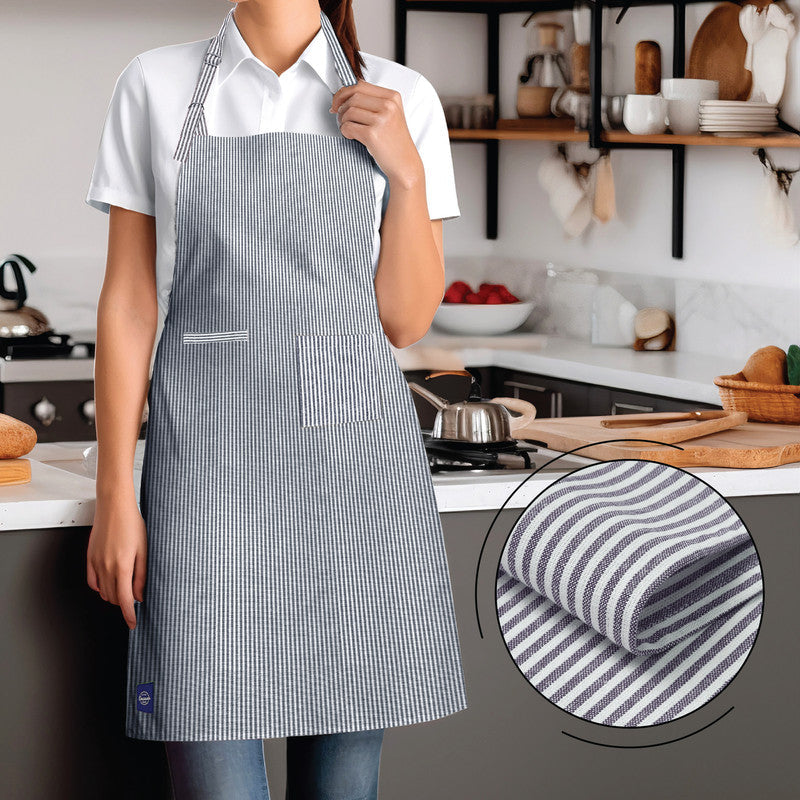
For anyone cooking most days, frying regularly and washing hot and often, a woven cotton apron around 200 gsm or heavier is the practical pick, and it is also the one you will find without hunting: Encasa's Aprons collection runs mostly in the ticking-stripe and butcher-check weaves that sit in that protective range. If you want the density of a workwear apron rather than a soft shirting feel, a ticking-stripe weave like this navy blue apron is close to that classic dense twill, and a butcher-check canvas is the same weight in a pattern that hides a stain better between washes. Both sit in the farmhouse apron collection, which is where the patterned heavyweights are gathered.

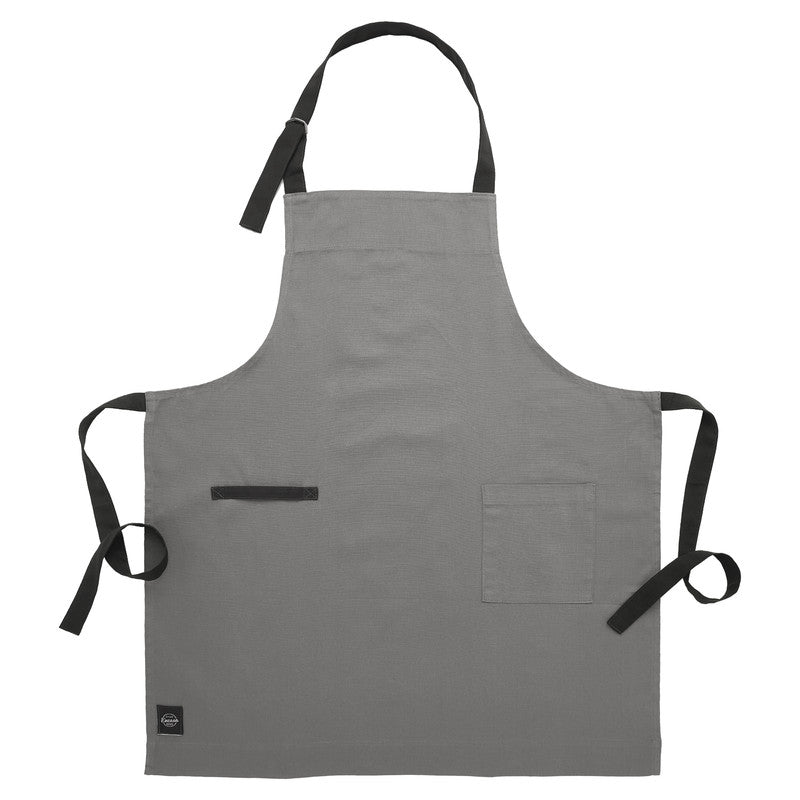
Weight is not what varies most across that range, though. A plain solid like the leaf green apron is in the same protective class as the patterned ones, so choosing between them comes down to colour and pocket layout rather than protection. What you would give up by going to linen is not a little coverage. It is that whole 200 gsm class, because the weight barely exists in linen at a price a kitchen apron can justify.
Fabric is only half the decision, though; shape, coverage and how an apron's length falls on your own height matter just as much, and that half is covered in our guide to choosing a kitchen apron for Indian cooking.
| Cotton | Linen | |
|---|---|---|
| Fibre source | Seed hair (cotton boll) | Bast fibre from the flax stem |
| Typical apron weight | Wide range, easily spun heavy (200 gsm+) | Usually lighter apparel weight; heavy linen is rare and costly |
| Common apron weave | Twill, ticking stripe, canvas | Plain weave, usually looser |
| Oil behaviour | Sits on surface longer in a tight, heavy weave | Soaks through faster in the typical open weave |
| Turmeric staining | Dye bonds to cellulose; stains readily | Dye bonds equally; no fibre-level resistance |
| Wrinkle recovery | Holds shape well, especially in twill or canvas | Creases readily, does not spring back |
| Wet strength | Gains slightly when wet | Gains more; around a fifth stronger wet than dry |
| Repeated folding and creasing | Fibres have give; survives daily crushing and knotting | Poor flex-abrasion; cracks along fold lines at ties, hem and waist |
| Price logic | Moderate; spins and weaves cheaply at weight | Higher; flax processing is slower and more labour-intensive |
Frequently asked questions
Is linen better than cotton for a kitchen apron?
Not for daily Indian cooking. Linen is cooler to wear and can shed a quick splash if the weave is tight, but most linen apron fabric is a lighter, more open weave that lets oil through faster. It also cracks along fold lines with repeated creasing, which is what an apron gets every day at the ties and the waist.
Does turmeric stain linen less than cotton?
No. Turmeric's dye bonds to cellulose, and both cotton and linen are cellulose fibres, so a fresh splash marks either one about as readily. The difference shows up afterwards, in how much hot washing and bleach each fabric can take to get the stain back out.
What GSM should a cotton apron be for cooking?
Around 200 gsm or heavier is a reasonable floor for daily frying and gravy-heavy cooking. Lighter cotton is fine for occasional or lower-splatter kitchen use.
Can a linen apron go through the same hot wash as a cotton one?
Yes. Flax is actually stronger wet than dry, and hot water on its own does it no harm; skip chlorine bleach and use oxygen bleach instead, which is the better choice for cotton too. What shortens a linen apron's life is not the wash temperature but the folding and knotting either side of it, since flax cracks where it is creased in the same place over and over.

Leave a comment
This site is protected by hCaptcha and the hCaptcha Privacy Policy and Terms of Service apply.