
Drop mustard seeds and curry leaves into hot oil and the pan answers back. A fine spray lifts off the surface and settles on whatever you are wearing. Later, a smear of haldi lands on your kurta while you are stirring, and three washes on, the yellow ghost is still there.
A good kitchen apron for Indian cooking is heavy cotton, roughly 200 gsm or more, covers you from chest to knee, and has adjustable neck and waist ties so one size actually fits. Expect to pay somewhere around Rs 450 to 500 for a solid everyday one. Colour and frills are the last thing to decide, not the first.
That order matters more than it first appears. An Indian kitchen puts two specific pressures on an apron that a tidy Western baking scene never does, and both of them are about protection. Get the protection right and the rest is preference.
What actually ruins clothes in an Indian kitchen?
Two things, mostly, and they are worth naming because they decide what you should buy.
The first is oil. Tadka is the culprit. The moment spices hit hot oil, tiny droplets scatter well beyond the pan, and deep-frying pakoras or pooris throws them further still. Those droplets carry heat and grease. On thin fabric they soak straight through to your clothes and skin; on the right fabric they sit on the surface and wipe away.
The second is colour. Turmeric is a dye as much as a spice. Once it works into a fibre it does not simply rinse out, and the same goes for a splash of rich gravy or beetroot. This is why an everyday cooking apron earns its keep by taking these hits so your clothes underneath never see them.
There is a third, quieter factor: time. Many Indian kitchens are warm and not air-conditioned, and a proper meal can mean forty minutes or an hour standing over the flame. Whatever you wear has to be bearable for that long, not just protective for the first five minutes. It is worth keeping in mind, because it complicates the obvious answer.
How much coverage do you really need?
Aprons come in two broad shapes. A bib apron loops around your neck and covers you from the chest down. A waist apron ties at the middle and covers the lower half only, like a long half-pinny.
For Indian cooking the bib wins, and frying is the reason. Oil that jumps out of a karahi does not politely stay below your waist. It reaches your chest and forearms. A waist apron leaves exactly the zone that gets hit most.
Length is where a real number helps. Most full aprons here run about 85 cm long in the body, on a width near 68 to 70 cm. On someone around 5 feet 4 inches, an 85 cm apron falls to roughly mid-thigh, which covers the danger zone comfortably. On a taller cook, say 5 feet 10, that same apron sits higher and leaves the lower thigh bare, and the lower thigh is right where droplets from a low pan tend to land. It is not that the apron is badly made. It is that a taller person should picture where 85 cm actually ends on their own frame before buying, and if two cooks of very different heights share one, expect the coverage to be a compromise for the taller one.

Does fabric weight matter? Cotton, canvas and chambray
It matters a great deal, and this is where the neat answer gets complicated.
Heavier cotton is better armour. A dense weave over about 200 gsm holds oil on the surface and puts more material between a hot droplet and your skin. It also feels sturdy and hangs well, so it does not cling. The trade-off is warmth. In a sealed, non-air-conditioned kitchen in May, the thickest apron you can find will make a long cook sweatier than it needs to be.
Cotton chambray sits at the other end. It is a lighter, breathable weave that stays cooler over a long session and often comes in prettier finishes, including a frilled edge. But lighter means thinner, and thinner means less of a barrier against hot oil. It is a lovely thing to wear while you knead dough or plate food; it is not the one to reach for before a big frying job.
Cotton canvas lands in between: a firm, medium-heavy weave that wipes down easily and takes daily wear without looking tired.
| Fabric | Rough weight and feel | Best for |
|---|---|---|
| Heavy cotton (around 200 gsm or more) | Thick, structured, warmer to wear | Tadka, deep-frying, long stove sessions |
| Cotton canvas | Firm, medium-heavy, easy to wipe | Everyday all-round kitchen work |
| Cotton chambray | Lighter, cooler, thinner barrier | Lighter cooking, style, gifting |
Here is the caveat that the weight rule alone misses: the heaviest apron is not automatically the best one for you. If your cooking is mostly frying in short bursts, go for the armour. If you spend long stretches at a warm stove, a slightly lighter apron you will actually keep on beats a heavy one you shrug off after twenty minutes because you are too hot. Protection you abandon is not protection.
Matching the kitchen apron to how you cook
With the mechanics settled, the choice becomes about your own kitchen.
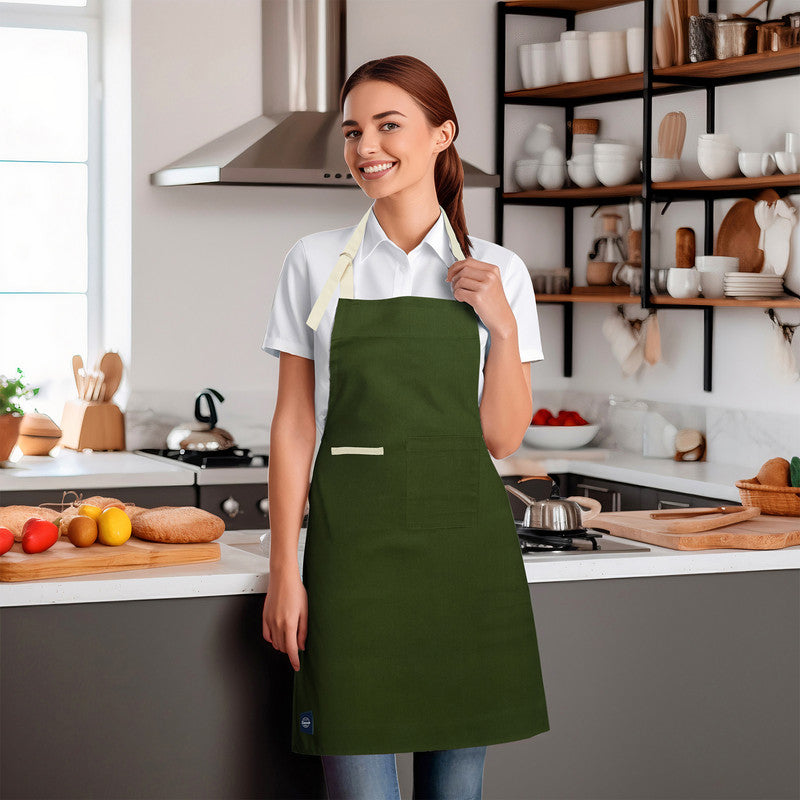
If you cook Indian food most days, with regular tadka and frying, buy for coverage and convenience. That means a heavy cotton apron, chest to knee, with a front pocket for your phone or a spoon and a small loop to hang a kitchen towel within reach. The cotton leaf green apron and its plain grey sibling fit this exactly at around Rs 449: over 200 gsm, roughly 68 by 85 cm, with adjustable neck and waist ties and a stain-resistant finish that shrugs off the worst of the splashes.
If you want something that looks good hanging in the kitchen, or you are buying a gift, the cotton blue chambray apron and its red partner are the ones to consider, at about Rs 499 with a frilled floral edge and two large pockets. Be clear-eyed about the trade: chambray is cooler and prettier, and it is a thinner barrier than the heavy cotton. It is style first, armour second.

If you bake, or you are forever pulling hot trays and heavy karahis off the flame, an apron alone will not save your hands. A set that pairs the apron with a quilted oven glove and a heat-resistant pot holder answers the whole problem at once. The cotton ticking three-piece set does this for around Rs 699, and if you already own an apron you like, the oven gloves on their own close the gap.
Still weighing it up? The full aprons collection lets you compare colours and cuts side by side once you know which fabric and coverage you are after.
Getting turmeric out, and keeping it off in the first place
Once you own the apron, two habits keep it usable.
Treat turmeric stains quickly. The longer the dye sits, the deeper it sets, so rinse and wash a fresh splash sooner rather than leaving it for laundry day. The old kitchen trick helps here, too: turmeric fades in direct sunlight, so dry a stained apron out in the sun rather than in the shade and the yellow lifts over time.
Prevention is easier than cure, and this is where that little towel loop earns its place. Hang a kitchen towel from it and you will wipe your hands on the towel instead of smearing them down the apron front, which is an easy way for deep stains to build up. A set of absorbent cotton kitchen towels beside the stove keeps both your hands and the apron cleaner for longer.
FAQ
What size kitchen apron should I buy?
Most aprons here are one size with adjustable neck and waist ties, so the fit is not the worry; the length is. Bodies run around 85 cm, which reaches mid-thigh on an average build and higher on a tall one. If you are on the taller side, picture where 85 cm lands on you before buying.
Cotton or chambray for everyday Indian cooking?
For daily tadka and frying, heavy cotton is the safer pick because it holds oil on the surface and puts more fabric between the heat and your skin. Chambray is lighter, cooler and better looking, which suits lighter cooking or a gift, but it gives you less protection against hot splashes.
How do I get turmeric stains out of an apron?
Wash the spot promptly rather than letting it set, then dry the apron in direct sunlight. Sun fades turmeric over repeated dryings. A stain-resistant heavy cotton apron makes this easier because less of the dye grips the fibre to begin with.
Do I need an oven glove if I already have an apron?
Yes, if you handle hot trays, pans or a heavy karahi. An apron protects your torso, not your hands. A quilted oven glove and a pot holder cover the part an apron cannot, which is why the two are often sold together.


Leave a comment
This site is protected by hCaptcha and the hCaptcha Privacy Policy and Terms of Service apply.