
It is the morning of Basant Panchami. The chowki is against the wall in the hall, a child's schoolbooks and a harmonium are waiting beside it, and someone has pulled out every yellow cloth in the house. There is a bright satin from last year's haldi, an old dupatta in a soft golden shade, and a table runner that is almost orange. Each one looks right on its own. Laid together on one small chowki, they look like three people shopped without talking to each other.
That is the real job in Saraswati Puja decoration at home. Pick one main yellow, or two yellows that are clearly different, and put white between them. Use washable cotton where the kalash, the books and the haldi-kumkum sit, and keep the shiny satin or velvet for the places nobody touches. A small home setup needs about two metres of cloth in all.
In 2027, Vasant Panchami and Saraswati Puja fall on Thursday 11 February. Flowers, rangoli and the idol make most of the look, and families do the puja in many different ways. The cloth is the part you can sort out a week ahead, so the morning itself is only flowers and the kalash.
Saraswati Puja decoration at home starts with one yellow
Shops sell all sorts of shades as "yellow". In practice you will meet three families. Lemon yellow is cool and bright, close to a highlighter. Golden yellow is warmer and deeper, like turmeric mixed into ghee. Mango or saffron sits between yellow and orange, the colour of a marigold.
Two cloths from the same family, a shade apart, are the risky pair. The eye reads them as a failed match. Two from different families, a lemon front and a golden back, read as a choice, as long as each covers a clear area of its own. A strip of white between them makes the split look planned. White also suits this puja: Saraswati is usually shown in a white sari on a white lotus, and many families use white beside the yellow anyway.
Light changes everything after dark. A diya and warm yellow bulbs push lemon towards gold and gold towards orange. A cloth that looked pale in the shop can look rich by the evening aarti, and a mango cloth can look much more orange. If you can, hold the cloths up together in the room where the puja will be, under the lights you will use, before you cut or pin anything.
For this festival, yellow with white is the usual pairing. Your family's way still comes first, and the pooja cloth guide goes through the common colour customs for the home mandir.
What sits on the chowki and what only gets looked at

A Saraswati Puja chowki gets crowded. There is the idol or picture, the kalash, a plate of fruit and sweets, flowers, the diya, haldi and kumkum in small bowls, and very often a pile of books, pens and an instrument or two. Some families leave the books there all day.
So the top of the chowki needs to be cotton. Cotton soaks up a small drip from the kalash rather than letting it run, and cotton napkins can go in the machine on Friday. Stand the kalash and the diya on a steel or brass plate as well, because a spill soaks through any cloth. The satin sold for this is polyester and very smooth. On a polished chowki it slides, and a kalash on top can shift when someone lifts it. Velvet holds powder in its pile.
The books need their own cloth. Lay a plain cotton square under the stack so a pinch of kumkum or a drop of ghee lands on cloth, not on a textbook. The Cotton Sunbeam Yellow Table Napkins are 43 cm squares in a set of four, a strong golden yellow. One goes under the books, one under the kalash, and the other two are spares for the prasad plate. After the festival they go back to the dining table.
Satin and velvet then go where nothing sits. That means the front drop of the chowki and the wall behind the idol, which are also what ends up in the family photos.
A worked home setup: one chowki, two metres of cloth

Take a common case: a chowki 60 cm long, 40 cm deep and 30 cm high, pushed against a wall. Here is how two one-metre cuts dress it.
The cover is one metre of satin. The Satin Yellow Fabric is 110 cm wide, so a one-metre cut is 100 x 110 cm. Lay the 110 cm side along the chowki's 60 cm length. That leaves 25 cm hanging over each end. The 100 cm side runs over the 40 cm depth, so 30 cm falls down the front and 30 cm down the back. On a 30 cm chowki the front edge just reaches the floor. This satin is a bright lemon yellow with a strong shine. Put a cotton napkin on top under the kalash and the books, so nothing slides.
The back cloth is one metre of velvet, turned sideways. The Velvet Lemon Yellow Fabric sells as a single 100 x 152 cm piece. Hang it with the 152 cm side across the wall and it covers 152 cm wide and 100 cm tall. Start it at the top of the chowki, 30 cm up, and it reaches 130 cm, well above a small idol. Despite the name, it photographs as a warm golden yellow, not a cool lemon. That is useful here: golden velvet behind and lemon satin in front are two clearly different yellows, and the velvet's soft sheen does not throw back the camera flash the way satin does.
Velvet frays at a cut edge, so turn the sides under or keep them behind the chowki. For hanging without drilling, the backdrop cloth guide covers tension rods, string and clips.
At selling prices on 20 November 2026, one metre of satin (₹319), one metre of velvet (₹499) and the set of four napkins (₹719) come to ₹1,537. Check prices again when you buy.
If the puja sits on a sideboard or the dining table and not a chowki, use a runner in place of the satin cover. The Embossed Velvet Lemon Yellow Table Runner in 32 x 150 cm leaves 15 cm over each end of a 120 cm sideboard. Its colour is a deep golden yellow, close to mustard, with a pressed damask pattern and white tassels. It pairs with the velvet back cloth as one family, so put a white cloth or a line of white flowers between them. If you want the runner itself to be the contrast, the table runner collection has white and cream in the same embossed velvet.
The yellows in our range, and where each one suits

Colour names on cloth are not reliable, ours included. This table goes by what the product photos show.
| Cloth | Width or size | Yellow in the photos | Where it suits |
|---|---|---|---|
| Satin yellow, by the metre | 110 cm wide; 1, 2, 3 or 5 m | Bright lemon, high shine | Chowki cover, front drop, a small photo wall |
| Velvet lemon yellow, by the metre | 100 x 152 cm, 1 m only | Warm golden, soft sheen | Back cloth behind the idol |
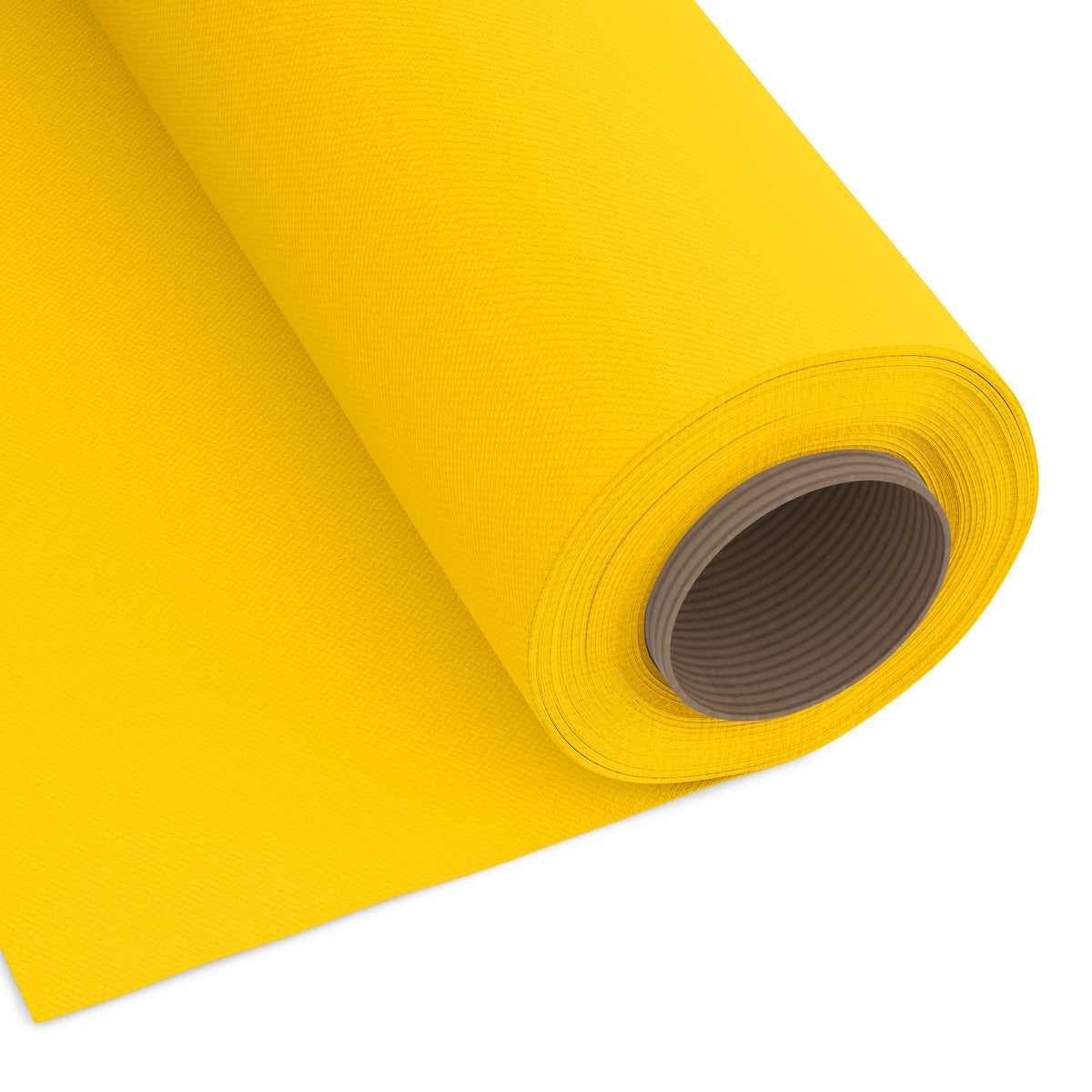
| Canvas sunbeam yellow, by the metre | 150 cm wide; 1, 2, 3 or 5 m | Strong deep yellow, matte | A wider back wall, a base for marigold strings |
| Embossed velvet runner, "lemon yellow" | 32 x 150 or 32 x 240 cm | Deep golden, near mustard | A sideboard or a long shelf |
| Cotton mango runner | 32 x 122, 150 or 230 cm | Saffron, between yellow and orange | An accent band on a lemon or golden base |
| Cotton sunbeam yellow napkins | 43 x 43 cm, set of 4 | Bright golden | Under the books, the kalash and the plate |
The Cotton Mango Table Runner is the one to reach for if your family prefers a basanti shade with more orange in it. Laid down the middle of a lemon satin cover, it reads as a deliberate stripe, not a near-miss. It is cotton, so it can sit under a plate and go in the wash afterwards.
For a wall wider than one metre of velvet covers, canvas or satin in longer cuts is the way, and the fabric width guide explains why the 110 cm satin needs more metres than the 150 cm canvas for the same wall. The fabric by the metre page lists every colour with its width in the size option.
The satin front and the diya

The satin front drop is the brightest thing in the setup, and the one most likely to end up near a flame. Both the satin and the velvet here are polyester, which melts when a flame touches it. Keep the diya on a metal plate on top of the chowki, or on a stand on the floor with clear space between it and the hem. On a 30 cm chowki the satin reaches the floor, so do not put a floor diya right in front of it. Fold the front edge under by a few centimetres if you want a gap.
Satin also creases in the packet. Iron it on the back at a low setting the evening before, as our satin care guide explains. A hot iron can leave a shiny mark on the face.
After the puja
Brush dry kumkum and haldi off the cotton before any water touches it, and shake the cloths outside so flower bits and rice do not go in the machine. If ghee has dripped on a napkin, treat it first using the steps for oil stains. The napkins and the mango runner go back to everyday use.
The satin and velvet need washing less often, since nothing sat on them, but shake out the ash and petals first. Fold them loosely and put them away until next year, or use them now. A one-metre satin cut makes a festive cover for a small side table. The velvet is enough for two cushion fronts. If you also dress a chowki for Diwali, the same velvet works as a back cloth there, and the Diwali puja chowki guide shows how to size the cover.
Common questions
Which date does Saraswati Puja fall on in 2027?
Vasant Panchami, the day of Saraswati Puja, falls on Thursday 11 February 2027 by drikpanchang.com. The puja time differs by city, so check a panchang for your own city or ask your pandit.
Which colour cloth is used for Saraswati Puja?
Yellow is the colour most homes use, often with white beside it. Some families choose a deeper basanti or saffron, and some follow their own custom. If you are unsure, ask an elder.
Do I need to stitch the puja cloth?
No. Fold raw edges under or keep them at the back, and fix a back cloth with safety pins or clips. Satin and velvet fray a little at a cut edge, so a quick hem is worth it only if you plan to reuse the piece as a table cover later.
Can I use a saree or dupatta as the backdrop?
Yes. A saree is long but only a little over a metre wide, so it suits a narrow wall or the space directly behind the idol. Pin it at the top and check its yellow against your chowki cloth before the day.


Leave a comment
This site is protected by hCaptcha and the hCaptcha Privacy Policy and Terms of Service apply.