
The home remedies are not nonsense. The one that sounds most ridiculous, putting a hot iron on a heat mark, is the one that works, and there are threads with well over a thousand upvotes behind it. Here is the awkward part: lifting the mark is the easy half of this problem, and it is not the half that decides what your table looks like in five years.
The short version: a white mark on a wood table is moisture trapped inside the finish, above the wood, where it scatters light and reads as a milky patch. Dry heat through a cloth, from an iron on a low setting with no steam, moves that moisture back out. Water and soap do nothing to it, and scrubbing can make it worse.
What are the white marks on a wood table, and why won't they wipe off?
Varnish and polish are not a waterproof lid. A hot dish or a cup of chai opens the coating enough for moisture to move in, and it is shut inside when things cool. A cold glass gets there from the other direction, its condensation collecting under the base through a long lunch. Professional finishers meet the same thing spraying in damp weather and call it blushing; the explanation on a wood finishing forum is water condensing into the lacquer layer, and our tea coaster guide covers how a ring forms in detail.
White means the moisture stopped in the coating and can still come out. Dark means it has reached the wood fibre below, where no heat will follow it, and that top has to be sanded and recoated. Stop reading if your table is laminate or glass: neither holds water inside a coating. This is a solid wood and veneer problem, which in many Indian homes means the sheesham or teak dining set.
The instinct to clean is the problem. An r/CleaningTips post about a hot pizza box left on a parent's table has 792 upvotes and 103 comments, and the poster's first move was dish soap and hot water. Their own report: it was "even brighter and more obvious in person". In a separate r/CleaningTips post, someone had gone at a ring with a toothbrush and toothpaste, and the reply told them the scrubbing had taken the finish off.
Leave it and you stop using the table properly. A bowl goes over the spot this week and everyone hovers with their glass. A month later there are three more rings, one formed unseen under a runner. A year on, the choice is living with it or paying to refinish the top, and one thread opens with the poster asking whether to sell the table.
What each popular fix actually does
The same handful of suggestions comes up in these threads. Two of them can cost you the finish.
| What people try | What they believe it does | What it actually does |
|---|---|---|
| Mayonnaise or Vaseline overnight | Oil draws the moisture out | Masks a faint mark at best. On damaged finish the oil reaches the wood and stains it |
| Toothpaste on a brush | Buffs the mark away | A mild abrasive. Takes off surface haze and gloss with it, never moisture a layer down |
| Hairdryer | Heat dries the water out | The right idea in its weakest form. Moving air rarely holds the coating warm long enough |
| Ring remover cloth or finish restorer | Purpose built, so it should be reliable | Polish for scratches and dulled finish. Useful after the moisture is out, not instead |
| Iron on low with a dry cloth, no steam | Surely more heat makes it worse | Warms the coating evenly long enough for the trapped moisture to leave, without adding water |
| Sanding and refinishing | The last resort | Needed for a dark ring. Overkill for a white one nobody has heated yet |
That mayonnaise row is not squeamishness: the most upvoted caution on that thread, at 385 upvotes, was to keep mayo, peanut butter and Vaseline off the table.
Lay a clean cotton cloth over the mark, run a warm iron over it in slow passes with the steam off, and lift the cloth every twenty seconds to look. Keep it moving between spots rather than parking it on one, and stop if the finish looks tacky or duller than the wood around it. On an r/CleaningTips post about marks on a new solid wood table, the top reply at 56 upvotes named trapped moisture and prescribed a low iron over a towel. The poster said they were nervous to try it; the reassurance came back at 19 upvotes, that the trick seems counter intuitive but works.
The biggest thread, also on r/CleaningTips, runs past 1,500 upvotes and is a thank you note. The poster ironed the marks out of a family table of 13 years in about an hour and a half, with the deepest ones fading rather than vanishing. Their instruction: no steam, just dry heat over a tea towel. On r/howto, a poster who had failed with toothpaste, oil and vinegar and a bought ring remover was told the same thing by 76 upvotes, and reported back that it worked better than anything else, with a few smudges left. That is the realistic result: improvement, not a factory finish.
It does not always work. In a quieter r/CleaningTips thread, someone with marks over a year old on a walnut veneer table had tried a hairdryer, an iron, a finish restorer and mayonnaise overnight. None of it moved, and the advice was stripping and refinishing. Heat is for a fresh white mark on solid wood.
The mark comes out. The conditions that made it do not.

An hour and a half with an iron changes the table. It changes nothing about the kitchen it lives beside. Same finish, same chai at seven, same pressure cooker carried straight over because the counter is full, same steel tumbler sweating through August. Through the monsoon the air sits closer to the condensing point, so it all takes less provocation than in January.
What touches the surface is the only thing left to change. Put something absorbent or heat resistant between the coating and the hot or wet thing, and nothing gets trapped.
Fabric does it by taking the water. A ribbed cotton mat holds the run off from a glass base in the weave, and the air in the rib conducts heat poorly, so less of a hot cup's heat reaches the table. The navy solid mats run 48 by 32 cm, so the dinner plate and the glass beside it both land on fabric rather than on the table, and the yarn is a 12 ply recycled cotton that goes through a machine wash. A dark weave hides a dried chai ring that a pale one broadcasts, so the white ribbed version at the same size suits a household that washes linen weekly and the navy suits one that does not.
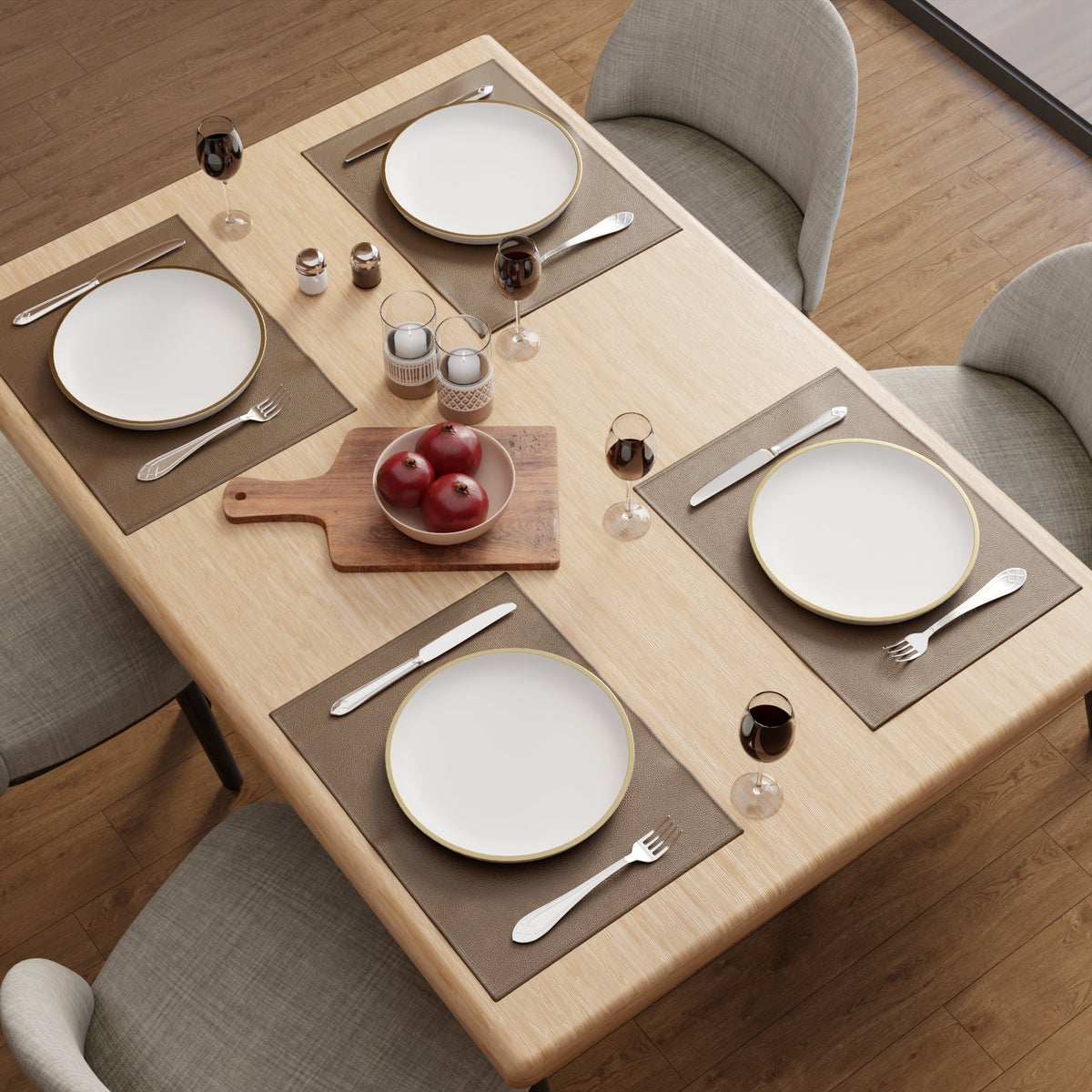
Faux leather refuses the water instead of absorbing it. The dark brown pebbled mats are water repellent and wipeable by their own description, cleaned with a damp cloth rather than a wash cycle, at 42 by 30 cm, about ₹550 for four and ₹700 for six, in six colours.
Picture the table in six months. Chai lands at seven on a mat that came out of the wash on Sunday, and nobody hovers over a guest with their glass.
Which to buy, and where a coaster still earns its place

If meals and hot dishes are what mark your table, buy mats, one per seat: a six seater takes a pack of six. Undecided between cotton and leather, take the leather: the mat that gets used daily is the one that never has to wait for a wash cycle, and a mat left in the drawer protects nothing. The table mat collection is where the darker solids sit, and whether a 48 cm mat fits your table is settled by its length and width, in our table mats guide.
Coasters answer the other pattern, drinks away from meals: the centre table, or a tumbler that stands on a desk all afternoon. A 9 cm round protects the circle under a cup base and nothing past it. Tea and coffee mark a coaster face quickly, so the black and dark green rope coil sets, six for about ₹400, take daily chai without showing it. The coaster range is fabric throughout.
Every month you wait, the odds get worse
Every attempt is itself a risk. Oil goes into damaged finish and stays, and abrasives take the gloss off around the mark. Fresh marks also respond best, so the ring you put off has worse odds than the one in front of you.
Protection has a failure mode too, and it is memory. An r/randomquestions thread asking whether anyone actually uses coasters drew 325 comments, and the pattern is not people calling them pointless but people describing the effort of enforcing them. One commenter, at 16 upvotes, wrote that wood furniture is a great reason never to let anyone in the house. The reply, at 9 upvotes: hand them a coaster with their drink. Somebody has to remember every time, including the guest.
Mats sidestep that. The thread's own author uses only placemats, because a mat leaves room for a drink and a plate, so a coaster never comes up.
Stripping and refinishing a top is skilled work you pay for, the only route left once a mark goes dark. Six mats at about ₹700 sit on the other side of it.
Frequently asked questions
Will a table mat or coaster remove the mark I already have?
No. They stop the next one; they do nothing for a mark already in the coating. Deal with that one first, using dry heat through a cloth.
I know I will not remember to use a coaster every time. Is there any point?
Not much, if your marks come from meals. Buy mats instead, since they go down before anyone sits and need no reminding from you. A coaster earns its place where a drink stands on its own for hours and no meal is being served.
Do fabric mats and coasters need a lot of washing?
Cotton mats machine wash. Fabric coasters take a wipe most days and a hand wash when marked, air dried on edge rather than stacked damp, which matters through the monsoon. If that is too much, buy faux leather and wipe it.
Does the iron trick work on every wood table?
No. Reddit threads on the subject carry first-hand reports of it working on fresh white marks on solid wood under an ordinary varnish or polish. Old marks, veneer, and anything already gone dark are a different case, and the answer there is a refinisher.
So, iron or mats?
Both, in that order, and only if your table is the kind this applies to. If it is laminate or glass, or the marks are dark and years old, this is not your fix.
If it is solid wood with a fresh white ring, spend an evening with an iron and a tea towel and get the mark out. Then decide what changes, because a coating that trapped moisture once will trap it again on the same Tuesday it did last time. A pack of table mats, one per chair, is the version of that decision you never have to remember to make.
Encasa XO is our own brand, and the mats and coasters named above are ours.

Leave a comment
This site is protected by hCaptcha and the hCaptcha Privacy Policy and Terms of Service apply.