
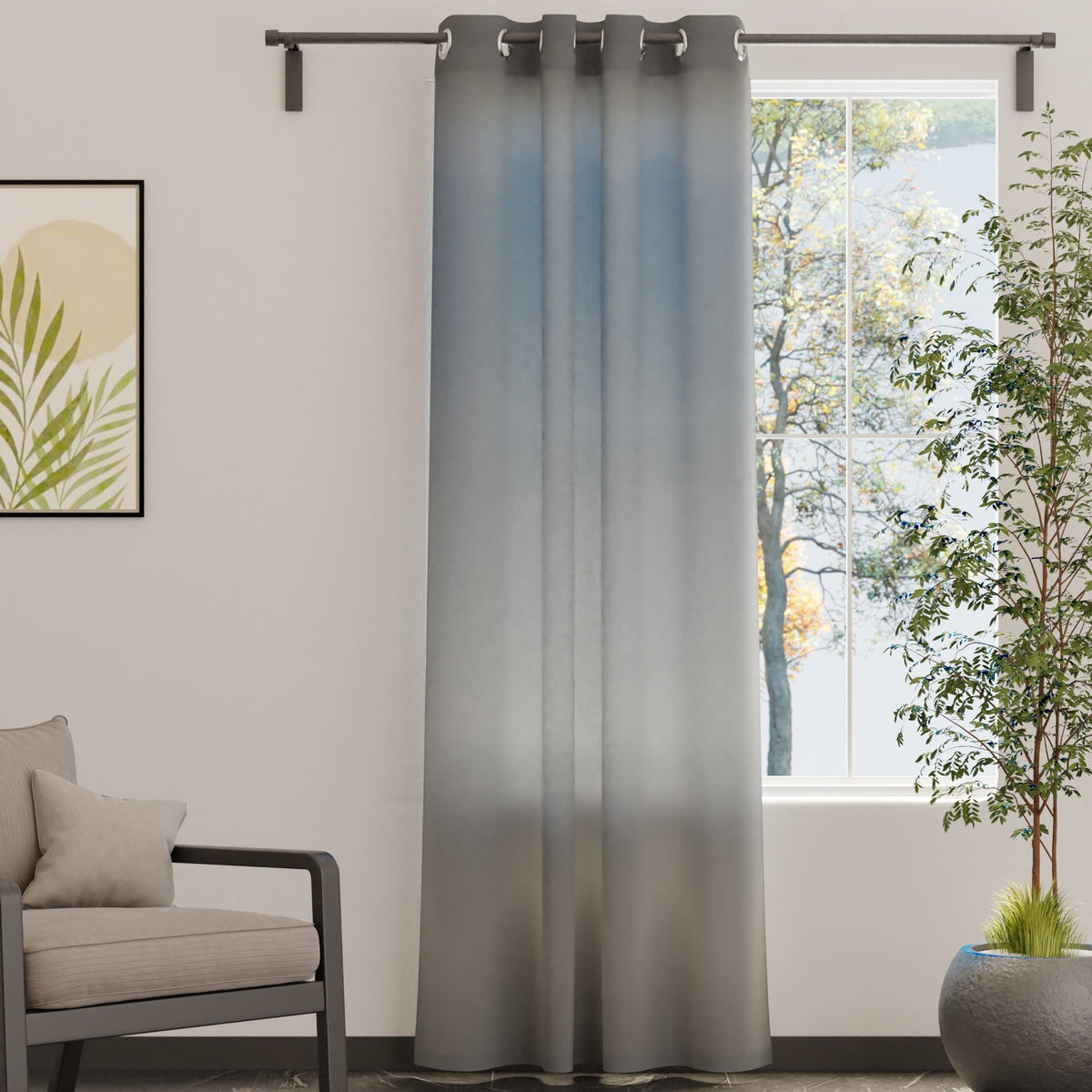
Ready-made curtains vary along four things that decide most of the outcome: how the panel attaches to the rod, how much light it lets through, what it is woven from, and how long it drops. Settle those four and what is left is mostly colour. Width, pack size and how much washing you are prepared to do still matter, but they rarely make a curtain wrong.
In practice the four axes are narrower than the style guides make them sound, and the first two are not separate choices at all. As the range stood in September 2026, from the product listings, the 175 curtains on this site use two headings between them, sit in four bands of light control, are made from three fabrics and are cut to five ready lengths. Ninety-six hang on eyelets. The other 79 hang on a rod pocket. There is no third option.
The counts here come from those 175 listings read one at a time, taking what each product page claims about its own heading and its own light rather than the tags. The tags are stuffed with search words and get it wrong often: all 22 cotton canvas curtains say in their own copy that they are not see-through, and all 22 are tagged "sheer".
Which types of curtains are actually on sale here
Worth saying early, because a good part of what a general curtain guide lists is not a ready-made panel at all. Blinds and roman shades are a different product with different fittings. Café curtains, valances, pinch pleat, wave headings and tab tops are real and common elsewhere in the world, and none of them is sold here. Neither are rods, rings or tracks, so hardware comes from somewhere else and the panel has to fit what you already own.
What is left is flat panels in fixed widths, in two headings. Everything below sorts those.
How the panel hangs: eyelet or rod pocket

An eyelet panel has metal rings punched through a stiffened top band. The rod passes through the rings, the panel hangs in even folds, and it slides along the rod with one hand. A rod pocket panel has a sewn channel across the top instead. The rod goes through the channel and the fabric gathers on it, which looks softer, but the fabric grips the rod rather than gliding on it.
That grip is the part people find out late. A rod pocket panel does not slide open nicely, so 56 of the 79 come with a fabric tie back sewn to the middle of the panel, and the listing tells you to gather the panel back during the day rather than slide it. The Reverse Leaf Green and Micro Mint pages both say it in as many words: no need to slide the curtain to open it. The mint one is out of stock in the 7 ft door length as this is written, worth checking before you fall for a colour.
So if the window is one you open and shut every morning, eyelets, and something like the single-panel Canvas Grey. Before you commit to them, check the rod you own will pass through the ring. Ring diameter, rod thickness, rod height and how to get a panel on without taking the brackets down are all in how to hang curtains.
How much light gets through

The largest group is semi-sheer and mid-transparent: 79 curtains, lightweight polyester, ₹672 to ₹2,079 a pack. Their own copy is blunt about it. The Reverse Leaf listing says the fabric "does not block light", and the mid-transparent ones promise privacy without darkness, which in daylight means a bright room nobody can see into.
Then blackout: 57 curtains, ₹1,209 to ₹2,769, all triple weave polyester. Read the individual listing rather than the word on the label, because the word is doing some work. Of the 57, 48 claim 85 per cent of light blocked and the remaining nine claim up to 80; 39 of them call their own fabric semi-blackout or room darkening somewhere in the description. The Timeless panel is one of the 85s, which is a dark room, and not a dark room at 6 am in June.
The two cotton bands sit in between and are quieter about it. Twenty-two cotton canvas curtains describe light filtering through without the room going dim, and not being see-through from outside after dark. Seventeen cotton Panama weave curtains say they moderately reduce outside light for a warm glow. Between them they are the middle ground, for a soft room rather than a dark one.
Those prices need one warning. The 22 cotton canvas curtains are the only line sold as a single panel, so ₹1,209 buys one 5 ft panel; every other curtain here comes as a pair, and a pair of 5 ft semi-sheers starts at ₹672. Compare the pack, not the price.
For which band your room needs, blackout, sheer and room-darkening compared does the functional side, and curtain GSM covers fabric weight.
The heading tells you the light, and the light tells you the heading
Heading and light control read like two separate decisions. Sorting the 175 listings by both at once says otherwise: they come bundled, and across the whole range there was not a single exception.
Every blackout curtain in the range is an eyelet curtain. Every semi-sheer and mid-transparent curtain is a rod pocket curtain. Ask for an eyelet sheer or a rod pocket blackout and there is nothing here to sell you.
The likely explanation is mechanical. A heavy triple weave panel is easier to live with when it glides, and rings on a rod glide. A light panel that spends its day tied to one side barely slides anyway, so a sewn channel does the job and costs less to make. Whatever the reasoning behind it, the effect on a shopper is that fabric weight narrows the heading before they get to choose one.
| Heading | Light control | Fabric | Ready lengths sold | Curtains |
|---|---|---|---|---|
| Eyelet | Blackout | Triple weave polyester | 5 and 7 ft on nearly all, 6 and 8 ft on about half, 9 ft on 13 | 57 |
| Eyelet | Light filtering | Cotton canvas | 5 and 7 ft on all but one each, 9 ft on two | 22 |
| Eyelet | Moderate light filtering | Cotton, Panama weave | 5 and 7 ft on all 17, 9 ft on 13, 6 ft on one | 17 |
| Rod pocket | Semi-sheer or mid-transparent | Polyester twill | all five lengths, though only 48 go to 9 ft | 79 |
Read that table backwards and it saves time. Start from the light you want and the heading comes with it, leaving fabric and length. It cuts the other way too: set your heart on the gathered look of a rod pocket and you have chosen a semi-sheer, which no amount of hunting will turn dark.
Fabric: two cottons and a polyester

Polyester accounts for 136 of the range, at both ends of the light scale: the triple weave that goes into blackout panels, and the light twill that goes into most of the semi-sheers. It washes easily, dries fast and hangs without ironing, which is a fair part of why so much of a rainy-season market is made of it.
The cottons are the other 39, both eyelet, both plain colours rather than prints, and worth telling apart. The Panama weave pairs are the heavier of the two, ₹1,739 to ₹2,539, grouped together in the cotton canvas collection; Cotton Charcoal Grey shows what that weight looks like hung. The canvas singles work out dearer per panel than a pair does, but they are the only curtains you can buy one of, which is the point when a narrow window or a kitchen doorway needs exactly one.
Print is not a fabric, though it gets sold like one. The boho curtains are five printed designs out of the semi-sheer polyester group: styled differently, built the same. Liking the look means choosing a print inside a family whose behaviour is already settled.
How long: the five ready lengths
Five lengths are cut, 5 through 9 ft, and the two standard Indian sizes are on almost everything: 160 of the 175 offer 5 ft for a window and 165 offer 7 ft for a door. About half also cut 6 ft and 8 ft, and 76 go to 9 ft. Which one you need is a drop measured down from your rod rather than a guess from the window, and the curtain size guide works that out properly.
Which type suits which window
Take a hall window in a dusty city, drawn open every morning and shut at dusk. It has to slide, so it is an eyelet panel, which leaves blackout or one of the cottons. Dust shows less on a mid-tone than on cream, and a heavier weave keeps its shape between washes, so the Panama weave cottons earn their price here, with curtain GSM for how much weight is enough. The trade is that cotton needs ironing after a wash and polyester does not, and in a house that washes curtains twice a year that is a real annoyance twice a year.
The bedroom that has to stay dark past sunrise is the one case where the light decides everything and you take whatever heading comes with it. Blackout, so eyelet, and read the panel's own figure rather than the word on the label. An east-facing room usually ends up with two layers, a light panel in front and a blackout behind, which is a second rod and a second decision rather than a better curtain. Whether the second layer is worth it is worked through in blackout, sheer and room-darkening compared.
Kitchen doorways and the small window nobody ever closes are the easy ones: semi-sheer, rod pocket, tied back all day, and the cheapest thing in the range. The awkward version is the doorway you walk through twenty times a day, where a panel that grips the rod becomes a daily irritation and a single canvas eyelet panel is worth the extra money. Doorways carry their own clearance and sizing problems, and door curtains works through them. To start from colour instead and work backwards, all 175 curtains sit in one place.
Questions people ask
What is the difference between eyelet and rod pocket curtains?
Eyelet curtains hang from metal rings set into the top of the panel and slide along the rod. Rod pocket curtains have a fabric channel sewn across the top that the rod threads through, so the fabric gathers on the rod and grips it. Eyelet suits a curtain you open and close. Rod pocket suits one you tie back and leave.
Can I buy a blackout curtain with a rod pocket?
Not from this range. All 57 blackout curtains here are eyelet, which fits the general pattern that heavy fabric is made with a heading that slides. If you want the gathered rod pocket look and real darkness together, the usual route is two panels on two rods, a rod pocket in front and a blackout behind it.
Which curtain fabric is best for an Indian home?
Polyester if the window sees rain, dust or frequent washing, because it dries quickly and does not need ironing. Cotton if you want a matte finish and a softer light, and are willing to wash it less often and iron it more. There is no fabric here that is best at everything, which is why the range carries both.
Do I need to buy a curtain rod to match?
You need to check the one you have. Eyelet rings have a fixed inner diameter, so a thick decorative rod may not pass through, while a rod pocket channel is more forgiving. Rods, rings and tracks are not sold here, so measure the rod before ordering the panel.

Leave a comment
This site is protected by hCaptcha and the hCaptcha Privacy Policy and Terms of Service apply.