
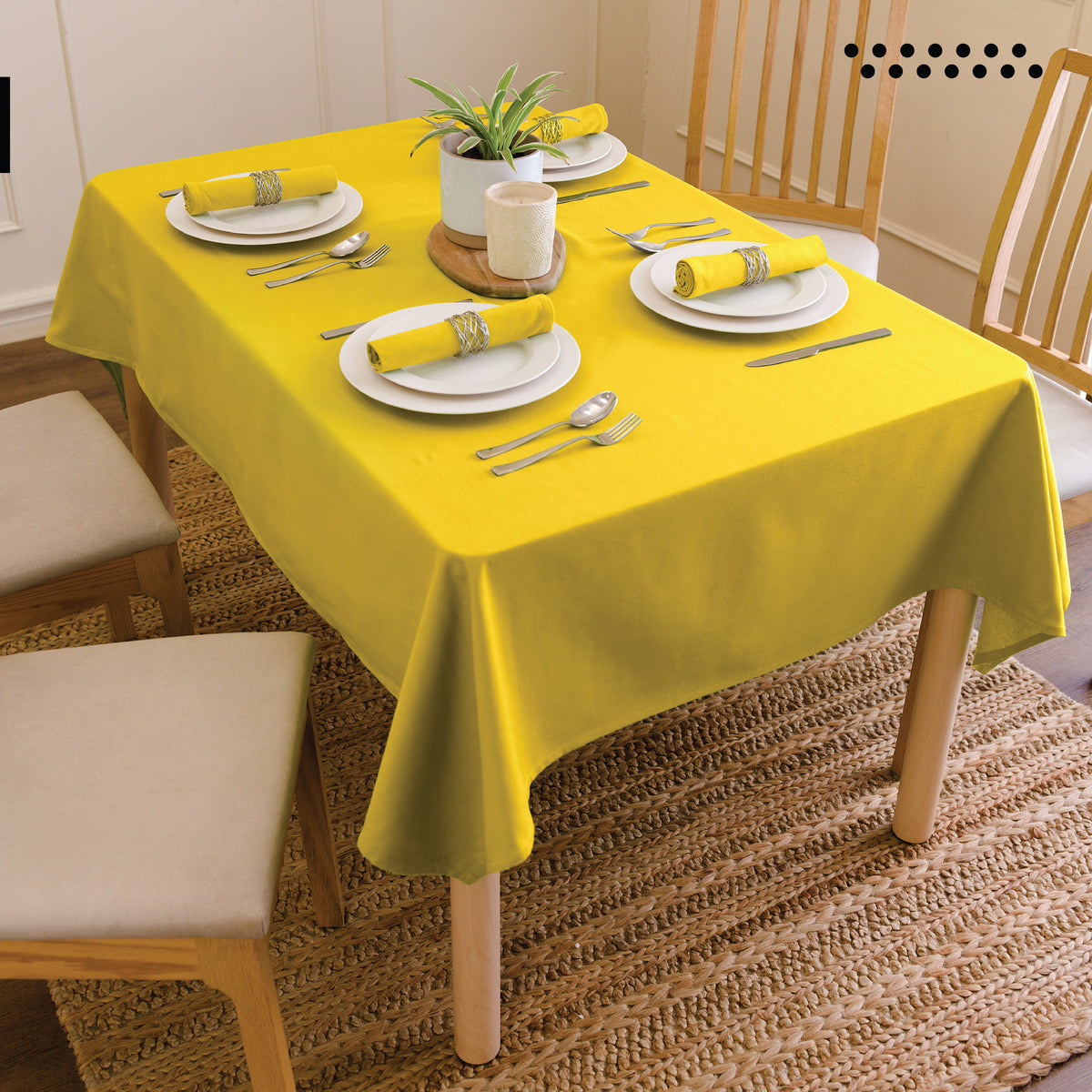
Take a centre table 90 cm long, 60 cm deep and 40 cm high, pulled into the middle of the living room for a Satyanarayan katha. Lay a 72 x 56 inch yellow cotton tablecloth over it, which is about 182 x 142 cm. The long sides hang 46 cm over each end and 41 cm over the front and back. On a 40 cm table, that just reaches the floor on all four sides.
Now try the same table with satin bought by the metre. Satin is 110 cm wide. Lay one metre with that 110 cm along the table, and it covers the top with a 10 cm skirt at each end and 20 cm at the front and back. Buy two metres and the ends now pool 15 cm on the floor, while the front and back still stop 15 cm short. More metres did not help, because the width was the problem all along.
So for Satyanarayan puja decoration at home, plan the cloth around the chowki's depth and height before you think about flowers. Use a washable cotton base under everything that sits on the table. Keep satin and velvet for the parts that only need to look good, like the wall behind or a panel down the front. Then build the mandap of banana stems around it, keeping their cut ends away from the good cloth.
What a katha table goes through in one morning
A home mandir sits against a wall, and only the front is seen. A Satyanarayan katha chowki (some families say Satyanarayana) is different. In many homes it moves into the open, the pandit sits on one side and the family fills the others, so every side of the cloth is on show. Usually the katha is read first, then comes the aarti, then the prasad. People sit close to the table for a long time.
Think about what lands on the cloth in that time. Water drips from the kalash and the achaman spoon. A little panchamrit spills when it is poured, and it has milk, curd, ghee and honey in it, so it leaves a greasy, sticky mark. Ghee creeps out from under the diya. Haldi and kumkum fall from fingers. Rice, tulsi leaves and flower petals get scattered. In some homes a small havan is lit, and the aarti thali passes close to the table edge.
That is why the cloth under the kalash, the plates and the diya should be cotton. It soaks up a drip instead of letting it run, it tends to stay put on a wooden top better than a shiny cloth, and it can go in the washing machine the same evening. Satin has a smooth, shiny face, and our satin guide explains why that makes it slide. A kalash on satin over a polished table can shift when someone lifts it to pour.
The satin and velvet in this guide are polyester, and polyester melts if a flame touches it. Keep diyas on a metal plate, keep the havan well away from any drape, and keep loose edges and tassels clear of the aarti.
How much cloth do you need for the Satyanarayan chowki?
The general rule is the top of the chowki plus twice the drop you want. Our Diwali chowki guide works through that rule for a festival chowki. For a katha table that is seen from all sides, add one more check: is the cloth wide enough?
For a cover that touches the floor at the front and back, the cloth's width must be at least the depth of the table plus twice its height. For the 90 x 60 cm table that is 60 + 40 + 40 = 140 cm. Satin at 110 cm cannot do it in one piece, however many metres you buy. Velvet at 152 cm wide can, and so can a 142 cm wide tablecloth.
Here is how real cloth sizes sit on that same table, 90 x 60 cm and 40 cm high:
| Cloth | Size | Over each end | Over front and back | Reaches the floor? |
|---|---|---|---|---|
| 1 metre of satin | 100 x 110 cm | 10 cm | 20 cm | No, a short skirt |
| 2 metres of satin | 200 x 110 cm | 55 cm, so 15 cm lies on the floor | 25 cm | Only at the ends |
| 1 metre of velvet, laid across | 100 x 152 cm | 5 cm | 46 cm, so 6 cm on the floor | Front and back only |
| 72 x 56 inch cotton tablecloth | about 182 x 142 cm | 46 cm | 41 cm | Yes, all four sides |
On a lower table, say 30 cm high, every edge that already reached the floor leaves another 10 cm lying on it, and the satin drops come 10 cm closer to the floor. Fold the extra under rather than leaving it in heaps, because a pooled edge at floor level is where a diya ends up. For metres on a full back wall, our backdrop cloth guide does the sums for width and fullness.
Setting up the Satyanarayan puja mandap with banana stems
Many families build a small mandap around the chowki with banana stems, one tied at each corner, with mango leaves or a marigold string across the top. Others use only banana leaves, a toran, or nothing at all. Follow your family's way or ask the pandit, since this changes from region to region and home to home.
If you do use stems, the cloth needs a little planning. The cut end of a banana stem is wet, and the sap can leave brown marks on cloth that are hard to wash out once they dry. So:
- Tie the stems to the table legs first, then lay the cloth.
- Fold each corner of the cloth back so it sits inside the stem, not wrapped around its cut end.
- Stand each stem on a steel plate or an old rag, not on the good cloth or the rug.
The stems, mango leaves, flowers and kalash come from the market or the pandit's samagri list, and every family's list is a little different.
Which yellow, and where the red goes
Many families dress the Satyanarayan chowki in yellow, and some add a small red cloth under the kalash. Others use red or white throughout. Our pooja cloth guide covers the colours families use and why they differ.
The practical problem with yellow is that it changes with the light. Yellows run from cool lemon to deep golden, and two yellows bought from different shops rarely match under a warm bulb and diya light. Our own yellow satin listing shows the same cloth as a strong yellow in warm light and a dull beige in dim light. If you mix pieces, buy them together, and check them in the evening light where the katha will happen, not by a sunny window at noon.
The cotton base and the small cloths

For the worked example above, the base was the Cotton Sunbeam Yellow Table Cloth in its 72 x 56 inch size, a little under ₹1,000. It is plain cotton, machine washable, and it comes in rectangles only, 72 x 56 or 91 x 56 inches. Its photos are not all the same yellow. The newer ones show a bright lemon with a slight green tint, and an older render shows a warmer golden yellow, so expect something in between and check it next to any satin you buy. After the katha it goes back on the dining table, which is what it was made for. If your family uses red throughout, the tablecloth range has a solid deep red and a maroon in the same 72 x 56 inch size.

Then add small cloths where the spills happen. A 43 cm cotton napkin, folded once, sits under the kalash and catches the drips before they reach the big cloth. A second one goes under the panchamrit bowl, and a third can cover the prasad until it is offered. The Cotton Sunbeam Yellow Table Napkins come six to a pack, enough for all three with spares for the next purnima. For red under the kalash, the Cotton Deep Red Table Napkins are the same 43 cm square in a pack of four. If a napkin gets a ghee mark, you wash a napkin, not the whole tablecloth.
Satin and velvet where nothing sits

The wall behind the mandap is where velvet earns its place. Nothing rests on it, and it is the part that shows behind the family during the aarti. The Velvet Lemon Yellow Fabric sells as a single 1 metre piece, 100 x 152 cm, for about ₹500. The name says lemon, but the main photo is a warm golden yellow, clearly deeper than the lemon tablecloth, so the two read as front and back rather than a near miss. Turned on its side, it fills a wall space about 150 cm across and 100 cm high, which is enough behind a 90 cm table with the stems standing in front. The cut edges fray, so hem them or fold them back before you hang it. For a red or maroon back cloth, the same plain velvet comes in both in the fabric collection.

Satin suits the front panel. A 1 metre cut of the Satin Polyester Silk Red Fabric is 100 x 110 cm and costs a little over ₹300. Despite "silk" in the name, it is polyester satin. Fold it lengthwise into a strip and lay it down the front of the chowki over the cotton cloth, so the red falls to the floor between two yellow sides. Tuck the top edge under the kalash napkin so it cannot slide. If your family prefers yellow at the front too, the same satin comes in yellow at the same price. Iron it on the back at a low setting.
After the katha
Shake the crumbs and rice off outside before anything goes in the wash. Brush off dry kumkum first, since water spreads it. Panchamrit and ghee are both oily, so treat those marks before washing, with the steps for oil and haldi stains. Cotton can go in the machine. The velvet and satin rarely touch a spill, so airing them is often enough; when they do need a wash, follow the care label.
If your family holds the katha every purnima, keep the whole set together in one cloth bag: the tablecloth, the napkins, the satin strip and the velvet. Store it dry and away from damp, the same way as your festive linen. Next month, setting up is quick.
Common questions
Can I use a saree as the chowki cloth?
Yes, and many families do, especially an old silk saree from a wedding. A silk or satin saree is smooth, so put a cotton cloth under the kalash and the plates to stop them sliding and to keep ghee off the saree. Most sarees are narrower than a tablecloth, so check the width against the rule above before you plan a floor-length drop.
Can the katha be done on the dining table?
It can, if people will sit on chairs. When everyone sits on the floor, a low table keeps the idol and the kalash where they can see them. A dining table is taller, so the same cloth will stop well short of the floor, which is fine when people sit on chairs.
Do we need new decoration for a griha pravesh Satyanarayan puja?
Not if you already have a set. The chowki cloths are the same, though the house may still be half unpacked. Our griha pravesh checklist covers what the rest of the home needs that day.


Leave a comment
This site is protected by hCaptcha and the hCaptcha Privacy Policy and Terms of Service apply.