
It is half past five. The sofa has been pushed against the side wall and the centre table carried out to the balcony. The bhajan group is due at seven with the dholak, the speakers and a framed picture of Mata in a red chunri. In an hour and a half, thirty people will sit facing one wall for the rest of the evening. Right now that wall is cream paint with a switchboard in the middle of it.
In mata ki chowki decoration, most of the cloth goes on that wall and on the low chowki in front of it. Put a red or gold backdrop behind the darbar so Mata's picture stands out from across the room, and cover the chowki in a cloth your family uses. Give the jyot its own safe spot on a metal plate, away from satin and velvet. Flowers, lights and the chunri come after that.
"Chowki" means two things here
A mata ki chowki is an evening of bhajans for Mata, usually a few hours long, often followed by dinner. A jagran is the longer, all-night version. In everyday speech, "the chowki" is the event. But there is also the chowki itself: the low wooden stand on which Mata's picture or murti sits. The event decides how long everything stays lit and how many people come near it. The stand decides how much cloth you need.
Before you buy anything, ask the group what they bring. Some bhajan groups that do home bookings list "darbar" or "stage décor" in their package, along with the singers and the sound. Some bring a murti or a framed picture and a ready-made backdrop. Others bring only the instruments and the samagri. If they bring the darbar, your job shrinks to the wall around it and the tables in front. One call saves you buying a backdrop that ends up hidden behind theirs.
What the evening asks of the cloth
A daily mandir is seen by the family for a few minutes at a time. A chowki darbar is watched for hours by a room full of guests, and filmed on a dozen phones. Once it is set up, stand where the last row will sit and take one photo on your phone. If you cannot pick out Mata's picture in that photo, the backdrop needs more contrast.
It also sits next to a flame for the whole evening. Many families light a jyot before the bhajans start and keep it burning until the end. At a jagran it may burn all night. Our satin and velvet are polyester, and polyester melts if a flame touches it. So the first decoration choice is where the jyot goes, and what is within its reach.
The front of the darbar is also the busiest floor in the room. In many homes, people come up one at a time to offer bhog, to touch the chowki, and to take the aarti. A cloth that pools on the floor there gets knelt on, stepped on and dragged. Keep every hem at the front a little above the floor.
Mata ki chowki decoration: which cloth goes where
| Spot | What happens there | Cloth that suits it |
|---|---|---|
| The wall behind the darbar | Seen by everyone, all evening; nothing touches it | Satin for shine, or velvet for depth, hung flat |
| A strip behind Mata's picture | The picture and red chunri must stand out from it | Gold satin, or a much deeper red than the chunri |
| The chowki top | Holds the picture or murti, flowers, maybe the kalash | Red or maroon, in velvet or cotton (see the jyot) |
| The jyot's spot | A flame for hours; oil or ghee | A metal plate on folded cotton, nothing polyester nearby |
| The bhog and prasad table | Plates, sweets, fruit, spills | A washable cotton tablecloth, napkins over the plates |
How do you make a red and gold backdrop for the darbar?

Here is one way to dress the wall in the opening scene. Say the space behind the darbar is 2 metres wide, and you can fix a rod or two hooks about 1.9 metres up.
Satin by the metre is 110 cm wide. Two 2 metre cuts of red satin, hung side by side, give 220 cm of cloth across a 200 cm wall. That covers it almost flat, with about 20 cm spare to overlap in the middle or ease into soft folds. Each drop folds about 10 cm over the rod and still reaches the floor.
Then take a third 2 metre cut, this time in gold satin. Fold it in half along its length, so it becomes a strip 55 cm wide and two layers thick. Pin it down the centre over the red, right behind where the picture will stand. A 2 metre cut cost ₹619 in either colour on 27 November 2026, so the whole wall came to ₹1,857.
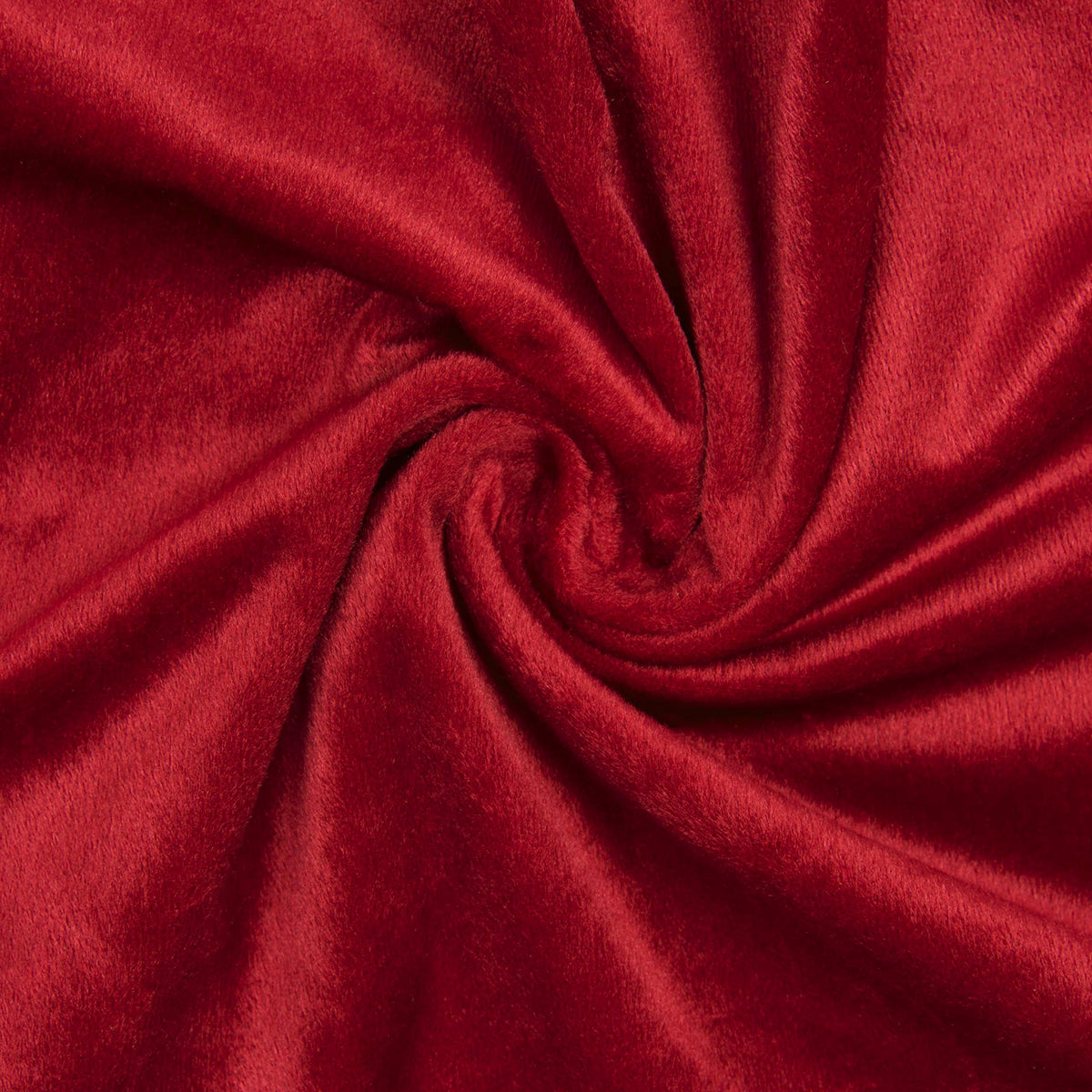
Why the gold strip? Mata's chunri is often red with a gold border, and the picture frame is often red too. Against a plain red wall in the same shade, the picture disappears from the back of the room. Gold behind the picture, red at the sides, keeps it clear. Our mandir decoration guide says the same about any back cloth. If your family prefers red all the way, choose a much darker red for the centre strip instead. The satin that photographs as maroon is Dark Wine, shown above: a deep burgundy that looks almost black in the folds.
Satin comes off the roll with fold lines, so iron it on the back, on the synthetic setting your iron's dial gives, before you hang it. For a wider wall, or for gathered folds instead of a flat drape, the backdrop cloth guide works out drops and metres, and ways to hang cloth without drilling.
Red, maroon and the names on the label
Red is the colour many families reach for at a mata ki chowki, often with gold, and some add maroon or yellow. Customs differ by family and region. Our pooja cloth guide covers the colours families use and why.
The practical trap is that colour names do not mean the same thing from one product to the next. From our own range:
- The satin called "Wine" photographs as a purple-plum, not a maroon. There is no satin named maroon. Dark Wine is the one that reads as maroon.
- The plain velvet called "Maroon" photographs as a deep cranberry red, only a shade darker than the velvet called "Red". Bought as a pair, they look almost the same.
- The cotton tablecloths are closer to their names. The deep red is a bright crimson and the rich maroon is a true dark maroon.
So choose by the photo, not the name. Buy the red pieces together if you can, and hold them up against each other under the bulbs you will use in the evening. Warm bulbs can push reds towards orange and make maroon look darker, and a phone camera may shift them again.
The chowki, the jyot and the bhog table

Measure the chowki top first. Then let the jyot decide the fabric. If your family has an old chowki cloth it uses every year, the same rule applies to it.
If the jyot will sit on the chowki, in front of the picture, cotton is the safer cover. The Cotton Deep Red Table Cloth comes as a 56 inch square, about 142 cm across, for a little under ₹1,000. That is far bigger than most chowkis, so fold it to the size of the top, and let a short drop hang at the front. Cotton does not melt. It can still scorch or catch if the flame touches it, so the jyot goes on a metal plate either way.
If you want velvet on the chowki for its rich look, give the jyot its own small stool or table in front instead. One metre of red velvet is 100 x 152 cm and costs about ₹500. Laid with the 152 cm side across, it covers a chowki top up to about 90 x 60 cm with some left to fold under. Our Diwali chowki guide works out how a metre of velvet fits a chowki top and front.

Use a metal plate wider than the jyot itself, so any spill of oil or ghee stays on the plate. A folded cotton cloth under the plate protects the chowki cloth from the drips that do escape, as long as no part of it sticks out past the plate's edge towards the flame. Any clean, old cotton cloth does this job. If you want matching ones, the Cotton Rich Maroon Table Napkins are 43 cm squares in a pack of four, at a little over ₹700, and a spare one can cover the prasad plate. For other reds, the table napkin range lists the size on each colour, so check it says 43 cm or 45 cm and not 23 cm.
The bhog and prasad table is often a folding table or a side table pulled near the darbar. It gets the plates of halwa, chana, fruit and sweets. A plain cotton tablecloth is easy here because it can go straight in the wash, though some families simply use a sheet or a disposable cover. The deep red or the rich maroon tablecloth in the 72 x 56 inch size fits a four-seater table. If the table is narrow, a deep red cotton runner 32 cm wide down the middle is enough.
The chunri, the picture or murti, the flowers, the kalash and the lights come from the market or with the group. If you add fairy lights behind the backdrop, use LED strings and keep the plug points clear of the jyot.
After the chowki
The red chunri is kept, offered again or given away, as your family does it. For the cloths, shake the flowers and rice off outside first. Brush off dry kumkum before any water touches it, since water spreads it. If the napkin under the jyot has an oil or ghee mark, treat it before washing with the steps for oil and haldi stains. The cotton tablecloth and napkins can go in the machine.
The satin and velvet on the wall rarely touch a spill, so airing them is usually enough. Fold the satin drops loosely and keep the backdrop set together, folded and dry, with the rest of your festive linen. The same red and gold wall works again for a Navratri puja, a jagran, or the next family chowki.
Common questions
Is decorating for a jagran different from a mata ki chowki?
The setup is much the same: a darbar, a backdrop and a jyot. A jagran runs through the night, so the jyot burns longer, the room fills and empties more times, and people are tired by the early hours. Give the jyot even more space, and check it every so often through the night.
What if the bhajan group brings its own darbar?
Then do not hang a second backdrop behind it. Ask how wide their darbar is and how high it stands. If it does not fill the wall, a single red or gold satin drop on each side can close the gap. Your cloths then go on the bhog table, under the jyot and over the prasad.
Can I decorate a mata ki chowki in a small flat?
Yes. A chowki needs one wall, a low stand and a safe spot for the jyot. In a small room, a single 2 metre drop of satin behind the chowki, a cotton cloth on top and a napkin under the jyot is enough. More cloth only means more to keep away from the flame.


Leave a comment
This site is protected by hCaptcha and the hCaptcha Privacy Policy and Terms of Service apply.