
Watch a family get the mandir ready before a festival. The idols are cleaned and dressed, fresh flowers go up, and a new diya comes out of the cupboard. The cloth behind and under the idols is often left as it is: whatever came with the mandir, or the piece someone bought the week they moved in.
Then stand at the door of the room and look. The idols are small. Most of what you see from there is the wall behind them, the front edge of each shelf, and the ledge where the thali and the matchbox sit. All of that can be cloth, and cloth costs far less to change than the mandir itself.
To decorate a mandir at home with cloth, start with the back wall and pick a colour that stands apart from your idols rather than matching them. Then put a short runner on each shelf, a washable cotton one on the ledge below, and keep a brighter set for festivals that you can swap in.
Lights, flowers and brass are the other half of the job; the ideas below are about the cloth. Which colour goes with which deity is a family custom, and our guide to pooja cloth for the mandir and chowki covers the common ones.
1. Choose the back cloth to stand apart from the idols, not to match them
It feels natural to buy gold cloth for brass idols. Put them together and the idols fade into the wall. The eye picks out a shape by the difference in tone and shine between it and what is behind it. Gold on gold has almost none, so you see a glow and lose the face of the idol.
The same thing happens with a white marble idol on cream velvet, or a black stone idol on deep maroon in a dim corner. Use this as a starting point, then hold a cloth up behind the idols before you buy:
| Your idols or pictures | Back cloth that makes them stand out | Back cloth that tends to swallow them |
|---|---|---|
| Brass or gold-tone | Red, maroon, wine | Gold satin, mustard or camel velvet |
| White marble | Red, maroon, deep yellow | White, cream, silver, pale gold |
| Black stone | Yellow, gold, orange, red | Maroon or navy in a dim corner |
| Silver | Red, maroon, deep yellow | White, grey, silver satin |
| Painted idols or framed pictures | One plain colour, a shade deeper than the picture | Printed, striped or patterned cloth |
If your family has a fixed colour for the mandir, keep it and change the finish instead. Brass on a matte red velvet stands out more than brass on a shiny red satin, because the satin throws back the same warm light the brass does.
2. Give a wooden mandir a velvet back panel you can lift out

Pins do not go into most wooden backs, and gluing cloth on is a job you only want to do once. Cut a piece of stiff card from an old carton to the size of the back panel; if it bows, glue two layers together. Wrap the velvet round it, pull it smooth, and tape the edges down at the back. Then stand it inside the mandir behind the idols. Nothing touches the wood, and when the cloth gets dusty or the festival comes, you lift the panel out.
Plain velvet suits a panel because its soft pile hides small creases and gives a deep, even colour. The catch is dust: the pile holds agarbatti ash, which is one more reason to make the panel easy to lift out and shake outdoors.
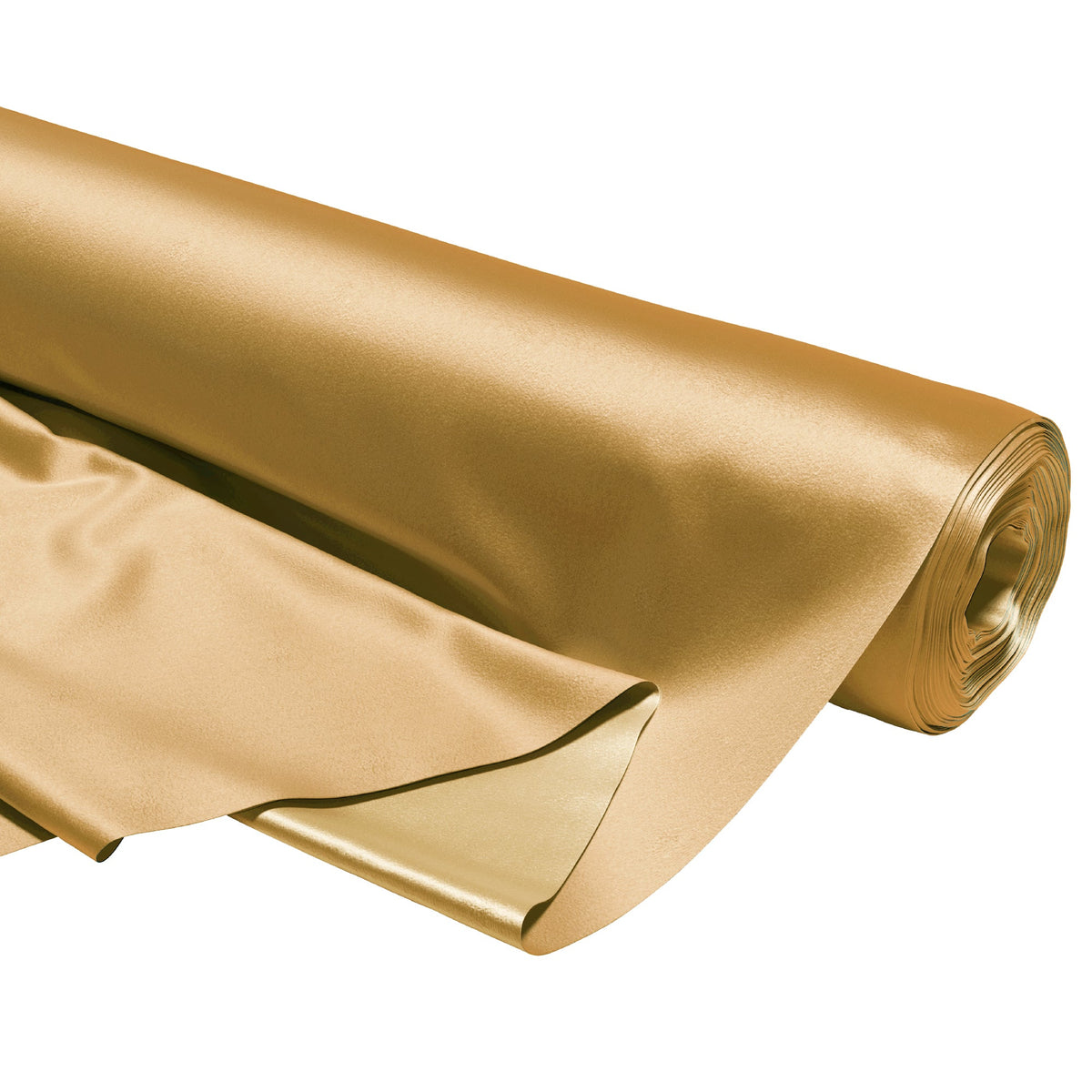
A metre goes a long way here. A back panel 45 cm wide and 60 cm tall, with 5 cm extra on every side to wrap round the card, uses about a quarter of one metre of the Velvet Maroon Fabric, which is 100 x 152 cm for about ₹500, so the rest can line the shelf or wait as a spare. Maroon is the one for brass. For black stone or silver idols, the lemon yellow is a bright, warm yellow. Skip the "gold" in this range if you want shine: on screen it is a camel or honey beige with no metallic look.
3. Gather satin in a wall niche for folds that catch the diya light

In a wall niche, cloth pulled flat can look like paint. Gathered satin gives depth instead, because each fold catches a line of light from the diya. The trade-off is that folds collect dust and need a shake now and then.
Take a niche 90 cm wide and 100 cm tall. Satin is 110 cm wide, so buy a 2 m cut and turn it on its side: the 200 cm length runs across the niche and the 110 cm width becomes the height. That is a little over twice the width of the niche, enough for full folds. Fold the top 10 cm over a small tension rod wedged across the top of the niche, pin the fold with three or four safety pins, and push the cloth along the rod into even gathers. No drilling and no stitching.
The Satin Polyester Silk Red Fabric costs a little over ₹600 for the 2 m cut, and it is a bright red with a slight orange glow. Despite the name, it is polyester satin, not silk. For a whole wall rather than a niche, the backdrop cloth guide works out drops and metres.
Polyester melts when a flame touches it, and heat rises. Hang the satin behind the idols, never as a swag above a diya, and keep the bottom edge well clear of the lamp.
4. Put a short runner on each shelf, just over the front edge

From the front, the shelf edges of a two-tier or three-tier mandir are bare wood lines. A short runner on each tier turns them into bands of colour.
Take a shelf 60 cm wide and 25 cm deep. A 32 x 91 cm runner laid along it hangs 15.5 cm past each end. Pushed to the back wall, its 32 cm width leaves 7 cm hanging over the front edge, which is the part people see.
A front drop needs some body, or it curls and shows its back. Thin satin is the worst for this. A quilted runner like the Quilted Velvet Red Table Runner, a true red with a basket-weave quilt, hangs more firmly, and its 32 x 91 cm size costs a little over ₹400. On a polished shelf, any cloth can still creep forward, so a strip of rubber shelf liner underneath helps. A chenille runner in maroon comes in the same short size if you want texture without the quilting. For a longer shelf, look at the longer sizes in the table runner collection before you choose a colour.
5. Let a cotton runner take the oil and ash on the ledge below

Under many wall mandirs there is a ledge, a drawer top or a small cabinet, and that is where the real work happens. The thali waits there next to the ghee bottle, the agarbatti drops its ash, and the matchbox leaves black marks. Nobody photographs it, so it is often left bare.
This surface wants plain cotton, not velvet. The Cotton Deep Red Table Runner is 32 x 150 cm for under ₹500. On a cabinet 120 cm wide it hangs 15 cm over each end. A deep crimson hides matchbox marks better than a pale colour would, though grey ash shows on it and an oil drip still leaves a darker patch. Cotton can also let oil soak through to the wood, so keep the bottle on a small steel plate. When the runner gets marked, it goes in the wash, and the velvet above never has to.
6. Pick the fabric for the light: satin for light from the front, velvet for light that skims
Many mandirs now have an LED strip as well as the diya, and where a light sits matters more than what kind it is.
When a light runs close to the cloth and skims across it, as a strip fixed along the top or side often does, satin shows every crease and the fold lines from the packet as bright and dark stripes. Velvet's pile scatters that light, so the same creases show much less. When light reaches the cloth more broadly from the front, satin's shine looks even and rich.
Before you choose, hold a sample in place with the lights you actually use switched on. If you do put satin near a strip, iron it on the back at a low heat first, as the satin care guide explains.
7. Keep a festival set cut to the same sizes, and swap it in
Redoing the mandir the night before a festival is stressful. Keep a second set of cloths cut to the same sizes as the everyday ones instead.
If the everyday mandir has a maroon velvet back panel and a red runner, the festival set might be a second card panel wrapped in Satin Polyester Silk Gold Fabric and a Chenille Mustard Table Runner in 32 x 91 cm. The satin is a deep antique gold that suits marble, silver or black stone idols. With brass, check it against the table in idea 1 first.
On the day, lift out one panel, slide in the other, and change the runner. Afterwards, roll the satin round a cardboard tube rather than folding it, so it comes out without crease lines next time, and pack the rest with your other festive linen.
8. Measure first, then buy in order of what people see
With a small budget, buy one piece at a time, starting with the largest area of colour. Measure the back panel or niche, each shelf and the ledge before you order anything. A runner that hangs a little past each end looks planned; one longer than the whole mandir ends up folded in a heap.
At the prices on 27 November 2026, the order works out like this. The back cloth comes first: one metre of plain velvet, about ₹500, or 2 m of satin for a niche, a little over ₹600. A short runner for the top shelf adds a little over ₹400, and the cotton runner for the ledge under ₹500. With the velvet, that full everyday set comes to about ₹1,400. A festival set like the one in idea 7 adds about ₹700, since a 1 m cut of satin covers a second panel. The card for the panels can come from a carton you already have.
Plain cloth can also be cut again later, into a chowki cover sized as the Diwali chowki guide shows. Every colour is on the fabric by the metre page.
Common questions
Can a dupatta or saree be used as a mandir backdrop?
Yes. A dupatta is long and narrow, so it suits a niche when gathered sideways, much like the satin in idea 3. A saree with a heavy border looks good with the border along the top. Avoid thin or sheer ones, because the wall shows through and the colour looks weak.
Should the mandir cloth match the rest of the room?
It does not have to. The cloth right behind the idols should contrast with them; the room only needs the mandir not to fight the wall or the sofa next to it. If the mandir sits in the living room, deep red, maroon or a quiet gold tend to sit comfortably beside many wall paints, while bright satin works better in a separate pooja room or a niche of its own.
Is a printed backdrop better than plain cloth for a mandir?
A printed panel gives a finished look in one step, but it comes in fixed sizes and a pattern can make painted idols or pictures harder to see. Plain cloth can be cut to your mandir and used again elsewhere later.
Encasa XO is our own brand, and the products named above are ours.


Leave a comment
This site is protected by hCaptcha and the hCaptcha Privacy Policy and Terms of Service apply.