
Picture a straight kitchen in a rented flat. A black granite slab runs along one wall, with a steel sink at one end and a two-burner gas hob under a chimney in the middle. White tiles go up to shoulder height. Nobody is going to change any of that.
Now look at what is on show in a kitchen like this. A grey cloth hangs over the tap. A towel that was once yellow hangs from the fridge handle. The apron is on a nail behind the door, and the pressure cooker sits on folded newspaper because nobody wants it straight on the slab. Every one of these is cloth or paper, and every one is in plain view.
Here is one way to change it in an afternoon. The grey cloth goes into a drawer. Two blue and white striped towels go on a hook beside the hob. An apron, an oven glove and a potholder in the same stripe go on hooks next to them. A set of jute trivets takes the newspaper's place. At today's prices on our own range that comes to about ₹1,500, and the costing is in idea 8.
So here is the short answer. In a kitchen you cook in every day, the decor is the cloth you can see. Hide the cloths that do the dirty jobs, choose one pattern for everything that stays in view, and give each piece its own hook. The eight ideas below start there.
1. Put the working cloths out of sight
Every kitchen needs rough cloths, for wiping the slab and the floor near the sink. They get stained with haldi and oil, and that is their job. The trouble starts when they also live in view, over the tap or on the edge of the sink, because that is where the eye lands first.
Give them a drawer or a basket under the sink. What stays out is only the good set, the pieces you would not mind a guest seeing. This costs nothing, and the rest of the list depends on it. For which cloth should do which job, our guide to kitchen cloths and kitchen napkins sorts that out.
2. Take your colour from the things you cannot change
The slab, the cabinets and the tiles are fixed, so the cloth has to work with them, not the other way round. So pick a colour that suits the two biggest of them.
Black or dark granite with steel tends to be the easiest. It can take a clear mid-blue, a red or a black check, because the dark slab holds its own against a strong colour. A beige, brown or speckled granite, or wood-look laminate, already has a lot of warm pattern in it. A quiet beige or grey stripe sits better there than a loud check, which ends up competing with the stone. If the cabinets are a strong colour, such as red, green or a bright gloss, let the cabinets be the colour and keep the cloth to a neutral stripe. An all-white modular kitchen can take almost anything.
3. Pick one pattern and repeat it

In a room of steel, granite, tile and glass, cloth is almost the only soft thing, so whatever cloth is out gets noticed. When the towel, the apron and the potholder were all bought at different times, the eye reads them as odds and ends. When they share a stripe, it reads them as a set someone chose.
You do not have to match everything. Pick one pattern for what hangs or lies in view, and let it show up in two or three places. A busy pattern also helps with stains: a small turmeric or tea mark gets lost in the stripes, where the same mark stands out on plain white.
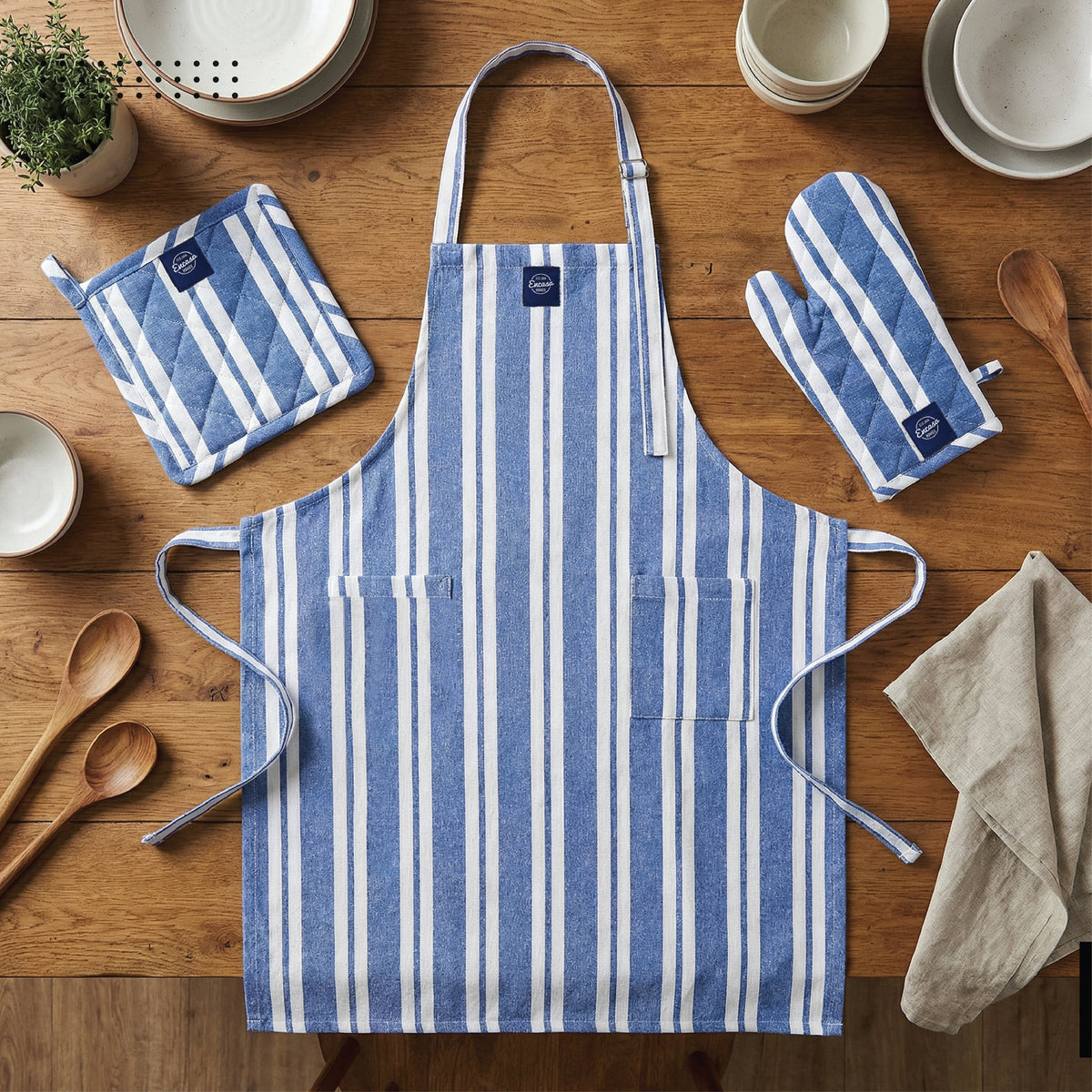
Several of our cotton patterns run across many kitchen pieces, so the matching is already done for you. The Franca blue stripes kitchen towels come four to a pack at 70x45 cm, and the same stripe comes as an apron, oven gloves, potholders, placemats and a runner.
| Pattern | Kitchen towels | Apron | Glove and potholder | Placemats | Runner |
|---|---|---|---|---|---|
| Franca blue stripes | Yes | Yes | Yes, also as a set with the apron | Yes | Yes |
| Franca beige stripes | Yes | Yes | Yes, sold separately | Yes | Yes |
| Roma grey stripes | Yes | Yes | Yes, also as a set with the apron | Yes | Yes |
| Roma red stripes | Yes | Yes | Yes, sold separately | Yes | Yes |
| Buffalo red checks | Yes | Yes | Yes, also as a set with the apron | No | Yes |
| Ticking navy blue | Yes | Yes | Yes, also as a set with the apron | No | Yes |
Expect small differences in shade. The Franca blue runner photographs a deeper navy than the towels and the apron, which are a lighter mid-blue. Side by side they still read as one set.
4. Hang towels on a hook by the hob, not on the tap or the fridge

Decor pages from abroad love a tea towel folded over the oven door. Many Indian kitchens have no oven door to use. The cooking happens on a gas hob, and the OTG, if there is one, sits on the counter. So the towel ends up on the tap, the fridge handle or the edge of the sink, hanging crumpled and damp.
A hook or a short peg rail on the tiles beside the hob fixes that. Put it to the side of the hob, not above it, where no flame or hot handle can reach the cloth. On a hook the towel hangs flat, shows its pattern and dries between uses. Our Franca stripes and Buffalo checks towels have a sewn loop at one corner, so they hang straight from a single hook. The red terry towels in the photo are thicker and do not show a loop, so they go over a peg or a rail instead.
In a rented flat, adhesive hooks save you from drilling. Near the hob, steam and a film of oil can weaken the glue, so stick them on tile you have just cleaned and dried, and pick ones made for more than a wet towel weighs. Keep it to two towels on show. Any more and the hook turns into a heap.
5. Give the apron, glove and potholder hooks of their own
At 68x85 cm, the apron is often the biggest piece of cloth in the kitchen. On a nail behind the door it does nothing for the room. The glove and potholder are worse off in a drawer, out of sight until a pan is already hot. Put all three on hooks at the end of the slab, in the stripe you chose, and they finish the set a visitor sees.
The quickest way to get all three in one go is the Franca blue apron, oven glove and potholder set, at about ₹700. The apron has a small loop at the waist meant for a towel, the potholder has a loop at one corner, and the glove has a tab at the cuff, so everything hangs. The apron also sells on its own for about ₹460. If you rarely bake, you may not need the glove at all: our piece on potholders vs oven mitts helps you decide.
6. Put hot pans on trivets, not newspaper

Newspaper or an old steel plate under the cooker does the job, but it looks like a stopgap, and newspaper soaks up oil.
Round cotton rope trivets do the same job and look like they belong there. Ours are 18 cm across and about half a centimetre thick, and each has a loop, so between meals they hang on a hook instead of lying about. The coral combo set gives you three looks: plain coral, coral with a cream rim, and a coral and white zigzag, at about ₹300 for three. With a blue or grey stripe, the plainer jute natural trivets fit in more quietly, at about ₹300 for four. The trivet collection also has sage, beige and grey.
7. Dress the table or counter where people eat and drink tea

In many flats the kitchen opens onto the dining area, or there is a small counter where breakfast and chai happen. That surface is seen more than the cooking slab. Carry the kitchen's pattern onto it and the two spaces read as one.
Two Franca blue placemats on a breakfast counter are enough. They are 48x32 cm and come in a pack of six for about ₹690, so four wait in the cupboard while two are in use. For a dining table in view of the kitchen, the Franca blue runner comes in lengths from 150 cm to 264 cm. For the tea corner, 9 cm cotton coasters carry the colour at a smaller size; our tea coaster guide covers what they protect.
Keep cloth off the stretch of slab where you chop and cook, though. A runner there takes oil and water within a day and soon looks worse than the bare granite.
8. Buy enough to rotate, so wash day does not undo the look
A towel on display still gets used and washed. If you own exactly two, then on wash day the hook is empty or the old rag comes back. A pack of four lets two hang while two are washed and dried.
Here is the costing for the example kitchen at the top of this page, in the Franca blue stripe. The four-pack of towels is about ₹500. The apron, oven glove and potholder set is about ₹700. The four jute trivets are about ₹300. That makes about ₹1,500. Add two placemats for the breakfast counter from a pack of six and the total comes to about ₹2,200. If you change towels every day, the twelve-packs in the kitchen towel collection are the next step up.
Where to start in your kitchen
If you rent and cannot drill, start with two adhesive hooks, one pack of patterned towels and the trivets, and leave the rest until you see how the room feels. A kitchen that opens onto the dining table is easier the other way round: dress the table first and bring the pattern back to the hob with matching towels. If you cook for a big family and the towels are in use all day, spend on a twelve-pack before anything else, because with only four the hook is often empty. If the kitchen is small and narrow, show fewer pieces: two towels and the apron in one stripe are enough.
Frequently asked questions
What can I hang on a kitchen wall without drilling?
Adhesive hooks on clean, dry tile, hooks that slip over the top of a cabinet door, and magnetic hooks on the side of the fridge all work in a rented flat. They suit light things such as towels, a potholder or an apron. Anything heavy, like a pan rack, needs a proper screw.
Which kitchen towel colours hide stains best?
Stripes and checks in a mid colour with white tend to hide small turmeric and tea marks, because the pattern breaks the mark up. Plain white shows every mark, so keep white for jobs where you want to see that the cloth is clean.
Do the kitchen towels need to match the dining table linen?
No. Sharing one colour is enough: a blue stripe in the kitchen and plain blue placemats on the table already look chosen together.
Encasa XO is our own brand, and the products named above are ours.


Leave a comment
This site is protected by hCaptcha and the hCaptcha Privacy Policy and Terms of Service apply.