
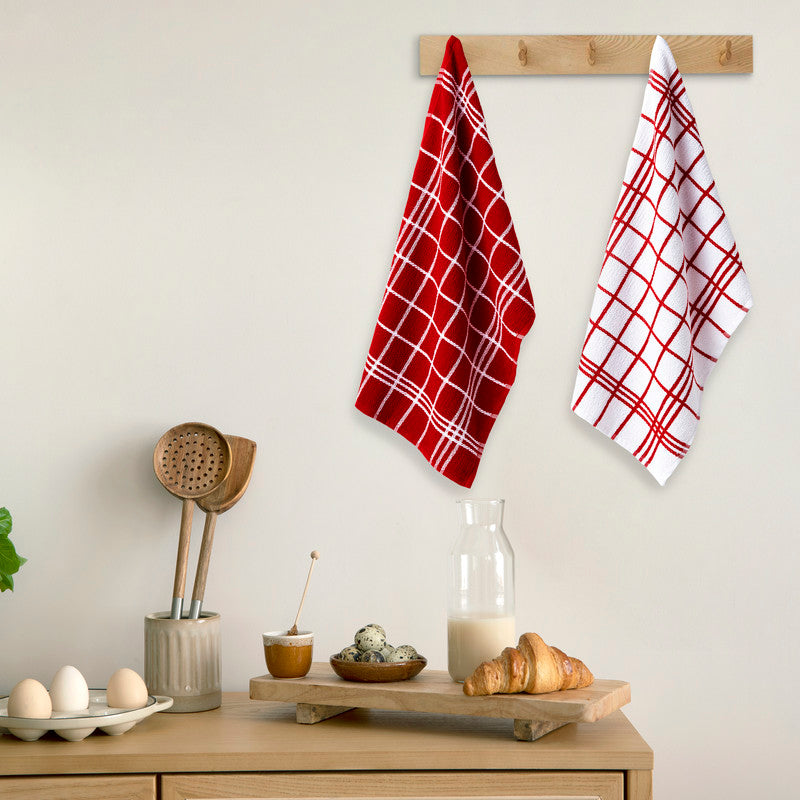
Watch one cloth in an Indian kitchen through a single morning. It dries hands between the atta and the tap. It wipes flour off the slab after the rotis. It dries a steel plate, and then somebody grabs the handle of a hot kadhai with it. One person in the house calls it the kitchen cloth. Another says kitchen napkin, kitchen duster, hand towel or just kapda, and shops call it a kitchen towel. Often these are all the same object, and that is what "kitchen napkin" means here. If you came for napkins to put on the dining table, go to our cloth napkins guide instead.
The name matters less than the habit. Trouble starts when one cloth does every job and never gets the chance to dry.
So use a small square, about 30x30 cm, for hands and quick wipes that you will wash straight after. Use a large cloth, about 70x45 cm, for the slab, utensils and glass, and use neither on a hot vessel. Then keep enough that one set is clean and dry while the other is in the wash. In the worked example further down, that comes to eight.
Which kitchen cloth for which job?
These are the jobs a cloth does in a kitchen where rotis get made and steel gets dried. They are sorted by what the job asks of the cloth, because that decides the size.
| Job | Which cloth | Why |
|---|---|---|
| Drying hands between dough and the tap | Small square | It gets dirty fastest, and a small cloth is easy to wash after one round |
| Drying steel plates and thalis | Large cloth | A full rack carries a lot of water, and a small square can be soaked before the rack is done |
| Drying glasses and tumblers | Large cloth kept for this alone | One that has wiped oil or flour will leave it on the glass |
| Wiping the slab after rolling rotis | Large cloth, folded | You can refold to a clean side as you go |
| Wiping oil around the stove | Small square, a dark one if you can | Grease stays on one small piece and away from the plates |
| Covering rotis or dough | A freshly washed cloth, large | It has to wrap the food, so it should come from the clean pile and not from the slab |
| Dusting shelves and the top of the fridge | An old cloth that has retired from food jobs | No need to buy anything for this |
| Lifting a hot kadhai or tawa | No cloth | See below |
The last row is the one to take seriously. A kitchen cloth is not made for heat, and a damp one can pass heat to your hand and scald. If you lift hot handles often, that job belongs to an oven glove or a pot holder, and our oven gloves guide covers which one to pick.
Why the size matters more than the name on the pack
Kitchen cloths in our range come in three sizes, and the gap between them is bigger than it sounds on a label.
The large cloth has three and a half times the area of the small one. On a rack of wet thalis, that is the difference between finishing the job and going to look for a second cloth. It also gives you room to fold, so you are not pushing yesterday's flour around the slab.
The small one wins on a different point. It is easy to put a small square in the wash after one spill, while a big cloth tends to stay in use because it still looks mostly clean. Then it wipes the stove, and after that a plate.
Weave has a big say in how much water a cloth holds and how quickly it dries. Our guide to terry, waffle and flat weave covers that, and is worth reading once you have settled on the sizes.
How many kitchen cloths do you need?
Start with the jobs that run at the same time, then allow for a set that is resting. Take this as a worked example and change it to suit your house.
Say a kitchen cooks two meals a day and has four cloths in use at once: a small one for hands, a large one for utensils, a large one for the slab, and a small one for wiping oil near the stove. While those work, a second set has to be in the wash or drying on the line, or someone will reach for a damp cloth because nothing else is ready. Four in use and four resting makes eight, so four small and four large.
Someone living alone and cooking once a day may run only two jobs, and three or four cloths can be enough if each gets a full wash and dry between uses. A joint family might add a second hand cloth, and a cook might keep a cloth of their own. That makes six in use and twelve in all. The monsoon changes the sum differently, since cloths take longer to dry on the line. If you keep running short by evening, add one or two more.
The cloth you keep for covering rotis stays outside this count, because it should not be in the daily rotation at all.
What a study of used kitchen towels found
One peer-reviewed study is useful here. A team led from the University of Arizona collected 82 used kitchen towels from homes in Chicago, Tucson, New Orleans, Orlando and Toronto, and published the results in Food Protection Trends in 2014. They found coliform bacteria on 89.0% of the towels and E. coli on 25.6%. E. coli numbers were lower on towels that were washed more often. The age of a towel and the days since its last wash showed no clear effect on the counts.
These were American and Canadian homes, not Indian ones, and the study counted bacteria. It did not check whether anyone fell ill, and it did not compare cloth with paper or tissue. Two of its six authors worked for a company that makes paper towels.
The same paper points back to an earlier UK study of cloths used in homes. Washing in detergent reduced the bacteria only a little, and the numbers rose again within 24 hours at room temperature, which the 2014 paper puts down to the cloths staying damp. Reliable cleaning in that UK study took a wash followed by two hours of drying at 80°C, which is not something a home washing line does. The 2014 paper also says, of sponges and dishcloths, that damp and bits of food give bacteria a good place to grow. So wash cloths regularly and let them get properly dry between uses, which is the practical reason for keeping a second set.
Same ₹499, two ways to spend it

Prices here are the store's selling prices in late October 2026, and the cost per cloth is our own division, rounded.
At ₹499 you can buy four large cloths or twelve small ones. Four at 70x45 cm come to 12,600 sq cm of cloth, and twelve at 30x30 cm come to 10,800 sq cm. The area is close, so the choice comes down to the jobs. Twelve navy squares suit a house that likes to change cloths often. Four large ones suit a house with big racks of steel.
Bigger packs save less than you might expect. Large cloths cost about ₹125 each in a four-pack and about ₹107 to ₹116 each in a twelve-pack, so the saving is about ₹9 to ₹18 a cloth. A twelve-pack from the kitchen towel range makes sense when the kitchen will really use twelve, as in the joint family above. The multicolour twelve-pack at ₹1,389 suits that house, because its stacks come in red, blue, tan and charcoal and you could give each colour one job. The colour idea is our suggestion and not something the pack tells you to do.
Small squares show a similar saving, and then it stops. In the dish towel range, six waffle squares cost ₹299, or about ₹50 each, and twelve cost ₹499, or about ₹42 each. Going up to 24 saves nothing: the pack is ₹999, and two twelves are ₹998. Not every colour is in stock at every pack size, so check the one you want.
For the kitchen in the worked example above, the plainest buy is a four-pack of large cloths plus six small squares. That is ₹798 for ten cloths: the eight you need and two small spares.
The red terry towel looks cheaper at ₹459 for four, but at 60x40 cm you get 3,000 sq cm less cloth for that ₹40 saving, so choose it for its looped weave.
A nicer cloth for the roti basket

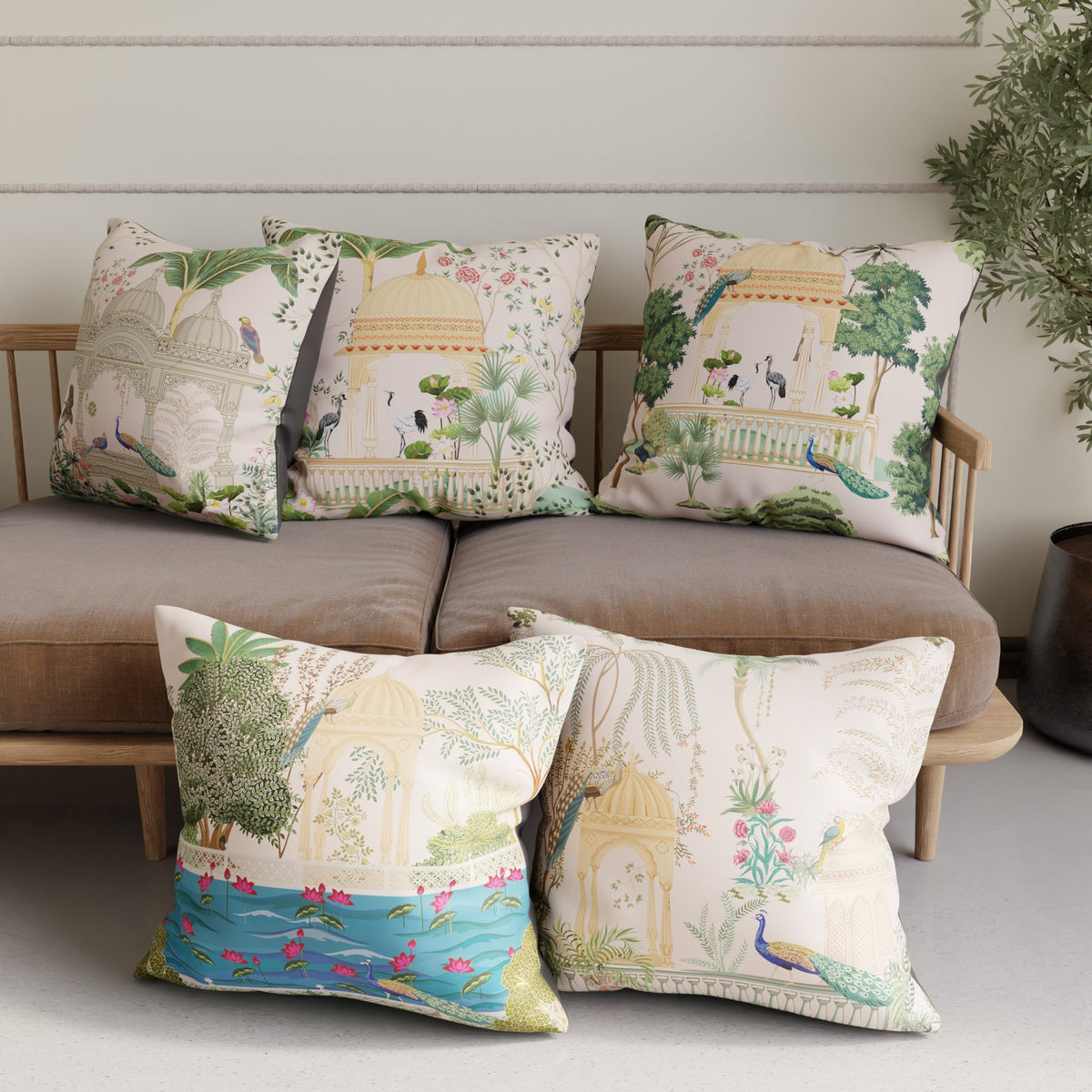
The cloth that covers rotis can be a nicer one, since people will see it on the table. The Mosaic Combo is the dearest large cloth here, three for ₹489, or about ₹163 each, and six for ₹919, or about ₹153 each. You are paying for the print, so it makes little sense for the slab. Its listing images show it wiping a glass, wrapping bread and sitting over a microwave, which are the jobs where a print gets seen.
Hanging and washing

A cloth balled up on the slab stays damp. One on a hook at least has air around it. The Buffalo Blue Checks towel and the multicolour pack above both show a sewn hanging loop in their images, and that small detail decides whether a cloth actually gets hung up in a busy kitchen. If a cloth has no loop, an S-hook through a corner or a rail will do. A rail is better if you have one, because the cloth opens out and dries faster than one hanging in a narrow fold.
For washing, follow the care label on the pack. Our care label guide explains the symbols. Wash a new dark cloth on its own for the first few rounds, and if you want to know why, read how to stop colours bleeding.
Frequently asked questions
What is the difference between a kitchen cloth and a kitchen napkin?
In many Indian homes there is none: both mean the working cotton cloth used for hands, utensils and the slab. A table napkin is a different thing, used for meals at the table and kept away from cleaning jobs.
Is a kitchen duster the same as a kitchen towel?
Often it is the same cloth at a later stage of its life. A towel that has gone thin or stained moves on to shelves and the top of the fridge. That is a good use for it, as long as it does not go back to drying plates.
How often should kitchen cloths be washed?
The study above does not give a safe number of days. A sensible house rule is to change working cloths at the end of each day, and straight away if one has touched raw meat, fish or egg, or if it smells. That is a habit that is easy to keep, not a lab result.
Is cotton or microfibre better for the kitchen?
We sell only cotton kitchen cloths and have not compared the two, so we will not name a winner. If you buy microfibre, check its pack before it goes in with the rest: several makers ask you to wash it away from cotton.


Leave a comment
This site is protected by hCaptcha and the hCaptcha Privacy Policy and Terms of Service apply.