
Most Indian kitchens have a version of this moment: a hot kadai just off the flame, no potholder within reach, and a hand grabbing the end of a dupatta, a folded dish towel, or whatever cotton is closest. It works, mostly. Then one day the cloth is slightly damp from an earlier wipe-down, and the heat comes through almost before you register it.
A good oven glove, sold as an oven mitt or kitchen glove depending on the shop, solves that problem by trapping several layers of dry, still air between your hand and whatever's hot. What separates a genuinely heat-resistant one from a decorative one is how thick that trapped-air layer is, not the price tag or the print on the outside. A potholder does the same job in a flatter shape, useful for a different set of tasks, covered further down.
What actually stops the heat

Cotton on its own isn't a great insulator. What protects your hand is the air trapped between layers. The quilting or batting sandwiched inside a well-made oven glove holds pockets of still air, and still air conducts heat far more slowly than fabric alone. That's why a single layer of cotton, like a napkin folded once, does very little: there's no trapped air, just direct contact between your skin and whatever's hot.
Dryness matters as much as thickness. Water conducts heat much faster than air, so a damp glove or cloth loses most of its insulating value. The trapped-air pockets that would normally slow the heat down are instead filled with moisture that carries it straight through to your skin. That's the actual reason a "safe enough" folded towel turns dangerous the moment it's wet, not that it's thin, but that it's wet.
Are oven gloves and oven mitts the same thing?
In the UK and across India, "oven glove" is the everyday name for what's shaped like a mitt: one compartment for the four fingers, a separate one for the thumb, no individual finger slots. In American usage the same shape is usually called an oven mitt, and in most Indian kitchens the two terms point at the same product. A genuinely five-fingered version exists but is less common, sold mainly for tasks like plating a hot dish where you need to grip something small rather than pull a heavy tray. If a listing calls itself a kitchen glove instead of an oven glove, it's worth checking the product photos rather than the name, since the description varies by seller far more than the shape does.
Why is a damp cloth more dangerous than a thin one?
Picture a kadai straight off a high flame. Its handle is hot enough to blister skin on contact. Wrap it in a single dry cotton layer and the heat builds gradually, giving you enough warning to set it down or swap to something thicker. Wrap the same handle in a damp cloth and two things go wrong at once. Water carries heat roughly twenty times faster than the still air it has displaced, so the insulating pockets stop insulating. Worse, the water closest to the metal turns to steam, and steam moving through the fabric delivers heat to your skin faster than the hot cloth alone would. That is why a wet cloth can scald before it feels properly hot, and why the towel grabbed out of habit because it happened to be nearest is the one that catches people out.
This is also why an oven glove or potholder kept on a hook near the stove, away from the sink and the wash pile, stays more reliable than one pulled from a general kitchen-towel drawer where everything gets damp together.
Oven gloves or a potholder: which for which task?

Neither protects better in the abstract. A well-made oven glove and a well-made potholder use the same layered cotton construction, so held side by side against a hot surface, they usually feel about the same. What differs is coverage and how each lets you move.
| Item | Covers | Best for | Trade-off |
|---|---|---|---|
| Oven glove | Hand, wrist, part of the forearm | Reaching into a hot oven, lifting a tray off a rack | Bulkier, less feel for a fine grip |
| Potholder | Palm and fingers only | Gripping a pot handle, lifting a lid, a quick stovetop adjustment | No wrist or forearm cover, riskier on longer reaches |
| Trivet | Nothing; the vessel rests on it | Setting a hot pan or dish down on a table or counter | Doesn't protect your hands at all |
For most stovetop moves, a potholder is the better tool. Lifting a lid, shifting a hot kadai a few inches, or grabbing a pan handle mid-stir all need dexterity more than coverage, and a flat pad like the Cotton Grey Potholder lets you feel the handle and adjust your grip as you go. Reaching into an oven is a different problem: your hand and wrist pass close to the walls and the upper heating element on the way in and out, so a glove that covers the forearm, like the Cotton Mango Oven Gloves, is worth the loss of dexterity there.
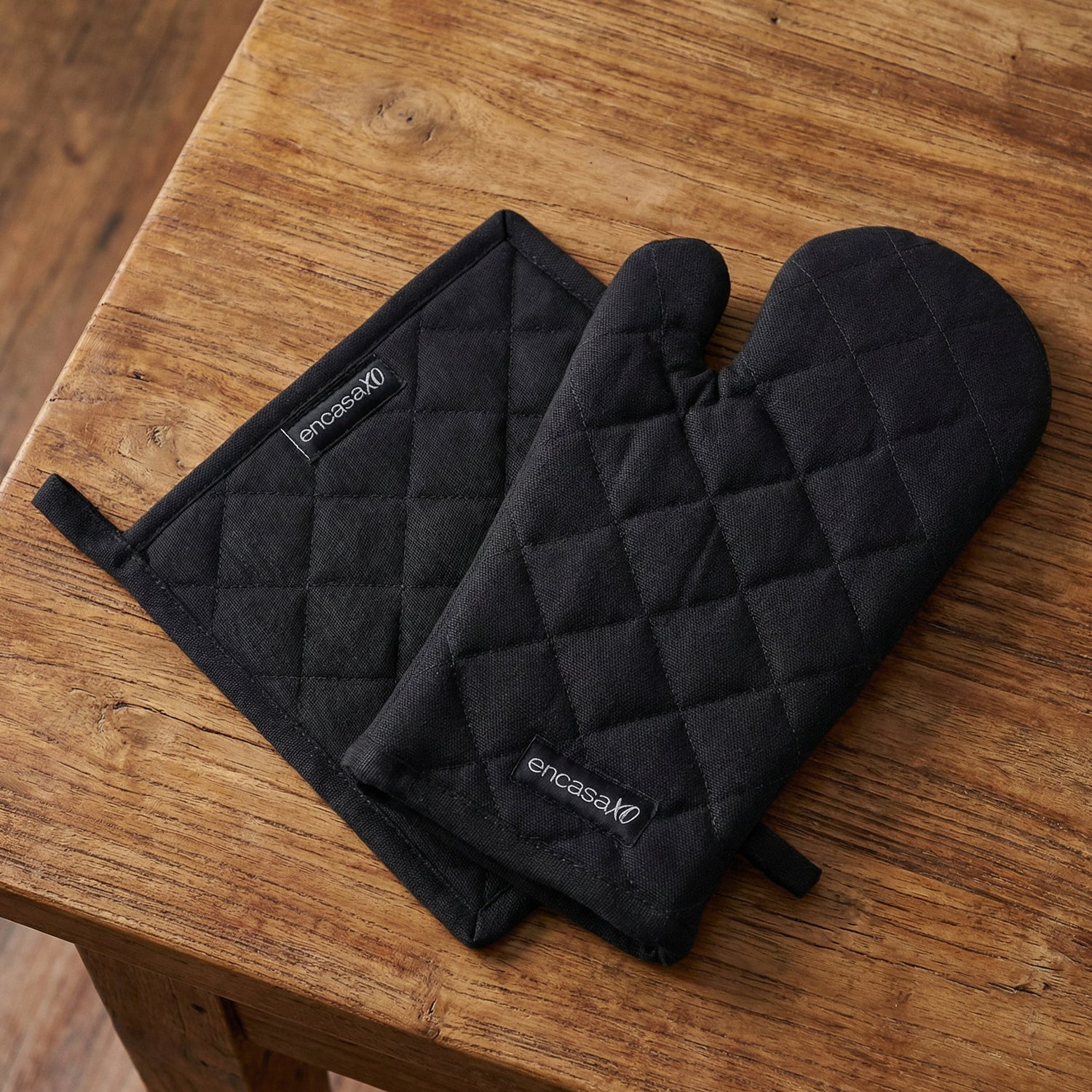
If you'd rather not decide, the two aren't mutually exclusive. A combined oven glove and pot holder set covers both jobs without duplicating fabric in the drawer, and pairs like the Cotton Full Black Oven Glove & Pot Holder are cut from the same fabric so they sit together on one hook. For setting a hot dish down on a table or counter rather than lifting it, that's a trivet's job, not a glove's or a potholder's; using either of those as a table mat wears through the insulating layer faster than using it for what it's built for.
What makes an oven glove genuinely heat resistant?

There's no fixed layer count that guarantees it, but you can feel the difference. Press two fingers together through the fabric near the middle of the palm, away from any seam or logo print. If you can feel your own fingers' warmth coming through quickly, a hot pan will do the same. A decorative glove with a single thin layer is often built more for looks than for pulling a cast-iron handle off a high flame; a plain quilted one with visible batting between the layers is usually the one built for actual stovetop and oven use.
Squeeze the whole hand, not just the cuff. A thick cuff over a thin palm protects the wrist while leaving the part that actually grips the pan underprotected, and that's the part that matters most. That's the test worth applying across the oven gloves collection rather than choosing on pattern alone, and the same logic holds for potholders: pick up more than one and compare how much padding each has before deciding by colour.
Beyond the oven: microwave and baking uses
An oven glove earns its keep well beyond the oven door. The same trapped-air construction that protects against a hot oven rack works just as well on a bowl straight out of the microwave, which is why the same product sometimes gets asked for as a microwave glove, even though it's usually just an oven glove doing a second job. Baking is the other common case: sliding a tray of hot cookies or a cake tin out, where reach and a secure grip matter more than raw heat. There's rarely a reason to buy a separate microwave glove or baking glove; a well-made oven glove that passes the press test above covers all three jobs.
Matching a full kitchen set

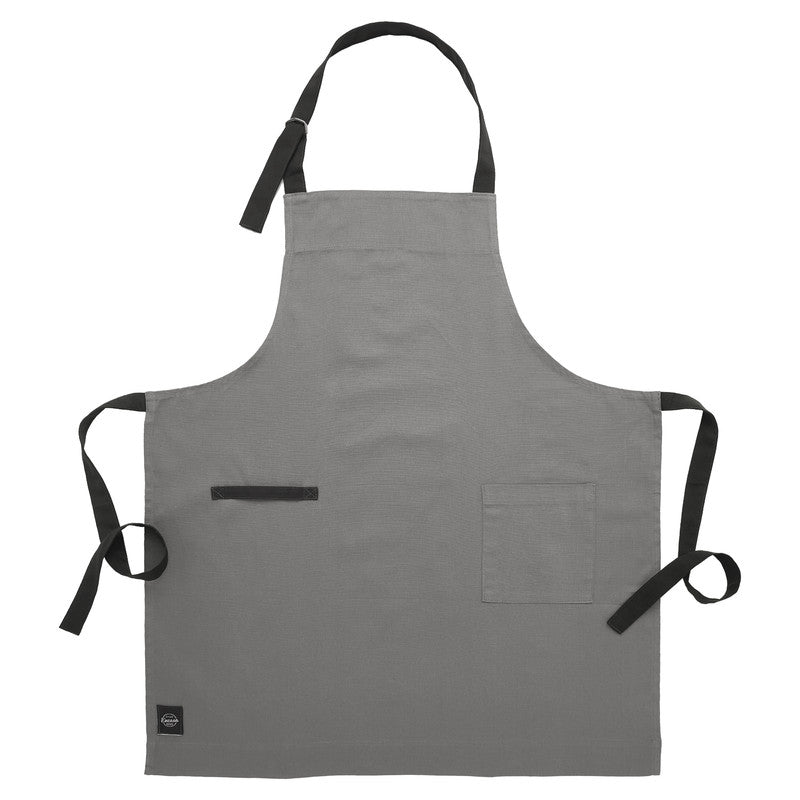
If you're setting up a kitchen from scratch, a matched three-piece set solves the coordination problem along with the heat problem. A set like the Cotton Ticking Black Apron + Oven Glove + Pot Holder puts an apron, a glove, and a potholder in the same fabric and print, which matters more for a gift or a new kitchen than for someone just topping up one worn-out potholder. For the apron half of that decision, including fabric weight and pocket placement for Indian cooking specifically, our guide to choosing a kitchen apron covers it in more depth.
Frequently asked questions
Can I use a folded kitchen towel instead of an oven glove?
A folded towel gives some protection if it's dry, thick, and folded into several layers, but a single fold rarely matches the trapped-air layering of a purpose-made oven glove or potholder, and a towel used for wiping surfaces is far more likely to be damp when you reach for it. Keep a dedicated glove or potholder near the stove rather than relying on whatever towel happens to be nearby.
What's the difference between a potholder and a trivet?
A potholder is for your hand: you hold it while lifting or gripping something hot. A trivet sits on the table or counter and the hot vessel rests on it; it never touches your skin. Using a potholder as a trivet, or the other way round, wears out the one piece of fabric doing two jobs.
Are silicone oven mitts better than cotton ones?
Silicone grips well even when wet and doesn't absorb moisture, which takes the damp-cloth problem off the table. It's also less breathable, so hands get warmer inside over a long cooking session, and a smooth silicone surface can slip on an oily pan handle in a way a textured cotton weave doesn't. Neither material is a clear winner; it comes down to whether wet-hand grip or breathable comfort matters more in your kitchen.
How often should oven gloves and potholders be replaced?
Replace one once the fabric feels thin at the point you actually grip, not by a fixed age. Repeated washing compresses the batting inside over time, and a glove that once felt padded can end up close to a single layer without looking any different from the outside.

Leave a comment
This site is protected by hCaptcha and the hCaptcha Privacy Policy and Terms of Service apply.