
Ironing on the bed or the dining table is normal in plenty of homes, and so is the damage: a damp patch in the mattress, a dull mark on the table top. On a Reddit thread that asked people who own no ironing board what they iron on instead, the person who started it said they had ironed straight onto a rug and melted a hole in it.
Most of that damage traces back to one belief, and it is only half right: that pressing clothes properly needs a proper ironing board. A board costs money and has to live somewhere, so many people skip it and use whatever is flat. When the shirt then comes out badly, they blame the iron.
You can iron clothes without an ironing board. What you need is a firm padded surface that does not soak up the press, that keeps heat and steam off what is underneath, that grips instead of sliding, and that gives the hot iron somewhere safe to sit. A board holds all of that up on legs. The legs are the part you can skip.
What the board was really doing
An improvised surface usually passes one or two of those jobs and fails the rest, which is why making do feels like it half works.
Firmness is the one you can feel. Pressing pushes heat and weight into damp cloth, and the weight only does something if the surface pushes back. A mattress does not. It swallows the iron, so the cloth goes warm and flattish instead of pressed, and the crease is gone by the time the shirt is on a hanger. A table pushes back well, which is why it is the better guess of the two.
Heat and steam are where the table gives it all back. A board is perforated, so steam passes through it and away. A solid table stops it. The steam turns back into water and sits in a warm film under whatever cloth you put down, and wood finish answers that with a pale bloom you spot hours later. On a bed it goes downward instead, into the mattress padding, and stays there.
Grip is the one nobody thinks about. A cloth laid loose on a table moves, and a cloth that moves does not stay flat, so you iron its own wrinkles into your shirt. The last job barely registers until you need it: a board has a metal rest for the hot iron, and a kitchen counter has nothing.
None of this means the first instinct was wrong. If ironing on the bed feels like it is not working, that reading is correct. What was missing was the surface, not the frame under it. The wrong turn comes next, when people decide the answer is a full-size board that then has to live somewhere in a flat with no spare corners.
The bill arrives in two parts. This week it is clothes you press twice and hang up still creased, and a shirt you give up on and wear as it is. Over a year it is ironing you put off until it becomes a Sunday afternoon job, and marks on the dining table that need more than a wipe to fix.
How do you iron clothes without an ironing board?
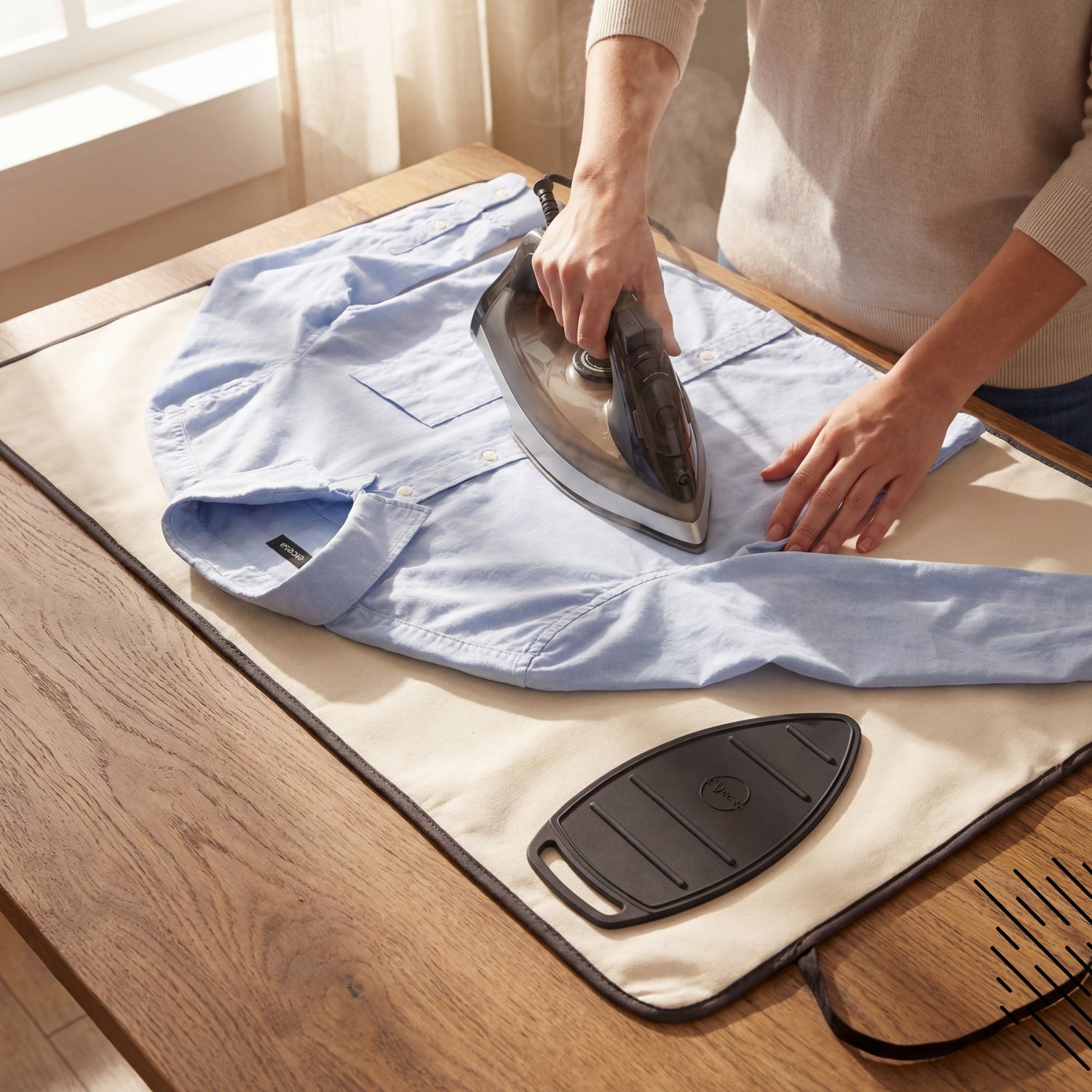
A padded ironing mat is the working surface of a board with the legs taken away. You unroll it on the table or the bed, iron, and fold it away after.

Each part of it answers one of the failures above. Encasa's mats are built on 3 mm of multi-layer padding, thinner than a board cover's pad and meant to be: a cover shields your clothes from perforated steel, while a mat lies on something already flat and hard. It spreads the press evenly and holds the damp, so steam stays in the mat instead of reaching the polish. The backing grips, so the mat holds still on a smooth table. A silicone rest patch is built into the surface, so the iron has somewhere to stand.
Both the Cotton Natural anti-slip mat and the Mauve Tiles mat pictured above come in a large 120 x 70 cm, in the ₹999 to ₹1,299 band; the mauve is a purple tile print, made in that size only.
Picture the same morning going the other way. The mat is down on the dining table, the shirt is flat on it and stays flat, so you are not stopping to straighten anything. The iron sits on the silicone patch while you turn a sleeve over. The collar takes one pass. Ten minutes later you are wearing the shirt, and the mat is folded into a drawer with the table dry and unmarked under it.
What each surface does
Here is how the usual stand-ins compare with a mat.
| Surface | Heat to what is below | Steam and damp | Stays put | Where the iron parks |
|---|---|---|---|---|
| Thick towel on a counter | Blocked well | Soaks in, then into the counter | Bunches under the iron | On the towel, on its heel |
| Folded sheet on the bed | Blocked, but the bed gives way | Into the mattress | Moves with the bedding | On the bed |
| Bare dining table | None | Turns to water on the polish | Garment slides | On the table |
| Padded ironing mat | 3 mm multi-layer pad | Stays in the mat | Anti-slip backing | Built-in silicone rest |
What people without a board actually use
On that same Reddit thread, the answer people agreed with most, at 183 upvotes, was a towel. It has real limits. A towel soaks steam up rather than keeping it out, so the damp ends up in the counter under it. Nothing holds it down, so it bunches under the iron. Its pile is thick and uneven, fine under a bedsheet and poor under a collar. And it leaves the hot iron nowhere to stand.
Inside those limits it does work, and the poster said so plainly: "put down a towel (thickest one you have) onto the kitchen counter or floor, and use that to prevent heat transfer". Someone replied, "Thank you this worked perfect!" A thick towel on a hard counter fixes the two loudest problems at once, because the counter is firm and terry cloth really does block heat.
Another poster, on a laundry thread, had gone a step further and bought what they called "a giant ironing pad", which they used on tables, counters and beds.
Which size to get
If you iron on a dining table or a bed, get the large 120 x 70 cm: that width is the reason a mat beats a board on bedsheets and sarees. The Cotton Cobalt anti-slip mat comes in that size. If your ironing is a five-minute press on a kitchen counter, get the small one at around 70 x 50 cm instead.
Measure the clear run on your surface before you order. If you cannot clear a full metre, buy the small size, because a large mat with one end hanging off the table is worse than a small one lying flat.
The part that shows up later
Go back to the bed and the table for a moment. Whatever you spread out there is not only padding. It is also the thing held against your clothes, hot and wet, for as long as you iron.
A Reddit poster giving padding advice put it plainly, and it applies just as much to a towel on a counter: do not use anything stained or dark-coloured, because "the steam and heat might cause the soil or color to bleed through the layers above". A maroon bath towel under a white kurta, with steam driving through both, is a real way to lose the kurta. Towels are not sold as ironing gear, so few people check them for it.
Then there is the iron itself, sitting hot for the thirty seconds it takes to turn a sleeve over. Where the mat does not reach, a silicone iron rest pad at about ₹300 does that one job: a 27 x 14.5 cm sheet of heat-resistant silicone, rated to 220°C for short spells, that grips the counter. Under ₹1,300 buys the mat; a good kurta that comes out of the wash still tinted can cost more than that.
Common questions
Won't a thick towel do the same job?
Not quite. It soaks up steam instead of keeping it out, so the damp reaches the counter in the end, and nothing holds it down, so it travels under the iron. A dark towel's dye can move into a pale garment under heavy steam. Terry pile is also not a flat weave, so a firm press on a collar picks up the towel's texture. Heat is the part it genuinely handles, and Reddit posters who iron this way say it works for them. The towel is free and the mat is under ₹1,300, but one good shirt with a scorch mark that will not wash out can cost as much as the mat, and a table that needs refinishing costs a great deal more.
Where does the mat live when you are not using it?
It folds. That is most of the answer, and it is the main practical difference from a board: the mats are made to fold flat and travel, so one goes into a drawer or onto a shelf instead of standing against a wall.
Is a mat safe on a wooden or a glass dining table?
On wood, yes, and that is what it is built for: 3 mm of padding with a backing that stops the mat sliding, so heat and damp stay in the mat rather than reaching the polish. Glass we make no claim about, so treat it as untested; a heated glass top is not a risk worth running for one shirt. Use a wooden surface or a kitchen counter instead.
I already own an ironing board. Is a mat still worth buying?

Usually not. If the frame is sound, the part that wears out is what sits on top: the pad flattens and the elastic goes slack, so the cover turns while you work. Replacement covers with their own pads run roughly ₹650 to ₹950, less than a mat and aimed at the thing that is actually broken. Add a mat only if you also want to iron away from the board.
What size mat fits a kitchen counter?
The small one, around 70 x 50 cm. It suits a counter or a chest of drawers, where you press a shirt front and a sleeve at a time rather than laying a whole garment out. The large 120 x 70 cm wants a clear metre and a bit, which a kitchen counter rarely has spare.
Where that leaves you
Two ways to go, and one may already be yours. If you own a thick pale towel and press something once a fortnight on a counter you do not care about, carry on: that setup works, and none of this is worth spending money on. If you iron most weeks, on a table or a bed you would rather not damage, the towel is blocking heat and failing at everything else.
The other way is the morning that goes right: the mat down, the shirt flat and staying flat, the iron on its silicone patch, the table dry when you fold everything into a drawer. A mat from the anti-slip range is under ₹1,300 and asks for less room than the board you decided against.
Encasa XO is our own brand, and the mats, rest pads and covers named here are ours.

Leave a comment
This site is protected by hCaptcha and the hCaptcha Privacy Policy and Terms of Service apply.