
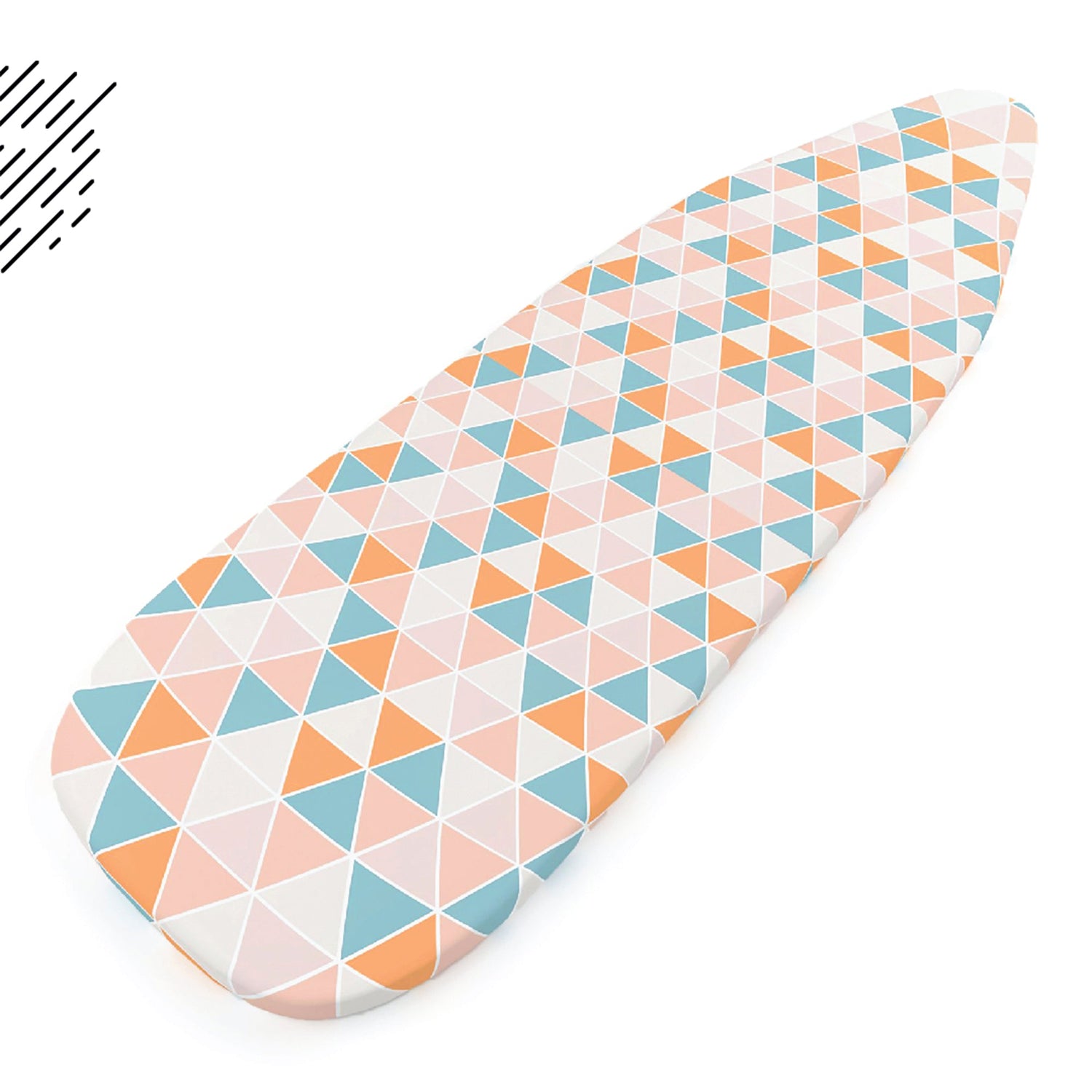
The navy trousers were pressed and ready, except for a faint shiny stripe down one leg that was not there before ironing. The usual response is to blame the iron, turn the dial down and iron everything twice as slowly from then on. The actual culprit is often lying flat under the clothes the whole time.
If your ironing keeps producing shine marks, mesh imprints or fresh creases, the cover and pad on the board are usually the problem, not the iron. A cotton replacement cover with its own pad costs well under ₹1,000, takes five minutes to fit, and Encasa's own product guidance is that any cover older than about two years is due for a change. Here are seven reasons that swap does more for your ironing than a new iron would.
1. Shine marks and mesh prints come from the pad, not the iron
That waffle pattern that sometimes appears on a dark shirt after a firm press is the metal mesh of the board itself. Most boards are perforated steel, and the only thing between the mesh and your clothes is the padding. When the pad compacts with age, every stroke presses the fabric directly against the grid, and on trousers and dark cottons the concentrated pressure flattens the fibres into that telltale shine.
Fresh padding spreads the pressure and the heat evenly. The canvas ironing board cover carries a 4 mm felt pad for exactly this reason: it spreads heat evenly across the surface and keeps the mesh from printing through. Dark clothes come off the board looking pressed rather than polished.
2. A loose cover irons its own creases into your clothes

A cover that shifts under the iron wrinkles, and the iron then presses those wrinkles straight into whatever is on top. You end up chasing creases you did not bring to the board. Once you notice it happening you also start pinning the cover with your free hand, which makes every shirt slower.
This is a fastening problem. The cotton twill triangles cover closes with an elastic cord plus a tightening clip that cinches it around the underside, so the surface stays drum-tight through a full session. Other designs in the range use a drawstring with a lock, which does the same job by a different route. Either way, a cover that cannot move cannot crease.
3. Steam needs to pass through the surface, or it comes back as damp
Steam ironing works by pushing hot moisture through cloth and letting it escape below. On a proper cover the fibre pad does two opposite jobs at once: it lets steam pass down through the perforated board while reflecting heat back up into the garment. Each pass does more work, and the garment stays dry.
Press the same shirt on a folded blanket and the steam has nowhere to go. It condenses where it stops, so you iron dampness back into the fabric you are trying to finish, and the session stretches on. If your clothes feel slightly moist when you fold them, the surface underneath is the first thing to question.
4. Cheap dyes travel onto light clothes, tested ones stay put
Damp heat is precisely the condition dye transfer likes. A printed cover made with untested dyes can tint a white shirt the day the steam gets heavy, and the stain never quite washes out. This is a quiet risk because nothing looks wrong with the cover itself.
The prints on the Big Leaves Blue cover are tested for colour fastness so they do not bleed onto clothes, and the fabric carries a scorch-resistant finish rated for iron temperatures up to 220 degrees, which is also what stops the cover browning where the iron rests. When it does get grubby, cover and pad both wash in cold water rather than needing replacement.
5. An odd-size board is a measuring problem, not a dead end
The most common reason people give up on replacing a cover is the belief that nothing fits their board. Indian boards do not follow the 137 × 38 cm figure that foreign guides quote as standard, but they do cluster into a handful of footprints, and covers are cut to match them.
| Cover size | Fits a board of (length × width) |
|---|---|
| Mini / tabletop | 70–74 × 28–32 cm |
| Bathla-fit | 109 × 38–40 cm |
| Medium | 110–114 × 32–36 cm |
| Large | 120–127 × 37–40 cm |
| Wide | 123–127 × 44–48 cm |
| X-Large | 133–137 × 44–48 cm |
Measure nose to tail and across the widest point, then match the two numbers to a row. The full method, including the thickness and nose-shape checks that catch the awkward cases, is in our ironing board cover size guide. Genuinely unusual boards are not stuck either, since custom covers can be made to order for non-standard sizes.
6. No board at all? A padded mat turns the dining table into one

Plenty of homes iron on the bed or the dining table and have no intention of buying a board that then needs storing. The problem was never the flat surface, it was what ironing does to it: steam soaking into the mattress, heat marks on the table's polish, and a bedsheet surface too soft to press against.
An anti-slip ironing mat solves each of those separately. The large size spreads 120 × 70 cm, wider than any board, so a saree or a bedsheet drapes with less repositioning. A multi-layer pad stops condensation seeping through to the wood or the mattress, the non-slip backing holds it in place mid-stroke, and a built-in silicone rest gives the hot iron somewhere safe to stand. When you finish, it folds into a cupboard. The full mat range runs from compact 70 × 50 cm versions up to the table-width size.
7. When to replace an ironing board cover
About every two years with regular use, and sooner if you can see the evidence. The signs are unambiguous once you look for them: a browned patch where the iron habitually rests, padding gone thin enough that you can feel the mesh ridges through it, prints faded from heat, or elastic so tired the cover rotates while you work.
Against that, the arithmetic is friendly. Replacement cotton covers with pads sell for under ₹1,000 in most sizes, the mats sit a little above that, and both are a fraction of what a new board costs. Fit the right size and the frame you already own carries on for years; the cover was always the part doing the actual work.
Frequently asked questions
How often should an ironing board cover be replaced?
Roughly every two years under regular home use. Judge by condition rather than the calendar: browning under the iron's parking spot, padding compressed flat, or a cover that slides during use all mean it is done, whatever its age.
Can you iron clothes on a bed or table without a board?
Yes, if you put a padded ironing mat down first. Ironing straight on a mattress traps steam in the bedding and gives too soft a surface for a sharp press, while a bare table risks heat marks. A mat with a moisture barrier and an anti-slip base fixes all of it and folds away afterwards.
Why do black clothes go shiny after ironing?
Heat plus concentrated pressure flattens the fibres so they reflect light. It happens fastest when thin or compacted padding lets the board's mesh push back against the garment. Iron dark fabrics inside out and press on a surface with intact padding.
What size cover fits a standard Indian ironing board?
There is no single standard, but a large share of full-size home boards measure 120 to 127 cm long and 37 to 40 cm wide, which corresponds to a Large cover. Measure your own board nose to tail and at its widest point before ordering, because compact and wide-top boards need different cuts.
Encasa XO is our own brand; the products named above are ours, and the covers, pads and mats described are the ones we make and sell.

Leave a comment
This site is protected by hCaptcha and the hCaptcha Privacy Policy and Terms of Service apply.