
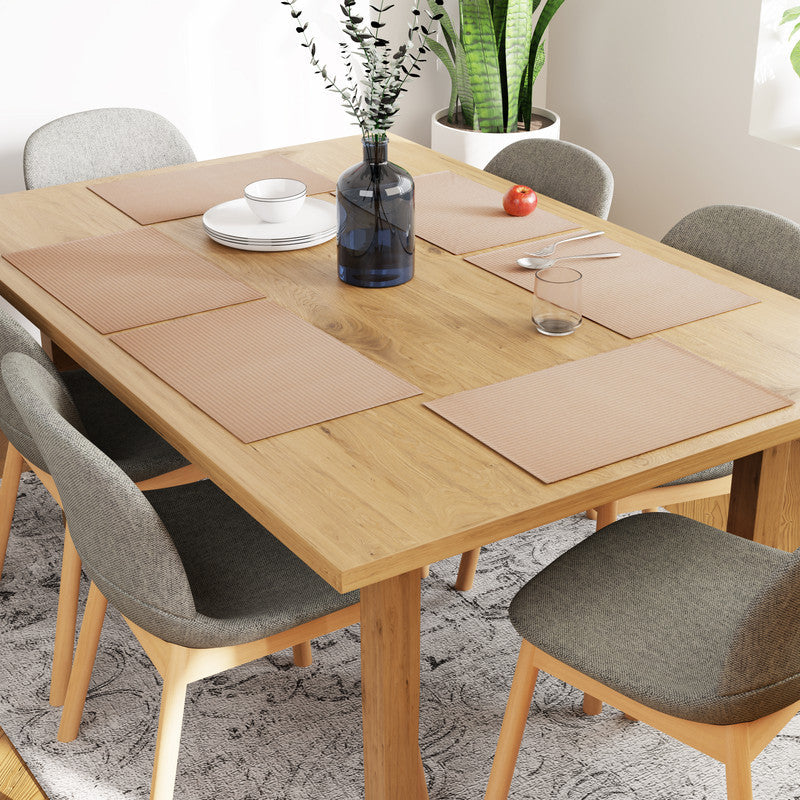
It is twenty to eight on a Tuesday. Four people are eating in the next fifteen minutes, the sabzi is still on the gas, and the table is holding a stack of post and somebody's charger. What happens next takes about ninety seconds. The table gets cleared and wiped. A mat goes down at each of the four seats, with a folded napkin on it. The water jug and the glasses go to one end, away from elbows. The middle of the table is left clear, because in a few minutes a hot kadhai and a plate of rotis are going to land there.
That is a set table. Two things per person, one protected space in the middle, and nothing else.
The advice that comes back from a search answers a slightly different question. It describes a Western formal layout built for food that arrives in courses, which is not how dinner turns up in an Indian home. The three things that decide whether a table works here are a defined space for each person, something to wipe hands on, and a middle that can take a hot vessel. Everything beyond that is added for the occasion.
Table setting in three stages: everyday, guests and festivals
The easier way to think about it is one ladder rather than three separate tables. Each stage keeps everything from the stage below and adds one thing on top.
Everyday is mats and napkins on a bare table. When guests come, a runner goes down the centre first, or a full cover, and the same mats sit back on top of it. For a festival, that same table gets a centrepiece, placed to one side so it is not in the path of the serving dishes.
This matters for what you buy. If the guest table is the everyday table plus one piece, you can buy within one range over a few months rather than keeping two unrelated sets of linen and picking between them whenever somebody visits.
The ladder does assume the meal happens at the table. Plenty of households serve from the kitchen counter and carry full plates through, and in that house the mats do all the work while the centre of the table never gets used at all. If that is how you eat, buy mats and napkins and stop climbing.
Where does everything actually go?
The plate or thali sits centred in front of the chair, in far enough from the edge that pulling the chair in does not catch it. The napkin goes to the left of the plate, or folded on top of it if you want the table to look done. One spoon on the right covers most home meals. Add a fork if your household eats with one, and leave the table knife in the drawer unless something on the menu needs cutting.
One rule is worth dropping outright. Search for how to set a table and the diagrams that come back show a Western formal setting: forks to the left, knife and spoon to the right with the blade turned inwards, and the cutlery laid out from the outside in so each course starts with the outermost piece. That is a real convention and it works, for a meal that arrives in courses. An Indian meal usually arrives all at once, on one plate or a thali, and a good share of it gets eaten with the right hand, with the left kept for the water glass and the serving spoon. There are no courses, so there is no sequence for the cutlery to follow. Laying out four pieces per person means washing three of them for nothing.
The centre of the table is the part those diagrams treat as decoration, and it is not waiting for a flower arrangement. The dal, the sabzi, the rice and the covered stack of rotis all sit there for the whole meal and get refilled from there, which makes the middle of the table a working surface that takes heat and drips. A kadhai comes off the gas and goes straight down. That is the real argument for a runner or a mat down the centre rather than a purely decorative object, and the table mats guide goes into which materials handle a hot vessel and which do not. None of them is a heat shield, though. Anything coming straight off the gas still wants a trivet or a steel stand between it and the cloth.
The everyday table

The everyday stage is two purchases. The Cotton Solid Beige Placemat in a pack of six is a plain ribbed beige mat at 48 by 32 cm, ₹689 for the pack, which is a six-seater set or a four-seater set with two mats spare while the others are in the wash. Plain is the safer buy at this stage, because it is the layer that has to sit under every pattern you add later. If beige is wrong against your wood, the rest of the placemats range does the same job in other plain colours.
For napkins, the Cotton Buffalo Beige Checks pack of six is 43 by 43 cm at ₹759, in a heavy 225 gsm homespun cotton with mitred corners. The size is the thing to notice. At 43 cm it stays on a lap instead of sliding off it, and it takes a proper wipe rather than a dab. The check here is woven into the cloth rather than printed on the surface, which usually ages better through repeated washing. Other colours and checks sit in the table napkin collection.
Bare wood between the mats is a real choice, not a gap in the setting. The laundry stays small enough to go in with a normal load instead of becoming one big cloth that needs its own wash and an iron, and on a table you like looking at, covering it defeats the point of owning it.
What changes when guests come?

One piece. A runner goes down the centre, the mats go back on top of it, and the table stops looking like it was laid in a hurry. The middle strip also gets a washable layer under the serving dishes, which is the half of the job that is easy to miss.
The Cotton Franca Beige Stripes range is the one line in our catalogue where the cover, the runner, the mats and the napkins are all the same beige and white woven stripe, so a guest table can be built one purchase at a time without anything clashing. The Franca runner sells in five lengths from ₹369 to ₹698, and the table runner size guide has the sum for picking one against your table. Check the price on every length before you choose, because they do not climb neatly with size. The 183 cm runner is currently the cheapest of the five, under the 150 cm one. If the stripe is not for you, the table runners collection will do the same job in another cloth, as long as you match it to mats you already own rather than to the table.
There is a matching Franca placemat pack and a Franca napkin pack in the same stripe, both priced the same as their plain counterparts. Buying all of it at once gives you stripe on stripe on stripe, which some people like and which gets busy fast once full plates are on the table. The calmer version is plain mats over the striped runner, or striped napkins as the only pattern.
Is a runner or a table cover better on a small table?

On a compact four-seater, and particularly a glass-topped one, a runner usually wins. Cotton on glass has very little to grip, so a full cover slides when a chair is pushed in and needs straightening through the meal. A runner and mats sit in the middle of the surface, where the dishes and the plates hold them down. They also give a glass top the scratch buffer it does not have on its own, which matters when a steel thali or a serving bowl with a rough base lands on it.
A full cover earns its place for the opposite reasons. It hides a surface you would rather not look at, it takes the splashes of a bigger spread, and it is one item to wash instead of six. The Cotton Franca Beige Stripes table cover comes 142 cm wide in two lengths, one sized for a four to six seater at ₹919 and a longer one for a six to eight seater at ₹999. How far it should hang over the edge is a separate question, answered in the table linen guide, and the table cover guide matches cover sizes to seater counts. Round tables are the awkward case, since a rectangular cover on one drops unevenly at the corners, and the round cuts sit inside the wider table covers collection rather than in a range of their own. Mats can also go on top of a cover if you want the washable layer exactly where the plates are.
What to buy at each stage
Napkins are what run short first, because they go into the wash after every meal while a mat can be wiped and reused. A household that entertains at all wants a second napkin pack long before it wants a second cover, and the table napkin size guide has the sizes and pack counts. Buy that spare pack in a different colour from the first, so the two sets do not get shuffled together in the cupboard and come out mismatched.
Order matters as much as choice. Mats and napkins first, then the runner once you know your table length, then the cover last, if at all. Buying the cover first is the common mistake, because it is the piece that looks most like a set table in a picture and the piece you will use least.
Frequently asked questions
How do I set a dining table properly?
For a home meal in India, properly means a mat and a napkin at every seat, a spoon where the eating hand can reach it, and a clear middle for the serving dishes. Nothing needs to be squared off with a ruler. Water is easier at one end of the table than at every place, since a jug and glasses take up room a plate wants.
Do I need placemats and a table cover, or just one?
Just one is fine, and which one depends on the table. Mats leave the wood on show and wash individually, so a spill is one mat in the bucket. A cover hides a scratched or marked surface and handles a large spread better. The two go together only when you want a wipeable layer sitting on top of a cover, which is worth doing on a festival table.
What goes in the centre of an Indian dining table?
The food. Serving dishes stay in the middle of the table through the meal and get refilled from there, so the centre needs to be free and able to take a hot vessel rather than occupied by a decoration. If you want something ornamental, keep it small and set it to one side where a serving spoon will not catch it.
How do I set the table for a festival like Diwali?
Start from the guest table, which is mats and napkins over a runner or a cover, then add a centrepiece and whatever festive colour you want. Diwali adds a lit diya to the table, and the Diwali table setting guide has the clearances and the order to lay things down in.


Leave a comment
This site is protected by hCaptcha and the hCaptcha Privacy Policy and Terms of Service apply.