
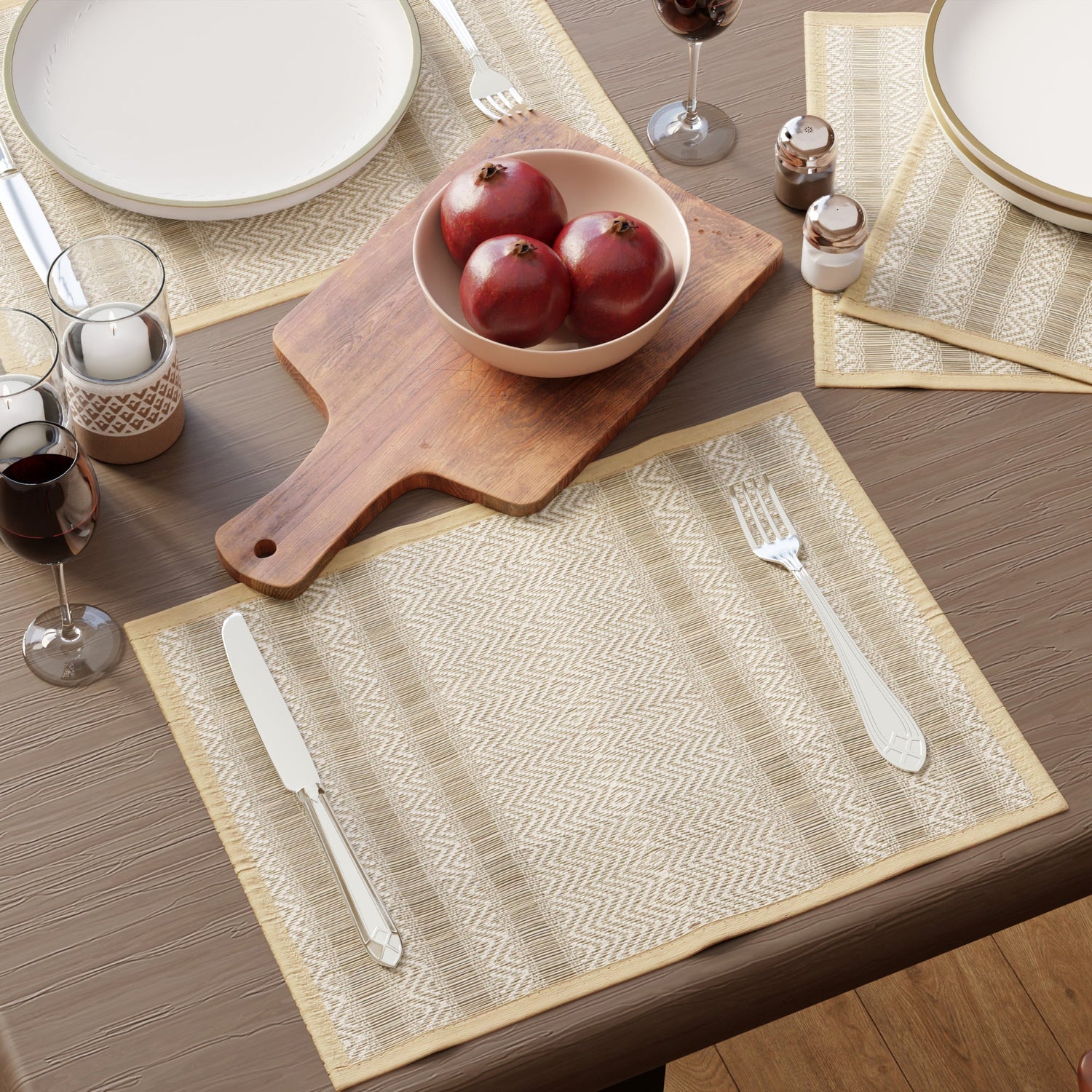
Watch anyone lay out a new set of table mats for the first time and the same small routine happens. The mats go down, one per chair, then get nudged: apart, then together, then a little further in from the edge. Somewhere in that shuffling it becomes clear the mats either crowd each other along the side of the table or float with too much bare wood between them, and by then the packet is open.
The mat is rarely the problem. The table is, or rather two of its measurements, which almost never get taken before the order goes in, because the listing gives you the mat's dimensions and says nothing about what they have to fit into.
Across our own range, rectangular table mats run 42 to 48 cm long and 30 to 32 cm deep, and round ones sit between 30 and 33 cm across. Buy one per seat, which in practice means matching the pack to your seater count rather than counting mats. Whether that mat fits is settled by your table's length and its width, in that order.
If what you actually want is a strip down the centre rather than a mat at each place, our table runner size guide has the length chart for that. If you want the whole surface covered, the table cover guide sizes that instead. The rest of this is for mats.
The two sums a table mat has to pass
The first sum runs along the length of the table. However many people sit on one long side, that many mats have to fit end to end with a little air between them. The gap people quote is about four inches, roughly 10 cm: a styling habit rather than a rule, but a useful number to hold the arithmetic against.
Across the width the arithmetic is simpler. Two mats face each other, so twice the mat's depth has to fit inside the table's width, and whatever survives in the middle is the strip the serving dishes, the water jug and any centrepiece have to share.
Both sums use the table, not the seat count, so measure the top. Our runner guide's chart puts a 4-seater at 90 to 120 cm long, a 6-seater at 150 to 180 cm, and an 8-seater at 210 to 240 cm. Widths run around 75 cm on a compact 4-seater, about 90 cm on a typical 6-seater, and 90 to 100 cm on an 8-seater.
Three 48 cm mats a side come to 144 cm, which the diagram shows sitting comfortably on a 180 cm table. Shorten that table to 150 cm, still sold as a six-seater, and the same three mats leave 6 cm in total: a rounding error rather than spacing. That is the table that wants 42 cm mats, or round 32 cm ones.
The width is where it goes wrong more often. Two 32 cm mats facing each other use 64 cm, so a 90 cm table has 26 cm down the middle and a 75 cm table has 11 cm. A runner, per our runner guide, wants 30 to 40 cm and fits in neither. That is why the usual advice is to lay the runner first and set the mats over it: the two are competing for the same centimetres, and the mats win because the plates go on them.
What size are table mats, and is there a standard size?

There is no fixed retail standard in India, which is worth saying because plenty of listings imply otherwise. A commonly quoted reference figure is 12 by 18 inches, about 30 by 45 cm, a touch shorter and shallower than most of what sells here. Treat it as a rough middle rather than a specification, and treat any single retailer's "standard size" the same way.
What we stock clusters tighter than that. The largest rectangular mat is 48 by 32 cm, used by the cotton off-white ribbed set of six. Printed cotton canvas mats are 46 by 32 cm, faux leather 42 by 30 cm, and the handwoven Madurkathi grass mats 30 by 42 cm, the same footprint turned the other way round on the label.
Round mats are a separate decision, not a smaller version of the same one. Ours run 32 cm in ribbed cotton, 32 cm in jute and 30 cm in rattan cane. A 30 cm circle holds a dinner plate and nothing else, which is fine on a round table and useful on a compact 4-seater, where two 48 cm mats a side will not fit inside 90 cm of length. Round is often the answer for a small table, not only for a round one.
How many table mats do you need for a 4, 6 or 8 seater table?

One per seat is the whole rule. The complication is that mats are not sold one at a time. Across the placemat collection they come in packs of two, four and six, and there is no pack of eight anywhere in the range, which is the arithmetic that trips up the larger tables.
| Table | Mats needed | What to buy | Left over |
|---|---|---|---|
| 4-seater | 4 | one pack of 4 | none |
| 6-seater | 6 | one pack of 6 | none |
| 8-seater | 8 | two packs of 4 | none |
| 6-seater, grass mats | 6 | two packs of 4, or the 7-piece set | 2 spare, or none |
Two things follow from that table. The first is that the larger pack is the cheaper route to the same number of mats. In the round ribbed cotton line as it is priced now, two packs of two come to ₹818 against ₹689 for a single pack of four, and three packs of two come to ₹1,227 against ₹949 for one pack of six. Same mats, same colour, ₹129 and ₹278 of difference.
The second is the awkward case in the last row. The Madurkathi grass mats only come in a pack of four, so a 6-seater buys two packs, ends up with eight mats and pays ₹998 at the time of writing. For one rupee more, the grass runner and mat set is ₹999 and holds six mats plus a runner. Six seats, no spares, and a runner instead of the two mats you would not have used.
Its pieces are cut to work together, which matters for the sums above. The mats are 28 by 41 cm rather than 30 by 42 and the runner is 29 by 125 cm, so two facing mats plus the runner come to 85 cm and fit inside a 90 cm six-seater. The trade-off is that a 125 cm runner is shorter than the table and sits inside the ends rather than hanging over them.
Cotton, natural grass, rattan or wipe-clean

Cotton is the everyday answer and the one with the widest range of colours, with one split in it the listings do not make obvious. The 48 by 32 cm ribbed mats are woven from 12-ply recycled cotton yarn and are described as machine washable. The round ribbed cotton mats, made from a heavier coiled cotton, are not: their care instruction is a damp cloth or a hand wash. Same fibre, different construction, different rules, so read the care line on the specific mat rather than assuming cotton means machine wash.
Colour is the part the arithmetic cannot help with. Turmeric and hot oil are what stain a light cotton mat, so an off-white set on a table that sees daily dal ages faster than a beige or a print. For everyday meals rather than guests, the darker and busier options are doing a job rather than a look.
Handwoven Madurkathi grass sits at the other end. It is river grass from West Bengal, woven on bamboo looms, and its description credits it with resisting heat and light spills, which is what the material has traditionally been used for. It reads as festive rather than everyday, and it never goes in a machine. Rattan cane is the most decorative of the three and the least practical: 30 cm across, varnished, wipe-clean, and best understood as a charger or a trivet. The size diagram on the rattan cane mat makes the limit plain: it shows a 12 inch dinner plate covering the mat edge to edge, which leaves the cutlery and the glass on bare table. Jute rounds, also 32 cm, are the stiffer natural-fibre version of the same shape and are hand-wash only.
Then there is the material the buying guides usually call vinyl. We do not stock PVC sheeting, but the faux leather mats at 42 by 30 cm do the same job: water repellent, stitched edges, wiped down with a cloth and never washed. On a table where a child eats twice a day, or where breakfast happens standing up, that difference is a load of washing a week rather than a matter of taste.
Heat resistance turns up in most of these descriptions and is worth reading conservatively: a mat protects against a warm serving bowl, and a vessel straight off the flame still wants a trivet.
Mat, runner or cover: pick one, or layer in that order

These get shopped for separately, but they are three answers to the same question of how much table you want covered, and each is bad at something different.
Mats wash one at a time, so a knocked-over bowl of dal is one mat in the bucket instead of a whole cloth, and the wood stays on show. What they do not protect is the middle of the table, which is exactly where the hot serving dishes and the water jug land. On a table with a mark you are trying to hide, mats are the wrong tool.
A runner covers that middle strip and adds a second texture. The catch is the width sum above: on a 90 cm table the runner and the mats will overlap. Each design in the runner collection lists its width, so check that number against the gap your mats leave, and pick a plain runner rather than a patterned one if most of it is going to sit under the plates. Lengths are in the table runner size guide.
A full cover hides the whole surface, which is the answer for a scratched table or a festive dinner. It is also one large cotton thing to wash and iron rather than six small ones, and it puts fabric under every plate, so it shows food more. The table cover guide has sizes by seater count, and mats can sit on top of a cover if you want the wipeable layer where it counts.
Care, and the monsoon problem
Machine-washable cotton mats want a normal cycle and a flat dry. The ribbed weave keeps its shape but is slow to dry through, so give it longer than a napkin.
Natural fibres need more thought between June and September. Grass, jute and rattan all take up humidity from the air, and a stack put away while still slightly damp can turn musty and mildew. Wipe them, leave them flat until they feel properly dry, and store them where air moves rather than sealed in a plastic box.
Frequently asked questions
What is the standard size of a table mat in India?
Measure your table rather than looking for one, because no fixed Indian standard exists. In our own range, rectangular mats fall between 42 and 48 cm long and 30 to 32 cm deep, and round ones between 30 and 33 cm across. Anything described online as the standard size, including the 12 by 18 inch figure, is a reference point that one seller has chosen.
How many table mats do I need for a 6 seater dining table?
Six, one per seat, ideally bought as a single pack of six rather than assembled from smaller packs. Check that three mats fit along one long side first: three 48 cm mats need about 164 cm of table with normal spacing, so a 150 cm six-seater is better served by 42 cm mats or round ones.
Are cotton table mats machine washable?
Some are and some are not, and it depends on the weave rather than the fibre. Flat ribbed cotton mats are generally machine washable. Heavier coiled or braided cotton rounds are usually listed as hand-wash or wipe-clean instead. Grass, jute and rattan mats are never machine washed. Check the care line on the individual product rather than going by the fibre named in the title.
Can table mats be used instead of a tablecloth?
Yes, and for daily meals it is usually the easier option: mats protect the spots where plates and glasses land, wash one at a time, and leave the table on show. A cloth makes more sense when the surface needs hiding or you want the fuller look for guests. The two can also be layered, mats on top. Our guide to setting a dining table goes through where the mats and napkins go every day, and what to add when guests come.

Leave a comment
This site is protected by hCaptcha and the hCaptcha Privacy Policy and Terms of Service apply.