
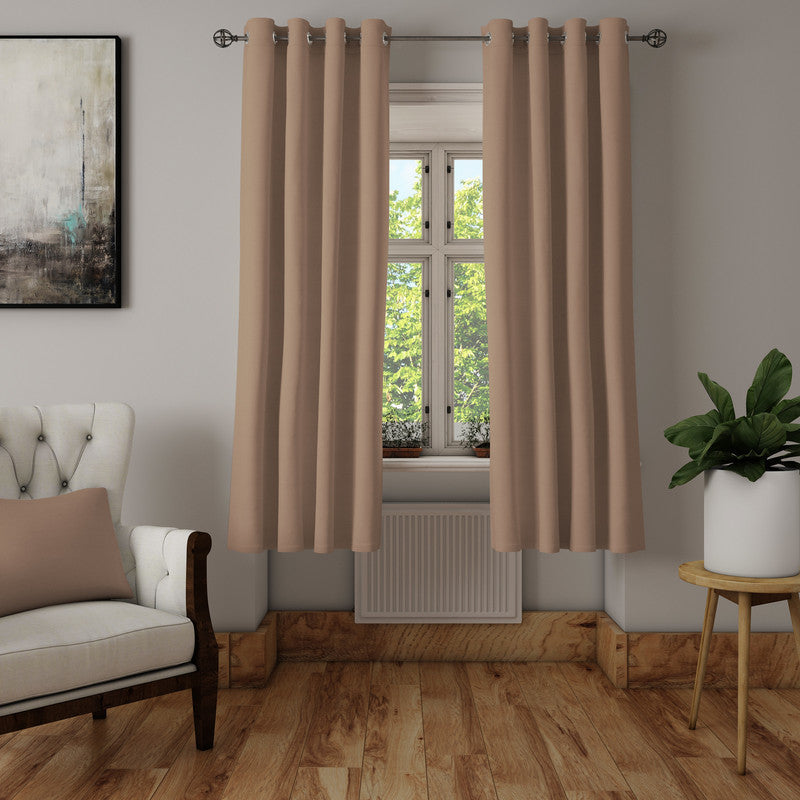
Hall curtains get moved twice a day in a lot of Indian homes. Pushed back in the morning so the room is bright for whoever walks in, pulled again in the evening when the TV goes on and the glare across the screen becomes the problem. Nobody buys with that in mind. People buy one set, hang it, and find out over the next few months whether it can do both jobs, and whether it still looks presentable in the room visitors see first.
For a standard hall window the safe default is the 7 ft door length in a mid-weight cotton, hung to the floor rather than to the sill. Colour matters less than weave. A warm neutral in a flat, mid-weight cloth keeps looking clean between washes in a way a dark pile does not, and light control is worth paying for only where your evenings need it.
What a hall asks of a curtain that a bedroom does not
A bedroom curtain has one job, and the people who live there are the only ones who ever look at it. The hall works differently. The same room receives people during the day, becomes a screen room after dark, doubles as overflow dining when there are guests, and in a lot of flats is where somebody ends up sleeping over Diwali. It is also usually the largest window in the house, so it takes the most sun, the most street dust and the most handling.
That last one is the part buyers underrate. A curtain pulled across twice a day gets touched at the leading edge every single time, so hands, wall dust and city grime all land on the same narrow strip of cloth. A bedroom curtain might get drawn once at night by the edge of a fingernail. The hall panel gets grabbed. Fabric that shows a handled edge, or that cannot go into a washing machine without an argument, is the wrong fabric for this room whatever it looks like on day one.
What size curtains does a hall window need?
A hall window in a normal-ceiling Indian flat usually takes the 7 ft door length, hung from a rod set above the frame so the hem finishes just clear of the floor. The 9 ft long-door length is the right answer only for a genuinely taller opening, a balcony door, or a rod mounted close to the ceiling for effect. Measure the drop from where the rod will actually sit rather than from the top of the glass, then take the ready length just above that number.
The curtain size guide carries the measuring method and the full 5, 7 and 9 ft breakdown, and how many panels you need covers the width side, which is what stops a wide hall window ending up with two thin panels stretched flat across it.
Which fabric survives a hall: dust, damp, or both

Search for hall curtain fabric and you get two pieces of advice that cannot both be right. One set of guides says go heavy, velvet or a dense jacquard, because a thick cloth keeps street dust out of the room. Another set says avoid exactly those fabrics, because a heavy pile holds moisture and a hall that never fully dries out starts to smell musty. Both are describing something real. They are describing different cities.
So decide by climate first. In Mumbai, Chennai, Kochi or anywhere the air stays damp for months, weight the drying problem higher and stay with cotton or a light polyester, because a dense pile at the biggest window in the house is the slowest thing in the room to dry through after a wet week. In Delhi, Jaipur or Ahmedabad, where the enemy is dust rather than damp, a heavier weave is a reasonable buy and the mustiness risk is small.
The awkward flat has both problems at once. A sea-facing hall in Chennai with a west-facing wall gets the afternoon sun that has you keeping the panel drawn from three o'clock onwards, and air damp enough that the bottom of that panel never quite dries out. A heavy pair handles the sun better. Two lighter panels you can wash and rehang the same afternoon are still the better buy, because what ruins the curtain there is the damp fold at the hem, not the glare.
Then decide by weave, the part almost nobody mentions. Dust does not just land on a curtain and sit there. A flat, tightly spun weave tends to hold it on the surface, where a wash lifts it off. A raised pile catches more of it down between the fibres, so the panel looks fine on the rod and then comes out of the machine a shade lighter than expected. That is why a mid-weight cotton canvas in a pale colour can stay looking cleaner in a dusty hall than a dark velvet does.
| Fabric | In a dusty city | In a humid or coastal one | Evening light | Being pulled daily |
|---|---|---|---|---|
| Mid-weight cotton, canvas or Panama weave | Holds dust on the surface, where a wash takes it off | Dries through quickly after a damp spell | Softens the light without stopping it | Enough body to hang straight, easy on eyelets |
| Light printed polyester | A busy print hides marks between washes | Of the four here, the quickest to dry | Lets a lot through | Very light, will lift near a fan |
| Semi-blackout triple-weave polyester | Dense face holds surface dust, print hides it | Slower than a single-layer polyester | Cuts most of the glare | Thick and stiff, wants a proper rod |
| Velvet or heavy jacquard | Pile catches dust rather than releasing it | Of the four here, the slowest to dry | Blocks the most | Heaviest thing to draw twice a day |
If you want a weight figure rather than an adjective, the Canvas Grey single panel states 180 GSM cotton canvas on its own page: enough body to hang without flapping, light-filtering rather than blocking, and around 1,200 to 1,300 rupees for one panel in the 5 or 7 ft length. Useful where a hall has a narrow window a pack of two would swamp. The cotton canvas curtain range sells Panama-weave cotton in pairs for the wider main window, and the curtain GSM guide explains what those numbers mean.
Which colours are safe in a hall

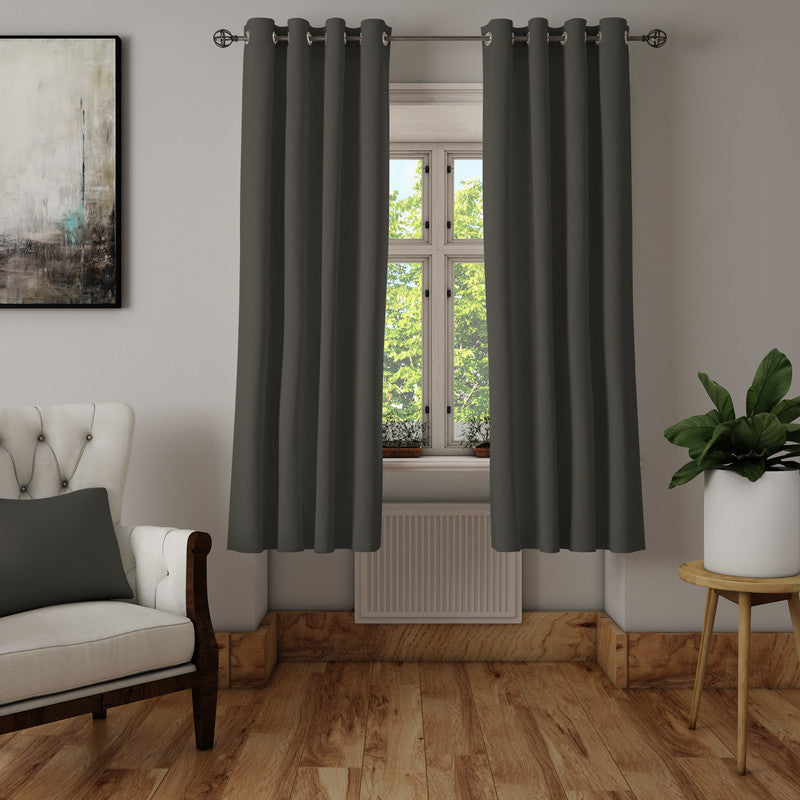
The same staged window and chair as the image at the top of this page, in charcoal instead of beige.
Three families cause the least trouble once the rest of the room is decided: a warm neutral like sand, beige or oatmeal, a muted green in the sage and olive range, and a dusty or greyed blue. What they share is not taste. They are all mid-tone, so a handled edge does not stand out against them the way it does at either extreme, and they read as deliberate against the cream and off-white walls a lot of rentals come painted in.
The two that cause the most are at the ends of the scale. Pure white shows the grey line where hands pull the panel across, in the room where that happens most. Jet black shows the opposite problem, lint and settled dust, and a black panel across the biggest window pulls light out of the brightest room in the flat.
Charcoal is the useful middle position if you want depth without going to black. The Cotton Charcoal Grey pair and the Cotton Beige pair are the same Panama-weave cotton pulled in two directions, both sold in 5, 7 and 9 ft at roughly 1,750 to 2,550 rupees a pair depending on length. Both listings ask you to wash dark colours separately, which is worth knowing before the charcoal goes in with the towels.
Matching a curtain to one specific wall shade is a longer conversation. Curtain colour combinations takes it wall by wall.
How dark does a hall really need to be?

Full bedroom blackout in a hall is usually a mistake. Draw it in the afternoon and the room stops reading as restful and starts reading as shut. The evening problem is narrower than that: less light landing on the screen, and less glare off the wall behind it. A semi-blackout panel handles both and still leaves the room feeling like a room during the day.
The Blackout Polyester Sage Green Birds pair is the practical version of that. Its listing puts it at about 85 percent of light blocked in a triple-weave polyester, which is enough to make an evening screen comfortable without turning the afternoon dark, and it comes in 5, 6, 7 and 8 ft. Worth knowing what the print actually is before ordering on the name: it is a pink rose and songbird pattern on a pale sage ground, not a plain green curtain. The busy print does real work in a hall, since it hides a handled edge better than a plain colour does, but it is a decorating decision rather than a neutral one. No percentage on a listing tells you how a panel will behave against your own wall at four in the afternoon.
If you are still choosing between types, blackout against sheer sets out what each does and where room-darkening sits between them.
A pattern for a hall with some personality

Solid neutrals are the low-risk answer, and not the only sensible one. A hall with plain walls, a plain sofa and nothing hung up can carry a printed panel as the single decorative thing in the room, for a fraction of what reupholstering costs.
The Polyester Boho Panel pair is an off-white ground with hand-drawn black geometric bands running vertically and black tassels down the side edges. Its page puts it at about 40 percent of light blocked, so it brightens rather than darkens, and it runs from 5 ft up to 9 ft, the widest size range of the curtains named here, starting under 1,000 rupees for the smallest pair. One thing to check before buying it for a hall: it is a rod-pocket panel, not eyelets. Rod-pocket fabric gathers on the rod and slides less freely, which matters in a room where the curtain gets drawn every evening. The door curtain guide covers where each heading type earns its place, and the rest of the printed and plain options sit in the full curtain collection.
Frequently asked questions
What size curtains are best for a hall in India?
The 7 ft door length suits a typical hall window in a flat with normal ceilings, hung from a rod above the frame so the hem finishes just short of the floor. Go to 9 ft only for a balcony door, a full-height opening, or when the rod is going up near the ceiling.
Which fabric is best for hall curtains?
Mid-weight cotton in a flat weave is the most forgiving choice for a room that gets handled daily and washed often. Light polyester works where you want brightness and a quick dry. Keep velvet and heavy jacquard for dry climates and rooms with less traffic, since a raised pile holds on to both dust and moisture.
Do curtains for a hall need to be blackout?
Rarely. Full blackout fights the daytime job the room is doing. A semi-blackout or room-darkening panel takes the glare off a television and the hardness off a west-facing afternoon, while leaving the hall usable as a bright reception space for the rest of the day.
What colour curtains suit a hall?
Warm neutrals, muted greens and dusty blues are the reliable range, because they hold up under warm daylight and sit easily with wood and stone. Pure white and jet black both show marks quickly at the edge where the curtain gets pulled, so both need washing more often.

Leave a comment
This site is protected by hCaptcha and the hCaptcha Privacy Policy and Terms of Service apply.