
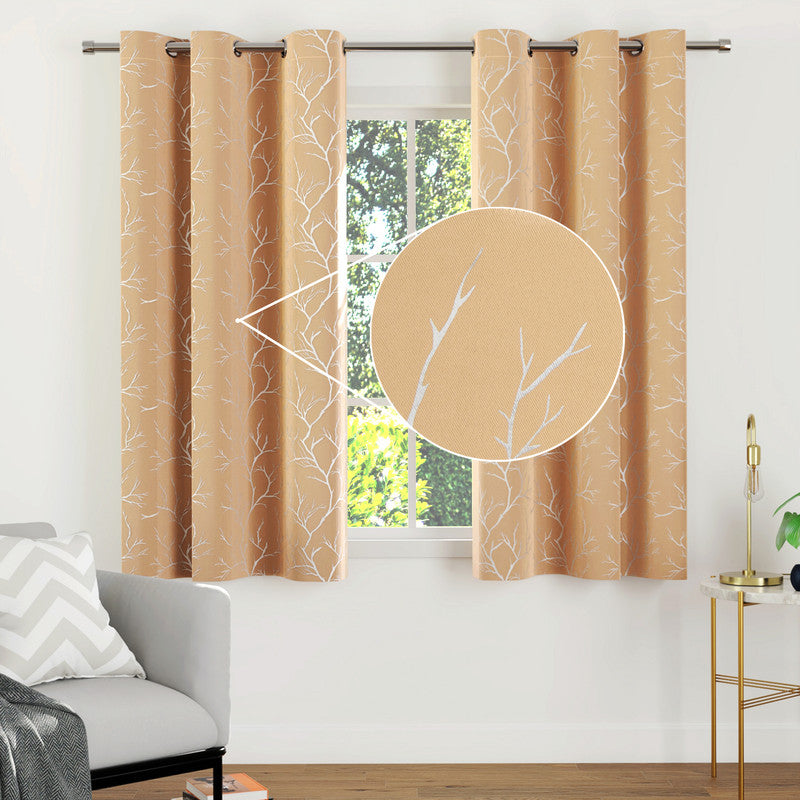
Two curtain listings can sit side by side on the same page, same colourway, same price, and differ in one number: one says 100 gsm, the other 280 gsm. Nothing else on the page explains what that changes, so most shoppers guess, or ignore it and buy on colour alone.
For curtains, that number is worth reading. Grams per square metre is how much fabric sits in a square metre of the panel, and unlike a lot of textile specs, it lines up fairly directly with something you can feel: how the fabric falls off the rod. Sheer curtains generally run about 50 to 100 gsm. Regular and room-darkening curtains, the middle ground most living rooms actually use, tend to sit around 150 to 250 gsm. Full blackout panels are usually 200 to 320 gsm, often built from a dense triple weave or a separate blackout backing rather than one thick layer of fabric. Those last two bands overlap, and the overlap is the honest part: at 220 gsm, what the panel is lined with decides whether you have a heavy room-darkening curtain or a real blackout. Our guide to GSM across home textiles covers the wider picture, including why the same number means something completely different on a bedsheet or a bath towel. Weight is a reliable guide to how a curtain hangs. How dark it makes the room is a separate question, and the lining answers most of it.
Curtain GSM by type: sheer, regular and blackout
The three bands aren't official categories, they're just where the catalogue clusters when you sort by weight and watch what each fabric does at a window. Here's the shape of it.
| GSM range | Typical fabric | Light blocked | Best room fit |
|---|---|---|---|
| 50–100 gsm | Cotton or polyester sheer, slub weave | Very little, filters and softens | Kitchen windows, balcony doors, layering under a heavier curtain |
| 150–250 gsm | Cotton canvas, Panama weave, printed cotton | Moderate, cuts glare and blocks view | Living rooms, dining areas, home offices |
| 200–320 gsm | Triple-weave polyester, satin weave, lined cotton | Near-total to full | Bedrooms, media rooms, night-shift sleepers |
Inside a band, small weight differences barely register. A loosely woven 90 gsm cotton won't block meaningfully more light than an 80 gsm one, and you would not pick the difference out from the sofa. What does move a panel across categories is construction: a lining or a blackout backing changes what a curtain does at the window far more than another 30 gsm of face fabric ever will.
What GSM should a sheer curtain be?
Sheers sit at the light end on purpose. Somewhere between 50 and 100 gsm, the weave stays open enough that daylight passes through and only softens on its way in, rather than getting stopped. Our cotton sheer range runs a cream slub-weave panel that's a good example: pure cotton with a linen-like texture, woven loosely enough that light filters through and the glare of direct sun breaks up before it hits the room, while still keeping the space from feeling like a fishbowl. That's the job a sheer is built for, and asking it to do more, hoping it'll also block a streetlight or a sunrise, will disappoint you no matter what colour you pick.

The trade-off is drape. Light fabric moves with any draught, catches a ceiling fan, and shows every crease from being folded in a packet before it's hung and steamed flat. That looseness is also what makes a sheer forgiving on odd-sized windows: it gathers softly instead of pulling stiff if the width runs a little short.
The middle band: regular and room-darkening curtains
Most Indian living rooms end up here without anyone deciding on a GSM figure at all, because this is the weight a plain cotton or cotton-canvas curtain naturally lands at once it's woven densely enough to hold its own shape. A Panama-weave cotton curtain, the kind sold in solid colours for door and window openings, is the typical example. Our cotton canvas curtain collection includes a mint green panel that publishes no gsm figure at all, which is normal for this band, so the description does the work instead: it moderately reduces outside light for a warm glow rather than full dark, with nobody able to see through from outside. It's not trying to be a blackout, and it isn't marketed as one, but it does the two jobs most living rooms actually need, privacy and a softened glare, without the stiffness of a triple-weave fabric.

This band also drapes the best of the three, in most people's judgement: enough weight to fall in clean folds and hold a pleat, not so much that it needs a heavy-duty rod. Where it loses out is at a bedroom window that gets early sun. A mid-weight cotton curtain will dim a room, not darken it, and if you're the kind of sleeper who wakes with the first light, that difference matters more than the colour ever will.
How much GSM do you need for real blackout?
Full blackout is less about a single high number and more about density plus construction working together. A triple-weave polyester at 200 to 320 gsm, the range most blackout panels fall into, gets there by packing three layers of yarn into the weave rather than one thick layer, which is part of why blackout curtains often feel stiffer and heavier in hand than their weight alone would suggest. Our blackout polyester twig-print curtain states an 85% daylight reduction on its product page, using six eyelets to keep the panel hanging flat against the rod. A step up, the blackout L1 curtain in gold, uses a triple-weave fabric with a black lining and 16 grommets, and its listing claims full sunlight and UV block, with a note that darker shades give a stronger result than pale ones at the same weight. Take manufacturer light-block percentages as a starting point, not a lab certificate, but they're a more useful proxy than the raw gsm number by itself.

Hang a 320 gsm triple-weave blackout panel over a 120 cm window on a plain rod, and in a ceiling fan's draught it barely stirs, sitting almost architectural against the wall rather than moving with the room. That's right for a bedroom that needs to stay dark till eight in the morning. It's wrong for a balcony door, where the whole point of a curtain is to feel the room breathe, and a panel that heavy just becomes a wall you occasionally slide open.
Which weight suits which room?
A bedroom that needs to stay dark past sunrise wants the 200 to 320 gsm band, full stop, and the eyelet or grommet count matters almost as much as the fabric: more points of contact keep a heavy panel from sagging in the middle over a few months of daily sliding. A living room or dining area usually does better in the 150 to 250 gsm middle band, where a cotton or cotton-canvas curtain cuts glare and blocks the view in without turning the room dark at 4pm. Kitchens, balcony doors, and any window you actually want to feel a breeze through are sheer territory, 50 to 100 gsm, chosen for filtering rather than privacy.
Plenty of homes end up combining two of these on the same rod rather than picking one, a sheer for daytime and a heavier panel behind it for night, which is its own separate decision covered in our guide to blackout, room-darkening and sheer curtains. If none of the three bands feels obviously right yet, the full curtains collection is filterable by fabric and can be narrowed once you know which weight you're shopping for.
Frequently asked questions
What GSM is best for curtains?
There's no single best figure, it depends on what the window needs to do. Around 50 to 100 gsm for light filtering, 150 to 250 gsm for a general-purpose living space curtain, and 200 to 320 gsm where the room needs to go properly dark.
Does a higher GSM always mean better blackout?
Not on its own. Weave structure and lining do a lot of the work, so a lined curtain at 150 gsm can block more light than an unlined one at 250 gsm. GSM is a useful shorthand, not a guarantee, which is why a stated light-block percentage on the product page is worth more than the raw weight figure alone.
Is curtain GSM on the same scale as bedsheet or towel GSM?
Same unit, different useful range. A bedsheet in the 120 to 180 gsm band feels right for sleeping under, but a curtain at that weight sits below the regular curtain band altogether, closer to a heavy sheer than to anything that will darken a room. Comparing a curtain's gsm to a towel's or sheet's number isn't meaningful, since each fabric is built for a different job.
Can I judge a curtain's weight without a GSM figure on the listing?
Yes, roughly. Hold a corner up to a light source: a lot of daylight coming straight through points to the sheer range, a dimmed glow points to the regular band, and almost nothing getting through points to blackout. Feel in the hand tracks with this too, heavier and stiffer generally means denser weave and less light passing.


Leave a comment
This site is protected by hCaptcha and the hCaptcha Privacy Policy and Terms of Service apply.