
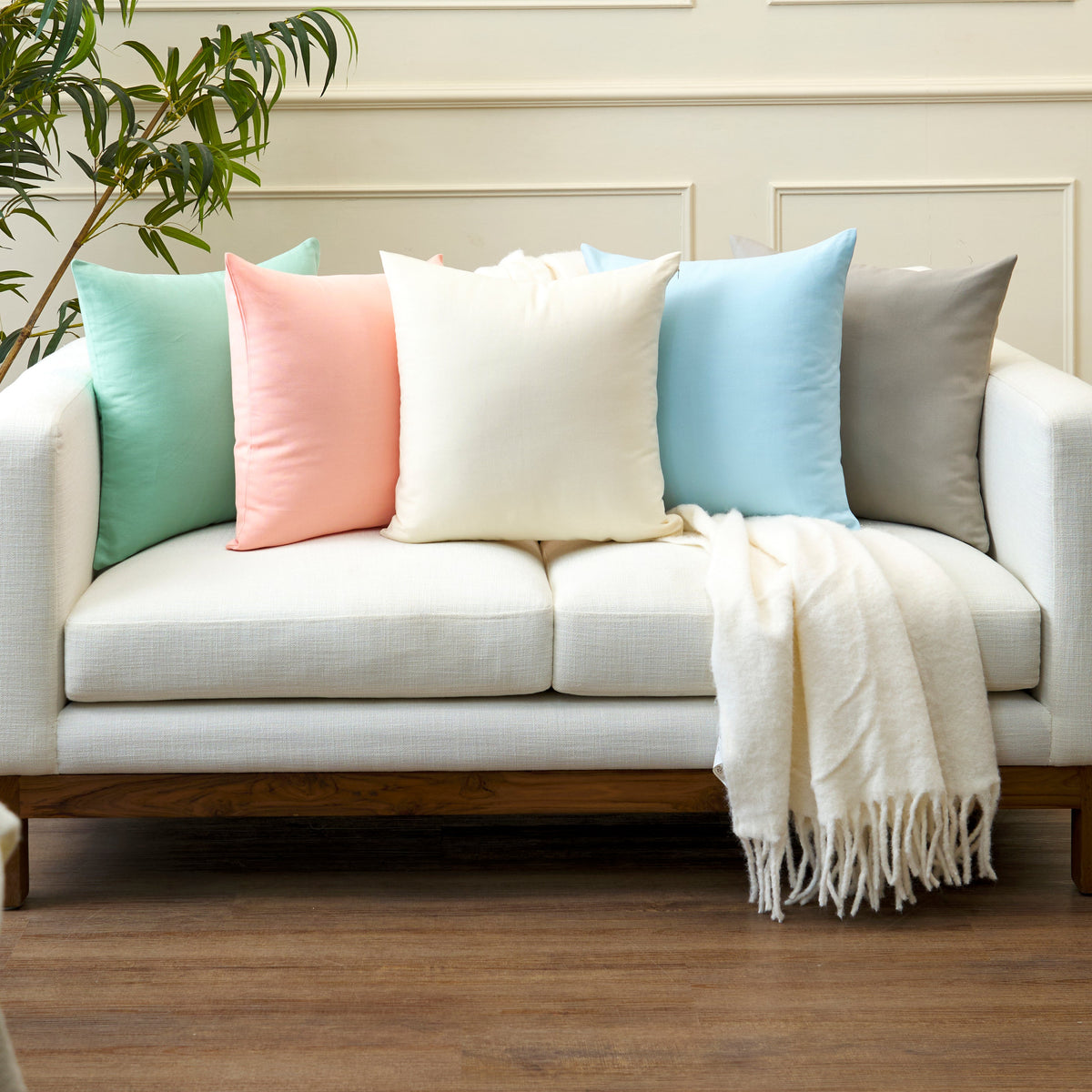
Watch a sofa cushion through one ordinary evening. It gets pulled forward by a corner, pushed behind a lower back, squashed under an elbow during a film, and dropped on the floor when someone wants the whole seat. The next morning it goes back with a quick punch, and that night the same corner gets pulled again.
So a cover's life is decided in two places: the corners that get grabbed and rubbed, and the wash that follows. Both depend on which cotton you bought.
Cotton cushion covers suit an Indian sofa well, because cotton breathes in the heat and can go in a washing machine. The cloth is the real choice. A plain canvas gives a crisp, quiet base but shows marks, while a yarn-dyed check or stripe hides small marks and keeps its pattern at the corners. Any of them can fade in direct sun and shrink in a hot first wash.
What cotton cushion covers are really made of
"Cotton" names the fibre. It tells you nothing about how the threads were woven or when they got their colour, and those two things decide how the cover looks after many washes. Three cloths turn up under the name.
Canvas is a firm, even weave, usually in one solid colour. Up close it has a regular grain, like very fine basket work.
Homespun is softer and a little uneven, with small thick spots in the thread. Checks and stripes in this cloth are made from threads dyed before weaving, so the colour looks flecked rather than flat.
Chambray has coloured threads running one way and white threads the other. From close up it looks like soft, light denim.
Go by the close-up picture rather than the word on the listing. Weight will not settle it either: a GSM figure tells you how heavy the cloth is, not where its colour sits.
Are checks and stripes woven or printed?
They can be either, and the back of the cloth usually tells you. Turn over a corner or open the zip. A woven-in pattern looks the same on both faces. A print is often paler on the back, or missing altogether.
The second clue is on the front of a check. Where a dyed thread crosses another dyed thread, you get the full colour. Where it crosses a plain thread, you get a flecked middle shade, and up close you can see the two colours side by side.
This matters at the corners. A print sits mostly near the surface, so a corner that gets rubbed for years can go pale in patches. In a yarn-dyed cloth the colour is in the thread, so a worn corner may turn fuzzy or thin before the pattern goes. Sun is a separate matter, and it fades either kind wherever the light falls.
How does cotton wear on a sofa?
Unevenly, and in places you can predict. The corners usually go first because that is where hands go. On a three-seater, the cushion people lean against usually takes more wear than its neighbours, so swapping them now and then spreads the load.
A firm, tight weave holds a sharp corner longer. A softer cloth relaxes sooner, which some people like.
Hair oil is the test. Cotton soaks up sweat and oil, which is part of why it is comfortable in May, and also why the cream cushion behind someone's head ends up with a mark. A dark cover hides that, then shows pale rub lines along its edges instead. A check breaks up a faint mark, though a real stain on a white square still shows.
Creases come with the fibre. A well-filled cushion pulls most of them out, while a thin insert shows every one. The same thin insert lets a cover sag and twist, and getting the fit right stops that.
For a seat in hard sun or under very rough use, polyester may be the better cloth, and the fabric comparison sets out that choice.
Washing and drying cotton covers, monsoon included
Close the zip before the cover goes in, since an open zip can snag the cloth around it. Turning the cover inside out protects the face from rubbing against the drum or agitator.
Keep the water cool, whatever machine you use. Heat and rough handling make cotton shrink more, and most of the change comes in the first wash. A cover that already fits its insert snugly can start to feel tight after that, and how cotton shrinks explains the reason and what to do about it.
Wash dark and strong colours apart from pale ones, at least for the first few washes. Several Encasa pages advise the same, and why colours bleed covers what to do if a load has already gone wrong.
Dry in shade, inside out if you can.
In the monsoon, cotton holds water longer than a synthetic, and that causes the real trouble. Hang the cover with its zip open so air moves through it. Never put a damp cover back on an insert, because the filling stays damp inside and starts to smell. If it is needed tonight, a warm iron on the inside finishes the drying, as long as the care label allows it.
Plain canvas: a sensible place to start

Encasa's canvas covers cost about ₹250 a cover in a pack of two at 40 cm, and about ₹460 a cover at 60 cm. Bigger packs do not always save money. A pack of four at 45 cm comes to about ₹200 a cover against about ₹250 in a pair, which is a real saving. A pack of five at 40 cm saves only a few rupees a cover, and a pack of five at 30 cm costs more per cover than a pair does.
The natural canvas cover reads as a soft cream and sells in sizes from 30x30 cm to 65x65 cm, plus a 30x50 cm rectangle. Its page gives 180 GSM and calls the cloth medium weight, with a concealed zip. Pale colours shift a lot under different light, and the page shows the same cloth in five lighting conditions, so check it against your sofa in daylight once it arrives. The line runs to about 30 plain colours, but sizes and packs differ by colour, so a colour you like may not come in the size you need. Settle the size first with the cushion cover size guide, then use the size filter on the full cushion cover range and pick from the canvas colours it shows.
Checks and stripes: the names, in plain words

Buffalo is a big, even two-colour check. The red and white buffalo shows the three shades clearly, and its close-up has a corner folded back so you can see that both faces match. Ticking is a narrow, even stripe. It can shimmer in a phone picture, an effect of the camera rather than the cloth. Roma has thin white stripes spaced well apart on a coloured ground, and Franca mixes stripes of different widths, as on the lime and white pair, which reads as a bright apple green.
They cost much the same as canvas: about ₹245 a cover in a pair at 40 cm. So price should not decide this. Look at the sizes instead. They start at 40 cm, and nothing in the checks and stripes range comes smaller. Ticking stops at 50 cm, and only some patterns reach 60 cm. If your sofa needs big back cushions, check that first.
The real caution is what else is in the room. A big check against a patterned rug or a printed curtain starts to compete, so look at what already carries a pattern before adding more. On a plain sofa with a plain rug, one checked pair does a lot.
Chambray floral and piped pairs

The chambray floral pair has white scrolls and leaves over a flecked blue ground. It stops at 50 cm, so it cannot be your big back cushion, and at 50 cm it costs more than the other two cloths. Buy one pair for the front of the sofa. The page does not say how the pattern is applied, so turn a corner over if that matters to you.
The navy and taupe pair goes the other way: two plain covers, each with piping in a contrast colour along the edge, 40x40 cm only. Piping makes each cushion read as a bordered square. That gives some shape to a soft, shapeless sofa, but it can look fussy next to a sofa that already has contrast stitching. The raised edge is also the first place to check for rubbing. Its page gives the same 180 GSM as the canvas line.
Which cotton cover for which sofa?
| Cloth | Good at | Watch for | Sizes sold | Pair at 40 cm | Pair at 60 cm |
|---|---|---|---|---|---|
| Plain canvas | A crisp base, the widest colour choice | Plain colour shows oil and rub lines | 30 to 65 cm, by colour | about ₹500 | about ₹920 |
| Checks and stripes | Hiding small marks, keeping a pattern at the corners | Competes with other patterns | 40 to 50 cm, some 60 cm | about ₹490 | about ₹880 |
| Chambray floral | A soft accent | Dearer at its largest size | 40, 45 and 50 cm | about ₹500 | not sold |
The harder choice comes when sun and stains pull in opposite directions. Take a plain grey three-seater with one end by a west window, in a house with children. Fading is easier to see on a deep colour, so the window end takes a pair of natural canvas at 50 cm (about ₹690), and you accept that it needs washing more often. The far end stays out of the sun, so it can take the red buffalo check at 50 cm too (about ₹660), which hides small marks. That is about ₹1,350 for four covers.
FAQ
Is canvas better than cotton for cushion covers?
Canvas is a way of weaving, and cotton is the fibre, so a cotton canvas cover is both. The useful comparison is canvas against a thin cotton. A tight, firm weave tends to hold its shape and corners. A thin, loose one is softer but can wear through or sag sooner.
Do cotton cushion covers fade?
Yes, in strong direct light, and Encasa's own pages warn about it. The fade is easier to see on deep reds and navies than on pale creams. Moving the cushion out of the direct beam does more good than any wash setting.
Can cotton cushion covers go in a washing machine?
Yes. A gentle cycle in cool water works in a top-load, front-load or semi-automatic machine. Hand washing works too, as long as you press the water out rather than twist the cover.
Do these covers come with the cushion inside?
No. Encasa sells covers only, so you need your own insert at the right size. Checks and stripes sell in pairs, and canvas may also come singly or in packs of four or five, depending on the colour.

Leave a comment
This site is protected by hCaptcha and the hCaptcha Privacy Policy and Terms of Service apply.