
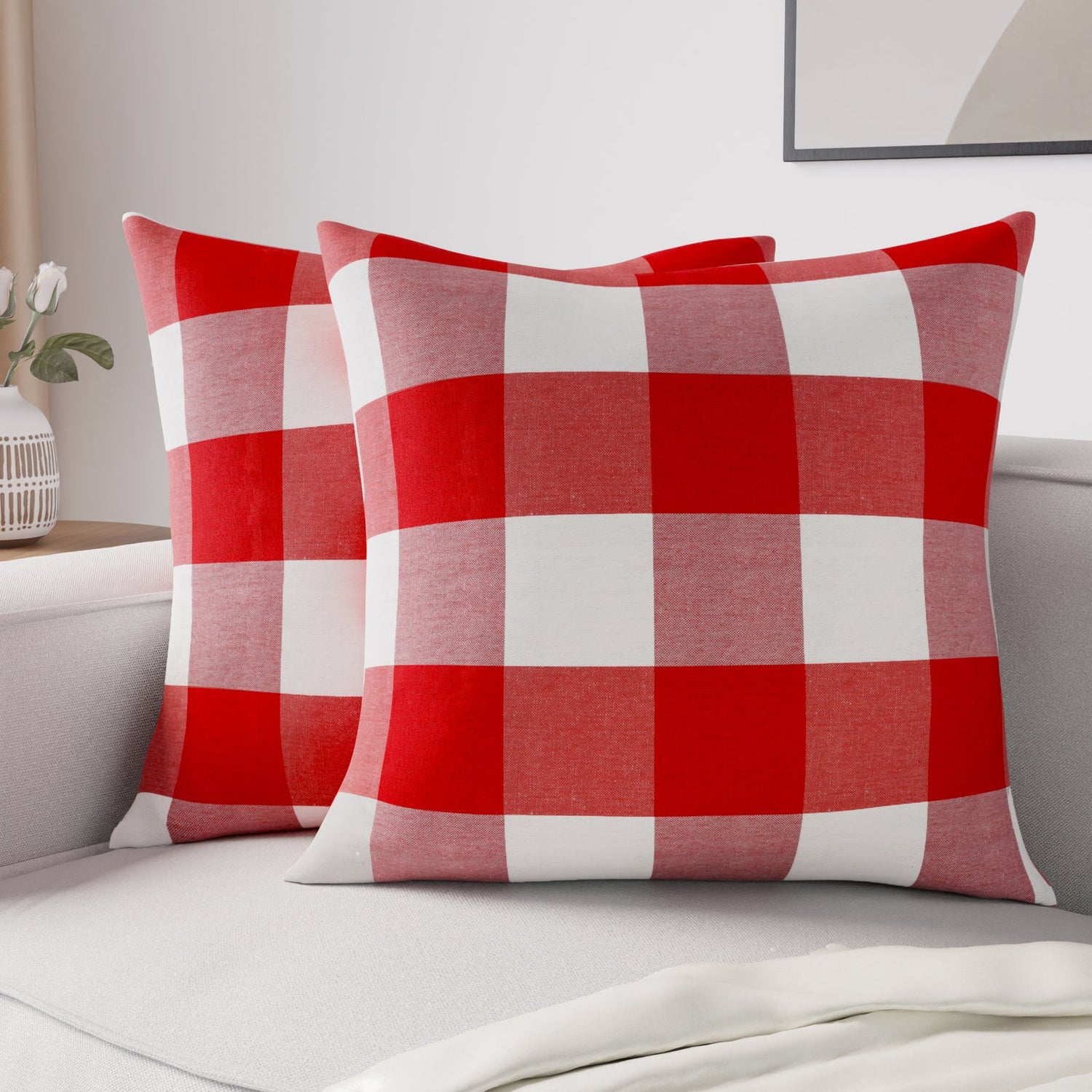
There is a particular cushion on most sofas that never sits right. You plump it on your way past, square it up, and by the time you have crossed the room it has slumped again, one corner pointing off into space and a soft dent running along the seam where the zip is. The cover is not faulty. It has almost certainly been paired with the wrong insert, and the mismatch shows up first at the two spots a cushion is under the most stress: the corners and the zip.
A cover slips, sags, or twists mostly for one reason: the insert does not fill it properly. Insert size and fill type set that fit, and the zip is what holds the fit once you have it right. Get an insert that fills the cover firmly, size it to the kind of fill you are using, and pick a cover whose zip runs the length of one side and stays closed, and the cover sits firm again. Encasa sells covers only, so the insert is whatever you already own or buy separately, which makes fit the one thing you choose on purpose rather than inherit.
Why covers slip, sag, and gape
Think of the cover as a fixed box and the insert as the thing that has to fill it. When the insert is smaller than the cover's cut size, the fabric has slack it cannot lose, and that slack collects in the two weakest spots. Along the top edge, where the zip breaks the seam, the face dips into a soft valley, so you can read the zip line even when the zip itself is hidden. At the corners there is nothing pushing the fabric out, so they flop empty and point away from the cushion, the look people call dog ears. And because the insert is loose inside, the whole cover can rotate on it, which is why the print or the pile ends up crooked by evening.
Oversizing is its own problem, just a rarer one. Force a firm insert two sizes too big into a cover and the seams strain, the corners go hard and pointed, and the zip carries a load it was never built for, which is how sliders start jumping the track.
One thing worth separating out, because the two get confused. If your trouble is a seat cushion sliding off a chair or a sofa base creeping forward, that is a grip problem between the cushion and the furniture, solved with a non-slip pad or a tab of hook-and-loop. This guide is about the cover slipping on the insert inside it, which is a fit problem, and the fixes are completely different.
How much bigger should the insert be?
As a working rule, buy an insert that matches the cover's stated size or runs a little over it, and never under. Covers are cut to finished dimensions, and fill compresses over time, so an insert that only just fits when new soon reads slack as it settles. How far over you go depends on the fill, which the next section covers, but here is a starting point against Encasa's standard cover sizes. Sizes are also worth mixing on a sofa rather than ordering all in one, which is one of the six cushion cover mistakes that make a good sofa look cheap.
| Cover size | Fibre or polyester insert | Feather or down insert |
|---|---|---|
| 40x40 cm (16 in) | 40 to 42 cm | 42 to 45 cm |
| 45x45 cm (18 in) | 45 to 47 cm | 47 to 50 cm |
| 50x50 cm (20 in) | 50 to 52 cm | 52 to 55 cm |
| 60x60 cm (24 in) | 60 to 62 cm | 62 to 65 cm |
| 30x50 cm lumbar (12x20 in) | 30x50 to 32x52 cm | 32x52 to 33x53 cm |
The ranges are a starting point rather than a fixed rule, because brands cut and fill differently and a soft insert behaves like a smaller one. If you can press the cover corners with an insert in place and they give easily, size up. Lumbar and rectangular covers gape along their long edge first, so do not skimp there, though do not overstuff the short ends either or they bunch.
Does the fill change the rule? Feather versus fibre
Yes, and it is worth getting right. Feather and down inserts are soft and they settle. They compress under their own weight and drift towards the edges, so a feather insert the same size as the cover soon leaves it looking slack as the fill beds down. Buy feather two to five centimetres over the cover so there is enough loft to stay plump as it beds in, and push it back into the corners now and then.
Polyester fibre inserts spring back and hold their shape, so they can run true to size or a touch over. They are the easier choice if you would rather not think about it again, and they suit covers with a pile you want sitting smooth, like velvet, where a slack face shows every ripple. For a sofa where the velvet cushion covers do the styling, a firm fibre insert close to the cover size keeps the flat sheen a gold velvet cover depends on.
India adds one more variable: humidity. Through a damp monsoon, cotton and some polyester fills take up moisture and pack down, so a cover that sat firm in the dry months can feel loose later in the season. Press the corners at the end of the monsoon; if the fill has gone soft and slow to spring back, that insert wants replacing with one a size larger. If you are buying in winter for year-round use, err a size up rather than exactly to size.
What a good cushion cover zip actually does

Fit does most of the work, but the zip is what holds it, and a weak one quietly undoes a good fit. A cushion cover zip has two jobs: to close the cover flat without drawing attention to itself, and to stay shut under the pressure of a firm insert. A few things you can see or feel tell you whether it will.
Start with the zip type. A concealed coil zip, the fine nylon spiral tucked into the seam, lies flat and disappears, which is what you want on a decorative cover. Exposed metal teeth are stronger but they show, and cheap moulded-plastic teeth are the ones most likely to split or jump the track when a firm insert pushes on them. Run the slider next: it should glide and sit where you leave it, not creep open on its own. Check the length too, because the zip should run most of the way along one side. A short zip set in the middle of an edge concentrates all the strain at its two ends, which is exactly where gaping appears. Last, look at the stitching where the zip meets the seam, since that corner takes the pull every time you stuff the cover, and a few reinforcing stitches there help the seam survive being stuffed again and again.
Encasa's cotton canvas covers show what this looks like in practice: a concealed zip set into the seam, on a cover sold on its own so you fill it with whatever insert you already have. That is the combination to hold out for, a flat hidden closure on a cover that firm stuffing will not burst.
Fixing a cover you already own
If the cover is already too big for its insert, you do not have to rebuy. Here are the fixes, roughly in order of effort.
Add bulk to the insert. Wrap it in a thin cushion or an old pillowcase, or slide a flat fibre topper in alongside it. Even a folded muslin adds enough to reach the corners.
Shuffle your inserts. If you have several cushions, the too-small insert may fit a smaller cover you own, which frees a larger insert for the loose one.
Deal with dog ears at the source. The karate-chop dent people press into the top does nothing for empty corners, because the problem is missing fill, not shaping. Work the insert corners fully into the cover corners, and if they still collapse, the insert is genuinely too small.
Settle a lazy zip. If the slider creeps open, a tailor can swap it cheaply, or a single stitch at the closed end stops it wandering. Remember that a loose cover strains the zip, so correcting the fit often quiets a misbehaving zip on its own.
Revive flat feather. Feather that has packed down can be tumbled on a cool, no-heat setting or beaten by hand to bring the loft back, which is worth trying before you write the insert off.
A quick check before you buy

Before you order, run the short list. Know your cover's finished size in centimetres, not a vague small or large. Decide your fill, fibre for hold and a smooth face or feather for a softer sink, and size the insert against the table above. Check the listing for the zip type, and on Indian marketplace pages that rarely mention it, treat a described concealed or invisible zip and reinforced stitching as the trust signal, the way you would judge the karigari on anything stitched. If the listing says covers only, that is normal for decorative covers and simply means you pick the insert.
A textured weave also hides minor slack better than a flat one, which helps if you are unsure of your insert size. The chenille covers, for instance, carry enough surface interest that a slightly soft fill still reads full, where a smooth cotton would show the same slack as a wrinkle.
Frequently asked questions
How much bigger should a cushion insert be than the cover?
Match the cover's stated size at the very least, and go over rather than under. For a firm polyester fibre insert, the cover size or up to two centimetres over is plenty. For soft feather or down, two to five centimetres over gives loft to settle into. A 45 cm cover, for example, takes a 45 to 47 cm fibre insert or a 47 to 50 cm feather one.
Why do my cushion cover corners look empty or floppy?
Empty, pointed corners mean the insert is not reaching them. Either it is too small for the cover overall, or it is a soft fill that has drifted inward. Work the insert corners into the cover corners; if they will not stay filled, size the insert up. No amount of shaping fixes a corner with nothing behind it.
Are zip covers or envelope covers better for holding shape?
A concealed zip holds a cover tighter and flatter, so a firm decorative cushion keeps its shape and stays closed. Envelope covers, with an overlapping back opening, are easy to slip on and off and fine for softer cushions, but the flap can gape and let the insert peek through when the fit is loose. For a taut look on a well-filled cover, a good zip has the edge.
Can I fix a cushion cover that is too big for its insert?
Yes. Bulk the insert out with a thin topper or an old pillowcase, move the insert into a smaller cover if you have one, or replace the insert with one sized to the table above. None of these needs a new cover, so you keep the cover you actually like.


Leave a comment
This site is protected by hCaptcha and the hCaptcha Privacy Policy and Terms of Service apply.