
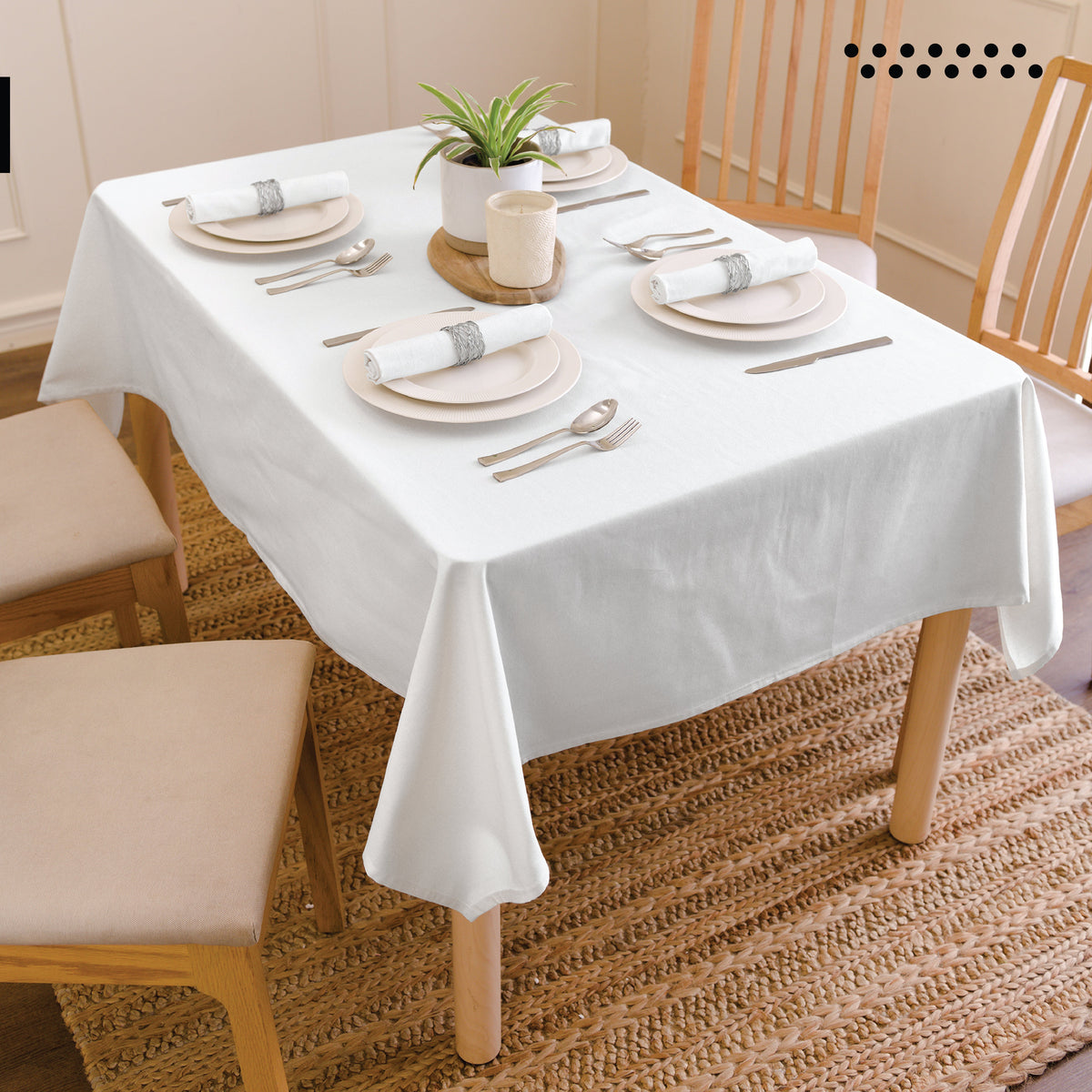
You buy a white table cloth for one dinner, and for that one dinner it looks like a good hotel. Two weeks later there is a yellow patch where the dal went, a brown ring from someone's chai, and the whole cloth is a shade darker than it was. So you buy a bottle of bleach, turn up the care label, and find a small triangle with a cross through it.
The bigger mistake came before the first wash. Many people buy white on the idea that it can always be bleached back, and many white cloths cannot.
So choose by how a spill leaves the cloth and how the cloth ages in your wash. Cotton feels better and soaks up a spill quickly. A polyester with a water-repellent finish gives you a little time, but it is harder on oil. Neither stays brilliant white for good, and an off-white or a light print forgives far more.
Why does a white table cloth turn grey or yellow?
White has no colour to hide behind, so it shows the state of your wash as well as the state of your dinner. Grey and yellow are the usual two, and they have different causes.
Grey usually comes from the wash itself. Detergent lifts dirt into the water and has to hold it there until the rinse. In a packed machine, or with too little detergent, some of that dirt settles back onto the cloth. Hard water makes this more likely because its minerals use up part of the detergent. It happens a little at a time, so you tend to notice only when you put the cloth next to a new white napkin.
Yellow is more often old oil. Ghee, tadka splashes and the oil from hands can stay in the cloth after a wash that looked fine, and detergent or softener can build up with it. A cloth that smells clean can still carry a thin layer.
Pink is rarer, and worth knowing only so you recognise it. A laundry trade magazine described a batch of white 100% polyester tablecloths and napkins that turned pink over about 10 weeks. It blamed a clash between the optical brightener in the cloth and the one in the detergent, and the launderer who raised it said cotton and polycotton were not affected. Its suggestion for keeping that batch white was a colour detergent with little or no brightener, and it warned that, with the tint gone, the cloth would no longer look bright white. That is one report about one batch, not what will happen to yours.
Which stains matter most on white?

Yellow food on a plain ground, here our Cotton White Table Cloth. The first drip has nowhere to hide.
What matters here is what you cook. This list is our rough order of trouble for an everyday Indian table, and how soon you get to a stain can change it. It covers whether each one shows and whether it tends to come out. The methods are in the linked guides.
- Haldi and curry are the worst. Turmeric acts more like a dye than a food stain, it shows at once, and a pale shadow often stays after the first wash. The haldi stain guide explains why.
- Oil and ghee are sneaky. They can look like a faint damp patch and show up properly only after the cloth has dried, and old oil is the slow cause of yellowing. They usually come out if you treat them before the next wash, as the oil and wax guide shows.
- Tea and coffee leave an obvious brown ring. A fresh one often lifts, a dried one is harder, and the milk in chai adds fat to the job.
- Rust shows as small orange spots, sometimes from a damp iron pan or a rusty trivet. It rarely shifts in an ordinary wash.
- Red wine looks dramatic and is less common at many Indian tables. It comes out best when it is fresh.
If haldi and curry are on your table every day, a plain white is a choice to make with open eyes.
Can you bleach a white table cloth?
Only if the care card allows it, and you should read the card before you buy, not after the stain. A triangle with a cross means no bleach. Our guide to care label symbols covers the rest.
If the card says no bleach, you have no rescue later, and the white depends on quick treatment and a good routine. Each cloth we sell has its own answer, and they are in the table below. Where a gallery shows no bleach symbol, follow the care label that comes with the cloth. If you get no label, leave the bleach out.
Which white table cloth should you buy?
These are the white and off-white cloths we sell, with sizes and selling prices from the product pages. Fibre and colour come from the listings and the images.
| Cloth | Fibre and look | Sizes sold (inches) | Price | Bleach, per its care card |
|---|---|---|---|---|
| Cotton White | Cotton canvas, bright white, visible weave | 56 x 56, 72 x 56, 91 x 56, 56 round | ₹989 to ₹1,279 | Do not bleach |
| Damask White | Listed as cotton twill, plain white with a faint sheen | 72 x 56, 91 x 56 | ₹989 to ₹1,219 | No symbol shown: follow the label |
| Spun Polyester White | Spun polyester, bright and matt | 56 x 56, 72 x 56, 94 x 56, 118 x 56 | ₹449 to ₹999 | Do not bleach |
| Polyester White | Polyester, smooth with a slight sheen | 56 x 56, 72 x 56, 91 x 56, 56 round | ₹499 to ₹759 | No symbol shown: follow the label |
| Cotton White Tiles | Cotton, white ground with a grey quatrefoil print | 57 x 57, 72 x 56, 91 x 56 | ₹789 to ₹989 | Do not bleach |
| Cotton Natural | Cotton canvas, warm cream | 56 x 56, 72 x 56, 91 x 56, 56 round | ₹989 to ₹1,279 | Do not bleach |
| Polyester Cream | Polyester, pale butter cream | 56 x 56, 72 x 56, 91 x 56, 56 round | ₹499 to ₹759 | No symbol shown: follow the label |
Five solid white listings sit behind the first four rows, because Polyester White is listed twice and the second listing sells only 91 x 56. For which cut suits your table, use the tablecloth size chart, and the round table cover guide for a round top.
Take a four-seater used three times a day, with children, dal and chai on it. Cotton White is the wrong daily cloth here. It looks the best of the group, but spills soak in and the care card rules out bleach. Polyester White makes more sense for those meals, because the listing describes a water-repellent finish and shows the cloth being wiped with a damp cloth. Keep the cotton for the evenings when you have guests, and it gets far fewer chances to stain.

Polyester has its limits, though. The picture above is a render, and it shows water, not ghee. Polyester fibre tends to hold on to oil, and water-repellent finishes generally weaken with repeated washing, so do not read "repellent" as "stain-proof". It buys you a little time with a cloth in your hand.
Damask White is a different kind of buy. The name suggests a woven pattern, but this one is plain, with a faint sheen that looks more formal than the canvas. It has no round or square cut, so it suits a rectangular table you lay for occasions.
If your table is long, the choice narrows quickly. Spun Polyester White is the only one here sold at 94 and 118 inches, and it also starts at the lowest price, so a big family table has little to decide. Its card says no bleach, no dry cleaning and a low iron.
Cotton White Tiles is the one to look at if you like white but not the upkeep. It has a white ground, yet the grey print breaks up the surface, so a faint mark left after washing shows less than on a solid. Where food is served from the middle of the table, a washable cotton piece from the table runner collection catches many of the drips from serving spoons and can go in the wash alone. If curry is on the table every day and none of this appeals, skip white and pick a stronger colour or print from the table cloth collection.
Does a white cloth show through on a dark table?

It can. A thin white cloth on a dark sheesham or walnut top may look slightly grey, and you can sometimes see the table's edge through it. There is no safe GSM figure to quote for this, because the weave, the finish and how dark the table is all change the result. Images will not settle it either, and the one above of Spun Polyester White is a render.
Use your hand instead. Hold a single layer up to the light and put your fingers behind it. If you can see them clearly, a dark table will probably show. Then spread the cloth on your own table in daylight and look at it from a chair, because that is the view you will live with. If it looks grey, a plain pale sheet underneath can help. Cotton White Tiles has "lightweight drape" on its own image cards, so expect a dark top to show more through that one, though the print will distract from it.
White or off-white: which is easier to live with?

Off-white, for most daily tables. A warm ground has already started where an ageing white is heading, so slow yellowing shows far less, and pale marks left after a wash blend in more easily. It does not hide a fresh haldi stain, and you lose the crisp look that made you want white.
Cotton Natural is clearly warmer than Cotton White, and it costs the same in every size. Polyester Cream is a paler butter shade with the same sizes and prices as Polyester White, so moving away from white costs you nothing on price.
Frequently asked questions
Is cotton or polyester better for a white table cloth?
Cotton if you care most about how it feels and looks. Polyester if the table gets used for every meal and you would rather wipe than wash. Oil is the exception: it is not the easy case on polyester.
How do I keep a white tablecloth from turning yellow or grey?
Wash it soon after a meal instead of a week later, and leave room in the machine. Use enough detergent for your water, skip the softener, and make sure the cloth is fully dry before you fold it. Store it clean and dry. This slows the change, but it will not stop it for good.
Can a white table cover be bleached back to white?
Go by the care card or label on that exact cloth. Four of the seven in our table carry a do-not-bleach symbol, and the other three show no bleach symbol in their galleries. Never assume one cloth's care rules apply to another just because both are white.

Leave a comment
This site is protected by hCaptcha and the hCaptcha Privacy Policy and Terms of Service apply.