
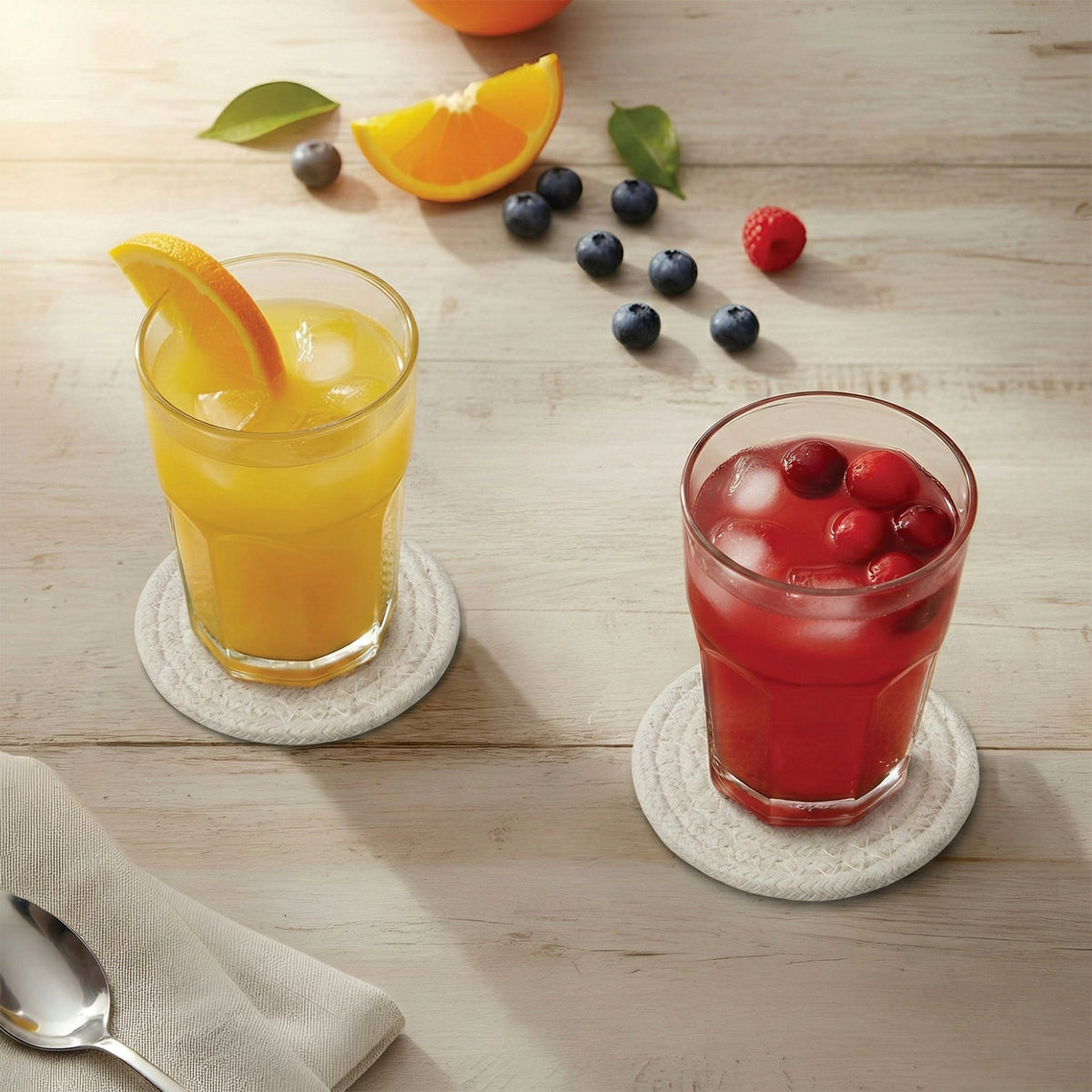
A tea coaster only protects the patch of table it is standing on. On a 9 cm round that patch is the width of a cup base plus a finger of fabric around it, and inside it the coaster does two useful things: it takes the water off a cold glass before that water reaches the table, and it keeps the hot bottom of a cup off the surface. A centimetre outside it, the coaster is doing nothing at all.
What a tea coaster actually protects
Put a glass of cold water on a bare table in July. Soon a film of water forms on the outside of the glass and starts to run down. Some collects under the base, and that is what the coaster catches. The rest runs off the coaster edge, or drips from the widest part of the glass straight past it onto the table. So does everything else that lands nearby: the wet spoon put down after stirring, the plate of biscuits pushed across, the jug set down for two seconds mid-pour. A cup coaster is a small target, and it only works when the thing making the mess is standing on it.
Why a glass leaves a ring when nothing has spilled
Two separate things make a ring, and they get mixed up constantly.
The first is condensation. A cold glass chills the air touching it, that air can no longer hold all its moisture, and the moisture settles on the glass as a film. In humid weather this needs no spill and very little time, and the water gathers under the base, in contact with the table, for as long as the glass stands there.
The second is heat. A hot cup warms the finish underneath it, and a finish is not a solid seal: warming it lets a little moisture move through. Steam from the tea, or moisture already in the wood, gets into the finish layer and is trapped there as things cool. A white ring is moisture sitting inside the finish. A dark ring means it went past the finish into the wood itself, and that one is not a cleaning problem. The surface has to be sanded back and refinished.
Both need time and contact, and the coaster removes the contact. They are less tidy in practice, though: cold water left through a long lunch works slowly and quietly, while one hot cup on a polished top can mark it in a single sitting. A mark that has already formed is moisture trapped in the finish, and our guide to white marks on wood goes through the fixes that actually work.
Your dining table is probably laminate or glass
The standard advice about water rings assumes a solid wood or veneered top. Plenty of Indian dining tables are neither, and the failure mode is different for each.
A laminate top over engineered board has a printed plastic face, and it shrugs off a wet glass for the length of a meal, so the ring people worry about does not really happen there. The weak points are the joins: the edge banding, and any seam where water can reach the board underneath. Once water gets in the board swells, the laminate lifts at the edge, and there is no sanding that back.
A glass top has no finish to trap anything, so an ordinary cup of tea leaves at most a haze that clears and never a permanent ring. What glass gives you instead is a smeared wet circle every time, plus a chalky ring where a drip has dried if your water is hard.
So the reason to use a coaster changes with your table. On the solid wood of an older dining set it is damage control. On laminate, plenty of households skip coasters entirely and lose nothing by it, which is fair enough as long as nobody parks a wet glass on a seam or an edge. On glass, nothing permanent happens and what a coaster saves you is the wiping.
What size is a tea coaster, and what fits on 9 cm
Round coaster sets are commonly cut somewhere between 9 and 10 cm, roughly three and a half to four inches. That size is chosen around a cup, and checking it against yours takes ten seconds: turn over the glass or mug you use most and measure the base. Narrower than the coaster and it sits inside with a rim of fabric showing all the way round, and that rim is where the run-off from the sides lands. As wide as the coaster or wider, and the water has a clear path to the table.
A teacup with a saucer is the awkward case, since the saucer is usually wider than 9 cm and ends up resting on the table with the coaster hidden underneath. A serving bowl or a casserole dish is simply too big.
Coaster materials compared: fabric, cork, wood and silicone
Material guides written for other markets tend to start from wine and iced drinks. An Indian household runs one set through both duties in a single day: chai at seven, a steel tumbler of water at noon, nimbu pani when the afternoon gets bad, coffee after dinner. So heat matters here as much as absorbency, and what a fabric coaster does about heat is simple. The rope coil holds air, air conducts heat poorly, and much less heat reaches the table under a cup of tea than would reach it directly. That is the whole mechanism, and its limit matters: a 9 cm fabric disc is made for a cup, a mug or a glass, not for a kadai off the flame.
| Material | Cold glass | Hot cup | Upkeep | The catch |
|---|---|---|---|---|
| Cotton or jute fabric | Soaks up the run-off from the glass base | Fabric layer between cup and table | Wipe or hand wash, air dry | It absorbs, so it needs washing and drying properly |
| Cork | Absorbs well, costs little | Fine under a cup | None until it wears out | Porous, so tea and coffee mark it and the edges crumble |
| Wood | Water runs to the edge and off | Fine under a cup | Wants oiling now and then | The run-off lands on your table unless the coaster has a lip |
| Silicone | Wipes clean instantly | Handles hot and cold | None | Absorbs nothing, so a puddle sits there until you wipe it |

Encasa's coaster range is entirely fabric: fourteen sets, thirteen cotton, one jute, every one a 9 cm round. There is no cork, wood, silicone or stone in the coaster collection, so if a stone coaster suits your table, buy it elsewhere.
Within fabric, the choice is about the table you are putting them on. The cotton designs are a tightly wound flat rope coil, in colours from off-white through to black. The jute set is a coarser braid in natural tan that reads as texture rather than colour, which is why it works on pale wood and on a bare glass top. It is handmade, so shade, shape and size vary a little between pieces, and that pale tan shows a spilled tea mark more plainly than a dark cotton weave does.
How many coasters do you need

For two people and a centre table, six is plenty and stays that way. It is the six-seater that runs out. Six water glasses at dinner uses the whole set, and when someone makes tea afterwards there is nothing left on the tray.
That is the case for twelve, and it has little to do with entertaining. It is the second round, half the set drying while the other half is in use, and the scattering that happens anyway across a dining table, a centre table and a desk.
The off white cotton set is sold both ways on one listing, six or twelve, and the twelve works out cheaper per coaster. Six is around ₹400 and twelve around ₹700. One other colourway is sold as a twelve as well, and the rest of the range is a set of six.
Keeping fabric coasters clean, and drying them properly

If your household drinks a lot of tea, the colour of the centre matters more than it sounds. The coral and off white set has a rust-coloured woven centre inside a cream rope rim, and that centre is where the cup base lands. A dark chai mark there disappears into the colour in a way it does not on a plain off-white face.
The care instruction on these is a wipe with a damp cloth, or a hand wash in mild soapy water, then air drying. Not a machine cycle, and not a dryer. For a disc that has taken one cup of tea the wipe is usually enough, which makes the hand wash monthly rather than weekly. Deal with a tea or coffee mark while it is fresh, because once it has dried into a light cotton weave it takes much more than soapy water.
Drying is where it goes wrong here, and the mistake is the one the product photos encourage: stacking them. Six damp coasters in a pile leaves the middle ones wet for hours, and damp cotton in humid air starts to smell. Stand them on edge instead, spaced apart in a dish rack or against a wall, so both faces get air. It matters most through the monsoon, when a stacked pile can stay damp long enough to turn musty.
Coaster, table mat, runner or table cover
A 9 cm coaster covers about 64 square centimetres of table. A table mat at 48 by 32 cm covers 1,536. A runner 32 cm wide and 200 cm long covers 6,400. A table cover at 72 by 56 inches, which is 183 by 142 cm, covers close to 26,000. After the first jump, each step is roughly four times the one below it.
Each step answers a different mess. Rings under cup bases and nothing else, and a coaster set is the whole solution. Marks under and around the plates too, and you want table mats, which take the plate, the glass and a little spill margin around both. Damage down the centre where the serving dishes go, and that is a runner, cut about 30 cm longer than your table top. Homework, chopping and children's paint, and the answer is a cloth over the whole thing, which our guide on protecting a dining table goes into properly. They also stack: coasters on a runner is a normal way to lay a table.
Frequently asked questions
What size tea coaster should I buy?
Around 9 cm across covers ordinary cups, mugs, tumblers and most glasses. Measure the base of the drinkware you use most: it should be narrower than the coaster, so a rim of fabric shows all the way round.
Can cotton coasters go in the washing machine?
Encasa's cotton and jute coasters are labelled for a damp wipe or a hand wash in mild soapy water, then air drying, so follow that rather than a machine cycle.
Are cork or wood coasters better than fabric ones?
Only if you would rather wipe than wash. Neither needs laundry, but cork holds on to marks from chai and coffee, and wood sheds condensation off its edge onto the table unless it has a raised lip. Fabric has to be washed and dried, and in return it holds the water rather than moving it somewhere else.
How many coasters come in a coaster set?
Six is the standard set size and covers one sitting at a dining table. Twelve suits households that split coasters across rooms, or that want half the set drying while the other half is in use.

Leave a comment
This site is protected by hCaptcha and the hCaptcha Privacy Policy and Terms of Service apply.