
The floor was mopped on Sunday evening and the shelf above the TV wiped down after that. On Monday morning the tiles feel faintly gritty under bare feet, a grey bloom is back across the shelf, and the laptop lid that was clean at bedtime has a film on it again. Nobody walked mud through the house overnight. The dust simply arrived.
Someone on r/indiasocial photographed that exact morning and asked what to do about it. Three weeks into a new flat, they wrote: "this is the amount of dust collected, this is every single day", and added that they barely open the windows, not even once a day. The post drew 417 upvotes and 123 replies. On r/IndianHomeDecor a poster described the same day on a loop: "Everyday I have to clean everything from my working desk to floor to the top of my keyboard."
Most household dust is not made in the house. In the homes modelled by a 2009 study in the journal Environmental Science and Technology, more than 60 per cent of indoor dust had started outdoors, arriving by two separate routes: air through windows, gaps and vents, and soil carried in underfoot. Cleaning deals with what has already landed. Reducing what arrives means working on those two routes, and only one of them has a door in it.
The dust on your shelf was outdoors last week

That study, by Layton and Beamer, modelled house dust as a mixture: shed skin and fibre off carpets and upholstery made indoors, plus material carried in from outside, with the outdoor share coming out the bigger one. Those were American houses, and a model rather than a survey, so read it for the shape of the problem, not as a measurement of your bedroom. Fine particles drift in through open windows, the gaps around shut ones and vents, and settle wherever the air slows. Soil and road grit ride in on the soles of shoes and chappals, and get crushed finer by every step after that.
In those threads, nobody treats the second channel as a dust problem. Every fix people reach for aims at the air or at the cleaning routine: an air purifier, a humidifier, sealing the room and running an AC, a cloth kept handy, dusting twice a day. Between them the two threads carry 143 comments. Not one mentions a mat at the door. The purifier and the shut windows do work on the channel they aim at, and wiping removes what has already landed. None of it touches soil coming in underfoot.
Indian cities load the outdoor side heavily, and the people in those threads say so. One commenter compared their old hostel, which faced a garden and trees, with their current home, which has a road running past the window: dust problem in the second, none in the first, 12 upvotes for the observation. Another put it down to construction that never stops. Add ceiling fans lifting settled dust off one surface onto another, and even a flat with the windows shut collects a fresh layer by morning.
The cost of leaving it alone is never one big event. This week it is the twice-a-day wipe of the desk and keyboard, and mopping again on Wednesday because Sunday did not hold. Over a year it is the deep cleans stacked on top, from the fan blades to the back of the TV. One person in that thread found their iPad greying over within fifteen minutes and traced it to filthy fan blades, a fair reminder that not every home's dust comes from outdoors.
| Where it starts | How it reaches your shelf | What actually reduces it |
|---|---|---|
| Road grit, construction dust, dry soil at the gate | Carried in on soles, then crushed fine and spread by footfall | Coarse textile at the door, and a second run of textile indoors |
| The same outdoor dust, airborne | Open windows, window gaps, balcony doors, vents | Shutting up on windy afternoons, filtration, wet wiping |
| Skin, lint, fibre off rugs and upholstery | Made indoors. It never comes in at all | Washing textiles, vacuuming soft furnishing |
| Dust already lying in the room | Lifted by fan draught and by dry sweeping | Cleaning fan blades, mopping wet rather than sweeping dry |
On a high floor away from a main road, with greenery below and a household that takes shoes off without being asked, the tracked-in share is already small, and a coir mat at the door will not change your week.
How to reduce dust in a house you cannot seal
Start with the fix people actually buy. The most-upvoted piece of advice in the r/indiasocial thread, at 149 upvotes, told the poster to shut the doors and buy an air purifier, then admitted in the same breath that it still had not stopped the dust at their own place. That is not a bad machine failing. It is a machine doing its own job, on its own channel, in a home where the other channel stayed open. In the second thread, someone suggested sealing the house and air conditioning it centrally, and the reply that drew agreement asked how many Indian homes have central air conditioning.
The floor channel has a body of practical knowledge behind it, though it comes from commercial buildings rather than homes. The ISSA, the cleaning industry's trade body, estimates that around 80 per cent of the soil and dust inside a facility walks in through the door on shoes. The same trade press sets out what catching it takes: roughly four to five steps on matting before grit transfers off a sole, and 12 to 15 feet of matting outside and inside an entrance to take most of the load, which a flooring contractor quoted there puts at 80 to 90 per cent.
Ours are 45 by 75 cm and 60 by 40 cm. Either way that is one step, maybe two, nowhere near a lobby, so nobody should be quoting you lobby numbers off a single mat. What the mechanism does say is that capture scales with how much textile a shoe crosses before it reaches clean floor, so a mat outside takes a share of the load and a mat with something inside the door takes more.
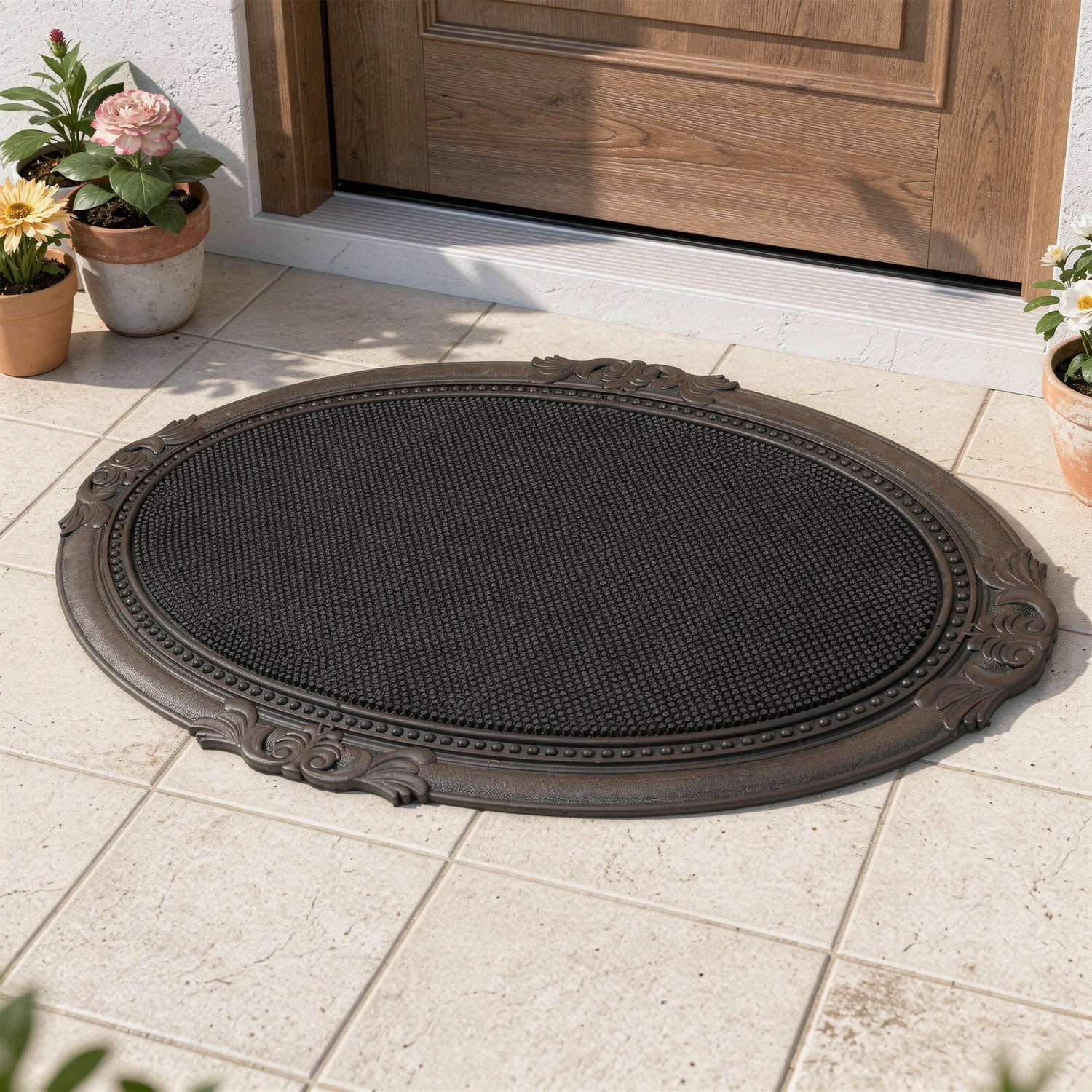
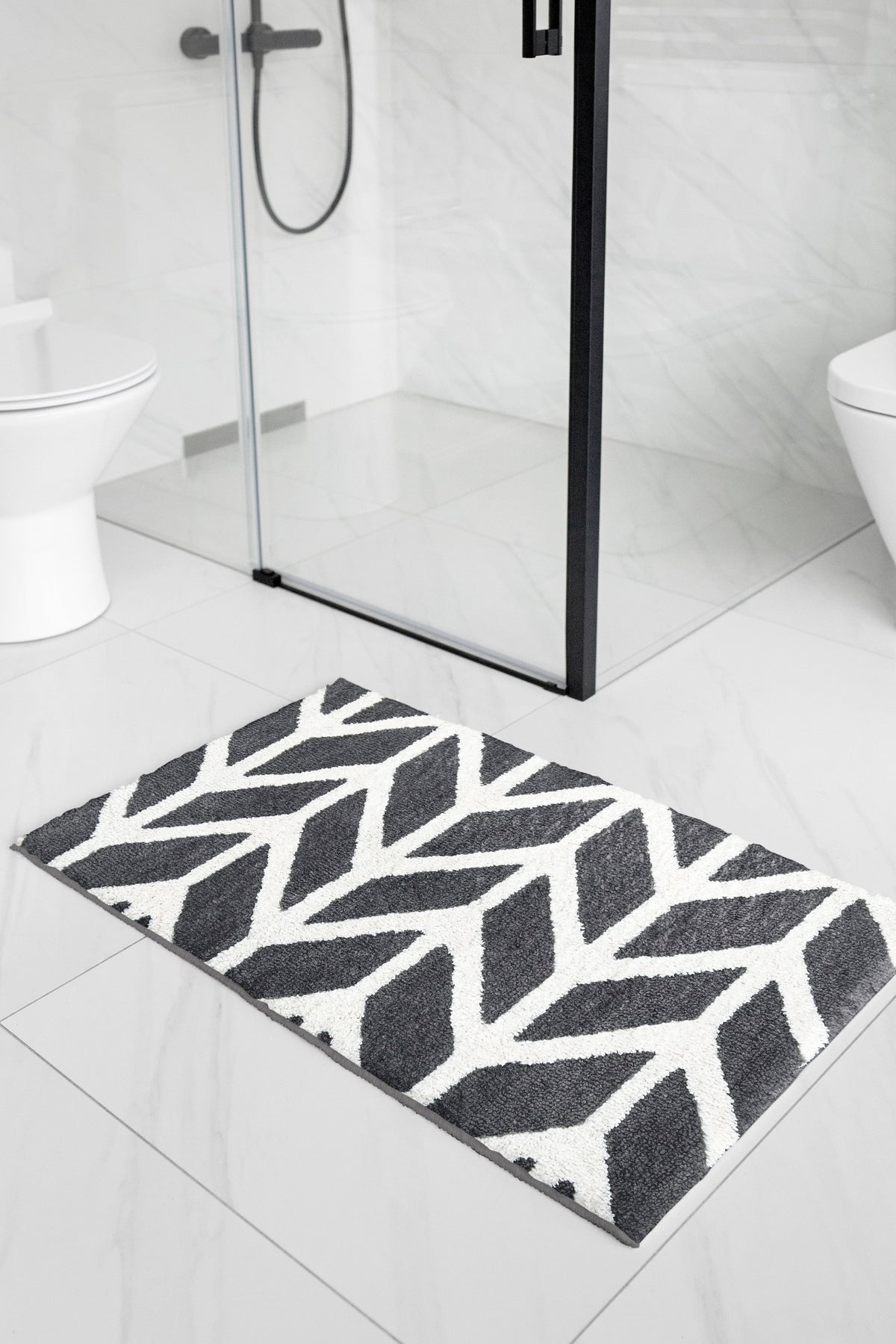
That points at two places rather than one purchase. Outside goes the coarse work, and coir is stiff enough to strip dried mud and grit off a sole, which is why it has long been the standard outdoor mat. It also sheds, which is the reason it belongs outside rather than a reason to skip it. Inside the door there is usually a metre or two of bare tile that hands back everything it receives. Something flat and low-pile there, laid along the line people actually walk, gives the sole more textile to unload onto and holds what it takes until you shake it out. Among the cotton rugs and floor carpets the small round is enough for a short entrance, and the long oval suits a corridor, since it follows the walking line instead of cutting across it.
With both in place, the entrance changes first. The floor inside the door stops needing its own sweep every evening, and the corridor past it still looks mopped two days later.
Which mat to buy, and what goes just inside the door

Measure the gap under your door before buying anything. Indian main doors often swing inward with a centimetre or two of clearance, and a thick mat in the wrong place becomes a doorstop. If the gap is tight, the low-profile polypropylene mat in 60 by 40 cm is the one to try: grooves deep enough to hold sand, behind a bevelled edge that a door can ride over. If the entry is covered and the door swings clear, take coir in the larger 45 by 75 cm, because a longer mat is literally more steps. Where rain actually reaches the mat, solid rubber is the one that soaks up nothing and will not rot, though sun and age tell on it in the end. Which material suits which entrance is worked through properly in our door mat guide, and the door mat range carries all three, the coir and the polypropylene in both sizes, at roughly ₹440 to ₹750.
A mat that has to be kicked flat every time the door opens ends up folded against the wall by the end of the month, so buy for the clearance rather than the design you like most. Then measure the clear run from the threshold to where the hallway opens out, because that number decides the shape of what goes inside.
What gets past the door does not stay near the door

Soil that crosses the threshold does not settle politely in the first metre. It gets walked deeper on socks and bare feet, ground finer with every pass, and the finest of it lifts on the fan draught onto whatever sits above floor level. That is the route from a shoe sole at the gate to the film on a bookshelf in the back bedroom, and it is why the dust seems to have no source you can point at.
It also explains the lopsidedness of the cleaning. Wiping a shelf removes the dust on the shelf and leaves the reservoir underfoot that supplies the next layer, which is why the desk gets done twice a day in those threads.
Setting up both costs a mat at roughly ₹440 to ₹750 plus a rug from about ₹600 for the smallest round to around ₹1,500 for the long oval, and the outdoor mat is a consumable replaced every year or two rather than a fixture. It adds a chore too, since a braided cotton rug by the door has to be taken up and shaken out to keep working. That is the trade: one weekly job at the entrance against the daily wipe-down, the mid-week mop, and the deep cleans that follow them.
Questions people ask about house dust
Can a door mat really change the dust on my shelves?
It changes one input to it. Soil coming in under shoes is a real share of household dust, and a mat with something inside the door takes part of that share before feet spread it around. It does nothing about particles blowing in through a window, or about the lint and skin your own household makes. Expect less, not none.
Will a coir mat swap floor dust for coir fibre indoors?
Coir sheds, and a loosely made mat with an unbound edge sheds longer than a dense one that is bound and backed. Ours carry an anti-skid PVC backing and are built to keep the shedding low, which is our claim about our own construction rather than a promise that coir has stopped behaving like coir. Keep it outside, where what comes off lands on a floor you sweep anyway.
I already have a doormat. Why add a rug inside as well?
Because capture depends on how many steps a shoe takes on textile, and one mat is one or two steps. The second surface takes what the first missed, and it covers the stretch of floor that is walked on hardest. An entrance already running an outer and an inner mat has the same arrangement under a different name.
Does a rug near the entrance just collect dust itself?
Yes, and that is the job. Someone on r/IndianHomeDecor asked whether rugs work in a road-facing flat or only gather dust, and the question sat there with no replies. A rug near the door holds dust instead of letting it travel, so it works only if you can take it up and shake it out. Buy one you can lift with one hand.
Does an air purifier help with house dust?
On the airborne channel, yes, which is what it is built for. If your dust load is mostly blowing in through the windows, a purifier will do more for you than any mat. What it cannot do is pick up soil arriving on the floor, which is why the person in that thread could own one and still be looking at dust every morning.
Wednesday morning, and the cloth comes off the shelf almost clean. The corridor still looks mopped, and the tiles are not gritty underfoot on the way to the kitchen. The window side of the room is a different story, because what blows in off the road keeps blowing in and the fan blades still want a clean before the season turns. A mat does nothing about either of those. What it does do starts at the door, on the two measurements you took, clearance under the door first and weather at the porch second, in the door mat range.
Encasa XO is our own brand, and the mats and rugs named above are ours.


Leave a comment
This site is protected by hCaptcha and the hCaptcha Privacy Policy and Terms of Service apply.