
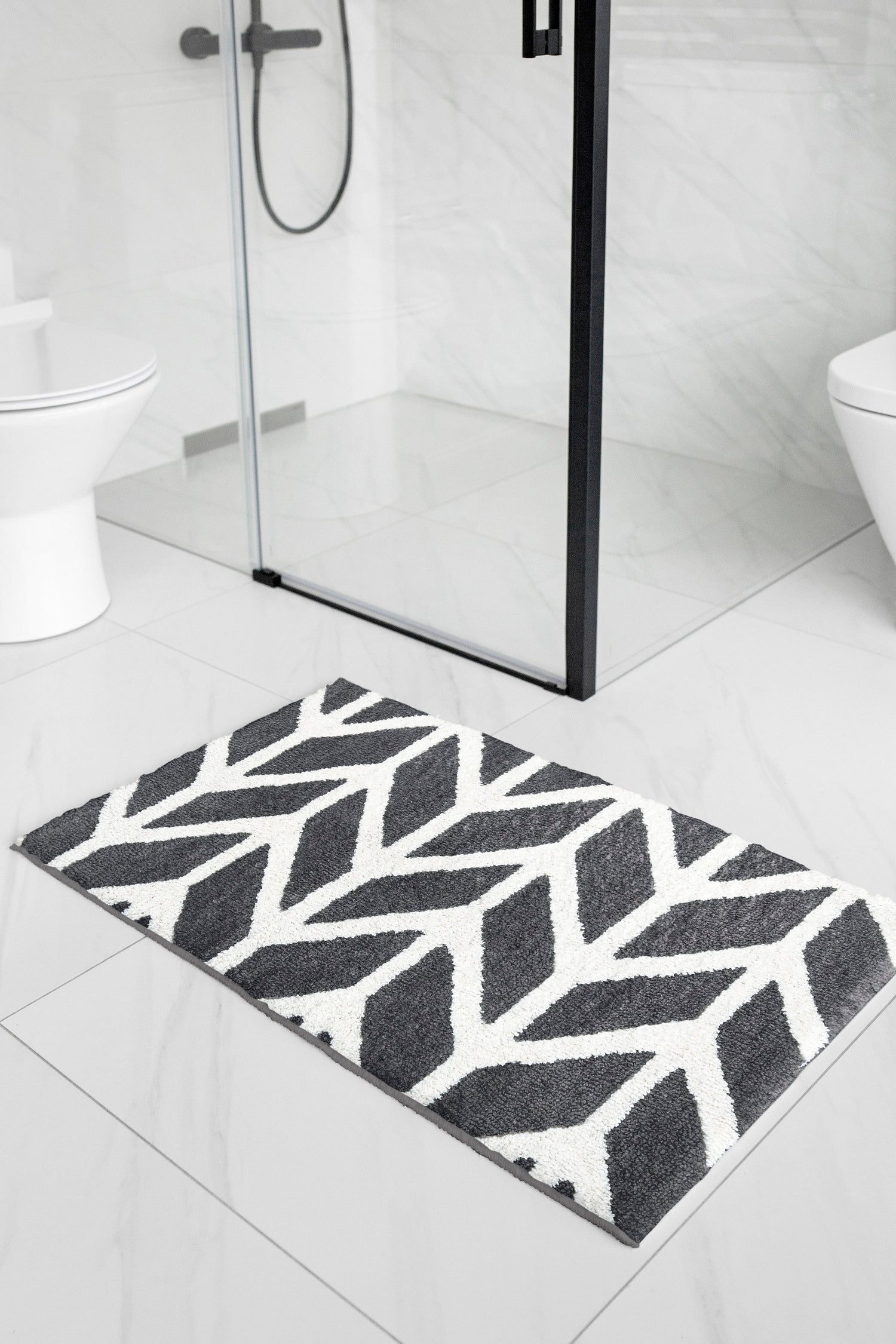
A bath mat that held its place in February starts moving in July. Same mat, same tile, same corner of the bathroom. But now it travels a few centimetres every time someone steps off it, and by the weekend it has ended up half under the washbasin with a wet fold running through the middle. The label still says anti-slip.
Nothing has gone wrong with the mat in the way people assume. A backed bath mat does not grip the floor the way a suction cup does. It holds position because its underside is in real contact with clean, dry tile, and that contact is the part that fails. Water films, soap residue and mineral scale all work their way in between, and once the backing is no longer touching the floor, the texture moulded into it has nothing to bite on.
The phrase covers two products that work in opposite ways
Searches for "anti slip bath mat", "non slip bath mat" and "anti skid bath mat" return two things that look related and are not.
One is a rubber, TPE or PVC mat with suction cups moulded into the underside, made to lie inside a bathtub or on a smooth shower tray. You press it down onto a wet, smooth surface and the cups hold by vacuum. The other is a textile mat with a grippy backing, meant for the floor you step out onto, where the job is absorbing water off your feet and staying put while you dry yourself.
Your bathroom decides which you need, and it comes down to what the underside has to hold on to. Suction needs a smooth, non-porous surface, which in practice means an acrylic tub or a moulded shower tray. Bathtubs are uncommon in Indian flats and moulded trays are not standard either; what bathrooms here usually have is an anti-skid ceramic or vitrified floor tile, given a matt, slightly rough finish on purpose, and a suction cup has nothing to seal against on that. The whole room is the wet zone, so the useful mat is the backed one, where you step down.
That is also the product Indian bath textile brands typically sell, Encasa included. No amount of backing texture makes a textile mat behave like a suction mat.
What is actually under the mat
"Rubber or PVC backing" gets used as though it names one material. It covers several, and they do not behave alike.
| Backing | What it is | Grip | In the wash |
|---|---|---|---|
| TPR | Thermoplastic rubber moulded onto the base | Firm | Takes machine washing without much trouble |
| SBR rubber | A rubber sheet laminated to a sponge layer | Firm | Lasts, but heavy when wet and slow to dry |
| PVC mesh | A net bonded onto sponge or foam | Varies a lot from mat to mat | Can start lifting away from the fabric |
| Plastic dots | Dots laid onto a non-woven base; more dots, more grip | Light to moderate | The dots wear off the high points over time |
| Latex spray | Sprayed on thin, so you feel fabric more than rubber | Light | The thinnest layer here, and it thins further with use |
| Hot melt adhesive | A light adhesive sprayed across the underside | Light to moderate | The lightest to wash and the quickest to dry |
Reading that off a listing is the hard part, because Indian listings routinely say "anti-skid backing" and stop there, which tells you nothing. A seller who names the material has told you something. Turning a mat over in a shop tells you more than either, since a moulded rubber sheet, a plastic net, a scatter of dots and a sprayed film all look and feel quite different.
The firmest grip tends to come with the most rubber, and rubber is also what makes a mat slow to dry and heavy on a balcony line. A hot melt or latex backing trades some of that grip for a mat you can wash weekly without thinking about it. Pile height and density pull in the same direction, so a deep, dense mat on a thin backing can still shift under a wet foot while a thin one on the same backing sits quietly. If the mat only comes out of the machine once a month, take the rubber; if it goes in every week through a damp season, the lighter backing will serve you better.
Why does an anti-slip bath mat stop gripping?

Four things go wrong, and each leaves its own evidence on the floor.
Water gets underneath. A backing rests on tile, it does not seal to it, so once a film of water has spread under the mat the backing is floating on a lubricant. You see this as a mat that is rock steady on a dry floor at six in the morning and skates at eight. Lift it and the tile underneath is wet.
Sometimes the mat slides on a floor that looks perfectly dry, and then the culprit is on the backing rather than under it. Every shower sends a thin slurry of soap, shampoo and dissolved minerals across the tile, and it dries into the same chalky film that builds on a showerhead, filling the texture on the backing and glazing the tile at the same time. Run a finger over the underside: if it feels smooth and slightly stiff instead of tacky, that is it. This is the one failure you can undo. Scrub the tile under the mat with an acidic bathroom cleaner, wash the mat, dry both properly, and the grip usually comes back.
Then there is the curl. Wash and dry cycles shrink and harden a backing slightly, and not evenly, so corners go first, because that is where the backing has least material holding it flat. A curled corner is a toe catcher in its own right, and it breaks the contact along the whole edge, which is why a mat that has only lifted at one corner starts swinging around its centre. Curling does not reverse, and nothing you buy for the floor fixes it.
The fourth is barely a materials problem. If the water lands over a metre-wide arc and the mat covers half of it, you step off onto wet tile as often as not, which is exactly the risk the mat was bought to remove, and water reaches the mat's edge from the side, where it works underneath fastest. Our bath mat size guide covers the sizes and where each one belongs.
None of these is the mould-and-smell problem, which has its own causes and its own fix, and is covered in why your bathroom floor stays wet and the mat smells.
Hard water and the monsoon shorten the cycle
Where the water supply carries a heavy mineral load, every drying puddle leaves solids behind, so the glazing described above builds up faster on the tile and the backing together. A quick check: if your taps and showerhead scale up quickly, the floor under your mat is doing the same thing where you cannot see it.
Then June arrives. In the humid months, a bathroom without an exhaust fan or an outside window may not dry properly between one person's shower and the next. A backing that would recover its grip overnight in March never gets the chance in August, so the mat spends the season sitting on a wet film and behaves accordingly.
That wet season floor is a documented fall-risk condition, at least in one place. A community study of 170 adults aged 50 and over in the Uluberia-II block of Howrah district, West Bengal, carried out between February and July 2021, found a seriously poor household environment to be a significant predictor of falls, and the fieldworkers recorded that the area in and around the bathroom stayed constantly wet and became more slippery during the rainy season. It looked at households rather than bath mats or backing types, and one small rural sample carries no national figure with it. What it does confirm is that a bathroom floor in the rainy season is not a trivial thing to get wrong.
What to check, especially with older parents or small children at home

Coverage matters more than backing. Take a common layout: a bathroom a little over two metres deep, shower fitting on the far wall, washbasin beside the door, toilet in the corner between them. Water lands in two places well over a metre apart, and an elderly parent crosses between them on wet soles twice a day. A single 60 x 40 cm mat in front of the shower leaves both of those trips on bare tile. A 76 x 51 cm mat like the microfibre grey bath mat at around ₹800 covers the step-out properly, and a second mat at the basin does more for that household than upgrading either one to a grippier backing.
Then check the mat in your hands and keep checking it. A backing that covers the whole underside beats scattered dots or a border of grip. Feel the corners every month or two, and the day one of them stops lying flat, replace the mat rather than reposition it, the way you would deal with a loose stair rod. No fixed replacement interval is worth quoting, because it turns on how hard your water is and how often the mat is washed, but those signals are easy to read.
Two habits are worth more than the upgrade. Hang the mat over a rail or a line after the last shower of the day so both faces dry, and once a month clean the tile the mat sits on rather than only the tile you can see. When you do wash it, keep the heat down, since heat rather than the washing is what wears out a backing; our guide to washing a bath mat has the settings for each type.
What Encasa's bath mats are, and what they are not

Every mat in the bath mats range is the step-out kind. There are no suction mats for inside a tub. The cotton and microfibre lines carry a hot melt adhesive backing, the light, fast-washing end of the table above; the plush polyester range is described as having an anti-skid backing.
Which one to take follows from which failure you are most likely to hit. If yours is the coverage problem, with the toilet and the shower area close together and bare tile between them, the cotton grey bath mat set at a little over ₹800 is the useful shape: an 80 x 50 cm mat for the step-out plus a 45 x 45 cm U-shaped contour mat that goes round the toilet base, which is the spot households often leave uncovered. If your problem is the wet film, because the bathroom never dries and the mat needs washing every week, a light backing that survives that schedule matters more than raw grip, and the 60 x 40 cm microfibre bath mat under ₹500 is the plainer answer; if that size leaves the step-out short, the same microfibre pile and hot melt backing come in a wider 76 x 51 cm across the microfibre range.
One line in the range carries the bath mat name and belongs somewhere else. The plush polyester bath mat, from ₹299, is a warm, deep-pile mat listed as much for kitchens, balconies and the floor beside a dressing table as for the bathroom, and that is where it is happiest. In a bathroom that stays wet through the monsoon, a thinner, faster-drying mat is the better buy whatever the backing.
Frequently asked questions
What makes a bath mat non slip?
The backing bonded to its underside does the holding: a grip layer of TPR, rubber, PVC mesh, printed plastic dots, latex or sprayed hot melt adhesive. All of them work by contact, so they hold on clean dry tile and let go when water, soap film or mineral scale gets in between. Size and placement decide how often you are on the mat at all, which matters just as much.
Is a suction cup mat or a backed mat better for an Indian bathroom?
A backed mat, unless you actually have a bathtub or a moulded shower tray, in which case a suction mat inside the enclosure is worth adding. Suction needs a smooth, non-porous surface to seal against, and the matt anti-skid ceramic tile common on Indian bathroom floors gives the cups nothing to grip.
How often should a non slip bath mat be replaced?
Go by condition rather than by the calendar. Curled corners that no longer lie flat, a backing that has gone smooth and stiff to the touch, or a mat that slides on a dry floor after cleaning are all signs it is finished. Hard water and frequent washing bring that day forward.
Why does my bath mat slide on the tiles even though it has anti skid backing?
Almost always because something is between the backing and the tile. Check whether the floor under the mat is wet, and run a finger over the backing to see if it feels glazed rather than grippy. Cleaning the tile with an acidic bathroom cleaner and washing the mat restores the grip if the backing itself is still sound.

Leave a comment
This site is protected by hCaptcha and the hCaptcha Privacy Policy and Terms of Service apply.