
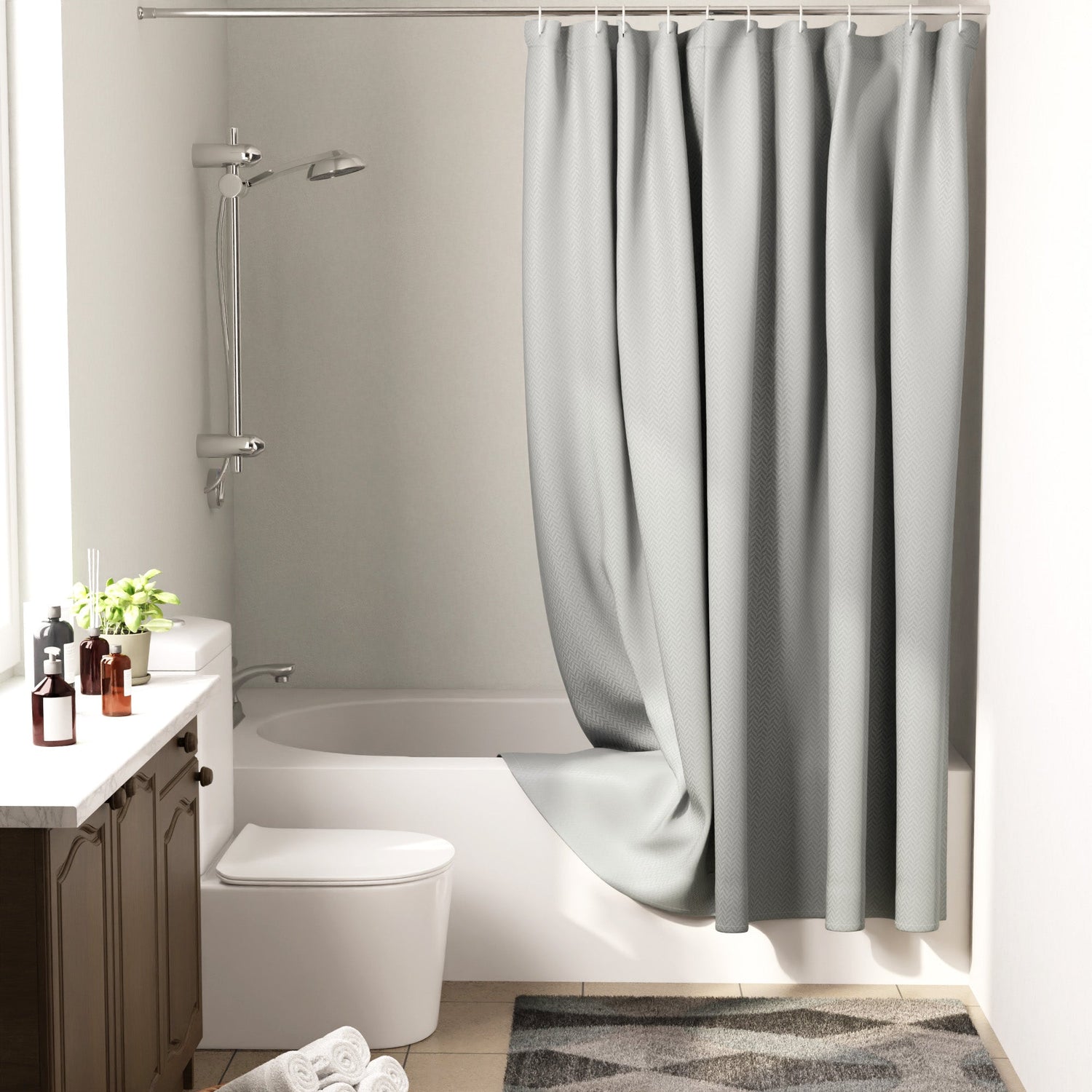
If you have searched this question, the answer you found was probably written for a bathroom you don't have. Almost all the guides you'll find on shower curtain liners come from American and British sites, and they all quietly assume the same room: a bathtub with a moulded lip, a straight rod above it, and a thin plastic liner whose weighted hem clings to the inside of the tub. In that room a liner earns its keep. In the average Indian bathroom, a tiled floor that slopes to a drain, usually no tub, often a glass partition or nothing at all, the whole mechanism has nothing to hold on to.
So here is the short version. In most Indian bathrooms you do not need a separate shower curtain liner. A liner solves a problem that belongs to tub-and-rod bathrooms, and it needs a tub edge to work properly. If your bathroom drains through the floor, one fully waterproof curtain does everything a curtain-plus-liner pair would, with less to wash and nothing extra to hunt for in the shops.
The rest of this is about when that short answer flips, and how to get the single-curtain setup right.
What a shower curtain liner actually is
A shower curtain and a shower curtain liner are two different objects doing two different jobs. The curtain is the decorative outer layer, usually a printed or textured fabric you chose to suit the room. The liner is a plain, fully waterproof inner sheet, plastic or coated polyester, that hangs on the shower side of the same rod and takes the actual water. The point of the pair is a division of labour: the liner keeps the pretty fabric dry, and you swap the cheap liner when it tires rather than the curtain you like.
That system was built around one specific piece of hardware. Most liners have a weighted or magnetic hem along the bottom, and its job is to pull inward and cling to the inside wall of a bathtub, so water runs back down into the basin instead of creeping onto the floor. That is the detail everything else hangs on: the hem needs a tub wall to grip, and take the tub away and it has nothing to press against.
So do you actually need one in an Indian bathroom?
Picture the two bathrooms above. On the left is the room every foreign guide has in mind: a basin-shaped tub with a raised lip, and a liner hem tucking neatly against its inner wall. On the right is what a great many flats and independent homes here are built around. The floor is tiled, it slopes gently to a drain in a corner, and the water is meant to leave through that drain rather than sit trapped in a basin. There may be a glass partition around the shower, or a half wall, or simply an understood wet side of the room.
None of that gives a hem anything to cling to. Hang a weighted liner in a floor-drain bathroom and it sways loose over the tiles, doing nothing its outer curtain isn't already doing. The feature that makes a liner worth the trouble is the one your bathroom can't use.
This is also why a shower curtain liner is harder to find here than the curtain itself. Home stores stock plenty of shower curtains and rarely a liner; search online and much of what turns up is imported stock on marketplaces rather than something a neighbourhood shop keeps on the shelf. Whatever the reason for that, the practical takeaway holds either way: work out whether your bathroom geometry actually needs a liner before you go hunting for one, because the layout it was designed for is the exception here, not the rule. The same goes for size: our shower curtain size guide covers the widths and drops actually sold here, and how to measure from your rail.
When a liner or a second layer does earn its place
A few bathrooms genuinely do want the two-layer setup. The obvious one is an actual installed bathtub: if you have a tub with a lip, a liner works exactly as designed, tucking inside the tub while a fabric curtain hangs outside and stays dry. Keep the pair, and treat the rest of this guide as the exception rather than your case.
The other situations are less about the room and more about what you hang or who uses it. A genuinely decorative cotton or linen curtain, the kind chosen for looks, will wick water and sit damp for hours, which in a humid bathroom invites mildew; a cheap waterproof liner behind it saves the fabric without changing the look. And some households simply generate more water than one curtain holds back, whether that's a handheld sprayer that wanders or young kids who treat the shower as a water park. Here a second waterproof layer mainly does one job, catching the splash that gets past a single curtain, tub or not. If none of that is your bathroom, the extra layer is effort you don't need.
The simpler fix most people want: one waterproof curtain

For the ordinary case, a floor drain, no tub, everyday showers, the sensible answer is to stop thinking in two layers at all and hang one curtain that is waterproof on its own. A polyester shower curtain doesn't drink water the way cotton does. It sheds most of it and dries off quickly once the shower is off, which is really the entire reason the liner was invented. One layer, one thing to launder, and nothing to source separately.
Work backwards from your own bathroom and the choice turns concrete. Measure from the rod to a little above the floor and pick a curtain that lands there, so the hem clears the tiles instead of pooling and wicking water back up. The lack of a weighted hem stops mattering here, since there was no tub wall for it to grip in the first place. Colour is worth a thought as well: a mid grey hides the faint mineral film hard water leaves along the lower edge better than a white curtain would, which is part of why the Polyester ZZ Light Grey Shower Curtain is an easy one to live with. It hangs on standard rings and keeps water on the wet side of the room on its own, and it sits in Encasa's small range of shower curtains if you want to compare textures before deciding.
Keeping a single curtain clean without a liner

Without a liner, the one curtain you own is the surface that meets soap, shampoo and your water supply every day, so a little upkeep keeps it presentable. The trouble in Indian bathrooms is rarely the volume of water and more often what rides in it. Hard, mineral-heavy supply leaves a pale film along the lower third of a curtain, and monsoon humidity keeps everything damp long enough for mildew to consider moving in.
Neither of those wants a rigid schedule so much as a habit. After a shower, pull the curtain fully across the rod instead of leaving it bunched, so it dries flat rather than holding folds of moisture in the creases. When the lower edge starts to look cloudy, a gentle machine cycle or a wipe with a mild solution lifts the film off. How often that comes around depends entirely on how hard your water runs and how well the room breathes, not on any fixed number of months. In a sealed, unventilated bathroom through the rains you will do it more often; in an airy one, much less. The wider question of drying textiles out in humid weather is its own subject, and the monsoon home textile care guide goes into it.
One last thing helps the curtain only indirectly, by drying the room around it. A quick-dry mat just outside the wet zone soaks up the water you track out instead of leaving it on the tiles, and a room that dries out faster is a curtain that spends less time damp. A microfibre bathmat does exactly that, drying between showers rather than sitting soggy; the broader microfibre range and the quick-dry bathmat guide cover matching one to a floor-drain bathroom.
Common questions
Can you use a shower curtain without a liner?
Yes, provided the curtain is waterproof to begin with. Polyester and coated curtains are made to meet water directly and shrug it off. The only curtains that truly need a liner are the absorbent ones, cotton and linen, which soak through and sit wet without a barrier in front of them.
Does a waterproof polyester curtain still need a liner?
Not in a normal bathroom. A liner is a shield for a curtain that can't handle water on its own, so putting one behind a curtain that already repels water just leaves you with two things to dry. The exception is if you're using the liner to protect a separate decorative fabric curtain hung for looks.
What if my bathroom has no bathtub?
That is the common Indian case, and it tilts the answer firmly towards a single waterproof curtain. A liner's weighted hem is built to seal against the inside of a tub; with only a sloped floor and a drain, it has nothing to seal against, so it adds laundry without adding any protection.
How often should you replace a shower curtain?
There isn't a universal figure worth trusting, and much of the "every few months" advice online comes from makers of disposable plastic liners abroad. A washable polyester curtain lasts as long as it still sheds water and comes clean after a wash. Replace it when the surface stays cloudy despite washing or the coating begins to flake, and sooner if your water is especially hard.


Leave a comment
This site is protected by hCaptcha and the hCaptcha Privacy Policy and Terms of Service apply.