
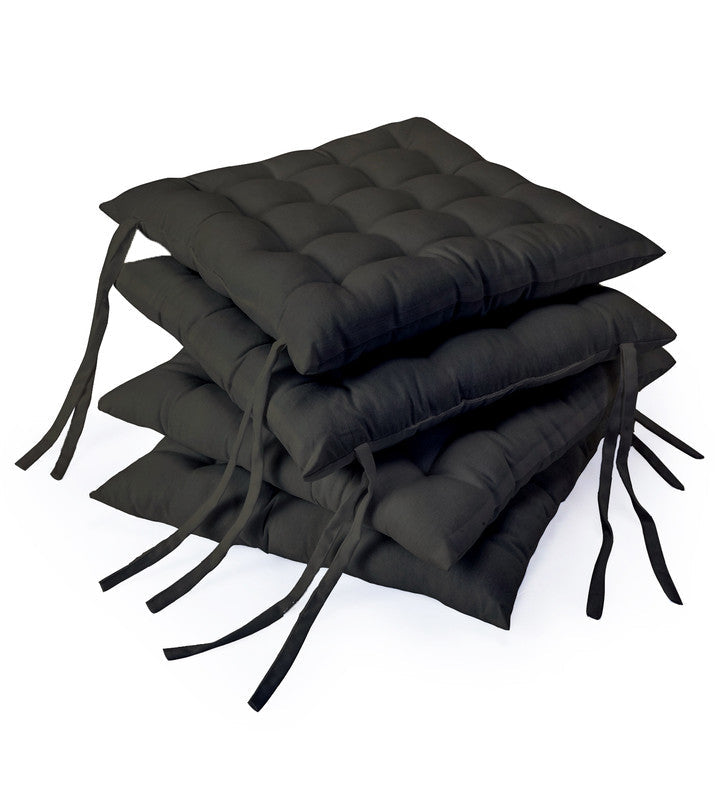
A hard dining chair is fine for twenty minutes. The trouble starts with Sunday lunch, or the hour after it when everyone is still sitting there talking, or the slow discovery that the dining table has become the place somebody works every afternoon. That is when a wooden or cane seat stops being furniture and starts being the thing you are thinking about.
The answer is a small square cushion that ties onto the chair, which sounds simple until you search for one. Type "chair cushion" into any shopping site and you get at least four products that have very little to do with each other.
For an ordinary Indian dining chair, what you want is a 40x40 cm square pad, roughly 4 to 6 cm thick, with two fabric ties along the back edge. That size covers the flat part of most dining seats without hanging over the front, and the ties stop the pad creeping forward every time someone stands up. The thickness is the number worth checking against your own table before you buy anything, and it is the one nobody mentions.
What people actually mean by "chair cushion"
Four fairly different things share the name, and picking the wrong one is the most common way this purchase goes wrong.
| What it is | How it stays on | What it is really for |
|---|---|---|
| Tie-on chair pad | Two fabric ties knotted to the chair back | Dining and kitchen chairs, cane and wooden seats |
| Moulded foam seat cushion | Friction, sometimes a rubberised base | Long hours at a desk or in a car; tailbone and posture support |
| Floor cushion | Nothing, it lies on the floor | Low seating and extra places at a festival meal |
| Chair pad cover | A zip or envelope opening over a pad you already own | Changing colour without buying new pads |
Everything in the Encasa chairpad range is the first kind: a filled cotton square with two ties. If you are shopping because your lower back aches after six hours at a desk, a tie-on cotton pad is not going to fix it. That job belongs to a shaped foam cushion, and it is not something we make. A cotton pad adds a layer of give between you and a hard seat, keeps the wood from pressing into you, and lets your legs breathe. For a dining chair that is usually the whole requirement.
The fourth row does not apply to these either. The filling is sewn in, so there is no separate cover to buy or swap, which turns out to matter later.
Measure the seat, not the chair
Take a tape to the seat itself and write down two numbers: front edge to the back rail, and side to side at the narrowest point. Ignore the overall width of the chair. Arms and a flared back add centimetres you cannot actually sit on, and going by them is how people end up with a pad that overhangs.
A 40 cm square suits a flat seat area of roughly 38 to 45 cm, which covers the common run of dining chairs sold in India. Below about 35 cm the front corners hang past the seat edge and fold down under your knees. Above about 48 cm you get the opposite problem: bare seat showing all around a pad that now has somewhere to slide to.
Many dining chairs are wider at the front than the back, so measure the back. A square pad on a tapered seat leaves two small triangles of bare wood at the front corners. That is normal, and within a day you stop seeing it.
Encasa makes chair pads in a single size, 40x40 cm, across both ranges, so the fit is either right or it is not. If your chairs are genuinely unusual, a deep armchair-style dining chair, a small cane moora, a low stool, then nothing here will fit properly and it is not worth forcing. A dining bench is the happy exception: two 40 cm pads sit side by side on a standard bench with almost no gap.
How much thickness can your table spare?
A chair pad works by lifting you, and everything you gain in softness you lose in the gap between your thighs and the underside of the table. Product pages give you the thickness and leave the consequence to you.
Furniture guidance puts standard dining tables at 28 to 30 inches high with seats at 18 to 19 inches, and asks for 10 to 12 inches of clearance between the seat and the tabletop, which is about 25 to 30 cm. Do the arithmetic on a standard set. A 75 cm table over a 46 cm seat gives you 29 cm, comfortably inside that range. Put a 6 cm pad on the seat and you are at 23 cm, just under the bottom of it.
In practice the pad squashes under an adult, so you get some of that back, but plan on the full 6 cm and you will never be caught out. For a forty-minute dinner, 23 cm is fine and you are unlikely to notice. For an afternoon of laptop work at the same table, taller people notice within the hour, and if your chairs have arms, the arms are what will tell you first.
Compact dining sets are where this actually bites. A 72 cm table over a 46 cm seat starts you at 26 cm, and a thick pad takes you to 20. Measure your own gap before you order six of anything. And measure to the underside of the apron if your table has one, or to a drawer if there is a drawer, because that is the surface your knees will meet, not the tabletop.
Where should the ties go?

A pad does not really move while you are sitting on it. It moves in the two seconds when you push the chair in under the table, and in the two seconds when you stand up and drag the backs of your thighs across it. Both push it towards the front edge. That is why the ties belong on the back edge: they anchor the corner that every bit of that movement is pulling away from.
Two ties is the standard, long enough to loop around the uprights or spindles of the chair back and finish in a bow. Use a bow rather than a hard knot, because you will be undoing these to shake crumbs out of the seat.
There is one chair this does not suit. If the back meets the seat flush, with no gap at the bottom to pass a tie through, there is nothing to anchor to. Upholstered dining chairs with a solid panel back are the usual culprits. On those the pad is held by friction alone, which works reasonably on cane and rush seats and works badly on polished wood or laminate.
Contrast straps are a small thing that turns out to be useful. On pads like the egg blue with coral ties, the tie is a different colour from the pad, so you can see from across the room which chair has been untied and never retied. On a matched set you find out by sitting down.
Cotton half panama or printed sheeting

Two cloths run through the range, and they behave differently under a person.
The solid colours are cotton half panama, a basket weave in which paired warp threads cross single wefts. It is heavier and denser than an ordinary sheeting, and it is mercerised, which gives the dye some depth and lustre. Under body weight it holds a flat plane rather than rucking, which is most of why the solids feel more substantial than they look.
The printed pads are 20s cotton sheeting, a lighter plain weave, and the print is the reason to choose them. A pattern hides the small daily marks of a dining table far better than a flat colour does, and several are two-faced: the black arrow print backs onto plain black, so there is a second usable side when the first has had a hard week.
Both are cotton, and in an Indian summer that is not a small detail. Two hours on a vinyl or leatherette dining chair is a sweaty business; a breathable cotton layer between you and the seat is the fix, and it is where a foam cushion in a synthetic cover tends to do worse.
Inside, both use a microfibre filling held by nine tucks in a three-by-three grid. Those tucks are what stop the filling migrating to the edges and leaving you sitting in a shallow dip, which is the usual way a cheap pad fails.
Colour is a laundry decision

The filling in a pad of this construction is sewn in, ours included. There is no zip and no removable cover, so when dal lands on it you are spot cleaning, not stripping and washing. The care instruction is to brush it with a damp cloth rather than soak it, and to dry it under a fan rather than in the sun. You can put one through water if you must, but a sewn-in microfibre pad holds that water for a long time and the filling can come back lumpy.
Which means colour is a maintenance choice before it is a decorating one. Under a dining table where children eat, a pale natural or white pad has a short and eventful life. A charcoal grey or a deep red or a cobalt absorbs a lot before it shows anything. The natural and white shades are lovely, and they belong on the chairs that get used least, or in a house where the dining table is mostly for guests.
The pack sizes follow from this. Pads come in twos and fours, and in both ranges the four-pack costs less per pad than two twos, so for a six-seater two four-packs beats a four plus a two and leaves you two spares. Spares are the whole strategy when washing is slow: pull the marked one off, put a clean one on, deal with the first at your leisure. They stack flat, so the extras keep on a cupboard shelf.
There is one case where all this thickness works in your favour. A six-year-old at an adult dining table needs height, not less of it, and two pads stacked on one chair is the standard fix.
Common questions
Do tie-on chair pads help with back pain?
Not meaningfully. A 4 to 6 cm cotton pad cushions the contact between you and a hard seat, which is a comfort problem, not a posture one. Back and tailbone pain from long sitting is a job for a shaped foam or gel cushion designed with a cut-out, and for the height of your chair relative to your desk. If that is why you are shopping, buy the foam one.
Will a 40x40 cm pad fit a round stool or a cane moora?
Only loosely. A square pad on a round seat leaves four corners hanging in the air, and on a moora there is usually nothing at the back to tie to, so it shifts every time you get up. It is workable on a wide round stool where the flat top is close to 40 cm across. On anything smaller or lower, it will look and feel like a pad balanced on a stool.
Can chair pads go in the washing machine?
Only as a last resort, never as routine. Wash the pad on its own rather than in a load, and give it a full day lying flat under a fan afterwards. The dyes are set to hold, so colour bleeding is not the thing to worry about; the water trapped inside a sewn-in filling is.
Do the ties fit every chair back?
Any chair with a gap between the seat and the lowest rail of the back will take them: spindle backs, ladder backs, cane backs, most metal dining chairs. If the ties come out longer than you need, wrap them twice around the upright before knotting rather than trimming them short.
Related guides
- Cushion cover sizes for Indian sofas. The same 40x40 cm square, doing a very different job on the sofa.
- 6 reasons to put a cloth on your dining table, which is the other half of looking after a dining set.
- Does cotton shrink, and how much? Worth reading before you put any of this through water.

Leave a comment
This site is protected by hCaptcha and the hCaptcha Privacy Policy and Terms of Service apply.