
It is four in the afternoon and the doorbell keeps going. The women coming in are mostly in black sarees, and they settle on the sofa and the two dining chairs pulled into the hall. A thali goes round with haldi and kumkum in small bowls, and behind it comes a steel plate of tilgul. Someone reaches for the kumkum, and a pinch of red lands on the pale cushion beside her. Nobody notices until the evening, when it has been sat on for three hours.
That small red mark is the whole problem with festival cloth. For Sankranti decoration that uses cloth, pick the colour from your own region's version of the festival, and pick the fabric for what will land on it that week: powder at a haldi-kumkum, ghee and jaggery at a Pongal lunch, smoke at a Lohri bonfire. A deep warm colour in washable cotton covers most of it. Keep velvet and anything pale for the places nobody eats or passes the thali.
Kites, rangoli, kolam and til-gud make most of the festival's look, and none of them needs cloth. Cloth comes in at the table and on the seats, which is where the guests spend the afternoon.
In 2027, the central government's list of restricted holidays, issued by the Department of Personnel and Training in July 2026, puts Makar Sankranti on Thursday 14 January and Pongal on Friday 15 January. Lohri is usually lit on the night before Makar Sankranti. Haldi-kumkum gatherings in many Maharashtrian homes carry on for some days after the festival itself, so the cloth you put out may stay out for a week or more.
What lands on the cloth during Sankranti week
Each festival this week has its own mess, and each behaves differently on fabric.
Haldi and kumkum arrive as dry powder. While they are dry, much of the colour sits on top of the weave and can be shaken or brushed off. Trouble starts when the powder meets water, sweat or the pressure of someone sitting on it, which pushes it into the threads. So the first move with a powder mark is a dry brush outside, before any water touches it. Turmeric leaves a yellow stain and kumkum leaves a red one, and a pale cloth shows both straight away. For the full method on turmeric, use our haldi stains guide.
Ghee is different. Sakkarai pongal, til laddoos and gajak all carry fat, and a ghee drop is an oil stain. A deep colour hides it for the evening but it will still darken the cloth, so treat it the same day with the steps in our oil stains guide. Plain jaggery is easier. It is mostly sugar, and sugar dissolves in water, so a sticky spot of tilgul or chikki usually lifts in an ordinary wash. Jaggery cooked with ghee or milk, as in sakkarai pongal, carries fat as well and needs the oil steps too.
Lohri adds smoke, ash and sparks, all outdoors. Nothing in a living room needs to go near the fire, and the good cushion covers and the tablecloth are better left inside where the food is laid out.
Which colours suit each version of the festival?
The festival has a different name and a different look in each region, and the colours many families use change with it. Treat the table below as what is common, not as a rule.
| Where | What the day is often called | Colours many homes use | Cloth that fits |
|---|---|---|---|
| Maharashtra | Makar Sankranti, with haldi-kumkum | Black, with yellow and gold | A black-and-mustard runner on the thali table; yellow or apricot covers on the sofa |
| Tamil Nadu | Pongal (Bhogi, Thai Pongal, Mattu Pongal) | Turmeric yellow, leaf green, white | A green runner under the banana leaves; a marigold or yellow cloth |
| Punjab | Lohri, the night before | Orange and red, phulkari brights | An orange cloth for the food table; velvet covers indoors |
| Gujarat | Uttarayan | Every kite colour | An old cotton sheet or durrie for the terrace; the good linen stays downstairs |
The black in the first row surprises people, since many families avoid black at other festivals. Wearing black at Sankranti is a custom found mainly in Maharashtra, and the Free Press Journal describes women in black sarees meeting to exchange tilgul at haldi-kumkum. If your guests come in black, a table in black and yellow looks as if it was planned for them.
Uttarayan is the odd one out, because the family spends the day on the terrace with the kites, and lunch (often undhiyu, with chikki and til laddoos) is eaten up there in the sun and the wind. Anything you carry up gets dust, string and sticky fingers, so use something you would not mind losing to the day.
The weather matters too. Mid-January is cold in Punjab and warm in Chennai. A velvet cover feels right on a winter evening in Amritsar and too heavy on a Pongal afternoon in the south, where cotton is the easier choice.
Haldi-kumkum decoration: the sofa and the thali table

At a haldi-kumkum, guests sit for a long time while the thali goes round, and the sofa is where the powder ends up. Cotton canvas is the safer fabric here, because you can unzip it, shake it out in the balcony and wash it the next morning. A strong yellow also hides a fleck of turmeric better than cream or white does, though kumkum will show on any light colour.
For the table where the thali, the tilgul and the small gifts sit, the black and mustard table runner is the piece in our range that gives that black-and-yellow look. It is a chenille runner, a mustard panel with a black band down each side and pointed ends. The 91 cm length (₹799) fits a side table or a small sideboard, and the 150 cm length (₹1,199) runs down a four-seater dining table. It costs more than our plain runners, so if the table will be crowded with plates anyway, a cheaper cotton runner does the job.

On the sofa, the Franca Yellow Stripes cushion covers have a matching runner in the same stripe, sold separately, so the sofa and the table can match without much thought. In the photos the yellow reads as a soft apricot with white stripes, not a lemon yellow. The pairs start at ₹489 for 40 x 40 cm. These are covers only, so check your inserts against the cushion cover size guide. If you want a true bright yellow, the plain Sunbeam Yellow canvas covers in the cushion cover collection are the stronger colour.
Many families seat a crowd on a mattress or a durrie on the floor. We have no floor cushions in stock right now, so plan the floor with what you already own.
Pongal decoration ideas for the table

Pongal lunch is often served on banana leaves, and many people take that to mean the table needs nothing. In practice a wet leaf on bare wood can leave a mark, and ghee from the sakkarai pongal finds the gaps between leaves. A runner down the middle, or a cloth, gives the leaves something to sit on and goes in the wash afterwards.
The Cotton Ladder Green runner is a bright lime green, close to a fresh banana leaf, with bands of orange near each end that pick up the turmeric. It comes at 183 cm (₹499) or 240 cm (₹639). For a longer or shorter table, the table runner size guide works out the length. If you use mats instead, set the leaf on the mat, not beside it.
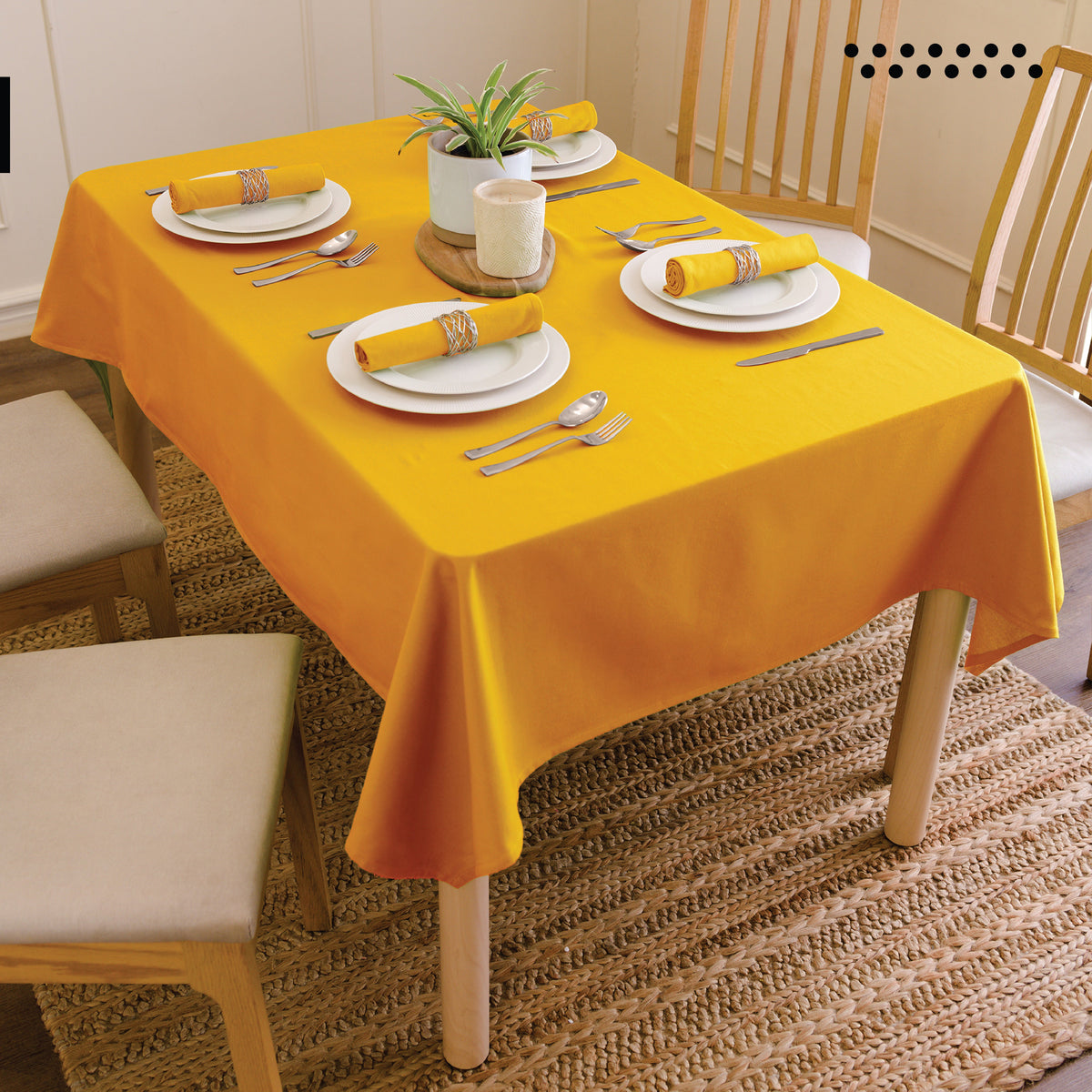
If you would rather cover the whole table, the Cotton Mango cloth is a deep marigold yellow, the colour of the flowers on the doorway, and a turmeric mark shows less on it, though it is still there until you wash it. It comes in three sizes, from 72 x 56 inches (₹999) up to 120 x 56 inches (₹1,399), and the tablecloth size chart shows which one suits your table. Our Jaipuri Yellow block-print cloth is prettier, but its ground is white with mustard flowers, so keep it for visitors on Kaanum Pongal rather than the day of the ghee.
Lohri decoration ideas inside the house

The bonfire is outside, and that is where most Lohri decoration goes: the fire, the rewri, peanuts and popcorn thrown into it, the dhol. Indoors is where everyone eats and warms up afterwards.
A cold Punjabi evening is where velvet makes sense, on the sofa at least. The Velvet Orange covers are a deep burnt orange with a soft sheen, from ₹499 a pair. Keep them indoors and away from the smoke, and zip them closed before they go in the wash, as the listing asks.
For the food table, a bright orange cloth carries the colour of the fire indoors. The Cotton Orange cloth is a true strong orange, at ₹999 for 72 x 56 inches or ₹1,279 for 91 x 56 inches. Rewri and popcorn leave mostly crumbs and sugar, so apart from a ghee spot from the gajak, this is one of the easier tables to clean. If someone in the family has a phulkari dupatta, lay it down the middle over the cloth. It will say Lohri more clearly than anything you can buy, and it costs nothing.
A first Lohri after a wedding or a new baby brings more guests, and more of them eat with a plate on their knees. On the seats where plates will rest, use cotton covers that go in the machine and keep the velvet against the backrest. A long food table may also outgrow one cloth. Cotton stripe runners in the table runner collection go up to 304 cm, for a buffet made by pushing two tables together.
After the week: what you keep
The kites tear and the flowers go, but the cloth stays. A marigold or orange cloth comes out again at Diwali, and our festive cushion covers guide shows how warm colours carry across the year. Before you put anything away, brush off any powder outside, wash the cottons, and let them dry fully out of strong sun. Velvet needs a little more care in a damp cupboard, and our guide to storing festive linen covers that.
Frequently asked questions
What colour is good for Makar Sankranti decoration?
It depends on how your family keeps the day. Yellow and marigold suit almost every region. Maharashtrian homes often add black, Pongal homes add leaf green, and Lohri leans to orange and red. Use the strong colour on cloth that washes easily.
How do I decorate for haldi-kumkum at home without much money?
Change the covers on the cushions people will sit against, and put one runner on the table that holds the thali. Two pairs of covers and a runner change the room more than a pile of small decorations, and you will use them again.
Can one set of decoration work for all three festivals?
Mostly, yes. A marigold cloth and yellow covers suit all three, because yellow is common to most versions of the festival. Add what your own family uses, such as banana leaves on the Pongal table or a phulkari dupatta at Lohri, and leave the base as it is.
How do I get kumkum off a cushion cover?
Take the cover outside and brush or shake the powder off while it is still dry. Do not rub it with a wet cloth first, which drives the colour in. Then wash the cover on its own as its care label says, and check the mark before it dries.


Leave a comment
This site is protected by hCaptcha and the hCaptcha Privacy Policy and Terms of Service apply.