
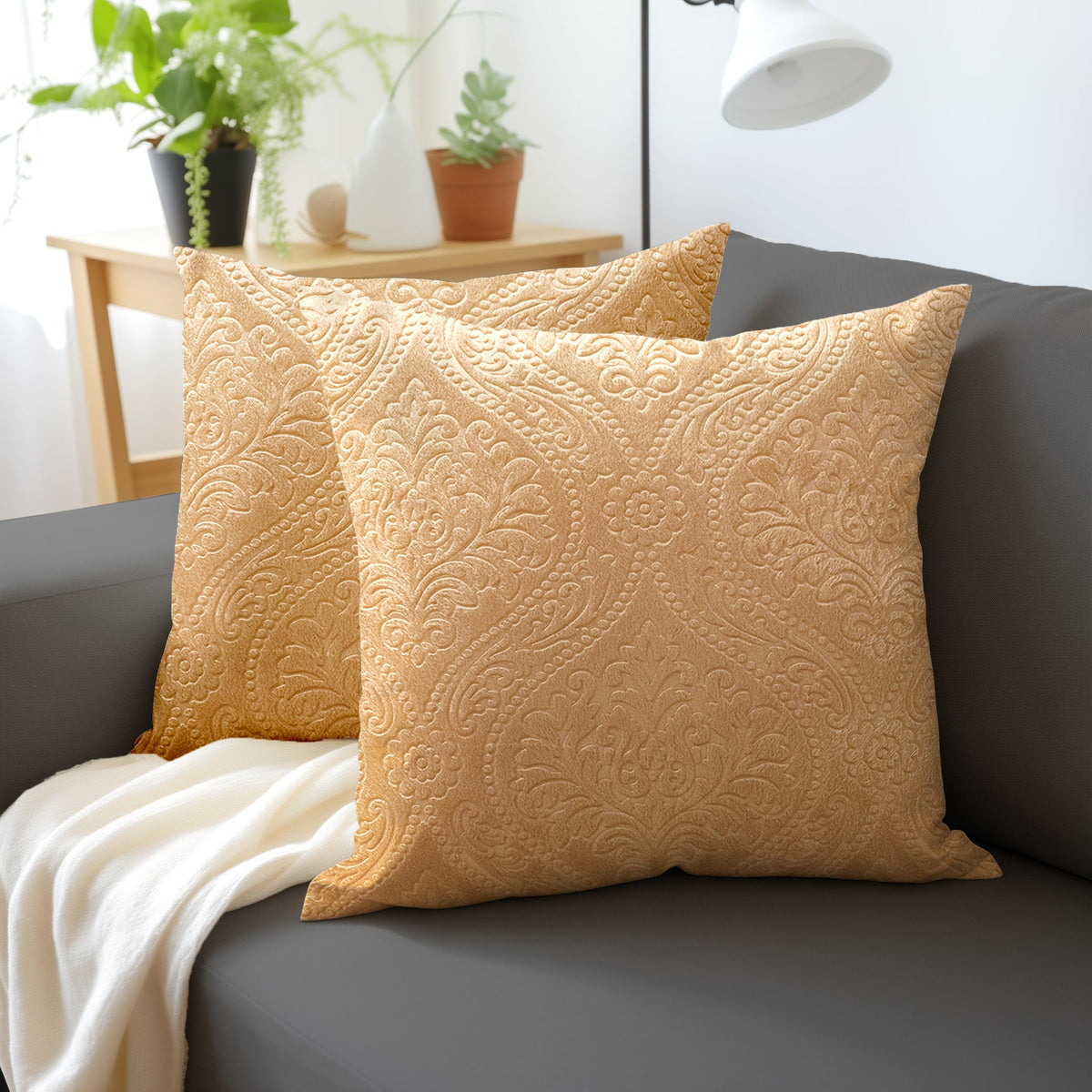
The shiniest cushion cover in the shop is rarely the best one for your sofa. Shine is light bouncing off a smooth surface, and anything smooth enough to shine is also smooth enough to show every crease, snag and oily fingerprint. That trade runs through every festive fabric, so the useful question is not "which one looks richest" but "where will this cushion sit, and who will lean on it?"
For cushions people actually lean on through the festive week, velvet in gold, maroon or deep green gives a rich look and forgives rough use. Keep the high-shine pieces, silk, satin and metallic foil prints, for one or two accent spots where hands and direct sun don't reach them all day.
Why festive fabrics shine, and why that matters for care
Every festive fabric gets its glow in one of three ways, and each way fails in its own manner.
Smooth flat yarns are the first. Silk and satin reflect light because their fibres or weave lie flat and long on the surface. Satin is a weave rather than a fibre, which is why polyester satin can look much like silk. The catch is that long floating threads on the surface catch on rings, watch straps and a cat's claws. One pulled thread on a satin cushion shows as a bright line across the whole face.
Raised pile is the second. Velvet has millions of short fibres standing up from the base. Light catches their tips, so the colour looks deeper and changes as you brush it one way or the other. This is why velvet reads as festive even in plain colours. Pile does not snag the way satin does, but it crushes. Sit on a velvet cushion for an evening and you get a pressed patch that looks a shade darker or lighter until you brush it back up.
A surface finish is the third. Foil prints and metallic prints put a thin shiny layer on top of the cloth. The base fabric can be quite ordinary; the sparkle sits on top. That makes foil prints cheap to make festive, but the shine lives in a layer that heat and rubbing can wear down. Hot irons on the printed side are the usual way people ruin them.
There is a fourth thing that sits across all three: direct sun. Strong light fades dyes over time, and deep festive colours like maroon, bottle green and royal blue show fading sooner than beige does, simply because there is more colour to lose. A cushion on a sofa under an east-facing window gets a few hours of hard light every morning. Rotate it, or put the pale piece in that spot.
Silk vs velvet vs satin vs gold print: which festive fabric suits which spot?
| Fabric | Where the shine comes from | Main weak point | Washing | Best spot |
|---|---|---|---|---|
| Pure silk | Smooth natural fibre | Water marks, sun damage, cost | Usually dry clean | A chair few people use |
| Poly-silk dupion | Slubbed polyester weave | Snags on rings and claws | Machine or hand wash, per label | Accent pair at the sofa ends |
| Velvet | Raised pile | Crushes, can fade in strong sun | Gentle or hand wash, dry flat | The main working cushions |
| Satin with foil print | Flat weave plus metallic layer | Foil wears with heat and rubbing | Cold wash, no tumble dryer, iron on the back | The centre accent |
Two notes the table can't hold. Pure silk is the one most likely to say "dry clean only", and diya oil or a drop of chai on it is a real problem rather than a quick rinse. And "silk cushion cover" on most shop listings in India means polyester dupion or art silk, not mulberry silk. Read the material line, not the title.
Gold cushion covers without the wedding-hall look
Gold is the colour most people reach for at Diwali, and it is also the one that goes wrong fastest. The usual mistake is gold on gold: a gold sofa throw, gold-print cushions, a shiny satin runner on the table, all at the same level of shine. Nothing gets to stand out, and the room looks like a banquet hall.
Gold works best in one of two forms. A matte gold, closer to mustard or old brass, sits happily next to almost any sofa and still reads as festive under warm lights. A bright metallic gold is better used in small amounts, as one cushion or one band of embroidery, so it catches the eye instead of filling it.

The Dupion Silk Chain Gold cushion cover is a good example of the second approach done quietly. The base is a slubbed poly-silk in a muted gold, and the shine comes mostly from a band of cream geometric embroidery rather than the whole face. Because it is polyester, the product page says it can be washed at home, which matters in a week of sweets and oily fingers. The back is plain dupion, so it reverses to a calmer look once the festival is over. It also comes in red and coffee if gold is already covered elsewhere in the room. At around ₹999 for a pair in the smallest size, it is the dearest piece in this guide, which is another reason to buy a pair for the ends and not five.
How many festive cushions on a 3-seater or an L-shaped sofa?
The festive mistake here is adding cushions on top of the ones you already have. A sofa only has so much backrest, and the count that works on an ordinary Tuesday is the same count that works at Diwali. You swap covers; you don't add bodies.
Our guide on how many cushions a 3-seater or L-shaped sofa needs works through the numbers. In short:
- A compact three-seater, about 165 to 185 cm across the back, takes three or four cushions: three 16 inch covers, or two 16 inch with one 20 inch.
- A standard three-seater, about 185 to 215 cm, takes four or five: two 20 inch in the corners, two 16 inch inside them, and one 12 inch or lumbar piece in the centre.
- An L-shaped sofa needs two counts. The main run takes three or four like a three-seater. The shorter return takes one or two, fewer if it is a chaise. The inside corner gets one lumbar cushion or nothing.
Now map the fabrics onto those slots. Take a standard three-seater with five cushions, used every evening by a family of four, near a window that gets afternoon sun. The two 20 inch corner cushions take the most leaning, so they should be velvet in a deep colour. The two 16 inch pieces next to them can be the dupion pair, slightly protected because people lean on the corners first. The centre 12 inch or lumbar slot is where a foil print or satin earns its place: it is looked at more than it is leaned on.
On an L-shape, put the shiny accent on the main run, where guests sit and see it. The return, especially a chaise, is where people lie down with a phone, so velvet or plain cotton belongs there.
Whatever the count, the insert matters as much as the cover. Our cushion cover size guide explains why the insert should be about an inch larger than the cover. A flat, half-filled cover makes even good velvet look cheap, and that shows more at Diwali, when the room is full and everyone is sitting.
Velvet for the cushions that get used

Velvet is the workhorse of a festive sofa, and the plain colours are more useful than they look. A plain Velvet Gold cushion cover has a soft, matte-gold sheen that changes with the light, so it does the festive job without any print at all. The product page lists four sizes from 40 to 60 cm, which covers both the 16 inch inner slots and the 20 inch corners on a standard three-seater.
If you want pattern without shine, embossed velvet is the in-between option. The damask pattern is pressed into the pile, so it shows as light and shade rather than as print. The page for the embossed gold version does warn that long exposure to direct sunlight may cause fading, which is true of velvet generally. So the sunny corner gets the paler gold, and the deep maroon or green goes on the shaded side.
For more colours, the velvet cushion cover collection has the deeper shades that pair well with gold. Maroon with gold is the classic Diwali pairing; green with gold looks a little less expected and carries into winter better.
Foil print: sparkle for the centre seat

Foil prints are the cheapest way to get real sparkle, and they are also the most fragile, so they belong in the slot that is looked at more than used. Encasa's foil prints are silver rather than gold, on a satin-weave polyester. The Citylight Maroon cushion cover puts a silver dot pattern on a deep maroon ground, and the page lists it as 260 gsm polyester, to be machine washed in cold water and not tumble dried. Silver on maroon sits well next to gold velvet: the two metals don't compete, because one is a sheen and the other is a sparkle.
Turn it inside out before washing and iron only on the back. That is most of what keeps a foil print looking new.
A palette that still works after 8 November
Diwali falls on 8 November in 2026. The covers will still be on the sofa a week later, and most families won't swap them back straight away. So it helps to choose a festive set that also suits an ordinary winter evening.
The trick is to let the deep colours do the festive work and keep the metal small. Maroon, bottle green, rust and deep blue all look rich under fairy lights and still look right in December. Gold works as the accent across them: one matte-gold velvet pair, or embroidery on dupion, not a full set of metallic covers.
When the festival is over, take out the brightest piece, usually the foil print or the most metallic one, and leave the velvet. The sofa still looks warm for winter, and the sparkle goes back in the cupboard for weddings and next year. If you only buy one festive set, buy the velvet in two deep colours and one gold accent pair. Browse the full cushion cover range with that ratio in mind: most of the count in deep matte colours, one pair in shine.
Frequently asked questions
Are silk cushion covers washable?
Pure silk usually needs dry cleaning, and water can leave marks. Most "silk" cushion covers sold online are poly-silk or art silk, which are polyester and can normally be washed at home. Check the material line and the care label before the first wash.
Which colours are best for Diwali cushion covers?
Deep colours such as maroon, bottle green, rust and royal blue, with gold as a small accent, look festive under warm lights and still suit the room in winter. All-gold sets tend to look flat because nothing stands out.
Should festive cushion covers match the curtains?
They don't need to match. It usually looks better if one colour connects them, such as a gold thread in the cushions and a gold curtain tie-back, rather than the same fabric on both.
How do I stop velvet cushions looking crushed?
Brush the pile back up with your hand or a soft clothes brush after use. Turn and plump the cushions each morning so the same side is not crushed every evening, and avoid ironing velvet flat.

Leave a comment
This site is protected by hCaptcha and the hCaptcha Privacy Policy and Terms of Service apply.