
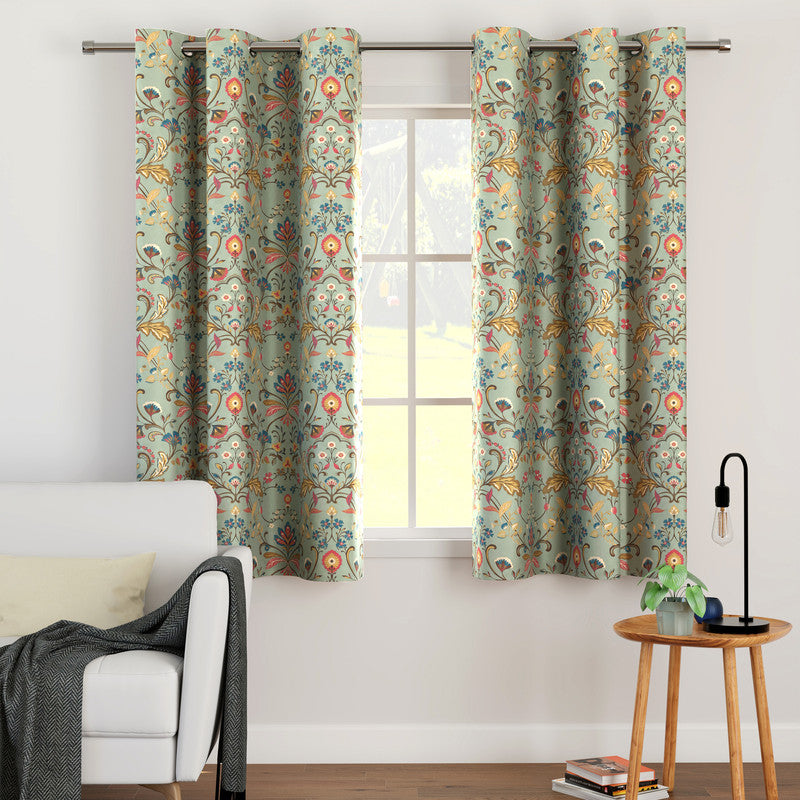
The window is 120 cm wide, the rod is already up, and a pack of two 7 ft eyelet panels is sitting on the floor still in its plastic. Nothing has to be drilled and nothing bought; this version of the job is only about the order.
Check the rod's thickness first. The eyelets on a ready-made panel have a fixed inner ring, 4 cm on Encasa's, so a 25 mm rod slides through easily and a 40 mm one will not go on at all. Then lift the rod out of its brackets, unscrew the finial at one end, feed the panel on ring by ring with both panels facing the same way, finial back on, rod back into its brackets, folds straightened by hand from the top down.
The rule underneath that: mount the rod 10 to 15 cm above the window frame, run it 15 to 20 cm past the frame on each side, fix it with whatever plug your wall actually takes, and thread the curtain on while the rod is off its brackets. A 120 cm window therefore sits under a rod of roughly 150 to 160 cm, bracket to bracket.
What is your wall made of?
Hanging guides written for American houses open by telling you to find a stud. Indian walls mostly do not have studs. What you have is plastered brick or reinforced concrete, and the fixing for it is an expanding plastic wall plug: drill a hole slightly deeper than the plug, blow the dust out, tap the plug in flush, then drive the bracket screw into it so the plug spreads and grips.
A masonry bit is not optional in concrete, and neither is the hammer setting on a lintel or a beam. Plaster over brick gives way quickly; concrete does not, and if the bit stops biting almost as soon as it starts, you have probably found reinforcement steel. Move the bracket a few centimetres along rather than fight it.
Gypsum board partitions, which turn up in newer flats around a dry balcony or a dressing area, are the opposite problem. A masonry plug spins uselessly in board. Find the batten behind the sheet and screw into that, or use a hollow-wall anchor made to spread out behind the board.
Then there is the rented flat where drilling is not allowed, and here weight decides everything. A tension rod needs two facing surfaces the right distance apart, so it suits a window recess, and it carries a light panel only. Adhesive brackets come with a load rating that assumes sound modern paint, which distemper and lime wash are not. So weigh the curtain first: a 7 ft pair of Encasa's semi-sheer polyester panels comes to about 340 g, the same drop in blackout polyester to about 1.8 kg, and in cotton panama about 1.2 kg. Of those three, only the sheer pair is a realistic tension-rod candidate, and then only inside the rod's own rating.
How high, and how far past the frame?
Ten to fifteen centimetres above the top of the frame, fifteen to twenty past it on each side. The curtain size guide measures its drops from that same rod line, so if you have measured for length you have already agreed to it.
Height above the frame does not make the window bigger; it makes the eye read the whole curtained rectangle as the opening, so the wall reads as taller. Width past the frame is the practical half: with the curtain open, the fabric stacks against the wall instead of over the glass, and you keep the daylight you paid for.
Some designers go much higher, taking the rod roughly two-thirds of the way from the frame to the ceiling. That is a separate rule with a more dramatic look and no tolerance for a panel that turns out short, and because it changes the drop, it has to be decided before you buy.
How to hang curtains on the rod, by heading type
Encasa sells two headings and no others: eyelet, where large metal rings are punched into a reinforced top hem, and rod pocket, where the hem is folded and sewn into a continuous sleeve. No pinch-pleat, tab-top or clip-ring panels exist in the range, so a guide that tells you to clip your curtain onto rings is describing hardware you would have to buy elsewhere.
Both of ours are threaded rather than clipped. The rod passes through the eyelets exactly as it passes through the pocket, so with either one the rod comes off its brackets, the curtain goes on, and the rod goes back up. What changes is how long that takes, and how the panel behaves once it is up there.
Eyelet panels

The rings are quick to thread and quick to move, which is the whole argument for them: buy eyelet if the curtain gets opened each morning and closed at night. The count is fixed at the factory and varies by range, six a panel on the blackout polyester line and eight on the cotton panama ones.
What decides compatibility is the ring's inner diameter rather than the count. At 4 cm inside, an eyelet takes an ordinary 25 mm rod comfortably and refuses a thick decorative one, so measure the rod's thickness as well as its width before buying panels for it. On a 25 mm bedroom rod the semi-blackout T1 panels clear every check: six stainless eyelets a panel over a 4 cm ring, a 7 ft drop, and enough weight at about 1.8 kg a pair that the folds hang straight instead of scalloping between rings. Their copy puts the light blocked at 85 per cent, so semi-blackout rather than true blackout, which is the number to argue with if you sleep past sunrise.
Rod-pocket panels

A pocket has no hardware in it at all. You feed the rod through a sewn channel running the full width of the panel, gathering fabric along the rod as you go, with the finial off since one wider than the channel will not pass. No rod-pocket product in the range publishes its channel width, so hold the pocket up to a thick rod before you commit.
Once it is on, the pocket grips the rod. That is deliberate. Encasa's own rod-pocket copy offers the stitched centre tieback as the way to open the curtain in the daytime, with no need to slide it along the rod at all. So the choice comes down to how you live with the window: eyelet for a curtain you draw twice a day, a pocket for one that stays put and gets tied back each morning. The reverse leaf green panels are the light end of that, semi-sheer polyester twill with the tieback stitched in, about 340 g for a 7 ft pair.
Doorway or door? They are not the same job
In an Indian house a door curtain usually means one hung across an open doorway, not one over a hinged door. Different jobs, and the advice does not transfer.

An open doorway between a living room and a passage is hung exactly like a window: a fixed rod above the opening, the same 10 to 15 cm up and 15 to 20 cm past each side, with a 7 ft panel taken to the floor. It stays drawn for privacy and dust and gets pulled aside when someone comes through, so the fabric matters more here than the drape does. The job asks for a panel opaque enough that nobody sees through from the other side, washable without ceremony, and dark enough in tone to hide the hand-marks a doorway collects. The cotton scotch blue panels meet all three: mercerised cotton panama, machine washable, solid navy. What they cost you is weight, about 1.2 kg for a 7 ft pair, so the rod and its plugs have to be up to it. Lighter shades at the same weight sit in the cotton canvas curtains collection, though a pale doorway curtain shows marks first.
A hinged door with a glass panel is the other case, rarer here than the American guides assume. The rod goes on the door leaf itself, above the glass, and clearance sets everything: short enough to swing without catching the handle, light enough that the door still feels right to open. A tension rod compressed inside the frame is the usual no-drill answer, but the sizes quoted in Western guides are for their door frames, so measure your own.
Two layers on one window
Sheer for the day and blackout for the night on one window means two rods. A double bracket carries both off one wall plate, a short inner arm holding the sheer close to the glass and a longer outer arm holding the blackout clear of it, and both rods end up at the same height, the same 10 to 15 cm you would use for one.
Two separate single rods is the version that goes wrong. The outer rod has to clear the inner rod and its brackets, so it mounts higher than the standard number, and how much higher is set by your bracket rather than by any rule: measure the inner bracket from the wall face to the top of its arm and add that to the 10 to 15 cm. Thread and mount the inner rod first, or you end up working over the outer curtain. And if the second layer is going onto a rod you own, check the heading of each panel in the full curtains collection, because a rod-pocket sheer will not slide open each morning the way an eyelet one does.
Quick reference
| Your wall or rod | The fixing | Then |
|---|---|---|
| Plastered brick or concrete, no rod yet | Masonry bit, hammer setting, expanding plastic plug | Thread the panel with the rod off its brackets |
| Gypsum board partition | Batten behind the board, or a hollow-wall anchor | Same, rod down to do it |
| Rented flat, no drilling | Tension rod in a recess, or adhesive brackets inside their rating | Light panels only, so a semi-sheer pair rather than blackout or cotton |
| Rod already fitted by the builder | Nothing to buy | Check rod thickness against the 4 cm ring, then thread |
Frequently asked questions
How high should a curtain rod be above the window?
About 10 to 15 cm above the top of the frame, with the rod carried 15 to 20 cm past it on each side. Because a curtain's length is measured down from the rod rather than from the frame, raising the rod also raises the drop you need, so settle the rod position before buying panels. A kitchen window is the usual exception, since a grill or the counter often limits where the rod can go, and our guide to kitchen curtains covers that case.
Can I hang curtains without drilling into the wall?
Yes, within a weight limit. A tension rod in a window recess, or an adhesive bracket used inside its load rating, will hold a light panel, and polyester sheers weigh a few hundred grams a pair. A blackout or cotton pair can run well over a kilogram, and that needs a screw and a plug in the wall.
Do you put the rod through the curtain before or after fixing it to the wall?
Before, for both headings Encasa sells. Eyelet rings and sewn pockets are both closed, so the rod has to pass through them: take the rod off its brackets, thread the panel, put the rod back. Only separate clip rings can go onto a rod that is already fixed.
How do you hang a curtain across a doorway?
Treat it as a tall window. Fix the rod above the opening at the same height and width margins and use a 7 ft panel so the hem clears the floor. A solid, opaque cotton suits a doorway people walk through all day.

Leave a comment
This site is protected by hCaptcha and the hCaptcha Privacy Policy and Terms of Service apply.